+1 740 762 6496
 +91 70189 46603

TABLE OF CONTENT
- What bespoke software actually means
- Uniqueness is not a reason to build
- Why the forty-feature spec is a warning sign
- The process, minus the diagram
- One we can name
- Where the custom work usually sits, by industry
- When we tell people not to hire us
- Questions worth asking any development partner, including us
- The real objection isn’t price
- Three questions before you commit
- FAQs
Overview
- Build custom when it creates an advantage — not because your business is unusual. Every business is.
- The biggest cost driver is when you decide, not hourly rates. Same change: an afternoon in week 2, two weeks in week 8, a month in week 20.
- A forty-item spec usually means nobody has picked the five that matter yet.
- The custom work almost always sits at the seams between systems, not in a ground-up rebuild.
- Phase one should be useful on its own. If it only makes sense as groundwork for phase two, it’s a payment schedule, not a phase.
- A cheaper quote isn’t a cheaper project. Software that half-fits gets paid for later, in pieces nobody adds up.
- Sometimes the honest answer is don’t build.
AI Summary:
Bespoke software development means building an application around one company’s workflows instead of adapting the business to a generic product. It’s worth it when a workflow, customer experience or margin depends on something off-the-shelf tools can’t do — not when an existing product already handles the job. Timing drives cost more than rates: the same change costs an afternoon in week two, two weeks in week eight, a month after launch. That’s why phased delivery lowers total cost. Auspicious Soft has built custom software since 2018 — 30+ developers, 200+ projects, including Werover, a turbine monitoring platform delivered in under three months.
Search “bespoke software development services” and you get a page of near-identical results. Tailored to your needs. Built for your unique business. Scalable, secure, future-proof. Read five and you know roughly what you knew before you started. Bespoke software development is the process of designing and building an application around one company’s specific workflows, users, and business goals — rather than forcing the business to adapt to a generic product. It makes sense when a workflow, customer experience, or profit margin depends on capability that off-the-shelf tools simply cannot provide. When an existing product already handles the job well enough, building custom is the wrong call, and a good development partner will say so upfront.
This page is organised the other way round. It spends the first half on when custom software is the wrong decision, because that’s the part that actually determines whether a project pays for itself. The sales case comes later, and it’s shorter.
We’ve spent eight years and 200-plus projects building custom software, web applications and mobile apps across healthcare, fitness, travel and education. Most of what follows is the reasoning we’d give you on a call anyway.
What bespoke software actually means
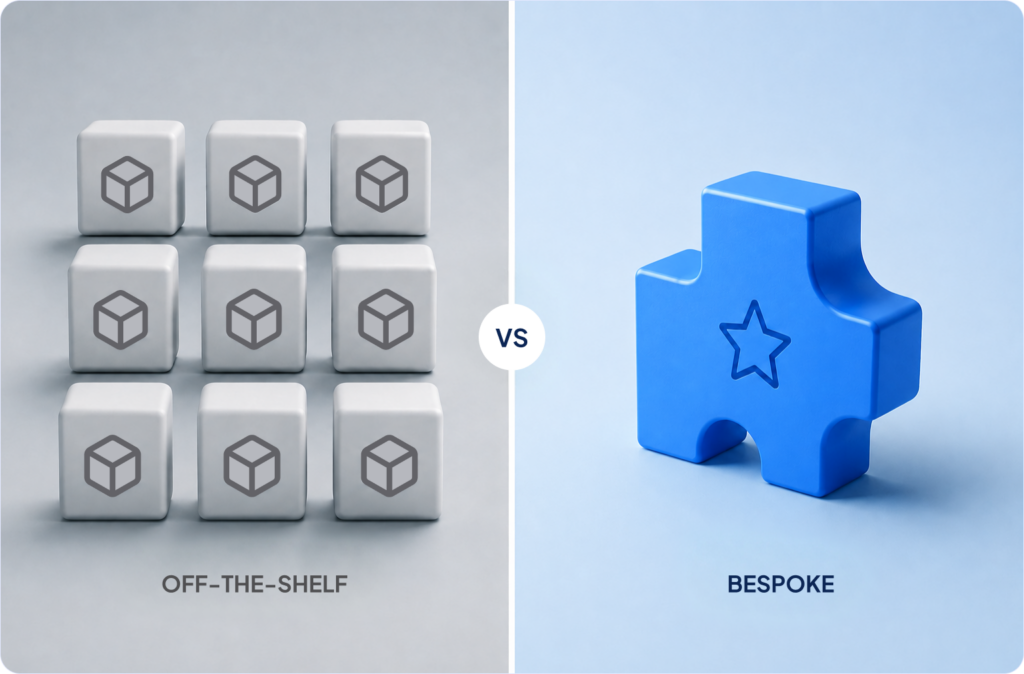
Custom software is built around one company’s workflows, users and goals. Off-the-shelf software is built to work acceptably well for ten thousand companies at once. That’s the definition you’ll find anywhere, and we’ve written a longer side-by-side comparison of custom and off-the-shelf if you want the full breakdown.
The useful version: custom is worth it when something you compete on — a workflow, a customer experience, a margin — depends on capability generic tools can’t give you. When it doesn’t, custom development is the wrong call, and a development partner worth hiring says so in the first conversation rather than the third invoice.
Uniqueness is not a reason to build
The standard agency pitch is that your business is unique, therefore your software should be. It’s a weak argument, and it’s why a lot of custom software exists that shouldn’t.
Advantage is the reason to build. Uniqueness is just a fact about your business, and most of it doesn’t cost you anything.
On a project, that works out to:
- Off-the-shelf wherever it already does the job. Nobody hands out awards for rebuilding a calendar.
- Custom work reserved for the parts that move revenue, cut real operating cost, or shape how customers experience you.
- Smallest useful version first — the same logic behind scoping an MVP properly rather than launching a full platform.
- Success measured by what changed in the business, not by tickets closed.
Here is how the two approaches compare in practice, based on what we have seen across 200-plus projects:
| Factor | Bespoke Software | Off-the-Shelf |
|---|---|---|
| Upfront Cost | $40,000 To $200,000+, Depending On Scope | $0 To $5,000 Per Year in Subscription Fees |
| Time To First Value | 8 To 16 Weeks For A Phased MVP | Days To Weeks For Setup and Configuration |
| Fits Your Workflow | Exactly, Because It is Built Around It | Partially — You Adapt To The Tool's Logic |
| Ongoing Cost | $1,500 To $5,000/Month Hosting and Maintenance | $50 To $500/Month Subscription, Plus Any Add-ons |
| Total Cost At Year 3 | $90,000 To $380,000 All-in | $2,000 To $20,000 Total |
| Best for | Workflows That Drive Revenue or Create Competitive Edge | Standard Business Needs Handled Well By Existing Tools |
Why the forty-feature spec is a warning sign
Most companies arrive with a spec. Usually long — forty items, sometimes more, everything anyone in the building has ever wished for.
A long spec feels rigorous. More often it means nobody has yet made the hard call about which five features matter, and the document is standing in for that decision.
The cost of postponing that call is not linear, and it’s worth seeing the mechanics, because “we’ll figure it out during development” sounds reasonable until you do:
Week 2, a requirement changes. Someone edits a wireframe. Cost: an afternoon.
Week 8, the same requirement changes. The data model is built. Changing it means a schema migration, updating every query that touches those tables, and rewriting the API endpoints that return them. If a mobile app is already consuming those endpoints, you now need versioning or a coordinated release. Cost: one to two weeks, plus regression testing.
Week 20, post-launch, the same requirement changes. Everything above, but now there’s production data in the old shape that has to be migrated without loss, users mid-session, and integrations built against the old contract. Cost: a month, and a period where things break in ways you can’t fully predict.
Not Sure This Needs To Be Custom?
Tell us the problem on one call. We'll tell you straight whether it's worth building — or whether something off the shelf already does it.Nothing dramatic happens in between. It’s the same change, quietly getting more expensive. That’s the whole argument for scoping properly and building in phases, and it’s why we push back on long specs instead of quoting them. It’s also the single biggest driver of what custom software actually ends up costing — more than hourly rates, more than tech stack.
The process, minus the diagram
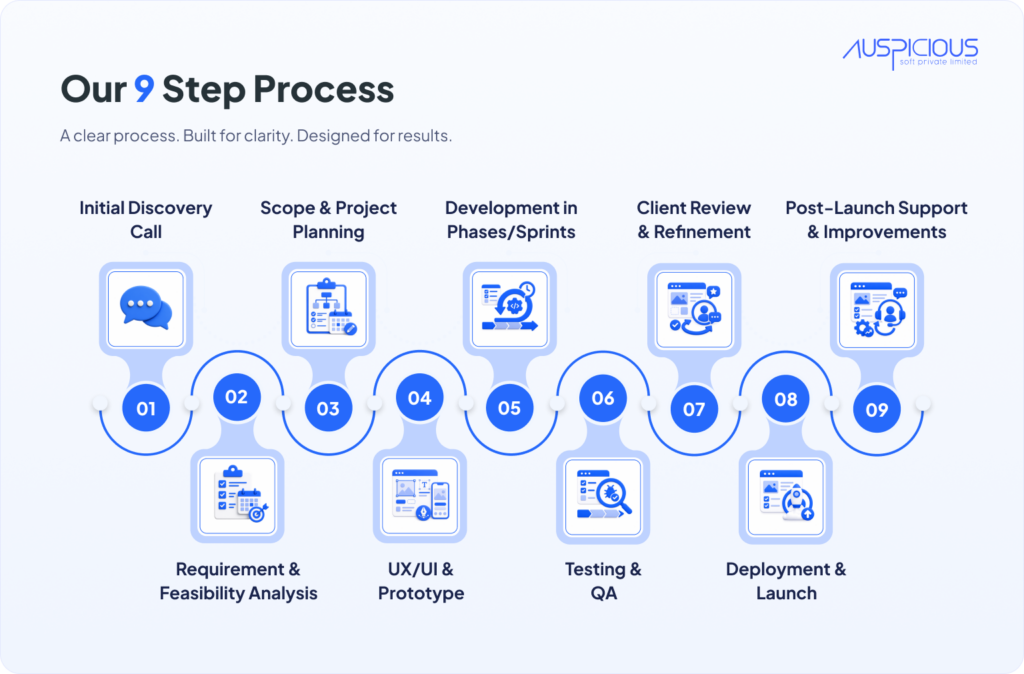
Every agency site has the same three-box graphic: discovery, development, launch. Here’s what actually happens, and how it maps onto a normal development lifecycle.
Discovery call. The business, the goals, how things run today, where it hurts, who uses it.
Requirements and feasibility. Break down what’s being asked for, flag integrations and technical risk, and decide honestly what needs building versus what an existing tool already handles.
Scope and planning. Core features, priority order, technical approach, timeline, budget, milestones.
UX, UI and prototype. Map the user journey, build wireframes, get it validated on screen while changes still cost an afternoon.
Phased development. Core functionality first, then priorities in order. Regular check-ins, no big reveal at the end.
Testing and QA. Functionality, usability, responsiveness, integrations, security, performance — the detail of which is its own discipline.
Client review. Working software in front of you, feedback collected, refinements made against what was agreed.
Deployment. Production setup, integrations, final checks, go-live.
Support and iteration. Monitor, fix, maintain, and decide what comes next from real usage data.
The numbering is a convenience. The work loops. Feedback runs the full length of the project, and that’s the only mechanism that catches a wrong assumption in week three rather than week twenty.
One we can name
Abstract principles are easy to agree with, so here’s the argument with a real project attached.
Werover monitors wind turbine health across wind farms. When we started, their operations ran across three-plus disconnected tools — device management in one place, SIM card control in another, reporting done by hand. The obvious pitch would have been a ground-up enterprise platform. What they actually needed was a single operational layer over the systems already producing the data, plus a mobile app that gave field users a scoped view of the turbines they were responsible for.
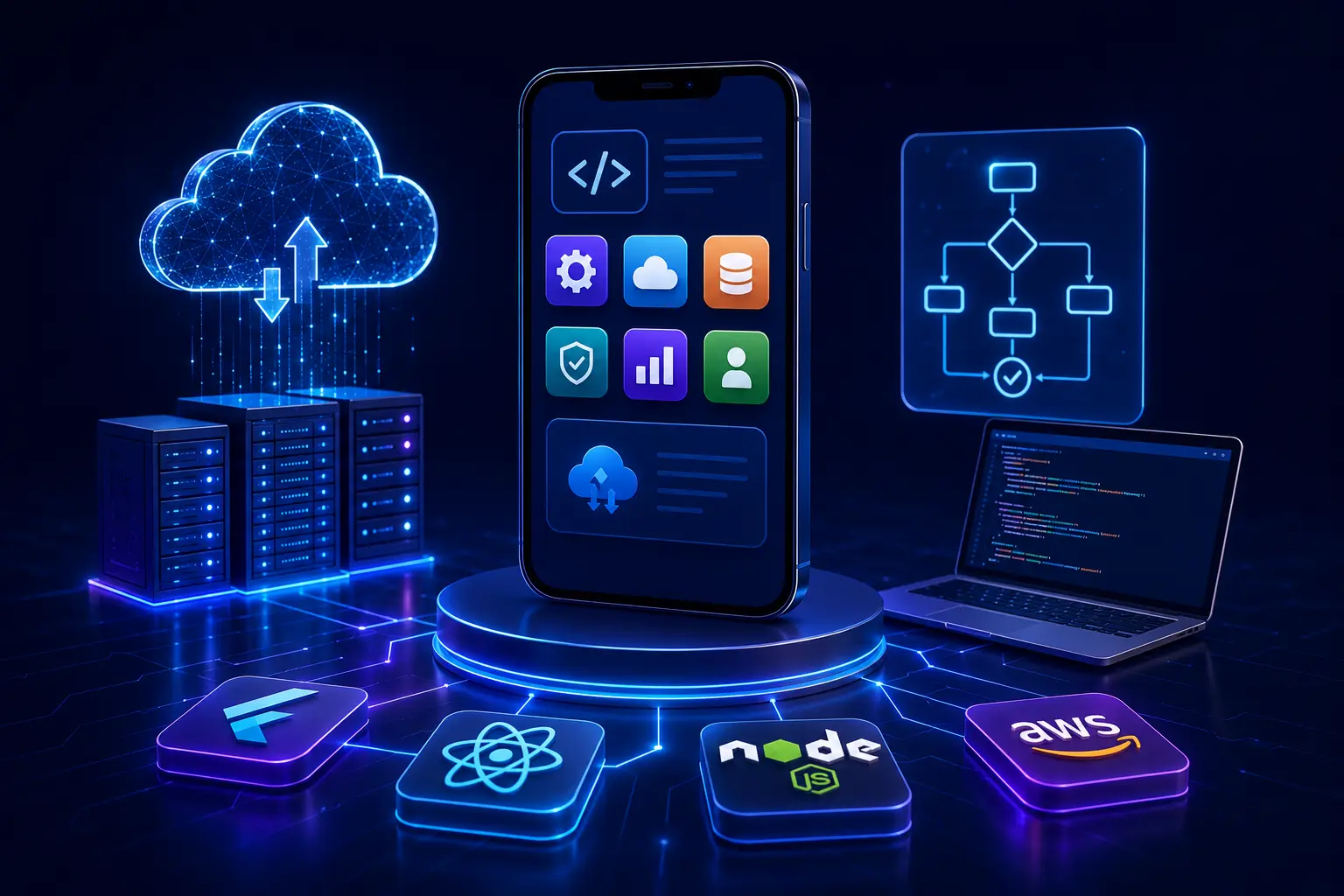
Two to three months. A team of four to five. React Native for the app, React 18 with TypeScript for the admin panel, AWS for infrastructure.
The most useful detail is a small one. New turbines were defaulting to a “Healthy” status before they had received any sensor data at all — so the dashboard was confidently reporting on turbines it knew nothing about. We replaced the default with a neutral “Pending” state. It’s a two-line change conceptually, and it mattered more to the people using the system than most of the features around it, because a monitoring tool that lies to you occasionally is worse than one that admits what it doesn’t know.
Distacart connects 500,000-plus Indian grocery and household products with buyers in the US, Canada, and other markets. When they came to us, the ordering experience was functional but the backend was a tangle — inventory syncing between suppliers, customs documentation, and delivery tracking ran through three separate systems that did not talk to each other. We built a unified cross-border commerce layer. The part that mattered most was not the storefront. It was the supply chain orchestration underneath it — making sure a customer in New Jersey could see real availability from a distributor in Mumbai without a three-day delay in the data. That is the kind of problem no Shopify plugin solves.
That’s the shape of good custom work. Narrow, aimed at a specific operational cost, and the highest-value change is often unglamorous. You can see the rest of our project case studies here.
| Phase | Typical Duration | What It Produces |
|---|---|---|
| Discovery and Scoping | 1 To 2 Weeks | Problem Definition, Feature Priority, Build-or-Buy Recommendation |
| UX, UI and Prototype | 2 To 3 Weeks | Wireframes and Interactive Prototype Validated With Real Users |
| Phase 1 Build (Core) | 4 To 8 Weeks | Working Software With The 3-5 Features That Actually Matter |
| Testing and Launch | 1 To 2 Weeks | QA, Security Testing, Deployment, Go-Live |
| Phase 2 and Beyond | Ongoing Sprints | Features Prioritised From Real Usage Data, Not Guesswork |
Where the custom work usually sits, by industry
The pattern in every sector we work in is the same: the platform-level problems are solved, and the gaps are at the integration seams.
Healthcare. Scheduling, billing and charting are well served by existing systems, and rebuilding them is close to always a mistake. The gaps show up around them. An EHR exposes a reasonable FHIR read API and a much weaker write path, so patient-submitted data has nowhere clean to land. Intake forms produce a PDF that a human retypes. A lab partner still speaks HL7 v2 while everything else speaks FHIR. The custom work is a sync and transformation layer — narrow, unglamorous, and costing staff hours daily. Compliance shapes all of it, which is why we’ve written separately on HIPAA-compliant EHR work and telehealth builds.
Fitness. Wearable data is the recurring problem, not the app shell. HealthKit and Google Fit have different permission models, different backfill behaviour, and different definitions of the same metric, so “sync steps and heart rate” means reconciling sources that disagree. What justifies custom work is whatever ties that data to your actual business — trainer sessions, programme adherence, retention triggers — because no template knows anything about that. We’ve broken down what a custom workout and training app involves in more detail.
Travel. Multi-leg itinerary logic is one of the few genuinely hard problems left in booking. Single-leg bookings are a commodity. But once an itinerary has connected segments, a change to leg two cascades: fare rules differ per segment, some legs are refundable and some aren’t, a cancellation may invalidate downstream connections, and reconciling that against a GDS or consolidator API is not something booking plugins attempt. Payments and calendars stay off-the-shelf. The itinerary engine is the piece worth owning. More on where travel platform budgets actually go.
Education. LMS platforms are built around the course, and most institutional questions are about the cohort. “How is this intake performing against the last one, across six courses and two years” is a query the gradebook isn’t shaped to answer. LTI 1.3 gets you launch and roster context, xAPI gets you granular activity data if the content emits it, but joining that into longitudinal cohort reporting is custom work. Replacing the LMS to get it is a nine-month project solving a two-month problem.
Same shape every time. The custom layer is thin, sits between systems, and targets the specific thing costing money or losing users.
When we tell people not to hire us
Worth stating plainly, because it’s the fastest way to save both of us a month:
Your process isn’t settled yet. If the workflow is still changing week to week, software will freeze a version of it you’re about to outgrow. Run it manually a while longer. Manual is cheap, and it’s how you find out what the process actually is.
An existing tool does 80% and the last 20% is preference. The 20% will cost more than the 80%, and preference changes. Adapt to the tool.
The real problem isn’t software. Some bottlenecks are hiring, pricing, sales process, or a decision nobody wants to make. Software applied to those makes them faster, not solved. This is the most common one, and the one people least want to hear.
You need it in four weeks and it’s a platform. That’s not a scope conversation, it’s a date conversation, and something has to move.
The budget only covers the build. Software has a running cost — hosting, maintenance, dependency updates, the fixes that surface in month two. Ongoing maintenance is not optional, and if the budget ends at launch the project ends shortly after it.
Questions worth asking any development partner, including us
Most of what separates a good engagement from a bad one is visible before the contract, if you ask directly. We’ve covered this at length in our guide to choosing a software development company, but the short version:
- Which parts of this would you not build custom, and why? An agency with no answer will quote everything you ask for.
- What’s in phase one, and what happens if we stop there? Phase one should be independently useful. If it only makes sense as a foundation, it’s not a phase, it’s a payment schedule.
- Who actually writes the code, and can I speak to them? Sales-led and delivery-led agencies feel identical until week four.
- What does handover look like if we leave? Repository access, documentation, credentials, deployment process. Ask while the answer is cheap.
- What’s the ongoing cost after launch? A quote without this is half a quote.
- What went wrong on your last project? Everyone has one. The signal is whether they’ll describe it specifically.
If you’re still weighing the model itself, we’ve compared agency versus in-house team and the economics of a dedicated development team elsewhere.
The real objection isn’t price
Most people already know custom costs more upfront than a subscription. That rarely stalls a decision.
What stalls it is not knowing. Will this run over? Will it take twice as long as quoted? Will we spend serious money and end up with features nobody opens?
Reassurance isn’t an answer to that. The structural answer is: define the problem before scoping, prioritise hard, put scope in writing, and break anything substantial into phases you can judge as they land. You should be able to stop after phase two and still have something that works.
And a cheaper quote is not a cheaper project. Software that doesn’t quite fit generates workarounds, manual patches, broken integrations and eventually a rebuild — paid for later, in pieces small enough that nobody adds them up. There are real ways to reduce cost without cutting corners, and picking the cheapest quote isn’t one of them.
Three questions before you commit
Answer these honestly and you’ll make the right call with or without us.
Does something that already exists solve this? Not “almost.” Actually.
Will building it create a measurable advantage? Revenue, efficiency, retention, competitive edge. Uniqueness doesn’t count.
Can it be built and scaled in phases, or does it only work if everything ships at once?
Yes to the second, and bespoke software is one of the better investments a business makes. If an existing product already does the job, build nothing. There’s no prize for it.
Not Sure This Needs To Be Custom?
Tell us the problem on one call. We'll tell you straight whether it's worth building — or whether something off the shelf already does it.FAQs
Q: How much does bespoke software development cost?
It depends on scope, which makes it hard to answer usefully in the abstract — our detailed cost breakdown covers the variables. The better question is what poor scoping costs. Phased projects that build the highest-value features first come in lower overall than one big build, because you find out where you were wrong while correcting it is still cheap.
Q: How long does a custom software project take?
A narrow, well-scoped first version can ship in weeks; Werover’s full platform took two to three months with a team of five. Full-platform builds attempted in one go routinely run months past estimate — rarely because of the engineering, usually because untested assumptions surface late.
Q: Is bespoke better than off-the-shelf?
Not as a general rule. Off-the-shelf wins for problems that are already well solved, which is most of them. Custom wins at the seams. We’ve compared both in depth for software generally and mobile apps specifically.
Q: Which industries benefit most?
Ones where integration gaps are expensive: healthcare, travel, education, and fitness. Any sector where two systems have to agree on something no vendor has bothered to support.
Q: How do you avoid scope creep?
Decide the core problem and priority features before development starts, then build in phases with review at each stage. It’s the first item on our list of mistakes that derail builds.
Q: What happens after launch?
Monitoring, fixes, dependency and platform updates, and prioritising the next phase from real usage. Budget for it from the start — it’s the difference between software that lasts three years and software rebuilt in eighteen months.
Q: What is the difference between bespoke and custom software development?
In practice, nothing. “Bespoke” and “custom” mean the same thing — software built specifically for one organisation’s needs rather than licensed off a shelf. “Bespoke” is more common in British English and in European markets; “custom” is the standard term in the US. If an agency uses one word over the other, it is a vocabulary choice, not a different service. What matters is whether they build around your workflow or just re-skin a template.
Q: How do I know if my business actually needs bespoke software?
Ask yourself one question: is there a workflow, customer experience, or margin in your business that depends on something no existing product can do? If yes, that specific gap is worth building for. If not — if an off-the-shelf tool handles it at 80% and the remaining 20% is just preference — adapt to the tool. We have talked more companies out of bespoke builds than into them, because a project that should not exist cannot succeed.
Do not Miss Our Latest Tech Insights
Stay one step ahead in the fast-moving world of AI and technology. Add us as a Preferred Source on Google and get our latest articles, guides, and industry insights delivered straight to your search feed.