+1 740 762 6496
 +91 70189 46603


TABLE OF CONTENT
- The Opinion Nobody Puts at the Top
- What Does Hiring a Software Development Company Actually Mean?
- What Does Building an In-House Team Actually Cost in 2026?
- The Real Skill Shortage That Changes Everything in 2026
- The 6 Factors That Should Actually Drive Your Decision
- The Hybrid Model: What Smart Companies Actually Do in 2026
- Three Myths That Keep Businesses From Making the Right Call
- How to Evaluate a Software Development Company Before You Sign
- The Auspicious Soft Perspective (Eight Years of Honest Observations)
- FAQs
Overview
- A software development company can start delivering within two to four weeks. An in-house team takes six to twelve months to become productive.
- Building a five-person in-house team in the USA costs $700,000 to $1,000,000 in year one before shipping a single feature.
- The global IT outsourcing market is projected to reach $812 billion by 2026, which tells you where most businesses are placing their bets.
- The hybrid model is what most serious product companies actually use in 2026, and it is the most underrated approach in this conversation.
- Speed to market now beats team ownership as a competitive advantage for most product categories.
- In-house still wins in one clear scenario: when your software is your core product, you have funding, and you are building for ten or more years.
AI Summary:
For the majority of startups and growing businesses, working with a software development company is faster, more cost-effective, and lower risk than building an in-house team from scratch. But the why matters more than the what. And there are real situations where in-house wins.
There is a question that comes up in almost every early discovery call at Auspicious Soft. A founder or CTO says something like: “We are not sure yet whether to hire a software development company or just build the team ourselves.”
Eight years and hundreds of projects later, the answer is almost never one-size-fits-all. But it leans heavily in one direction for most businesses in 2026. And the reasoning is not what most people expect.
This post does not sit on the fence. It takes a position, explains it clearly, and gives you the full picture to make the right call for your business.
The Opinion Nobody Puts at the Top
Most blogs on this topic bury the point of view somewhere in the middle or skip it entirely. So here it is, right at the start.
Building an in-house software team before you have product-market fit is one of the most expensive mistakes a growing business can make. Not because in-house teams are bad. They are not. But because the cost, the time, and the management overhead of building a technical team from zero can easily sink a company that has not yet proven its product works in the market.
Have A Project In Mind?
Talk to our software development team and get a clear estimate within 48 hours.The businesses that move fastest in 2026 are the ones that separate product decisions from execution. They keep a small in-house product brain. They hire a trusted software development company for execution. They ship. They learn. They iterate.
That is not outsourcing as a compromise. That is outsourcing as a strategy.
What Does Hiring a Software Development Company Actually Mean?
A software development company is not a freelancer marketplace. It is not a body shop. A real software development company is a structured engineering organization that takes ownership of delivery.
They bring developers, designers, QA engineers, and project managers. They run sprints. They send weekly updates. They flag problems before they become crises. And they build software that is documented, tested, and yours when the project ends.
Companies like Auspicious Soft work across mobile, web, and complex enterprise software. The client defines what to build and why. The development company owns how it gets built.
What has changed in 2026 specifically? AI-assisted development has shortened delivery timelines significantly. A feature that took three weeks in 2022 can now take one. That makes software development companies even more competitive on speed than they were two years ago. The friction that used to come with async communication and time zones has mostly been solved by better tooling, overlap-based scheduling, and weekly video rituals.
What Does Building an In-House Team Actually Cost in 2026?
Most business owners underestimate this number. Not by a little. By a lot.
Here is the real breakdown for a five-person in-house software development team in the USA:
| Cost Type | Estimated Annual Cost |
|---|---|
| Senior Software Developer | $130,000 To $180,000 |
| Mid-Level Developer | $90,000 To $130,000 |
| QA Engineer | $70,000 To $100,000 |
| Project Manager | $85,000 To $110,000 |
| UI/UX Designer | $80,000 To $120,000 |
| Benefits, Taxes, and Overhead (30%) | $135,000 To $162,000 |
| Recruitment Cost per Hire | $15,000 To $30,000 |
| Onboarding and Tools per Person | $5,000 To $15,000 |
| Total Year One (5-person team) | $700,000 To $1,000,000+ |
And that total assumes you hire the right people on the first try. In practice, one bad hire, one resignation, or one extended onboarding adds another $30,000 to $80,000 to the real cost.
A software development company offering equivalent team capacity typically costs $150,000 to $400,000 per year depending on team size, location, and project scope. That is a saving of $300,000 to $600,000 in year one alone.
According to Deloitte’s Global Outsourcing Survey, 70% of companies cite cost reduction as the top reason they outsource software development. But the second reason, which is less talked about, is access to skills they cannot hire locally. That second reason is actually more important in 2026 than the first.
The Real Skill Shortage That Changes Everything in 2026
Here is the data point most business owners are not factoring in.
The global developer shortage is now estimated at 4 million unfilled positions according to research from Korn Ferry and IDC. In the USA specifically, competition for senior software engineers is as intense as it has ever been. The average time to hire a senior developer in 2025 was 45 to 60 days per role. Multiply that across a five-person team and you are looking at six to nine months before you have a complete group, and that is before anyone has written a single line of your actual product code.
A software development company already has the team. You are not hiring. You are activating.
This is not a minor operational detail. In fast-moving markets, six months of hiring time can be the difference between launching first and watching a competitor take your market.
The 6 Factors That Should Actually Drive Your Decision
1. How Fast Do You Need to Ship?
If the answer is anything less than six months from today, in-house is not a realistic option. Period. You cannot hire, onboard, align, and ship a team in that window. A software development company can start delivering working features within two to four weeks of kickoff.
Decision: Software Development Company
2. How Complex Is the Product You Are Building?
A simple internal dashboard or a basic marketing website? An in-house developer or two might handle it. But a product that needs a mobile app, a backend API, cloud infrastructure, third-party integrations, and AI features requires a full squad of specialists.
A software development company carries that bench already. You get a senior developer, a mobile specialist, a backend engineer, and a QA engineer all working together on your project. You do not pay for all of them full-time, but you get all of them when you need them.
For businesses building mobile apps, AI-powered solutions, or enterprise platforms, this bench is not a luxury. It is a necessity.
Decision: Software Development Company for anything beyond basic scope.
3. What Is Your Real Year One Budget?
Be specific with yourself here. Not your total funding. Not your revenue. Your actual allocated budget for software development in year one.
If that number is below $500,000, building an in-house team is not a realistic option without making serious compromises on seniority, team size, or other business functions. A software development company gives you a full team working on your product for a fraction of that.
Decision: Software Development Company
4. How Much Daily Control Do You Need?
This is the one area where in-house genuinely has an edge. If your product requires constant real-time collaboration, rapid daily pivots, and deeply integrated product decisions hour by hour, having your team in the same Slack channel and ideally the same timezone is a real advantage.
A software development company relationship requires clear scope, regular communication, and some degree of trust in their process. That structure is not always a limitation. Often it forces better product thinking. But it is a different operating model.
The good news is that working with a remote development team through a structured software partner captures most of the control benefit without the cost burden of building in-house.
Decision: Depends on product type. Lean in-house for daily intensive collaboration. Software development company for everything else.
5. Is This a Core Product or a Project?
This question cuts through most of the noise in this decision.
If you are building the software that IS your business, the thing your revenue depends on entirely, then you will want in-house ownership eventually. But even then, the word to focus on is eventually.
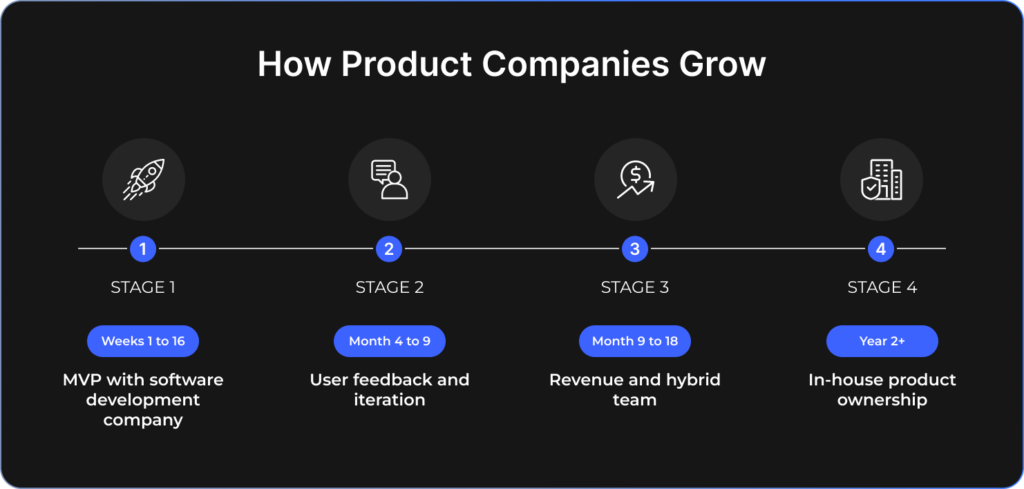
Dozens of successful SaaS companies built their first version with an external software development company, found product-market fit, generated revenue, and then hired in-house engineers who had something real to work with. Building in-house first, before you know the product works, is a bet most companies cannot afford to make.
If it is a project with a defined end, a tool, a feature set, or an MVP, a software development company is almost always the smarter and faster path.
Decision: Software Development Company to start. In-house when you have proven product and funding to support the team.
6. What Happens When You Need to Scale or Pause?
An in-house team has fixed costs. You pay salaries whether the sprint is full or empty. Scaling up means months of hiring. Scaling down means painful conversations and sometimes layoffs.
A software development company scales with you. You expand the team when you are in a heavy build phase. You reduce scope when you are in maintenance mode. You pay for what you use.
In uncertain markets, that flexibility is not just convenient. It is a genuine business advantage.
Decision: Software Development Company
The Hybrid Model: What Smart Companies Actually Do in 2026
This is the most underrated approach in this entire conversation, and it deserves more than a paragraph.
The hybrid model means you keep a small in-house product team for direction and ownership, and you work with a trusted software development company for execution.
Here is what that looks like in practice:
In-house (2 to 3 people): One product manager or owner who understands the vision, the customer, and the roadmap. One technical lead or CTO who reviews architecture decisions, manages the development company relationship, and owns code quality. Optionally, a designer who owns the product’s visual language and user experience.
Software development company (4 to 8 people): Frontend developers. Backend engineers. A mobile developer if needed. A QA engineer. A project manager who runs standups, manages sprints, and sends weekly video updates. This team builds. The in-house team directs.
What this gives you:
- Product direction stays internal. You are not handing over the vision.
- Execution speed is high. You have a full team building every day.
- Cost is controlled. You are not carrying the overhead of eight full-time salaries.
- You can scale the development team up or down without restructuring your company.
This is how the Offset7 cybersecurity platform was built. This is how BlackTherapy, a HIPAA-compliant mental health platform, went from concept to launch in under 90 days. Not because in-house teams cannot build great products. But because pairing focused product ownership with a capable external team is simply faster and more efficient at the build stage.
Three Myths That Keep Businesses From Making the Right Call
Myth 1: You lose quality control when you outsource.
This myth comes from bad outsourcing experiences, not from outsourcing itself. The quality of a software development company relationship is almost entirely determined by the clarity of communication, the structure of the engagement, and the rigor of the review process. A development company that demos working software every two weeks, sends written sprint summaries, and has a dedicated project manager gives you more visibility than most in-house teams provide.
The question is not outsourcing vs in-house for quality control. The question is: does this specific company have the process to deliver quality?
Myth 2: In-house engineers care more about your product.
Loyalty to a product is not a function of employment type. It is a function of culture, communication, and clarity of purpose. A software development team that has shipped three successful products for a client and has a five-year relationship is as invested in that client’s success as any full-time employee. Often more, because their reputation depends on it.
Myth 3: You can switch to in-house later without major problems.
You can, but only if two things are true. The code is clean and documented, and the software development company has built with handoff in mind from the start. Always ask about this before signing. Ask for examples of their documentation standards. Ask how previous clients have taken code in-house. A company that has done this before will have clear answers. One that has not will give you vague ones.
Have A Project In Mind?
Talk to our software development team and get a clear estimate within 48 hours.How to Evaluate a Software Development Company Before You Sign
Look at portfolio depth by industry, not just technology. A company that has built healthcare software understands compliance, security, and user sensitivity. A company that has built fintech understands API security, transaction logic, and regulatory requirements. Industry experience is not a nice-to-have. It is a filter.
Understand their communication cadence before you start. Ask exactly: how often will we have video calls? Who is my primary contact? How do you handle scope changes? How do you report progress? A software development company that cannot answer these clearly during the sales process will not answer them clearly during the project.
Check their tech stack. In 2026, a credible software development company is working with React, Node.js, Python, Flutter, React Native, AWS, and modern cloud infrastructure. They should be integrating AI where it adds real value. Outdated stacks for new builds are a red flag.
Confirm IP ownership in writing before anything else. Every line of code, every design asset, every API, and every database schema should belong to you at project end. No exceptions. If a contract is vague on this, do not proceed until it is not.
Read third-party reviews. Clutch.co is the most reliable review platform for software development companies. Look at review volume, recency, and the specific details clients share. Generic praise means little. Specific feedback about communication, delivery, and problem-solving means a lot.
The Auspicious Soft Perspective (Eight Years of Honest Observations)
Here is what eight years and 40-plus engineers building mobile apps, web platforms, and custom software development services for US businesses has actually taught this team.
The businesses that win are not the ones with the biggest internal teams. They are the ones that move fastest from idea to working product. They get real user feedback earlier. They iterate before they over-invest. They are not emotionally attached to a particular tech stack or team structure because they have not spent two years building one.
The goal of any software development engagement should not be dependency. It should be momentum. Build fast. Learn what works. Then decide whether to scale the relationship with your development partner, bring certain roles in-house, or do both.
That is not a pitch. It is just what the data from hundreds of real projects shows.
FAQs
Q: Is it better to hire a software development company or build an in-house team?
For most businesses, especially at the startup or growth stage, hiring a software development company is faster and more cost-effective. Building an in-house team takes six to twelve months before productivity ramps up and costs significantly more in year one. The best approach depends on product complexity, budget, and long-term goals.
Q: How much does it cost to hire a software development company?
Costs vary based on team size, location, and scope. A reliable software development company working with US clients from India or Eastern Europe typically charges $25 to $75 per hour. A US-based company charges $100 to $200 per hour. For a mid-size product, expect $50,000 to $250,000 total, which is far below the cost of building an equivalent in-house team.
Q: What is the biggest risk of outsourcing software development?
Poor communication, unclear scope, and weak IP ownership in contracts are the top three risks. All are avoidable. The right software development company has clear communication processes, written deliverables, and contracts that explicitly assign all IP to the client.
Q: Can a small business afford a software development company?
Yes. Fixed-price contracts, dedicated team models, and hourly retainers make software development services accessible for businesses with budgets starting from $20,000 to $50,000. This is significantly more achievable than year-one in-house team costs.
Q: When does building an in-house team make more sense?
When the software is the core product, when deep daily collaboration is required at every level, and when the company has sufficient funding to carry a full team through twelve or more months without needing the team to be immediately productive. Even then, starting with a development partner and hiring in-house in parallel is often the smarter path.
Q: How do I know if a software development company is trustworthy?
Look at verified reviews on Clutch.co. Ask for direct client references and actually call them. Review the portfolio for projects in your specific industry. Check the contract for clear IP ownership language. And pay close attention to how clearly they communicate during the sales process. How they sell is how they build.
Q: What is the hybrid model and does it actually work?
Yes, it works well. The hybrid model means keeping a small in-house product and strategy team while using a software development company for execution. The in-house team owns direction and roadmap. The external team builds and ships. This gives you control, speed, and cost efficiency at the same time. It is the model most successful product companies at the growth stage are using in 2026.
Q: How long does it take a software development company to start building?
Most structured software development companies can begin a new project within two to four weeks of contract signing. This includes a discovery and scoping phase, team assignment, and environment setup. Compare this to six to twelve months for in-house team hiring and ramp-up.
Do not Miss Our Latest Tech Insights
Stay one step ahead in the fast-moving world of AI and technology. Add us as a Preferred Source on Google and get our latest articles, guides, and industry insights delivered straight to your search feed.