+1 740 762 6496
 +91 70189 46603

Contact Us

Built for HIPAA & HITECH Readiness From Day One — AES-256 encryption at rest, TLS 1.3 in transit, RBAC, audit logs, and BAAs executed with every third party that touches PHI.
FHIR R4 & HL7 v2/v3-Capable Integrations with Epic, Cerner (Oracle Health), Athenahealth, and eClinicalWorks.
Fastest MVP Delivery in The Market For Our Tier — production-ready HIPAA-ready MVPs in 10–14 weeks.
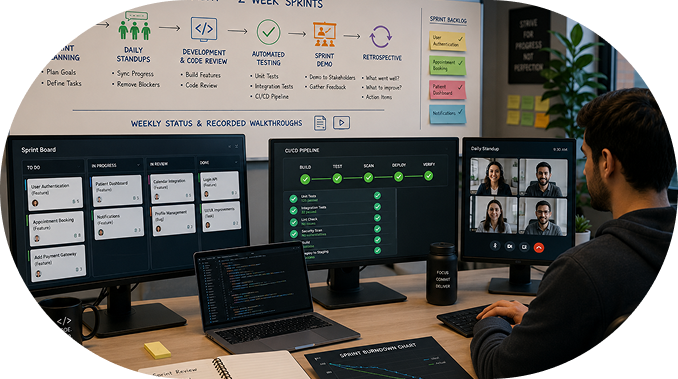
US-Timezone Coverage With Daily Standups and a Los Angeles-based commercial front.
Three Service Pillars Only: healthcare mobile apps, healthcare web development, and custom healthcare software — the same three we've delivered across 200+ builds.
We work best with three types of buyer:
If you're a Fortune 500 payer looking for a 2,000-engineer partner with ISO 13485 certification, we're honest: we're not your team. Scroll to "When We're Not the Right Fit" below for the full transparency. You need a 1,000+ engineer bench or ISO 13485 certification for Class II/III medical devices. You're replacing Epic or Cerner across a hospital system with a ground-up enterprise EHR — we'll refer you out. You need end-to-end FDA 510(k)/PMA submission management. We engineer to 21 CFR Part 11, but we don't run your regulatory filing. You want the cheapest offshore quote with no compliance rigor — that's not how we build.

Most agencies list "HIPAA compliance" as a feature and hope the buyer doesn't ask follow-ups. We approach it as an architecture decision — one that shapes cloud region choice, authentication design, logging strategy, and every API call in the system.
We deliver healthcare software across three pillars. Every engagement blends these depending on scope.
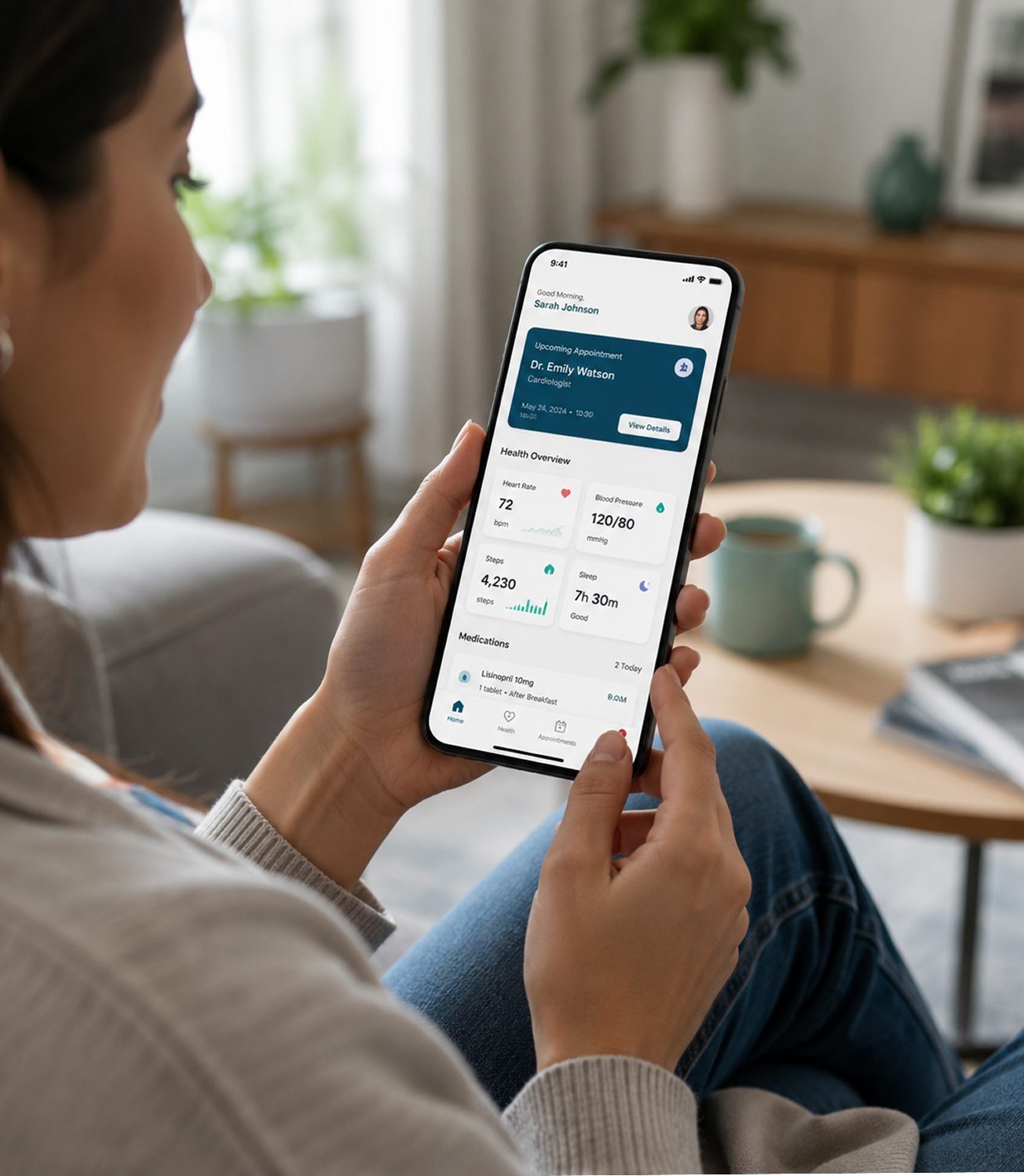
Native iOS (Swift), native Android (Kotlin), and cross-platform (Flutter, React Native) mobile apps for patients, providers, and caregivers. Every healthcare mobile build ships with:
HIPAA-ready native and cross-platform apps for patients, providers, and caregivers — biometric login, offline sync, and PHI encrypted on every device.
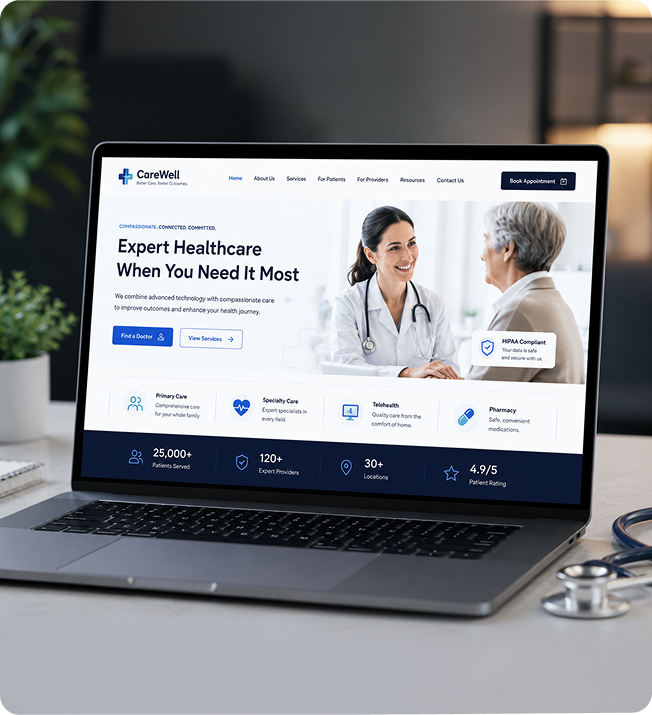
Provider portals, patient portals, admin dashboards, internal clinical tools, and healthcare marketing websites. Built on React, Next.js, Angular, Vue, Laravel, and Node.js. Every healthcare web build includes:
Secure provider and patient portals, telehealth platforms, and EHR-connected dashboards — WCAG-accessible, SSO-enabled, and engineered around real clinical workflows.
Custom platforms and SaaS builds — from EHRs and telemedicine platforms to LIMS, pharmacy management, and multi-tenant healthcare SaaS. Built on Node.js, Python (Django, FastAPI), .NET Core, and PHP (Laravel) with cloud-native architecture on AWS, Azure, or GCP. Every healthcare software platform includes:
Custom EHR/EMR, RPM, and hospital platforms with FHIR and HL7 interoperability — engineered for compliance, scale, and Epic and Cerner integration.
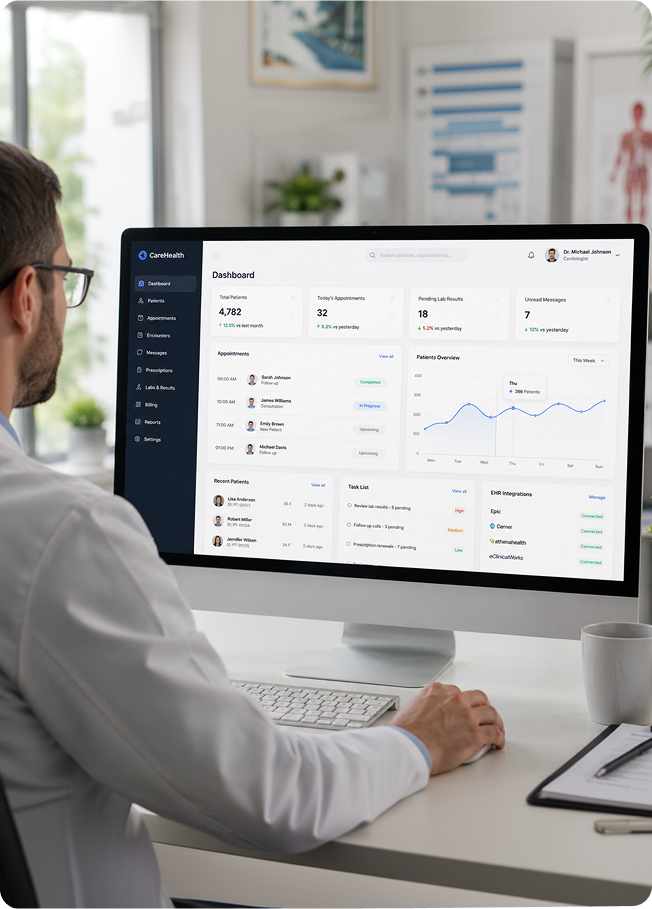
Every solution below is built inside one or more of the three service pillars above.
An Electronic Health Record (EHR) is a longitudinal digital patient record designed to be shared across care settings; an Electronic Medical Record (EMR) is the digital chart for a single practice. In practice, US buyers usually mean EHR even when they say EMR. We build custom EHR and EMR platforms for specialty practices — cardiology, oncology, behavioral health, orthopedics, primary care, and pediatrics. Every build includes SOAP notes, e-prescribing (SureScripts integration), clinical templates, lab and imaging integration, and FHIR-native interoperability.
HIPAA-ready video consultations built on Twilio Programmable Video, Amazon Chime SDK, or Vonage Video API — all with signed BAAs available. Features include end-to-end encrypted sessions, asynchronous secure messaging, e-prescriptions, integrated payments, and calendar-linked scheduling. This is where we shipped BlackTherapy — a HIPAA-aligned mental health telehealth platform on AWS with sub-2-minute AI therapist matching and a 39% efficiency gain for the care team.
Connected device platforms that pull data from Bluetooth blood pressure cuffs, glucometers, pulse oximeters, ECG patches, CGMs, and smart scales — then route the data to clinical dashboards with alert thresholds, trend analytics, and CPT 99453/99454/99457/99458 billing-ready reporting.
Role-specific portals with self-service intake, appointment booking, secure messaging, lab result access, prescription refills, and care plan tracking. Nurse portals include shift-based views, med-pass workflows, and escalation queues.
Modular HMS covering admissions, bed management, OT scheduling, inventory, HR, and finance. Start with what you need and add modules as you scale.
Inventory, dispensing, e-prescription reconciliation, DEA-compliant controlled substance tracking, insurance eligibility verification, and mail-order fulfillment workflows.
Sample tracking, HL7 ADT/ORM/ORU messaging, instrument integrations, result reporting, and quality control workflows.
Charge capture, claims scrubbing, ERA/EFT posting, denial management, and patient statements. X12 837/835 EDI support with ICD-10, CPT, and HCPCS code libraries.
HIPAA-ready CRM to nurture patient acquisition, run referral programs, manage physician relationships, and automate outreach. We build on Salesforce Health Cloud, HubSpot (with BAA), or custom.
Consumer wellness apps, digital therapeutics (DTx), CBT delivery platforms, meditation apps, and provider-side care platforms. Content moderation, crisis-escalation workflows, and outcomes tracking included.
Rule-based and AI-augmented decision support integrated at the point of care. Drug-interaction alerts, clinical guideline nudges, and risk stratification — all with explainable AI traceability.
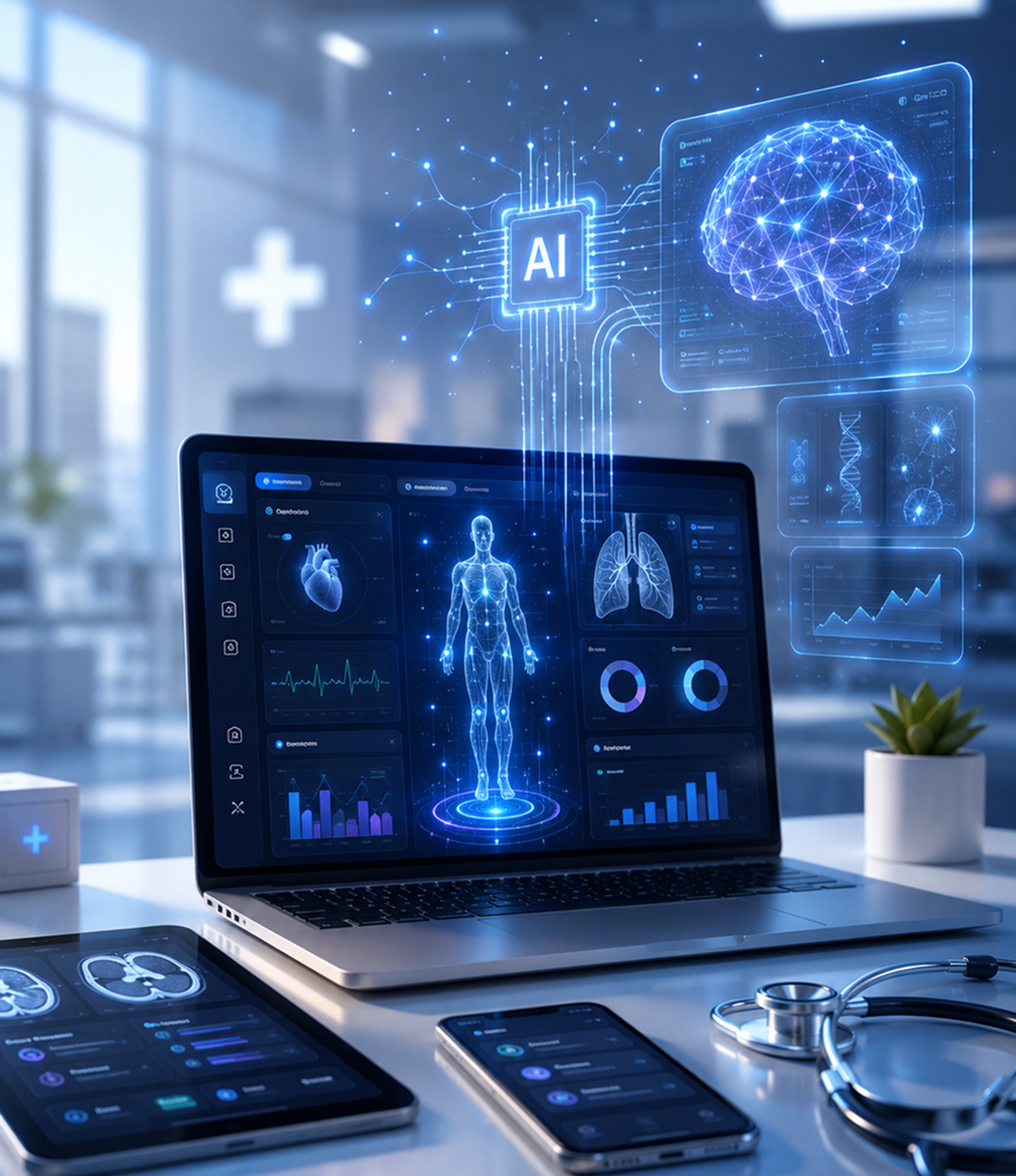

Ambient clinical scribes, patient-intake chatbots, discharge summary generation, and multi-lingual patient education content, built on OpenAI, Anthropic Claude, and open-source LLMs with PHI-safe deployment patterns.

Symptom checkers, differential diagnosis assistants, and triage bots positioned as decision support, not autonomous diagnosis.

HIPAA-ready conversational agents for scheduling, medication reminders, mental health check-ins, and post-op follow-up.

Readmission risk, no-show prediction, sepsis early warning, and population health forecasting.

Computer vision for radiology triage, dermatology screening, and pathology assistance, with DICOM pipelines and PACS integration.

Voice-controlled EHR entry, ambient documentation, and IVR-based patient outreach.

Wearables and connected medical devices integrated into unified care platforms.
Epic (App Orchard, USCDI, SMART on FHIR), Cerner / Oracle Health, Athenahealth (marketplace apps), eClinicalWorks, Allscripts, NextGen, Practice Fusion, Meditech, DrChrono.
AWS HealthLake, AWS HealthImaging, Google Cloud Healthcare API, Azure Health Data Services (Azure API for FHIR).
Twilio (SMS, Voice, Video, WhatsApp — all with BAA), Amazon Chime SDK, Vonage Video API, Zoom Healthcare (BAA-eligible).
Apple HealthKit, Google Health Connect, Fitbit, Garmin, Withings, Dexcom, Omron, iHealth, Whoop.
Stripe (BAA available for eligible use cases), Braintree, InstaMed, Change Healthcare, Availity.
Quest Diagnostics, LabCorp, Change Healthcare Imaging, DICOM PACS systems.
Auth0 (with BAA), Okta, Azure AD B2C, AWS Cognito, biometric SDKs, OAuth 2.0, SAML 2.0.
SureScripts, DoseSpot, ePrescribe networks.
Segment, Amplitude, Mixpanel, Snowflake, Databricks.
We choose technologies because they fit the specifications of a particular project, not because they are easy for us. All our recommended stacks are scalable, HIPAA-compatible (where needed), & designed to be long-term maintainable.
We build accessible, WCAG-compliant healthcare interfaces using Vue, Angular, Next.js, TypeScript, and Tailwind, delivering secure provider portals and patient dashboards around real clinical workflows.
Vue
Angular
Next.js
TypeScript
Tailwind
Our engineers build HIPAA-ready healthcare backends using Node.js, Python, Django, FastAPI, PHP, and .NET Core, powering secure APIs, multi-tenant architecture, and high-throughput clinical workflows.
Node.js
Python
Django
FastAPI
PHP
.NET Core
We develop HIPAA-ready healthcare apps using Swift, Kotlin, Flutter, React Native, and Ionic, with biometric login, offline sync, and PHI encrypted on every device.
Swift
Kotlin
Flutter
React Native
Ionic
We build clinical AI using OpenAI, Anthropic Claude, TensorFlow, and PyTorch, powering ambient scribes, triage bots, and predictive analytics with PHI-safe deployment patterns.
OpenAI API
Anthropic Claude API
TensorFlow
PyTorch
We deploy healthcare platforms on HIPAA-eligible AWS, Azure, and Google Cloud services with signed BAAs, ensuring secure, compliant, and scalable cloud infrastructure for PHI.
AWS (HIPAA-eligible)
Azure
Google Cloud Platform
We manage clinical data using PostgreSQL, MySQL, MongoDB, Oracle, Amazon Aurora, DynamoDB, and Redis, ensuring secure storage, tenant-level encryption, and fast, reliable access.
PostgreSQL
MySQL
MongoDB
Oracle
Amazon Aurora
DynamoDB
Redis
We automate healthcare delivery using Docker, Kubernetes, Terraform, GitHub Actions, and ArgoCD, with Datadog and Sentry monitoring, ensuring reproducible environments and reliable, secure deployments.
Docker
Kubernetes
Terraform
GitHub Actions
GitLab CI
ArgoCD
Datadog
Sentry
We enable healthcare interoperability using Mirth Connect, Rhapsody, and HAPI FHIR, connecting your platform to EHRs through FHIR R4 and HL7 v2/v3 interfaces.
Mirth Connect
Rhapsody
HAPI FHIR
We harden healthcare software using AWS KMS, HashiCorp Vault, Snyk, SonarQube, and OWASP ZAP, embedding encryption, secrets management, and security scanning from the first sprint.
AWS KMS
HashiCorp Vault
Snyk
SonarQube
OWASP ZAP
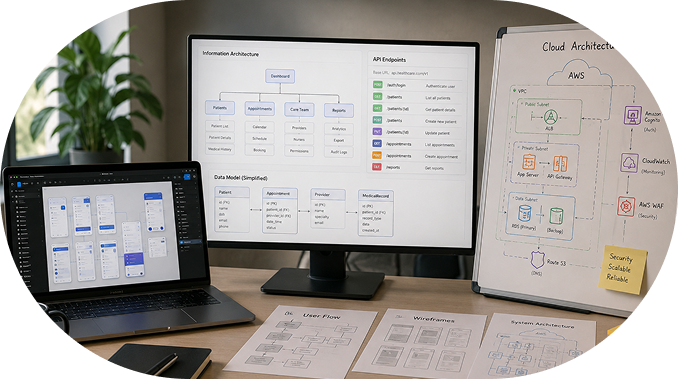
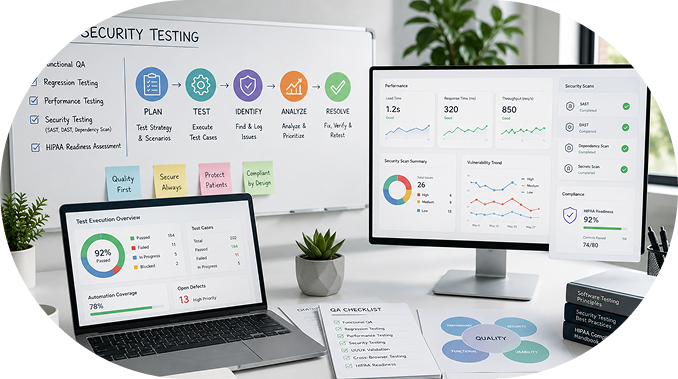
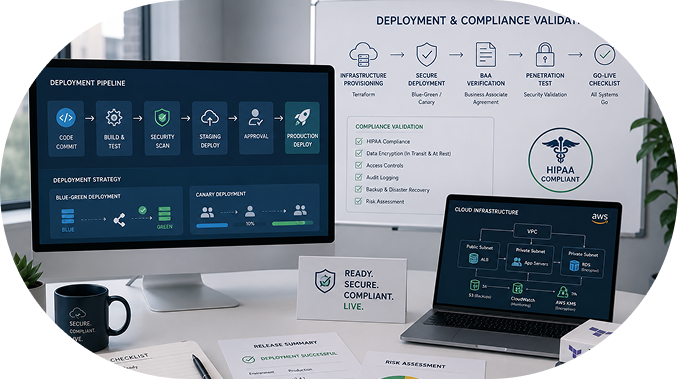
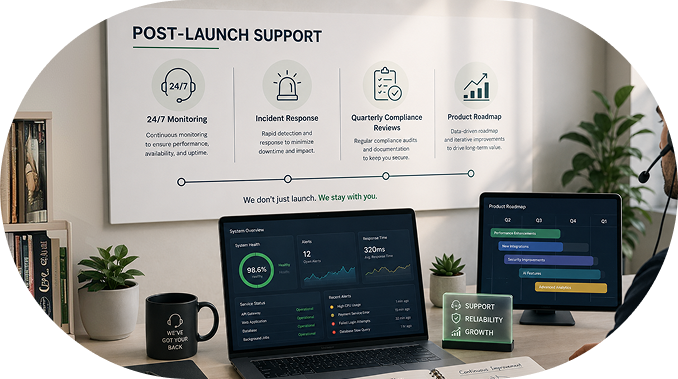
Business goals, user journeys, regulatory scope mapping, technical architecture draft, risk register, and a scoped Statement of Work.


Verified 2026 market cost ranges for healthcare software development, cross-checked against current industry benchmarks — giving you realistic, trustworthy figures to plan and budget your project with confidence.
| Product Type | Verified Market Range (USD) | Auspicious Soft Typical Range (USD) | Estimated Timeline |
|---|---|---|---|
| Basic Patient Portal / Appointment App | $40,000–$150,000 | $40,000–$80,000 | 10–14 weeks |
| Healthcare MVP (Single Platform) | $50,000–$150,000 | $45,000–$85,000 | 10–14 weeks |
| Telemedicine Platform (basic) | $60,000–$150,000 | $60,000–$120,000 | 14–20 weeks |
| Telemedicine + EHR Integration (Mid-Complex) | $150,000–$500,000 | $120,000–$300,000 | 5–9 months |
| HIPAA-Ready Mobile App | $45,000–$150,000 | $45,000–$110,000 | 12–20 weeks |
| Custom EHR / EMR (Specialty Practice) | $120,000–$500,000 | $100,000–$250,000 | 6–14 months |
| Enterprise EHR / Hospital Management | $500,000–$2,000,000+ | Referral partner | 12–24 months |
| Remote Patient Monitoring (RPM) + Device Integration | $80,000–$300,000 | $75,000–$180,000 | 4–10 months |
| Dedicated Healthcare Developer (Monthly, FTE) | $6,000–$18,000 | $6,000–$12,000 | Ongoing |
Healthcare software development is the design, engineering, and delivery of digital products that support clinical care, patient engagement, healthcare operations, or medical research. It covers EHR and EMR systems, telemedicine platforms, remote patient monitoring, medical billing, hospital management, patient portals, and AI-driven clinical tools — all built with compliance frameworks including HIPAA, HITECH, FHIR, and HL7 shaping the architecture.
We are a HIPAA-ready development partner. Our engineering practices, cloud deployment patterns, and data handling procedures are designed to support HIPAA compliance for our clients. Formal HIPAA compliance is a legal status held by the covered entity or business associate — we deliver software and BAAs that make achieving and maintaining that status straightforward.
Verified market ranges for 2026: basic patient portals and appointment apps run $40K–$150K, mid-complexity telemedicine platforms with EHR integration run $150K–$500K, and enterprise EHR or hospital management systems run $500K–$2M+. HIPAA compliance requirements typically add 15–30% to base development cost. Auspicious Soft’s typical ranges land in the low-to-mid portion of these bands. Full pricing table above.
A production-ready telemedicine platform typically takes 14–24 weeks from discovery to launch, covering HIPAA-ready video architecture, patient and provider apps, scheduling, e-prescriptions, payments, and compliance validation. A lean MVP can ship in 10–12 weeks. Enterprise builds with deep EHR integration run 6–9 months.
An EMR is a digital version of a single practice’s paper chart, holding clinical data for that practice only. An EHR is designed to be shared across care settings — hospitals, specialists, labs, and pharmacies — using interoperability standards including FHIR and HL7. EHRs are broader in scope and interoperability. Most modern platforms are EHRs, but US buyers often use the terms interchangeably.
FHIR (Fast Healthcare Interoperability Resources) is the modern healthcare data-exchange standard developed by HL7. It uses REST APIs and JSON to make patient data portable across systems. FHIR R4 is the required standard under the ONC Cures Act for interoperability with major US EHRs including Epic, Cerner, and Athenahealth. Any healthcare product built in the US in 2026 needs FHIR readiness.
HL7 v2 is a legacy pipe-delimited messaging standard used for real-time hospital data exchange (ADT admissions, lab orders and results). FHIR is the modern REST and JSON-based standard designed for web and mobile interoperability. Most US healthcare systems run HL7 v2 internally for legacy interfaces while exposing FHIR APIs for modern integrations. We work with both.
Yes. We integrate with Epic (via App Orchard, USCDI, and SMART on FHIR), Cerner / Oracle Health (via FHIR and HL7), Athenahealth (via marketplace apps), and eClinicalWorks. Integration timelines depend on the specific interfaces required. Full Epic production access requires marketplace review, which we help you plan for from the discovery phase.
RPM software collects patient physiological data (blood pressure, glucose, weight, heart rate, oxygen saturation, ECG) from connected devices, transmits it securely to a clinical platform, and enables providers to intervene early on abnormal trends. Under CMS rules, RPM services are reimbursable under CPT codes 99453, 99454, 99457, and 99458 when the software is built to the required specifications.
A HIPAA-ready mobile app requires encryption of PHI at rest on the device using OS-native secure storage (Keychain, Keystore), TLS 1.3 encryption in transit, biometric or strong password authentication, session timeouts and automatic logoff, BAAs with every third-party service that touches PHI, no PHI in push notification payloads, audit logging of PHI access, and a documented breach response plan. Auspicious Soft builds all of these in by default.
Yes. Beyond fixed-scope projects, we offer dedicated healthcare developers, QA engineers, DevOps specialists, and solutions architects on monthly retainers. Every arrangement includes full NDA protection, complete IP transfer, and integration with your internal tools (Jira, Slack, GitHub). US-timezone overlap is standard.
We engineer for HITECH, SOC 2 Type II (supporting your audit), GDPR (for EU-facing platforms), FDA 21 CFR Part 11 (for SaMD), ONC Cures Act interoperability requirements, and state-level rules including CCPA and CPRA in California. Our compliance workshop in week one maps every applicable regulation to your specific product.
We serve healthcare clients across the entire United States. Our sales office is in Los Angeles, California. Response time on new inquiries is under 2 business hours. Frequent engagement geographies include California, New York, Texas, Florida, Illinois, Massachusetts, Washington, and Georgia.
Every engagement starts with a mutual NDA. Source code, designs, and documentation belong 100% to the client on delivery. Developer laptops are managed and encrypted, access to client repositories and production environments is role-based and MFA-enforced, and every action is audit-logged. On engagement end, all access is revoked and any local copies of PHI or IP are securely erased.