+1 740 762 6496
 +91 70189 46603

TABLE OF CONTENT
- What a Software Development Company Actually Does
- The One Truth Most Guides Skip
- When to Skip the In House Team and Hire Outside
- What Actually Matters When Picking a Software Development Company
- Green Flag vs Red Flag Cheat Sheet
- Red Flags That Will Cost You Later
- Questions to Ask Before You Sign the Contract
- Types of Software Development Companies (Where Each Fits)
- How Much Does a Software Development Company Cost?
- Retainer or One Off Build? Both Have a Place
- How Auspicious Soft Approaches the Same Question
- FAQs
Overview
- Picking a software development company is a relationship choice, not a purchase. Fit and communication beat price every time.
- The best partner is often not the biggest or cheapest one. It is the shop whose calls feel like a real conversation, not a scripted pitch.
- Look for a portfolio with real case studies and numbers, a tech stack chosen for your product (not their comfort zone), and pricing you can read line by line.
- Confirm time zone overlap, post launch support, IP ownership, and NDA terms in writing before you sign.
- Ask sharp questions. Who owns the code? Which client fired you? What AI coding tools does the team use?
- Red flags include logo wall portfolios, fixed prices with no discovery, and founders who never join a call.
- Real builds like Habibi Rizz show what a shipped portfolio actually looks like.
Pick the software development company that gives you plain answers. Not the biggest one. Not the cheapest one. The one whose salesperson says ‘we might not be right for you’ every now and then.
That is the whole game. The rest is detail. This guide walks the detail, plus the traps buyers keep falling into.
What a Software Development Company Actually Does
A custom software development company builds digital products for other businesses. Mobile apps. Web platforms. Internal tools. Full SaaS builds.
The team runs deep. Product managers. Designers. Engineers. QA testers. Sometimes DevOps and cloud folks too.
Most shops do not do everything. Some only ship websites. Some live inside a niche like healthcare, fintech, or custom CRM and ERP systems. That match matters more than headcount.
The One Truth Most Guides Skip
Every list online says the same thing. Check portfolio. Check reviews. Check team size. Fine.
Here is what those lists dodge. The best software development company for you is often not the biggest name. It is not the cheapest. It is the shop whose calls feel easy.
When to Skip the In House Team and Hire Outside
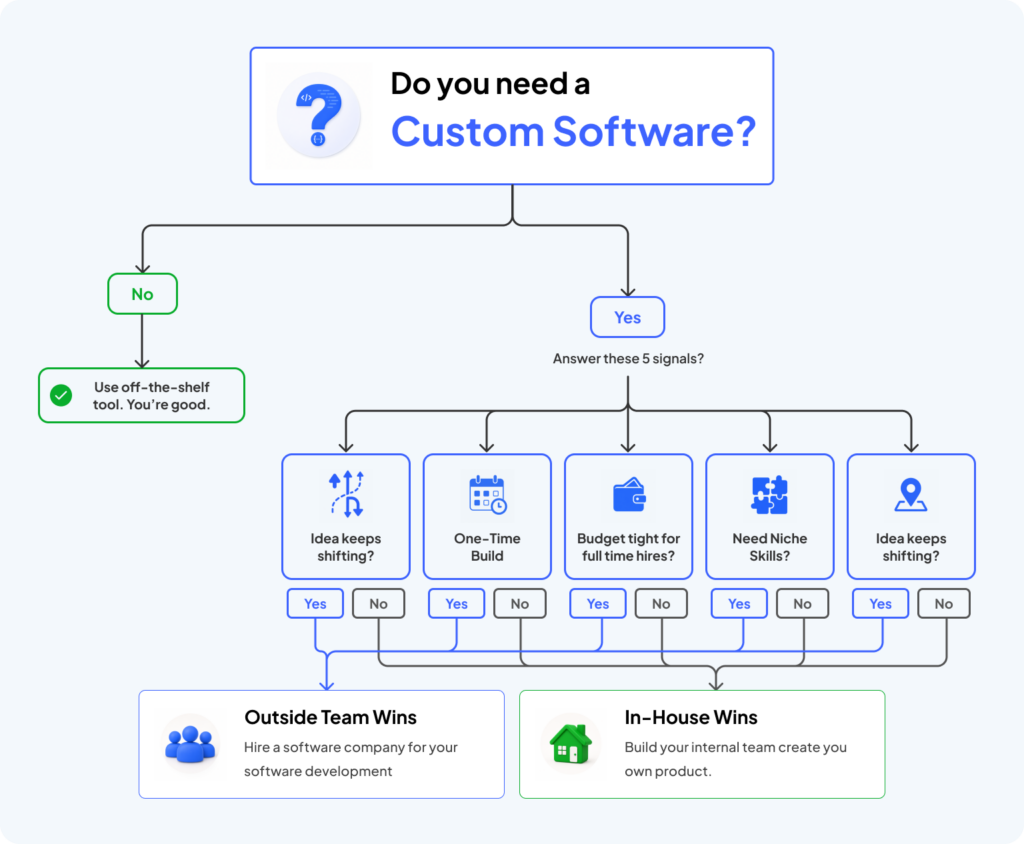
Some buyers still weigh a software development company against an in house team. A few signs outside help wins:
- Your idea keeps shifting. Speed matters more than a hiring pipeline.
- The product is a one time build, not a forever platform.
- Senior engineer salaries would drain your runway.
- You need niche skills like blockchain or AI/ML for six months, not forever.
- Local talent in your city is thin.
Two or more fit? Go outside.
What Actually Matters When Picking a Software Development Company
This is where most buyers rush. Slow down.
1. A Portfolio That Matches Your Space
Do not read what a shop claims. Read what it shipped.
A team that built a fitness app knows why streak logic breaks at midnight. A fintech team knows KYC pain. A team with no track record in your space will learn on your dime.
Ask for case studies with numbers. Downloads. Retention lift. Revenue jumps. Screenshots alone are not a portfolio.
Better yet, ask for a walk through of one build from problem to solution. What broke. What got fixed. Which choice cost money to reverse. That is what a real case study reads like. (See Habibi Rizz for one example. It names the three technical problems and the three fixes.)
2. A Tech Stack That Fits Your Product, Not Their Comfort Zone
Every shop pushes what it already knows. That is the honest truth of the industry.
A Laravel shop will pitch Laravel. A React Native shop will pitch React Native. That is not always wrong. But it is worth catching.
Ask why they suggest React Native over native iOS. Or Flutter over Kotlin. Or Laravel over Django. If the answer is ‘we always use it,’ walk. If the answer maps trade offs, keep talking.
One more question that catches shops off guard in 2026. Ask if the app can switch AI models without a redeploy. On Habibi Rizz, that switch between OpenAI and Gemini lives in the admin panel. Which means when model prices spike, the client flips a toggle. That is a one hour decision. Not a two week rebuild.
3. Communication That Feels Human
Slack replies inside hours. Weekly demos. Written notes after every call.
Ghosting in sales predicts ghosting in delivery. Every single time. That is not a slogan. It is a pattern.
According to the Stack Overflow Developer Survey, communication gaps beat code quality as the top killer of software projects. Talk matters more than talent.
4. A Team You Can Name
A five person crew ships an MVP fast. A twenty person crew drowns a small project in ceremony.
Ask who will build your product. First names. Roles. LinkedIn profiles. Not a stock list from the pitch deck.
5. Pricing You Can Actually Read
Fixed price feels safe. Often it is not.
Fixed price shops pad the number. They have to. Every unknown becomes a risk. Every risk becomes a line item. You pay for the padding whether you use it or not.
Time and materials feels risky. Often it costs less across a full project.
Retainer models fit long roadmaps. Ask for a sample invoice from a past client with numbers redacted. If they refuse, that is your answer.
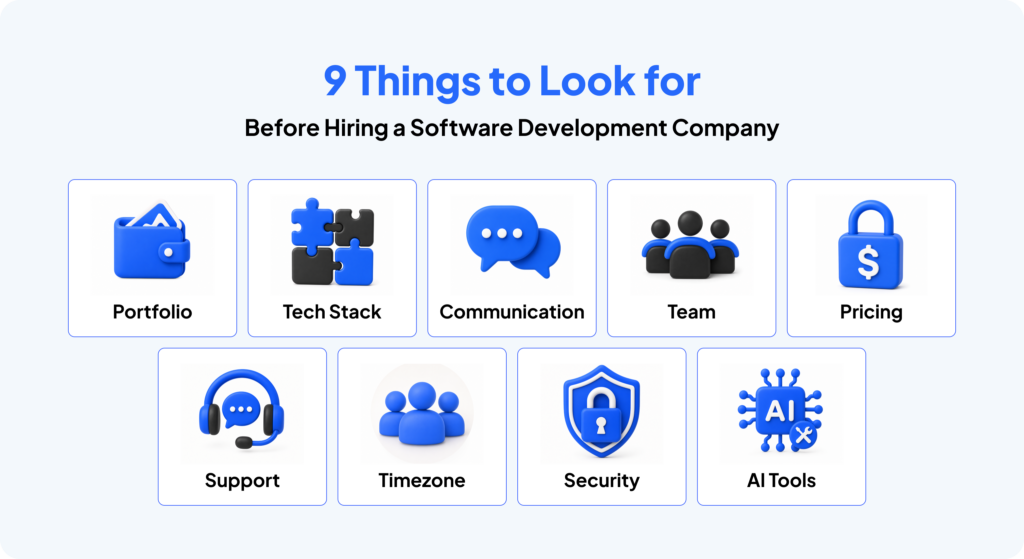
6. Post Launch Support (Where Cheap Teams Turn Expensive)
Shipping software is 40 percent of the job. Keeping it alive is 60.
Ask what happens the day after launch. Who patches bugs? Who watches servers? Who updates libraries when iOS 20 drops? Get every answer in the contract. Not the pitch. The contract.
7. Time Zone Overlap That Works
Four hours of daily overlap is the floor.
Anything less means late replies. Missed standups. Slow decisions. That is why so many USA buyers hire a remote development team from India or Eastern Europe. It works when the overlap is real and standups run daily. Not weekly.
8. Security, NDA, and IP Ownership
Sign an NDA before the second call.
Confirm on paper that you own the code, the designs, the data, and the third party keys. For security, look at whether the shop follows OWASP guidelines and can walk you through their threat model.
Some shops keep IP until final payment clears. Read every clause. Twice.
9. AI Coding Tools (The 2026 Question Nobody Was Asking Last Year)
This one would have felt strange two years ago. Ask what AI coding tools the team uses.
If the answer is ‘just VS Code,’ they are behind. If they use Copilot, Cursor, or Claude Code, ask how. A shop that uses AI tools well ships faster and cheaper. A shop that hides them is either behind or lying.
Green Flag vs Red Flag Cheat Sheet
| What Matters | Green Flag | Red Flag |
|---|---|---|
| Portfolio | Case Studies With Real Metrics | Only Screenshots and Logos |
| Communication | Written Summaries After Every Call | Only Verbal Updates |
| Team | Names and Roles Shared Upfront | Generic 'You Get A Team' Pitch |
| Pricing | Sample Invoices, Clear Line Items | Vague Monthly Totals |
| Support | Post Launch SLA in The Contract | 'We Will Figure It Out' |
| IP | You Own Everything On Delivery Day | Vendor Holds Code Until Final Payment |
| Sales Call | Feels Like a Working Session | Feels Like a Scripted Pitch |
| AI Tools | Uses Them Openly, Explains How | Refuses To Say or Claims Not To |
Score Your Vendor Sales Call (Quick 5 Point Test)
After the first sales call, run this. One point for each yes.
| Signal | Yes = 1 point |
|---|---|
| Did They Ask About Your Users Before Pitching Tech? | |
| Did They Push Back On Any Of Your Assumptions? | |
| Can You Name Three Engineers Who Will Build The Product? | |
| Did They Share A Sample Scope Doc, Invoice, Or Case Study? | |
| Did They Say 'We Might Not Be The Right Fit' Even Once? |
Thirty minutes. Straight answers on whether Auspicious Soft is the right fit for the project. No pitch. No pressure. Talk to Auspicious Soft →
Red Flags That Will Cost You Later
- They cannot say no. Every ask gets a yes.
- Fixed price on day one. No discovery. No wireframes. No scope.
- Portfolio is a logo wall. No case studies attached.
- Senior engineers on sales calls. Juniors on delivery calls.
- They avoid writing anything down.
- Reviews across Clutch, Google, and GoodFirms sound identical. Like a copy paste job.
- They pitch tech before asking about your users.
- The founder never gets on a call.
Any two of these together? Move on. Life is short.
Questions to Ask Before You Sign the Contract
- Who owns the code, the designs, and the data?
- What happens if the lead engineer leaves mid project?
- How do you handle scope creep?
- Tell me about one project that went sideways and how you fixed it.
- Can I speak to two past clients directly, not over email?
- What is your defect rate in the first 90 days after launch?
- Do you use agile or waterfall, and why? (See the Agile Manifesto if the answer sounds vague.)
Types of Software Development Companies (Where Each Fits)
| Type | Who It Fits |
|---|---|
| Boutique Agency | Startups With A Fresh Idea and a Strong Design Need |
| Mid Size Shop | Growing SaaS or App Businesses |
| Enterprise Vendor | Large Firms With Complex Compliance and Legacy Stacks |
| Freelancer Collective | Very Small MVPs or Side Projects |
| Offshore Team (India, Poland, LatAm) | Cost Aware Buyers Who Still Want Quality |
How Much Does a Software Development Company Cost?
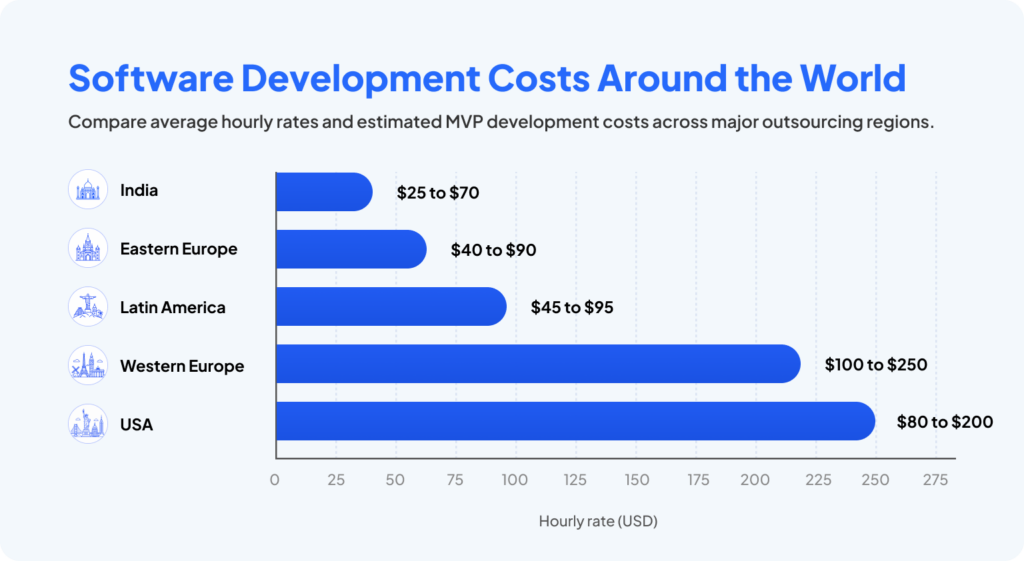
Rates swing by region, seniority, and stack.
Here is the truth about offshore pricing. The gap is closing.
A decade ago, India teams charged $15 an hour. The good ones now sit at $50 to $70. Still cheaper than USA rates. But not the price war it used to be.
An MVP lands between $15,000 and $75,000. A polished production app pushes past $150,000. Enterprise systems hit six or seven figures.
Costs also swing by industry. For instance, healthcare app development cost sits noticeably higher because of HIPAA rules and heavier QA. A real estate app development project sits in the middle, since MLS integration is a known problem now. If someone quotes $5,000 for a full mobile app, run. That number pays for a template with a fresh coat of paint.
The Discovery Phase Charge
Most software shops charge for discovery. Two thousand dollars. Five thousand. Sometimes twenty five thousand.
Discovery is worth paying for. When it is real.
Real discovery ends with a scope doc, wireframes, a tech recommendation, and a real budget. If the shop hands you a five slide deck with bullet points, they charged you for a sales meeting. Walk.
Auspicious Soft runs a free thirty minute call before any paid discovery. That is not a marketing line. It is a filter. It weeds out projects that would not fit anyway. Both sides save time.
Want A Real Number, Not A Range?
Send a rough brief. Get back a scoped estimate in two business days. Line items you can actually read. Send us a rough brief →
Retainer or One Off Build? Both Have a Place
A one off build works for fixed scope products. A marketing site. A v1 mobile app.
For long roadmaps, hire a dedicated development team on a monthly retainer. Predictable spend. Same engineers month over month. Context stays in the room. Ramp up costs stop.
How Auspicious Soft Approaches the Same Question
Auspicious Soft has been shipping software since 2018. Based in Mohali, India. Founded on the idea that offshore teams do not have to feel offshore.
The team focuses on custom mobile app development, custom web development, and full stack software builds for startups and enterprises across the USA.
The point of the next section is not sales. It is to show what ‘shipped portfolio’ actually looks like on the ground. Every software development company on your shortlist should be able to walk you through a build at this level of detail.
A Real Build: What Shipping Habibi Rizz Actually Looked Like
Take Habibi Rizz. An AI powered chat reply app. Live today on both Google Play and the Apple App Store.
The client walked in with an idea. Turn chat screenshots into smart replies that match the sender’s personality. Sounds simple. Was not.
Three real problems showed up mid build. AI replies kept drifting in tone across sessions. Users mostly uploaded screenshots, not typed text. And soft paywalls kept killing conversion.
The team fixed all three. A personality driven prompt framework locked tone in. Screenshot processing pulled chat context out of images. RevenueCat replaced hard paywalls with subscription flows that did not scare users away.
The Tech Stack Choice That Paid Off
The stack for Habibi Rizz was React Native for the app, Node.js and MongoDB on the backend, OpenAI and Gemini for AI, and RevenueCat for subscriptions. A React admin panel got built alongside it.
That admin panel is worth calling out. It was not in the original brief. It came out of a sales call question. The client asked how they would tweak AI prompts after launch. The team’s answer was blunt. ‘You will need a control panel. We should build one now, not later.’
That is the kind of pushback question 5 in this guide is trying to surface. If a shop only builds what you ask for, you get exactly what you asked for. Which is often not what you need.
Why Multi Model AI Beat Locking to One
Here is a detail buyers usually miss. The app can switch between OpenAI and Gemini without a redeploy. Live. From the admin panel.
Why bother? Because model prices and quality shifted more than once during 2025. Teams locked to one vendor got squeezed. Habibi Rizz did not. When one model got expensive or slow, the client flipped the switch. Same app. Cheaper bills. No downtime.
That is what ‘ready for 2026’ means in practice. Not a marketing line. A design choice.
Other Recent Case Studies Worth Looking At
Black Therapy is a HIPAA compliant telehealth app for African American patients. Different rules apply when patient data is involved. HIPAA touches every screen.
Disstrikt is an events discovery platform. Its founder Jaimy stayed on after v1 shipped and now runs long term with the team. That kind of retention is the real portfolio metric. Anyone can ship v1. Staying picked for v2, v3, and v4 is the harder win.
FAQs
Q: How do you check if a software development company is legit?
Real office address. Founders on LinkedIn with a track record. Verified reviews on Clutch or GoodFirms. Ask for two client references and actually call them. Skip that step and you deserve what happens next.
Q: How long does it take to build custom software?
An MVP takes 8 to 16 weeks. A full production product runs 4 to 9 months. Faster than that means corners cut on testing or docs. Both come back to bite inside a year.
For reference, Habibi Rizz shipped in 2 to 3 months with a team of 4 to 5. That includes React Native builds for both iOS and Android, a Node.js backend, AI integration with two model providers, subscription plumbing, and a React admin dashboard. That is roughly the speed a right sized team hits when the scope is honest.
Q: Should you hire a local team or go offshore?
Local feels safer. Costs 3 to 5 times more. Offshore shops in India or Eastern Europe often ship more per dollar. The trick is English fluency, time zone overlap, and a matching case study. Any of the three thin? Keep looking.
Q: What is the difference between a software development company and a freelancer?
A freelancer is one human. A company is a team, plus project managers, plus QA, plus backup when someone quits. Freelancers win on price. Companies win on delivery risk.
Q: Do software development companies sign NDAs?
Any serious one does. Ask before the second call. Refusal means walk. Full stop.
Q: What if you do not know what you want to build?
Normal. A good software development company runs a discovery sprint. Two to four weeks. It ends with a scope doc, wireframes, a tech recommendation, and a real budget.
Q: Can a software development company handle app store submission and marketing?
Some do. Some do not. Ask upfront. Auspicious Soft handles submission and post launch support in scope. Marketing is a separate line item.
Q: Is Auspicious Soft a good software development company for USA startups?
The team ships for USA startups every quarter. Case studies live on the site. Fit is a conversation, not a claim. Book a call. Find out in thirty minutes.
Do not Miss Our Latest Tech Insights
Stay one step ahead in the fast-moving world of AI and technology. Add us as a Preferred Source on Google and get our latest articles, guides, and industry insights delivered straight to your search feed.