+1 740 762 6496
 +91 70189 46603


TABLE OF CONTENT
- What Does It Actually Mean to Hire a Dedicated Development Team
- Why US Companies Are Choosing to Hire Remote Development Teams
- Who Should Use the Dedicated Team Model (And Who Should Not)
- How to Hire a Dedicated Development Team: Step by Step
- Dedicated Team vs Staff Augmentation: The Real Difference
- Technologies a Dedicated Development Team Can Work With
- Real Project: How a Dedicated Team Rebuilt BlackTherapy in Under 90 Days
- Industries Where a Dedicated Development Team Makes the Most Impact
- How Much Does It Cost to Hire a Dedicated Development Team
- What to Look for in a Dedicated Development Team Contract
- Why Auspicious Soft for Your Dedicated Development Team
- FAQs
Overview
- A dedicated development team works full time on your project only, not shared across multiple clients.
- US companies use this model to scale fast without the cost and delay of local hiring.
- The model works best when your project is ongoing, not a one-off build with a fixed brief.
- You keep full control: the team follows your process, your tools, your priorities.
- Auspicious Soft has used this model to deliver 200+ products, including a HIPAA-aligned telehealth platform built and launched in under 90 days.
AI Summary:
A dedicated development team works exclusively on your project. They are not juggling five clients. They learn your product, your codebase, and your goals. You get the output of an in-house team without the overhead of building one.
Most businesses that want to hire a dedicated development team start with one question: how much does it cost? That is the wrong question.
The right question is: what kind of team actually ships?
This post covers how to hire a remote development team the right way, what mistakes to avoid, and why the model works especially well for US-based companies that need speed without burning their runway. There is also a real project story from Auspicious Soft’s own work, not a theory, an actual build.
What Does It Actually Mean to Hire a Dedicated Development Team
People use the phrase loosely. Some use it to mean outsourcing. Others mean staff augmentation. The two are very different things.
A dedicated software development team is a group of developers, designers, testers, and a project manager hired specifically for your product. They do not switch between clients. They do not disappear mid-sprint. They show up every day for your work only.
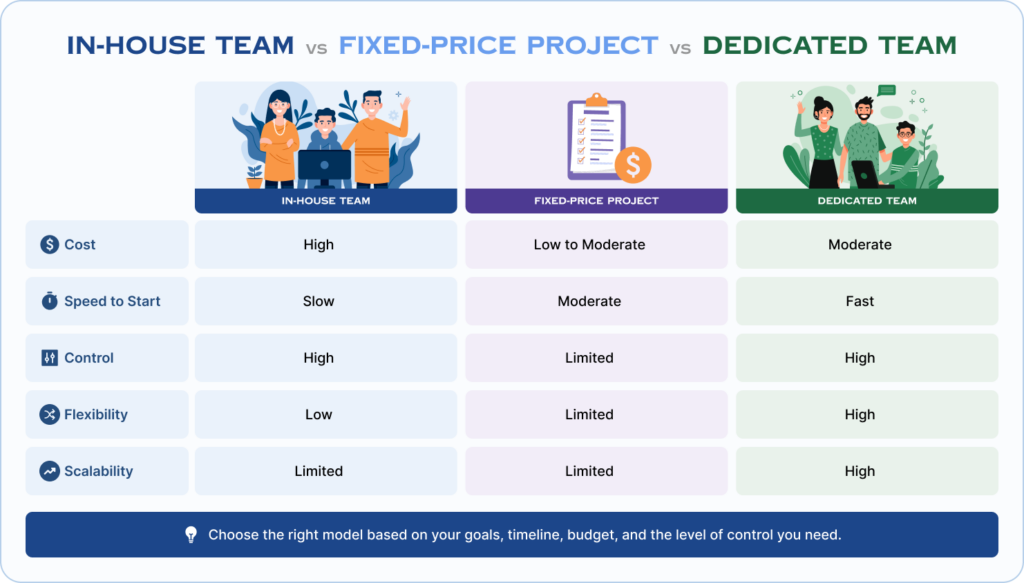
Compare that to a fixed-price project where you hand over a brief, wait six weeks, and get back something that misses half of what you needed. Or compare it to a freelancer who goes quiet when another client pays more.
The dedicated team model sits between in-house hiring and traditional outsourcing. You get commitment without the HR overhead. You get consistent work without locking into a rigid contract.
Why US Companies Are Choosing to Hire Remote Development Teams
The US tech hiring market is brutal. A senior React developer in California costs between $140,000 and $180,000 a year. That does not count benefits, payroll tax, or the three months it takes to onboard someone properly.
A dedicated remote development team solves that. You get the same quality of output at a fraction of the cost, and you can start in days rather than months.
But cost is not the only reason this model is growing. There are four things businesses actually get from it:
- A team that understands your product deeply, not just a rotating task list
- Faster iteration because the same people are always in context
- Easy scaling: add a developer to the team without posting a new job
- Flexible time zones: many quality teams work overlapping hours with US clients
Companies in New York, Texas, and California especially use this model to build products fast without raising a massive round just to cover payroll.
Who Should Use the Dedicated Team Model (And Who Should Not)
Not every project needs a dedicated team. Here is a clear breakdown.
| This Model Works If You... | This Model is NOT Right If You... |
|---|---|
| Have an ongoing product that keeps evolving | Need a single landing page built once |
| Want a team committed for 3 to 6+ months | Have a one-time MVP with a very fixed scope |
| Need to scale up or down based on your sprint roadmap | Have no internal person to communicate priorities |
| Want daily communication and real sprint cycles | Expect the team to run with zero input from your side |
| Have a US team that is stretched thin or does not exist yet | Have a total budget under $5,000 |
How to Hire a Dedicated Development Team: Step by Step
Most guides skip the part where things go wrong. Here is what actually works.
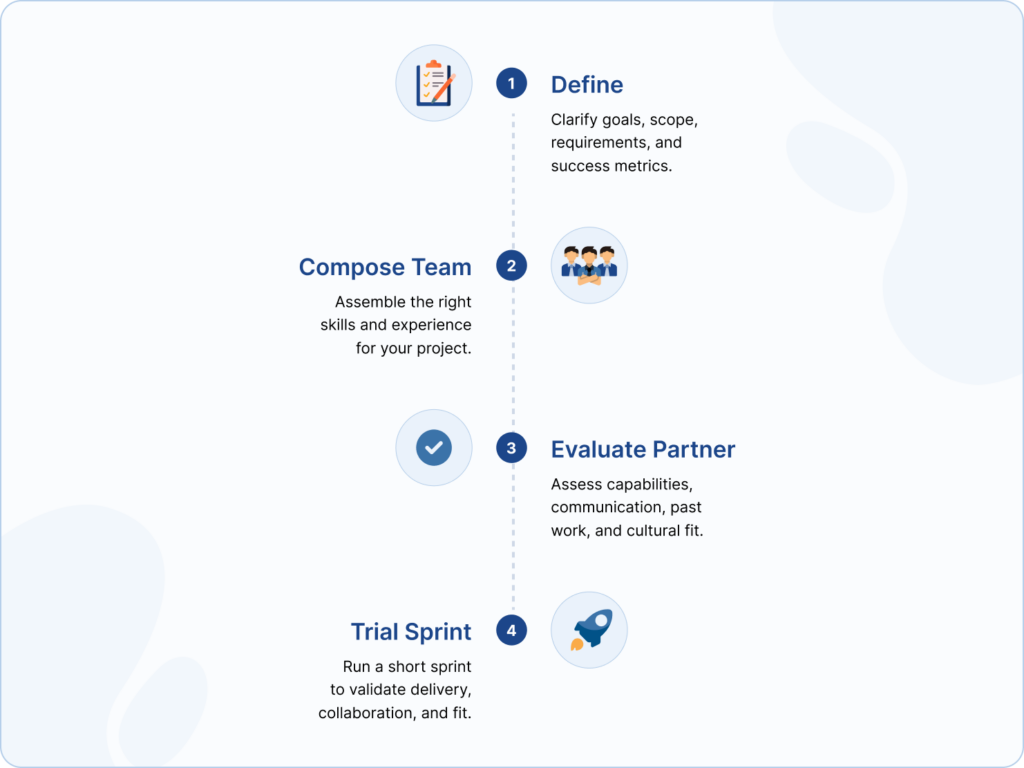
Step 1: Define What You Are Building Before You Talk to Anyone
Write down: what does your product do, who uses it, and what does done look like in 90 days? Vague briefs produce vague teams. No vendor can build well against a two-sentence description.
8 Years. 200+ Projects. Free First Call, No Commitment
Got a product that needs this level of dedicated focus? Let’s talk about your build.Step 2: Decide on Team Composition
A typical dedicated software development team for a mobile or web product includes:
- 1 to 2 specialized developers (frontend, backend, or full stack depending on your stack)
- 1 UI/UX designer, especially in the first phase
- 1 QA tester
- 1 project manager or tech lead
You do not always need all of these from day one. Start with what your product needs right now.
Step 3: Evaluate the Partner, Not Just the Portfolio
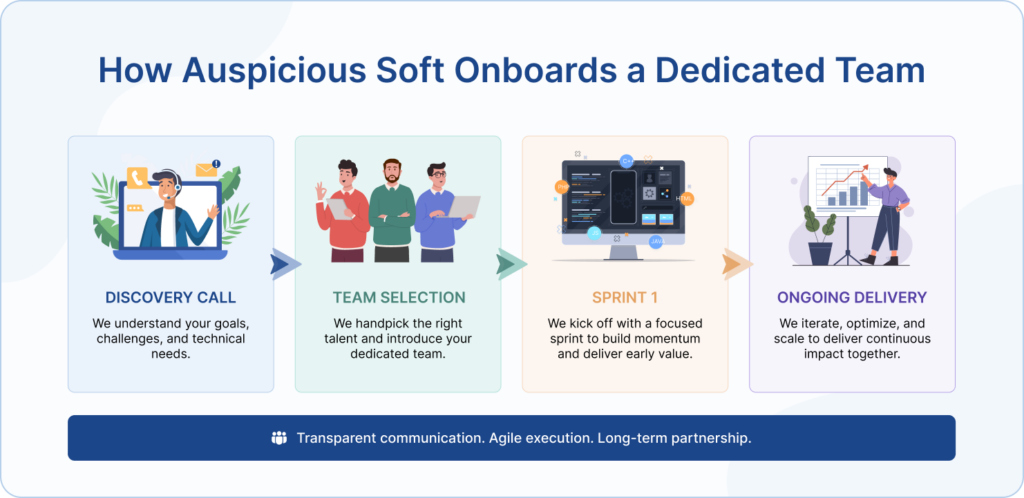
Portfolios show old work. What you want to see is how the team communicates. What is their sprint structure? How do they handle missed deadlines or scope changes? Ask for a discovery call, not just a sales deck.
Ask these four questions before you sign anything:
- What is your sprint length and how do you handle scope changes mid-sprint?
- Who is my main point of contact and how do I reach them daily?
- Can you show me a project in my industry or of similar complexity?
- How do you handle IP ownership and data security from day one?
Step 4: Run a Trial Sprint Before a Long Commitment
Even the best teams need a shakedown period. Start with a 2 to 4 week paid sprint. Judge the output. Check the communication quality. Then commit to a longer engagement if things work. This one step saves most companies months of regret.
Dedicated Team vs Staff Augmentation: The Real Difference
These two terms get mixed up constantly. Here is the clean version.
| Factor | Dedicated Team | Staff Augmentation |
|---|---|---|
| Team Structure | Full Team: Devs, QA, PM, design | Individual Developers Added To Your Team |
| Who Manages | Vendor Manages The Team | You Manage The Individual Directly |
| Best For | Ongoing Products Needing Full Ownership | Filling A Specific Skills Gap |
| Onboarding Time | Faster: Team Arrives Ready To Work | Slower: You Train and Onboard |
| Cost Model | Monthly Team Rate | Per Developer Per Hour or Month |
| Communication | Through PM or Tech Lead | Direct With The Individual |
Neither model is better in every situation. But if you need a full product built and maintained over time, a dedicated development team wins. If your internal engineering team just needs one extra React developer, staff augmentation is the right call.
For a deeper look at these models side by side, the Auspicious Soft guide on staff augmentation vs outsourcing vs managed services covers the differences with real-world examples.
Technologies a Dedicated Development Team Can Work With
The right team is not just committed. They are skilled in what your product actually needs. Here is what Auspicious Soft’s dedicated teams cover:
| Category | Technologies |
|---|---|
| Mobile App | React Native, Flutter, iOS (Swift), Android (Kotlin/Java) |
| Frontend Web | React.js, Next.js, Vue.js, Angular |
| Backend | Node.js, Laravel (PHP), Python (Django/FastAPI), .NET |
| Database | MySQL, PostgreSQL, MongoDB, Firebase |
| Cloud and DevOps | AWS, Google Cloud, Azure, Docker, CI/CD Pipelines |
| Specialist Areas | Blockchain, AI/ML integration, Shopify, WordPress, CRM/ERP |
Real Project: How a Dedicated Team Rebuilt BlackTherapy in Under 90 Days
Here is what this model looks like in practice, not theory.
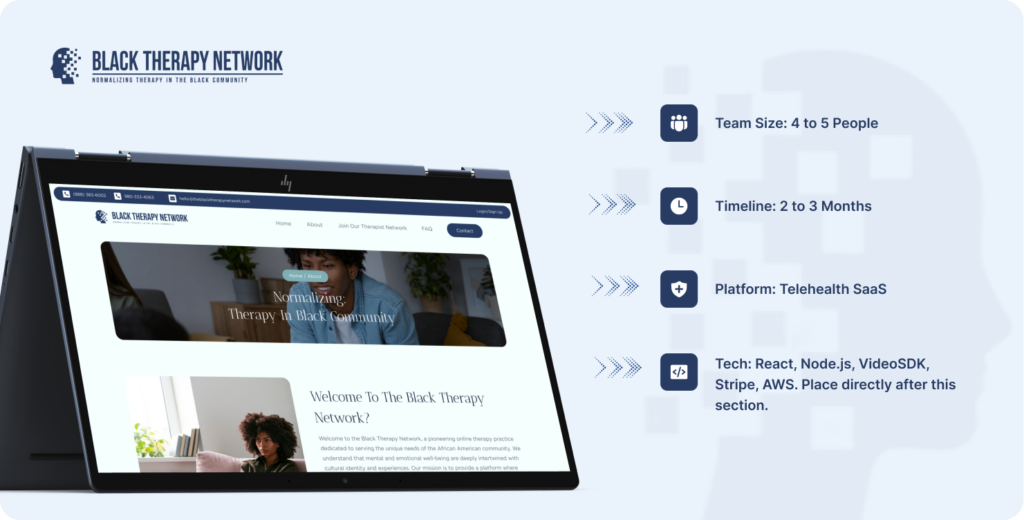
Kerry Shipman runs BlackTherapy, a US-based mental health platform that connects African American patients with licensed therapists for secure online sessions. The product is sensitive, regulated, and used by real people in real distress. When Kerry came to Auspicious Soft, the platform was breaking under its own weight.
The Problem
The original system ran on an older backend framework that could not handle real-time video sessions, concurrent users, or proper security for sensitive health data. Appointment scheduling was clunky. Performance was slow and inconsistent. The platform was growing in user demand but shrinking in reliability.
The dedicated team assembled for Kerry’s project included developers, a QA engineer, a UI/UX designer, and a project manager: 4 to 5 people working exclusively on BlackTherapy. No shared resourcing. No handoffs to other clients.
Here is what they delivered:
- Rebuilt the backend on a scalable SaaS architecture using Node.js and Express to handle high concurrency.
- Integrated real-time video sessions and encrypted messaging using VideoSDK and Socket.io
- Built role-based authentication for clients, therapists, and administrators with strong privacy controls.
- Designed a smart onboarding flow: users complete a brief assessment and the platform automatically matches them to a therapist.
- Added Stripe for subscription billing and admin dashboards for session management and platform reporting.
- Ran security, performance, and integration testing before launch.
The Outcome
The platform launched in under 90 days with improved load times, stable concurrent sessions, secure data handling aligned with HIPAA standards, and a user experience that clients and therapists could actually rely on. The SaaS structure also means the platform can grow without another rebuild.
Read the full BlackTherapy case study to see the tech stack, the development roadmap, and what a 5-step agile delivery looks like on a regulated US product.
That is what a dedicated development team does differently. They stay in the problem. They know the codebase. They do not start from scratch every sprint because the same people have been in the code since day one.
Industries Where a Dedicated Development Team Makes the Most Impact
The team model works across sectors, but some industries get outsized value because their products need to evolve constantly after launch.
Healthcare and telehealth: Ongoing compliance requirements mean you need a team that already knows your system. See the HIPAA compliant telehealth app development case study for how this plays out in practice.
Real Estate: Property platforms need continuous feature releases, new search filters, map integrations, and CRM connections. See real estate software development for how teams tackle this.
Education and EdTech: Custom functionality off-the-shelf tools cannot provide. Related: education software development.
Travel: Booking platforms and OTA products evolve constantly with pricing logic, API connections, and UX changes. See travel software development.
Fitness and Wellness: Data, wearables, and personalization require a team that stays across the roadmap. See fitness software development.
How Much Does It Cost to Hire a Dedicated Development Team
Cost depends on team size, seniority level, and tech stack. Here are realistic ranges for US companies hiring quality remote dedicated teams.
| Team Size | Monthly Cost Range (USD) | Best For |
|---|---|---|
| 1 Developer | $3,000 To $6,000 | Small Features or Solo Builds |
| 2 To 3 Developers | $7,000 To $14,000 | MVP or Early-Stage Product |
| Full Team (4 To 6 People) | $15,000 To $30,000 | Complete Product Ownership |
| Enterprise Team (7+ People) | $30,000 and Above | Large-Scale Platform or SaaS Builds |
These are market averages for quality teams. Vendors quoting $500 per month per developer are not running dedicated engagements. They are running shared pools with high turnover.
For a detailed breakdown of what SaaS products cost to build end to end, the post on SaaS MVP cost breaks down real budget ranges across different build paths.
Common Mistakes When You Hire a Remote Development Team
These are the ones that cost companies months and serious money.
- Picking a vendor based on the lowest quote without checking their process or past work
- Not setting up a sprint structure from day one, so work piles up with no visibility
- Assuming the team will self-manage with zero input or direction from your side
- Skipping a proper NDA or IP ownership clause in the contract
- Hiring for a specific technology when your product needs are likely to change
- Committing to a 6-month contract without running a trial sprint first
The most common failure is not bad developers. It is bad feedback loops. The code is often fine. The communication is broken. Fix that first and most other problems fix themselves.
8 Years. 200+ Projects. Free First Call, No Commitment
Got a product that needs this level of dedicated focus? Let’s talk about your build.What to Look for in a Dedicated Development Team Contract
Before you hire anyone, get these terms in writing. No exceptions.
- IP ownership: everything built belongs to you, not the vendor
- NDA covering your product, your users, and all business logic
- Clear deliverables per sprint or milestone, not vague output statements
- Offboarding clause: a clear process for how the engagement ends if needed
- Data handling and security standards, especially for regulated industries
For US companies, the FTC guide on business contracts is a useful reference when reviewing vendor agreements.
If you want market context on how big the global software outsourcing industry has become, Statista’s IT outsourcing outlook gives current data on size, growth rates, and regional trends.
Why Auspicious Soft for Your Dedicated Development Team
Auspicious Soft is a software development company with 8+ years of experience and 200+ delivered projects across mobile, web, and enterprise software for clients across the US.
The dedicated team model at Auspicious Soft works like this: your team is selected based on your tech stack and domain, a project manager handles day-to-day coordination, and you get sprint reviews, direct developer access, and transparent weekly reporting from the start.
Services available through a dedicated team engagement:
- Mobile app development services: iOS, Android, React Native, Flutter.
- Web development services: React, Next.js, Laravel, WordPress, Shopify.
- Custom software development: ERP, CRM, AI/ML, Blockchain.
- Hire a remote development team: flexible sizing, scalable, fully dedicated.
FAQs
Q: What is a dedicated development team?
A dedicated development team is a group of developers, designers, and testers who work exclusively on your project. They are not shared across clients. They operate as your product team without the cost and delay of in-house hiring.
Q: How is a dedicated team different from outsourcing a project?
Traditional outsourcing means handing a project over with a fixed brief and waiting for delivery. A dedicated team works with you continuously. You set priorities, they execute in sprints, and the relationship adapts as your product grows.
Q: How long does it take to hire a remote development team?
With a structured partner like Auspicious Soft, you can have a team assembled and running within 1 to 2 weeks. Traditional hiring for a single developer takes 2 to 3 months.
Q: Who manages the dedicated development team day to day?
The vendor typically assigns a project manager or tech lead. You communicate your requirements and priorities to that person. They handle the daily work. You can be as hands-on or hands-off as your workflow requires.
Q: Is my code and IP protected when I hire a remote team?
Yes, as long as the contract is right. Get an NDA signed before any work begins. Make sure the agreement clearly states that all IP, code, and product data belong to you from the first line of code.
Q: Can I scale the team up or down based on my roadmap?
Yes. That is one of the main advantages of the model. Before a big launch, you scale up. During a quieter phase, you scale down. No severance packages, no HR paperwork.
Q: What technologies does Auspicious Soft’s dedicated team cover?
React Native, Flutter, iOS, Android, React.js, Next.js, Laravel, Node.js, Python, AWS, Firebase, Blockchain, AI/ML, Shopify, WordPress, and more. The team is matched to your specific tech stack before the engagement starts.
Q: Do dedicated teams work across different time zones?
Yes. Auspicious Soft’s teams have experience working with US clients across California, New York, and Texas. Overlapping working hours are arranged from the start so sprint reviews, standups, and urgent calls are never blocked by time zone differences.
Do not Miss Our Latest Tech Insights
Stay one step ahead in the fast-moving world of AI and technology. Add us as a Preferred Source on Google and get our latest articles, guides, and industry insights delivered straight to your search feed.