+1 740 762 6496
 +91 70189 46603


TABLE OF CONTENT
- HIPAA in 2026: What Actually Changed (And What Is Coming)
- Real HIPAA Fines That Broke Companies
- The Four HIPAA Pillars Every EHR System Must Rest On
- Core Requirements for EHR Application Development
- State Laws That Also Apply to EHR Systems
- AI in EHR Systems: What Is Real, What Is Hype
- HIPAA Compliant EHR Development Cost (2026 Numbers)
- How Long Does EHR Software Development Actually Take?
- Step by Step: How to Build a HIPAA Compliant EHR System
- Tech Stack for EHR Application Development
- Build vs Buy vs Hybrid: Which Path Fits Your Practice?
- Custom EHR vs Epic vs Cerner vs Athenahealth
- Common Mistakes That Kill EHR Projects
- How to Choose an EHR Application Development Partner
- Why Auspicious Soft Builds Better EHR Systems
- Final Thoughts on EHR System Development
- FAQs
Overview
- A HIPAA compliant EHR system costs $45K to $85K for a basic MVP, $90K to $180K for a mid tier build, $180K to $350K for a full featured platform, and $350K to $2M+ for enterprise deployments.
- HIPAA is not a plugin. It shapes the database, the login flow, the logs, the backups, and the hosting stack. Retrofitting it later costs three times more.
- The 2026 HIPAA Security Rule NPRM would make MFA, encryption, and asset inventories mandatory. Final rule delayed to July 2027, but smart teams are building to the new bar today.
- Real fines are climbing. OCR closed 21 settlements in 2025 (second highest on record) and one company paid $49.5 million in a multistate settlement for a single ransomware breach.
- Interoperability (HL7 v2, FHIR R4, ICD 10) is table stakes now. Skip it and your EHR system becomes an island nobody wants to touch.
- Custom EHR builds beat Epic and Cerner on total cost of ownership past year three. Off the shelf beats custom on speed to launch.
- Hire a partner who ships healthcare software, not a general agency. General teams learn HIPAA on your dime, and it shows up on the invoice.
AI Summary:
A HIPAA compliant EHR system costs $45,000 to $350,000 to build in 2026 and takes 4 to 14 months to launch. A basic MVP with core patient records, scheduling, and eRx runs $45K to $85K. A full featured platform lands at $180K to $350K. Ongoing HIPAA maintenance eats another 15 to 25 percent of build cost per year. The one rule that keeps EHR projects on time and on budget: bake HIPAA into the arch.
An EHR system, short for Electronic Health Record, is a digital chart. It stores patient histories, lab results, prescriptions, insurance data, and clinical notes in one central place. Every clinic, hospital, or health tech startup that touches patient information runs on one. Or should.
EHR systems get mixed up with EMR systems all the time. The line is thin but real. An EMR sits inside one clinic. An EHR travels between clinics, labs, pharmacies, and specialists. Modern medical EHR systems are almost always EHRs, because interoperability is the whole point in 2026.
The global EHR market is heading toward $53 billion by 2033, pushed by federal incentives, AI adoption, and patient demand for portable records. Anyone launching an EHR product now is entering a massive market. Also a crowded one.
The competition is stiff. The rules are strict. The stakes are patient lives. Getting it right matters more than getting it fast.
HIPAA in 2026: What Actually Changed (And What Is Coming)
HIPAA has not sat still since 2003, but 2025 marked the first serious push to modernize the Security Rule in over two decades.
On January 6, 2025, the HHS Office for Civil Rights (OCR) published a Notice of Proposed Rulemaking (NPRM) that would overhaul how EHR systems protect electronic PHI. The comment period closed in March 2025. OCR received nearly 4,745 comments. The final rule is now delayed to July 2027, per the OMB Unified Agenda.
Delayed does not mean irrelevant. Auditors are already asking about these controls. Smart EHR teams build to the new bar now, not later. Here is what the NPRM proposes:
- Mandatory multi factor authentication for every user, every ePHI access point
- Mandatory encryption at rest and in transit (AES 256 baseline)
- Full asset inventories updated on a regular cadence
- Annual vulnerability scans and penetration tests
- Formal incident response plans with 24 hour recovery targets
- Elimination of the addressable versus required distinction. Everything becomes required.
Any team shipping an EHR system in 2026 or 2027 should treat these six items as design requirements. Compliance is coming for them anyway. Building to the higher bar now costs less than retrofitting later.

Talk To A Healthcare Engineering Expert
Get an EHR roadmap in 24 hours.Real HIPAA Fines That Broke Companies
Numbers hit harder than warnings. Here are the settlements that reshaped how healthcare organizations think about EHR security.
| Organization | Year | Settlement | Root Cause |
|---|---|---|---|
| Anthem Inc. | 2018 | $16 million | Cyberattack exposed 78.8 million patient records |
| Blackbaud (Multistate) | 2023–2024 | $49.5 million + $6.75 million | Ransomware attack and delayed breach notification |
| Premera Blue Cross | 2020 | $6.85 million | Missing risk analysis and phishing-related data breach |
| Excellus Health Plan | 2021 | $5 million | Weak access controls led to a breach affecting 9.3 million records |
| Montefiore Medical Center | 2024 | $4.75 million | Insider theft and a six-month gap in audit log monitoring |
| Cignet Health | 2011 | $4.3 million | Denied 41 patients access to their medical records |
OCR closed 21 settlements in 2025, the second highest annual total on record. Total dollars collected: $8.3 million. The largest single healthcare data breach settlement remains Anthem’s $16 million payout in 2018, but the Blackbaud multistate settlement of $49.5 million in 2023 (plus another $6.75 million with California in 2024) topped it in total exposure.
Two patterns show up in every recent case:
- Missing or stale risk analysis. OCR flags this in almost every investigation.
- Weak access controls or missing audit trails. When PHI leaks, the first question auditors ask is who accessed it, when, and why. If the logs are thin, the fine gets fat.
Building an EHR system that clears these two boxes costs a small fraction of what any of these fines cost the companies that paid them. That math should shape every design choice.
The Four HIPAA Pillars Every EHR System Must Rest On
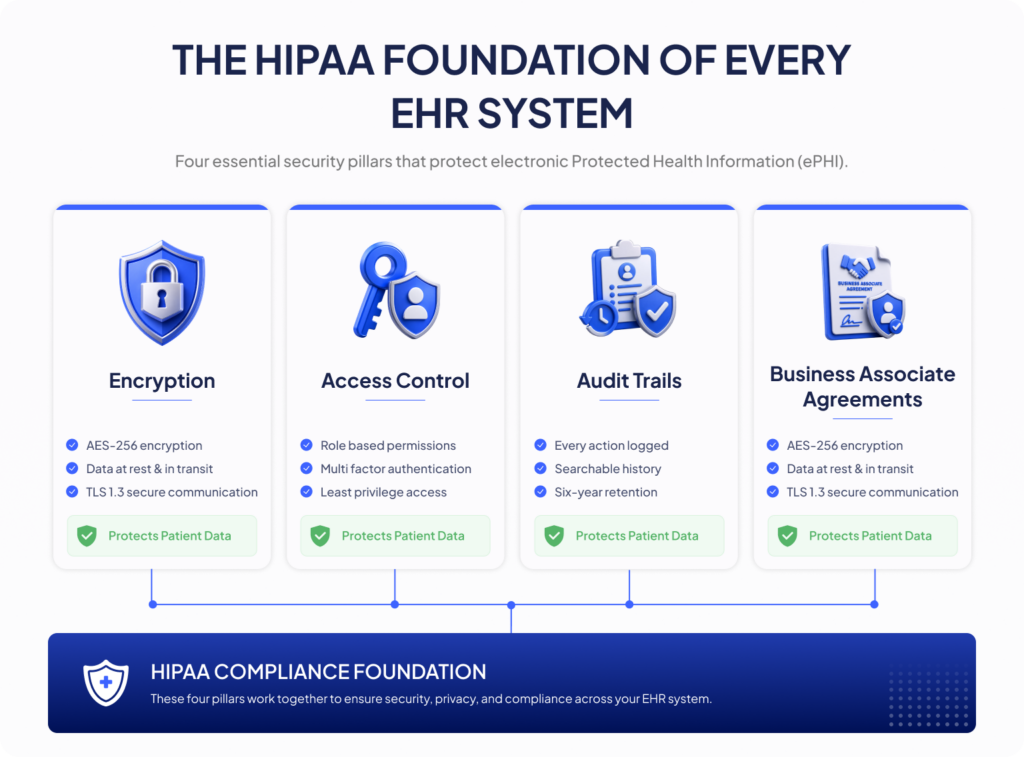
HIPAA lives in four places inside an EHR system. Miss any of them and the software is not compliant, no matter what the vendor pitch says.
1. Encryption
Every byte of PHI must be encrypted at rest and in transit. AES 256 is the baseline. TLS 1.2 minimum for data in motion, though TLS 1.3 is now standard. Anything less will fail an audit.
2. Access Control
Only the right people see the right data. That means role based permissions, multi factor login, forced session timeouts, and least privilege defaults. A receptionist should never see a lab result. A billing clerk should never open a mental health note. Even the CIO should not have blanket access.
3. Audit Trails
Every view, every edit, every print, every export gets logged. Timestamped. Signed. Kept for six years minimum. Auditors will ask. Have the logs ready and searchable.
4. Business Associate Agreements
Every vendor that touches PHI (cloud provider, email service, SMS gateway, analytics tool, AI model API) must sign a BAA. Missing BAAs is one of the top three fine categories every year. Read every contract twice.
Core Requirements for EHR Application Development
Every serious EHR application development project has three requirement buckets: compliance, technical, and functional. Skip one and the whole build wobbles.
Compliance Requirements
- HIPAA (US patient privacy and security)
- HITECH Act (drives EHR adoption and Meaningful Use)
- HL7 v2 and HL7 FHIR R4 (data exchange standards)
- ICD 10 and CPT codes (diagnosis and billing codes)
- ONC ATCB certification (needed for federal incentive payments)
- GDPR (if any EU patients touch the system)
- 21 CFR Part 11 (FDA rule for electronic signatures on clinical trials)
- State laws: California CMIA, Texas HB 300, New York SHIELD Act, and more (covered in the next section)
Technical Requirements
- Cloud hosting on a HIPAA ready platform. AWS, Azure, and Google Cloud all offer BAAs.
- End to end AES 256 encryption on every field of PHI. No exceptions.
- Role based access control across every user role.
- Multi factor authentication for every user, every session.
- Automated backups with a 15 minute Recovery Point Objective.
- Disaster recovery plan with a 4 hour Recovery Time Objective.
- Tamper proof audit logs, searchable and exportable.
- FHIR R4 APIs for external data exchange.
Functional Requirements
- Patient records module (demographics, history, allergies, meds)
- Appointment scheduler with automated reminders
- Electronic prescribing (eRx) with drug interaction alerts
- Lab ordering and results viewer
- Billing and claims module with insurance eligibility checks
- Reporting and analytics dashboard
- Patient portal on web and mobile
- Telehealth integration for video visits
Skip any of these and doctors will hate the software. Doctors who hate the software will not use it. Software that goes unused kills the project. That simple.
State Laws That Also Apply to EHR Systems
HIPAA is the federal floor. Many states pile on top. An EHR system serving multiple states has to clear all of them.
California CMIA (Confidentiality of Medical Information Act)
Stricter than HIPAA on patient consent for data sharing. Violations start at $2,500 per record and climb to $250,000 for willful disclosure. Any EHR system with California patients has to build consent flows that meet CMIA, not just HIPAA.
Texas HB 300
Requires all employees who handle PHI to complete Texas specific training within 90 days of hire. Fines run up to $250,000 per violation. Any EHR system used in Texas needs a training tracker built in.
New York SHIELD Act
Mandates reasonable data security safeguards and defines PHI more broadly than HIPAA. Also requires breach notification within a strict window. An EHR system holding New York records needs SHIELD ready incident response baked in.
Washington My Health My Data Act
New in 2024. Requires opt in consent for collecting consumer health data. Applies to health apps and EHR systems that touch Washington residents. Fines up to $7,500 per violation.
The trap: many EHR systems built for one state get sold or licensed into others without a compliance audit. That is where the fines pile up. Any EHR software development contract should include multi state compliance from day one.
AI in EHR Systems: What Is Real, What Is Hype
Every EHR pitch in 2026 mentions AI. Some of it is real. Some of it is marketing dressed as engineering. Here is the split.
What Is Real
- Ambient scribes that transcribe patient visits into structured notes. AWS HealthScribe, Nuance DAX, and Abridge are shipping today.
- Predictive risk scoring for readmission, sepsis, and no shows. Real models. Real accuracy gains. Real budget lines.
- Automated coding suggestions that speed up billing and cut claim denials by 15 to 20 percent.
- Voice dictation with medical vocabulary. Nuance Dragon Medical still leads. Cloud alternatives are catching up fast.
What Is Hype
- General purpose chatbots grafted onto patient portals. Most fail HIPAA basics on API calls.
- AI that promises to replace clinicians. Not now. Not soon. Not the point.
- Generative AI that writes prescriptions or diagnoses. Regulatory landmine. Do not build this.
The safe AI budget for a mid tier EHR system runs $20,000 to $80,000 per module. The hidden cost is compliance. Every AI vendor that touches PHI has to sign a BAA. Every AI model that ingests PHI has to be documented, audited, and monitored.
For teams planning AI features in an EHR system, start with one narrow use case. Prove it. Then expand. Any team that tries to build ten AI features into an MVP will ship none of them well.
HIPAA Compliant EHR Development Cost (2026 Numbers)
Cost depends on scope. Here is a straight look at what real EHR software development actually runs in 2026, drawn from shipped projects, not vendor rate cards.
Cost by Build Type
| Type of EHR Build | Timeline | Cost Range | Best For |
|---|---|---|---|
| Basic MVP | 4–6 months | $45,000–$85,000 | Small clinics and digital health startups |
| Mid-Tier EHR | 6–10 months | $90,000–$180,000 | Multi-provider practices and telehealth companies |
| Full-Featured Platform | 10–14 months | $180,000–$350,000 | Hospital groups and specialty healthcare networks |
| Enterprise EHR | 14–24 months | $350,000–$2 million+ | Large hospital systems and national healthcare chains |
Cost by Feature Module
A tighter view for teams building an MVP and picking which modules to include first. Costs assume a blended rate of $50 per hour, which sits at the top end of offshore and the bottom end of hybrid US teams.
| Feature Module | Development Hours (Avg.) | Cost Range |
|---|---|---|
| Patient Records Module | 180–260 hours | $9,000–$20,800 |
| Appointment Scheduling | 120–180 hours | $6,000–$14,400 |
| Electronic Prescribing (eRx) | 160–240 hours | $8,000–$19,200 |
| Lab Integration (HL7/FHIR) | 140–220 hours | $7,000–$17,600 |
| Billing & Claims Module | 200–320 hours | $10,000–$25,600 |
| Patient Portal (Web + Mobile) | 240–360 hours | $12,000–$28,800 |
| Telehealth Video Module | 180–280 hours | $9,000–$22,400 |
| Analytics Dashboard | 100–180 hours | $5,000–$14,400 |
| Clinical Decision Support | 140–220 hours | $7,000–$17,600 |
| AI Ambient Scribe Add-on | 320–520 hours | $16,000–$41,600 |
Cost by Role (Hourly Rates)
Team cost drives half of the total budget. Where the team sits changes the math dramatically.
| Role | US Rate (Per Hour) | Offshore Rate (Per Hour) |
|---|---|---|
| Project Manager | $100–$180 | $25–$45 |
| Healthcare Solution Architect | $150–$250 | $40–$70 |
| Backend Developer | $90–$160 | $25–$50 |
| Frontend Developer | $85–$150 | $22–$45 |
| Mobile Developer | $90–$160 | $25–$50 |
| UI/UX Designer | $80–$140 | $22–$40 |
| QA Engineer | $70–$120 | $20–$35 |
| DevOps / Cloud Engineer | $110–$190 | $30–$55 |
| HIPAA Compliance Consultant | $180–$300 | $60–$110 |
Cost by Third Party Integration
Integrations are their own budget line. Do not fold them into feature costs, or the numbers will get ugly halfway through the build.
| Integration Type | One-Time Cost | Annual Maintenance |
|---|---|---|
| Epic FHIR / Carequality | $18,000–$80,000 | $5,000–$15,000 |
| Oracle Health (Cerner) FHIR | $16,000–$60,000 | $4,000–$12,000 |
| Athenahealth API | $10,000–$48,000 | $3,000–$10,000 |
| Surescripts (eRx) | $8,000–$22,000 | $2,000–$6,000 |
| Lab Systems (LabCorp, Quest) | $10,000–$30,000 | $3,000–$8,000 |
| Insurance Eligibility (X12 270/271) | $12,000–$28,000 | $3,500–$9,000 |
| Wearables (Apple HealthKit, Fitbit) | $8,000–$20,000 | $2,500–$6,000 |
What Drives the Total Cost Up
- Feature Scope. Each advanced module adds $10K to $40K.
- Team Location. US teams charge $90 to $200 per hour. India teams charge $25 to $50 per hour for equal quality output.
- Compliance Depth. HIPAA plus HL7 plus FHIR plus ONC certification adds $30K to $80K.
- Data Migration. Moving legacy records costs $10K to $60K, depending on volume and format quality.
- Maintenance. Budget 15 to 25 percent of build cost per year. Forever.
- HIPAA Risk Assessments. $20K to $100K depending on system size. Annual, not one time.
Get a real cost estimate for your EHR project in 24 hours. Book a Free Scoping Call with Auspicious Soft
How Long Does EHR Software Development Actually Take?
An MVP takes 4 to 6 months. A mid tier build takes 6 to 10 months. Enterprise EHR systems take 12 to 24 months.
Timelines stretch when three things happen: scope creep, late compliance review, and messy data migration. Avoid all three by scoping tight, hiring HIPAA counsel in week one, and starting migration audits before development kicks off.
Step by Step: How to Build a HIPAA Compliant EHR System
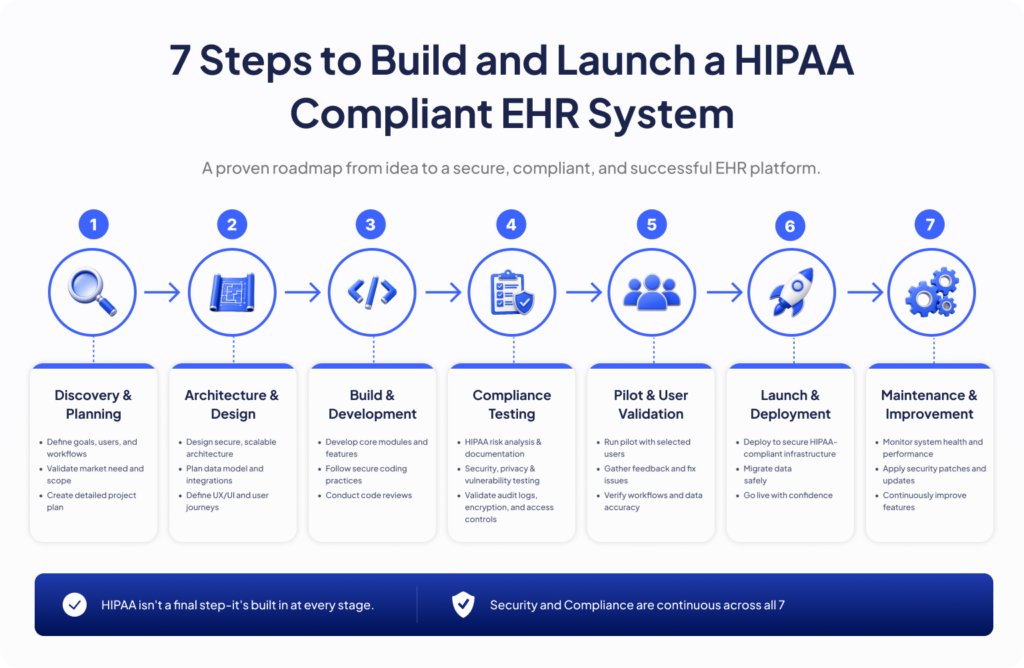
Here is the process a real EHR software development project follows. No fluff. No filler.
Step 1: Discovery and Compliance Audit (2 to 4 weeks)
Map every workflow. List every user role. Identify every piece of PHI the system will touch. Hire a HIPAA consultant now, not later. This step defines the safeguards you will build in the next six months.
Step 2: Architecture and Design (3 to 5 weeks)
Pick the cloud, the database, the API framework. Design the data model so PHI lives in a small, tightly guarded space. Wireframe every screen with doctors and nurses in the room. Their feedback here saves ten times the cost later.
Step 3: MVP Build (12 to 20 weeks)
Build core modules first: patient records, scheduling, electronic prescribing, patient portal. Every commit runs through automated security scans. HIPAA is a design rule, not a QA ticket.
Step 4: Integrations and Compliance Testing (4 to 8 weeks)
Plug in labs, pharmacies, and billing partners. Run penetration tests. Get a HIPAA risk assessment done by an outside auditor. Fix everything the auditor flags. All of it.
Step 5: Pilot With Real Users (4 to 6 weeks)
Launch to one clinic or one department. Watch how doctors actually use it. Fix what breaks. Do not skip this. Every skipped pilot becomes a public failure.
Step 6: Full Launch and Training (2 to 4 weeks)
Roll out clinic by clinic. Train staff in small groups. Keep support on speed dial for the first month. Two months for larger deployments.
Step 7: Ongoing Maintenance and Updates
Monthly security patches. Quarterly compliance reviews. Yearly HIPAA risk assessments. This never stops. Compliance shifts every year and the system has to shift with it.
Tech Stack for EHR Application Development
The wrong stack can lock a project into rework two years in. Here is what actually works in 2026.
| Layer | Recommended Tools & Technologies |
|---|---|
| Frontend Web | React, Next.js, TypeScript, Tailwind CSS |
| Mobile | React Native, Flutter, Swift, Kotlin |
| Backend | Node.js, Python (Django or FastAPI), .NET |
| Database | PostgreSQL (with Row-Level Security), MongoDB, Redis (for caching) |
| Cloud (with BAA) | AWS HIPAA-Eligible Services, Azure Health Data Services, Google Cloud Healthcare API |
| Authentication | Auth0, AWS Cognito, Okta (with Multi-Factor Authentication) |
| Interoperability | HL7 FHIR (HAPI FHIR Server), Redox, 1upHealth, Health Gorilla |
| Analytics | Snowflake, Google BigQuery, Metabase, Amazon HealthLake |
| AI / ML | OpenAI GPT Models (via Azure OpenAI HIPAA), AWS HealthScribe, Google MedLM |
| DevOps | Docker, Kubernetes, Terraform, GitHub Actions |
Pick tools that already have BAAs, audit logs, and encryption at rest. Rolling your own on any of these lines almost always ends badly.
Build vs Buy vs Hybrid: Which Path Fits Your Practice?
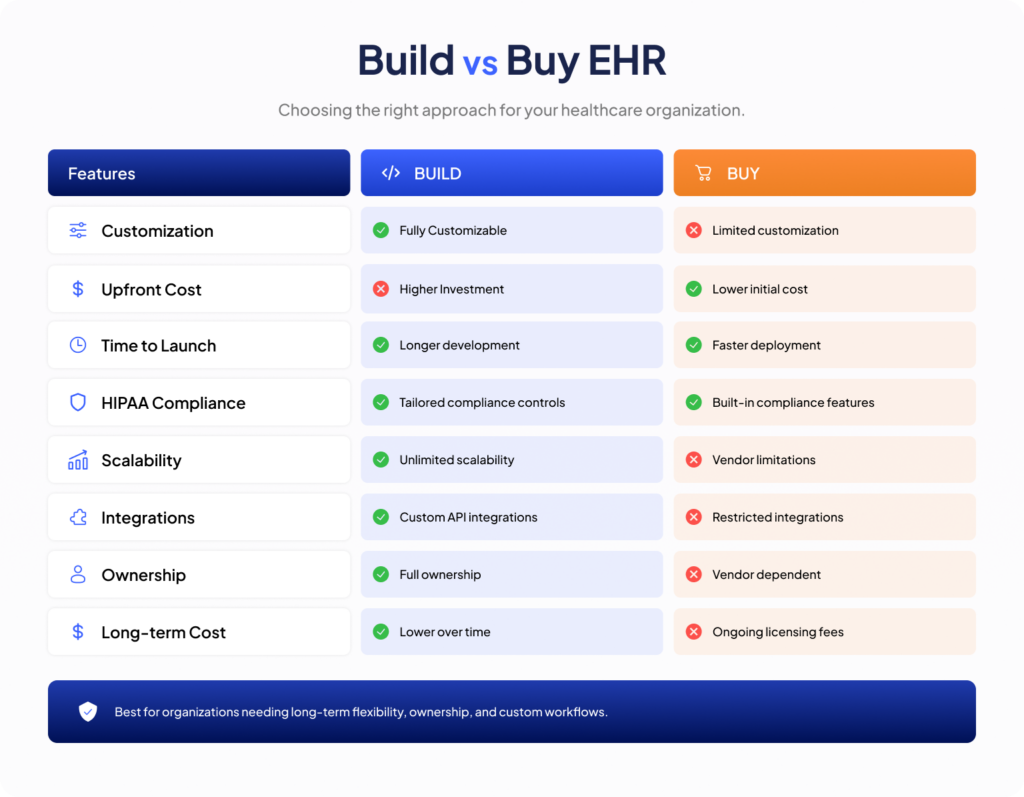
Small clinics under 20 providers usually win with a ready made system like Athenahealth or eClinicalWorks. Setup is fast and cost is predictable.
Startups, specialty groups, and health tech companies that need custom workflows win with a custom EHR system. It costs more upfront but the workflows fit. No vendor lock in. No per seat fees forever. No waiting six months for a feature request that never ships.
A hybrid model also works. Build custom modules on top of a base EHR system through FHIR APIs. Best of both worlds when the budget is tight and the timeline is tighter.
Custom EHR vs Epic vs Cerner vs Athenahealth
Most decision makers weigh custom against one of the big off the shelf vendors. Here is how they stack up in 2026.
The Verdict
- Epic dominates large hospitals with 44 percent of acute care beds. Implementation runs from $500K for mid size deployments up to $1 billion (yes, billion) for systems like Northwell Health.
- Oracle Cerner still holds 22 percent of hospitals but has lost 173 hospitals over five years. Pricing starts around $25 per user per month, with implementation deals in the $250K to $500K range for mid size groups.
- Athenahealth uses a percentage of collections model, usually 2 to 5 percent. Great for small practices. Painful once collections grow past $10 million.
- Custom EHR builds beat all three on total cost of ownership past year three, especially for practices under 200 providers. The upfront investment pays back through zero licensing fees and full customization.
A 10 provider practice using Athenahealth at 3 percent of $4 million in annual collections pays $120,000 every year, forever. A custom EHR system built once for $150,000 pays for itself in 15 months and keeps paying dividends after.
Common Mistakes That Kill EHR Projects
Most EHR software development failures follow the same pattern. Watch for these seven:
1. Treating HIPAA as a Final Step
Retrofitting compliance costs three to four times more than baking it in. Every retrofit means re architecting the database, the API layer, and the logging pipeline all at once.
2. Skipping the Pilot
Big launches without pilots create big public failures. Doctors complain. Nurses revolt. The board gets nervous. Pilot small, fail cheap, learn fast.
3. Ignoring Doctors During Design
If a doctor cannot chart in under 90 seconds, they will not chart. Then the data is bad. Then the software is dead. Involve five clinicians in every design sprint. No exceptions.
4. Choosing the Cheapest Team
A general agency will learn HIPAA on your budget. Every hour of their learning shows up on your invoice. Pick a partner who has already been through this.
5. Underestimating Data Migration
Legacy data is messy. Paper charts, PDFs, spreadsheets, CSV exports from three prior systems. Plan for migration to be its own project with its own timeline and its own budget.
6. Not Signing BAAs
Every vendor touching PHI needs one. Missing BAAs is a top three fine category and one of the easiest to avoid. Read every contract twice.
7. Forgetting Maintenance
Compliance shifts every year. Software that stops updating stops being compliant. Budget for maintenance from day one. Not day 400.
How to Choose an EHR Application Development Partner
Ask these questions before signing anything:
- How many HIPAA compliant projects have they actually shipped?
- Do they have HL7 FHIR engineers on staff, or do they subcontract the hard parts?
- Have they ever passed an ONC certification audit?
- Can they share a HIPAA risk assessment report from a past project?
- What is their post launch support model, month one, year one, year three?
- Will they sign a BAA before any PHI touches their infrastructure?
- Do they carry cyber liability insurance? What are the coverage limits?
A partner who bristles at any of these is the wrong partner. The right one has answers ready and paperwork on file.
Why Auspicious Soft Builds Better EHR Systems
Auspicious Soft has spent over eight years shipping software for healthcare startups, clinics, and hospitals across the US. The team builds HIPAA compliant EHR systems, patient portals, telehealth apps, and medical device integrations from the ground up.
Every project starts with a compliance workshop, not a code sprint. Every build ships with encryption, RBAC, audit logs, and FHIR APIs on day one. Every deliverable comes with documentation an auditor can actually read.
For any medical EHR systems project, from a lean MVP to a full hospital rollout, Auspicious Soft brings the healthcare specific engineering talent to get it launched on time and clear every audit. The team also offers mobile app development, web development, AI and ML development services, and custom API development to round out any healthcare tech stack.
Talk To A Healthcare Engineering Expert
Get an EHR roadmap in 24 hours.Final Thoughts on EHR System Development
A HIPAA compliant EHR system is not a product. It is an ongoing commitment. Every year the rules shift. Every quarter the audit runs. Every month a new vulnerability drops. The teams that succeed treat compliance as a habit, not a phase.
The 2026 to 2027 stretch will be the biggest HIPAA reset in over 20 years. Teams that build to the new bar now avoid the retrofit tax later. Teams that wait pay for it twice.
For any healthcare organization ready to invest in ehr software development that clears audits, moves patient data safely, and scales with the practice, the right partner matters. Auspicious Soft ships EHR systems that doctors use, patients trust, and auditors clear on the first pass.
FAQs
Q1. What does a HIPAA compliant EHR system cost in 2026?
A basic MVP costs $45,000 to $85,000. A mid tier EHR runs $90,000 to $180,000. A full featured platform lands at $180,000 to $350,000. Enterprise systems top $500,000, depending on features, integrations, and the location of the development team.
Q2. How long does EHR software development take?
An MVP takes 4 to 6 months. A mid tier build takes 6 to 10 months. Enterprise EHR systems take 12 to 24 months. Data migration alone eats 6 to 8 weeks in most cases.
Q3. Is HIPAA compliance a one time cost?
No. Plan for annual risk assessments, quarterly audits, and monthly security patches. Ongoing HIPAA compliance runs 15 to 25 percent of the initial build cost every year, forever.
Q4. What are the 2026 HIPAA Security Rule changes?
The 2025 NPRM proposes mandatory MFA, mandatory encryption, formal asset inventories, annual penetration tests, and 24 hour incident response targets. The final rule is delayed to July 2027, but smart teams are building to the new bar today.
Q5. Can EHR systems integrate with wearables?
Yes. Modern EHR application development supports Apple HealthKit, Google Fit, Fitbit, and clinical grade monitors through FHIR APIs. Data flows straight into the patient chart. Budget $8,000 to $20,000 per integration.
Q6. What is the difference between an EHR system and an EMR system?
An EMR is a digital chart used inside one clinic. An EHR is a digital chart that travels between clinics, labs, pharmacies, and specialists. Almost every medical EHR systems build today is an EHR, not an EMR.
Q7. Do I need ONC certification for my EHR system?
Only if you plan to bill for Meaningful Use or MIPS incentive payments. Certification takes 6 to 12 months and costs $30,000 to $80,000, but it opens the door to federal reimbursement programs worth far more.
Q8. Which cloud platform is best for HIPAA compliant EHR development?
AWS, Azure, and Google Cloud all offer HIPAA ready hosting with a signed BAA. AWS holds the biggest healthcare market share. Azure Health Data Services offers the strongest FHIR support out of the box. Google Cloud Healthcare API leads on data analytics tie ins.
Q9. Can AI features be added to an EHR system?
Yes. Common AI additions include ambient clinical documentation, predictive risk scoring, voice dictation, and OCR for scanned records. Each AI module adds $20,000 to $80,000 to the build. Every AI vendor touching PHI has to sign a BAA.
Q10. Should I build a custom EHR or buy a ready made one?
Small clinics usually win with ready made systems. Startups, specialty groups, and health tech companies win with custom EHR builds. Hybrid models work well for mid sized organizations that want both speed and control.
Q11. How do I migrate legacy data into a new EHR system?
Audit the source data first. Map every field. Clean the duplicates. Run a small pilot migration. Then migrate in phases, not all at once. Rushed migrations lose data. Lost data breaks trust. Broken trust kills the launch.
Q12. What certifications should an EHR development partner hold?
Look for teams with HIPAA training, HL7 FHIR certifications, ISO 27001, SOC 2 Type II, and past ONC certified EHR projects. These are the baseline for anyone serious about healthcare software.
Q13. What state laws affect EHR systems beyond HIPAA?
California CMIA, Texas HB 300, New York SHIELD Act, and Washington My Health My Data Act are the biggest. Each has its own consent, training, and breach notification rules. Any EHR system serving multiple states has to meet all of them.
Q14. Is Epic cheaper than a custom EHR system?
Not past year three for practices under 200 providers. Epic implementations start around $500,000 and climb into the tens of millions. Custom EHR builds start at $45,000 and pay back in 15 to 24 months through zero licensing fees and full workflow control.
Q15. What is the fastest way to build a HIPAA compliant EHR system?
Start with an MVP that covers three or four core workflows. Hire a healthcare specialist development partner. Bake HIPAA into the architecture from day one. Pilot with one clinic before wider rollout. Skip any of these and the project slips 3 to 6 months.
Do not Miss Our Latest Tech Insights
Stay one step ahead in the fast-moving world of AI and technology. Add us as a Preferred Source on Google and get our latest articles, guides, and industry insights delivered straight to your search feed.