+1 740 762 6496
 +91 70189 46603

Contact Us
Fitness software development refers to designing and creating digital products targeted at the health and wellness sector. These encompass mobile applications featuring workouts and nutrition, online tools to manage a gym, integration of wearable devices, and a wellness platform used by large corporations. Custom fitness software has numerous applications. A gym management system must include automated billing and a timetable of classes. A wellness brand requires a fitness tracking application to be connected with Apple Watch and Fitbit and provide individualized recommendations on exercises in the long run. Users who interact with personalized fitness platforms will easily become paid members and recommend other users. Health and wellness software can produce quantifiably superior business returns compared to items added with engagement options afterward.
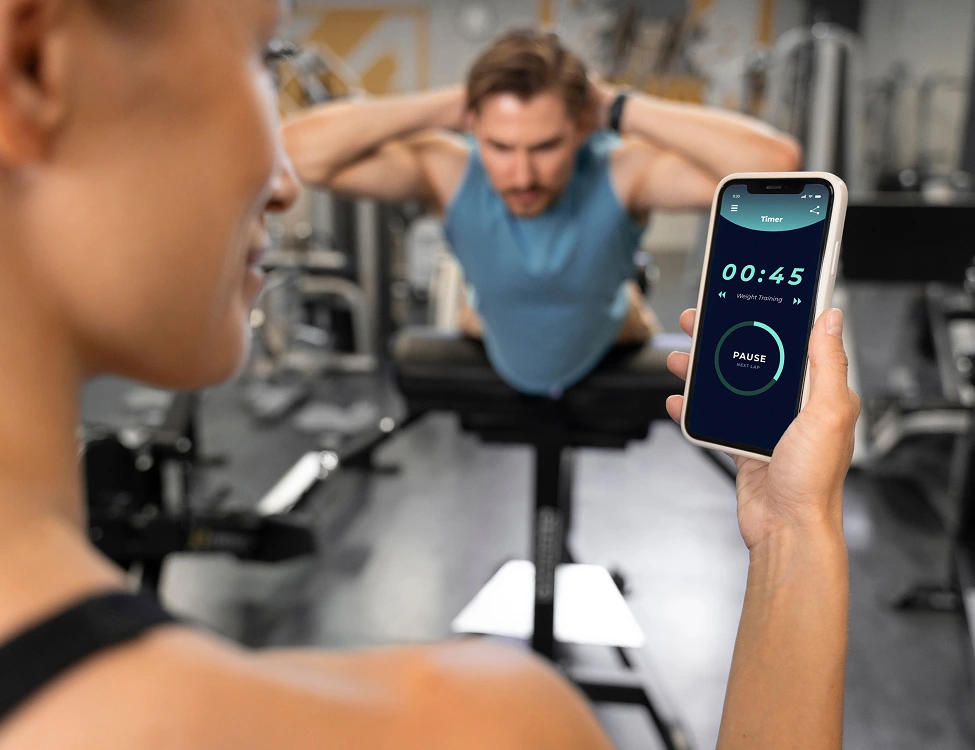
We develop end-to-end solutions in the form of fitness apps, enterprise gym technology, and more, depending on your business model and target audience. Each of the products we ship is designed based on real-world user behavior, rather than a feature checklist.
We create scalable fitness platforms that drive engagement, streamline operations, and support long-term growth.

We design and develop high-performance fitness apps for iOS and Android, covering the full spectrum of health and wellness use cases. Our approach balances cost-efficiency with performance by combining cross-platform and native technologies.
We build powerful web platforms and backend systems that help fitness businesses manage operations, users, and growth efficiently — all in one ecosystem.
We build advanced backend systems and management software that power fitness businesses and enable seamless scalability.
We choose technologies because they fit the specifications of a particular project, not because they are easy for us. All our recommended stacks are scalable, HIPAA-compatible (where needed), & designed to be long-term maintainable.
We build engaging fitness interfaces using React, Flutter, Swift, Kotlin, and Next.js, delivering quick-log workout flows and progress dashboards across web and mobile.
React
Flutter
Swift
Kotlin
Next.js
Our engineers build scalable fitness backends using Node.js, Django, FastAPI, Python, and Ruby on Rails, powering memberships, billing, live streaming, and reliable data sync.
Node.js
Django/FastAPI
Python
Ruby on Rails
We manage fitness data using MongoDB, PostgreSQL, and Redis, ensuring secure storage of workouts and health metrics, fast queries, and reliable real-time performance.
MongoDB
PostgreSQL
Redis
We deploy scalable fitness platforms on AWS, Google Cloud, and Azure, ensuring high availability, secure health-data storage, and reliable infrastructure for live streaming at scale.
AWS
Google Cloud
Azure
We integrate wearables using Apple HealthKit, Google Fit, Fitbit API, and Garmin Connect, syncing heart rate, steps, sleep, and calories accurately across major devices.
Apple HealthKit
Google Fit
Fitbit API
Garmin Connect
We embed fitness AI using TensorFlow Lite, OpenAI API, and custom ML models, delivering personalized workout plans, adaptive coaching, and dynamic training recommendations that evolve.
TensorFlow Lite
OpenAI API
Custom ML Models
We secure fitness apps using AES-256 encryption, OAuth2 authentication, and HIPAA-compliant cloud storage, protecting sensitive health data at rest and in transit by default.
AES-256 Encryption
OAuth2
HIPAA-Compliant Cloud Storage
Understanding fitness app development cost upfront assists founders and product managers in making better building choices. This is a broad range since no other factor influences cost more than the complexity of the project. An easy-to-use calorie tracker and a computer-based enterprise wellness program are entirely different engineering problems. How much does fitness software cost, depending on the complexity of features, any additional features such as HealthKit or Fitbit API, compliance requirements (such as HIPAA), the number of platforms it is meant to serve, & whether it has AI or live streaming features? Get a free, project-specific estimate by calling us.
| Project Type | Estimated Range | Timeline |
|---|---|---|
| Simple Fitness Tracking App | $15,000–$40,000 | 2–4 months |
| Mid-Level Gym Management App | $40,000–$80,000 | 4–7 months |
| Enterprise Wellness Platform | $80,000–$200,000+ | 7–12 months |
| Wearable-Integrated Fitness App | $30,000–$70,000 | 3–6 months |
We have a strong process, which is clear and transparent and keeps you informed and involved until the point of launch. Our intuitive UI/UX designs are then developed in an agile manner, with wearable integrations.

We start by knowing the business goals, who will use it, and what problem your product solves. This stage involves NDA signing, competitive analysis, feature selection, and tech stack. We do a project scope document formally with an estimated timeline before the development.

Our designers create wireframes & user journey maps that are specific to the fitness-oriented UX pattern, such as quick-log workout flows & progress dashboards. We create Figma prototypes, which are tested on real users, & then development begins to ensure the result is based on real behavior as opposed to assumptions.

Agile fitness app development operates as a sprint (two weeks) with weekly demos and open access directly to clients. We will rely on Git version control, CI/CD pipelines, and wearables APIs (like HealthKit and Fitbit) as and when that sprint is active, such that integration issues are identified earlier.

We test on machines and operating systems manually and automatically. Performance testing includes load cases such as live simultaneous classes streaming. Yet, security audits and checks regarding HIPAA compliance are carried out before any release is offered to the App Store or Google Play.

After the launch, we will implement new features according to relevant feedback, watch the performance reports, and address bugs on the monthly retention or project-related contracts. Recurring maintenance typically costs 15-20% of initial development costs annually and encompasses OS updates, security patches, and compatibility with third parties through APIs.

We facilitate the submission of App Store and Google Play, comply with review, and provide go-live services within the first 30 days after the launch. The support schemes offered by SLA are: issue critical response, monitor alert systems and special channels in the post launch period.

Fitness apps store some of the most personal information that users provide to any digital product like the heart rate, sleep patterns, health conditions, and location. It takes more than good intentions to build such trust. It demands architecture that is first line compliant. Our standard data handling procedures include HIPAA-compliant data processing, AES-256 encryption, and OAuth2 authentication when handling a fitness project involving health data. To platforms used by youth users, COPPA requirements influence feature design and policies regarding data collection since the discovery stage.


Auspicious Soft is an experienced fitness app development company and has provided 50+ projects in the professional field of fitness, health, and wellness. Our team is familiar with retention issues, monetization business plans, and regulatory needs that characterize the US market of fitness technologies.

Native Apple HealthKit, Google Fit, Fitbit API, Garmin Connect, and Whoop are built as part of our core offering, not an add-on. Our wearables are designed into the system as part of the system instead of being added like bolts after launch. We accurately and reliably sync heart rate, steps, sleep, calories, and HRV to all major platforms.

We have a team that operates on US business hours (EST, PST). You also receive immediate feedback without the delays caused by asynchronous communication experienced by offshore-only teams. This is not a cosmetic but a working benefit to US founders and product managers who are going to run fast-moving projects.

We provide fixed-scope contracts with clear milestones and no billing surprises. The startup founders have certainty on the budget at the very beginning. All deliverables are specified prior to the onset of development, and change processes of scope are clear and agreed in advance.

Customers communicate directly with the lead engineers, but not account managers. The quicker decisions are made, the better the products. When a technical query arises, the person creating it responds, as opposed to an overview being relayed via a series of project management filters.
Auspicious Soft is an expert fitness technology partner, rather than an ordinary development shop that just makes anything. We provide the US-timezone coverage, an extensive understanding of the fitness domain, and intrinsic access to developers, which eliminates the communication layers slowing other engagements.

The cost of building a customized fitness app ranges between $15,000 for a basic app and $200,000 for a wellness enterprise solution. Mid-level applications with integrations and artificial intelligence may cost between $40,000 to 80,000. The cost factors involve a number of platforms, wearable integrations, AI features, live streaming, and compliance requirements. Request a free quote of a project.
A good fitness tracking app should include workout logs, progress charts and analytics, wearable device connection, push notifications, share your activity, nutrition tracker and barcode scanner, coach or trainer portal and in-app payments. These features drive the day-to-day interaction that spans the long-term and retention with users.
Basic fitness applications require 2-4 months. Mid-level gym management applications (scheduling, billing, and member management) require 4-7 months. AI-based enterprise wellness solutions that include wearables and live streaming require 7-12 months. Timelines are prolonged in case of compliance work, training of the custom AI model, or involved third-party integrations.
Yes. We are in accord with Apple HealthKit, Google Fit, Fitbit API, Garmin Connect, and Whoop. These types of data can be synced: heart rate, steps, sleep patterns, calories burned, and heart rate variability. Integrations in wearables are implemented into the architecture, not as an addition on launch.
We use AES-256 to encrypt our data at rest and transit, as well as OAuth2 to authenticate users and use role-based access control, and our cloud-based storage is HIPAA-compatible with regular security audits by third parties. In scenarios where such applications are used with safeguarded medical data, the architecture choices during the discovery phase are affected by the compliance policies, as opposed to the testing phase.
An app for fitness is consumer-facing; it assists the users in tracking their workouts, their coaching programs, and their health indicators. A gym management system is a B2B application that provides scheduling, billing, staff administration, member lifecycle, and business reporting. It is necessary in many successful fitness businesses, and we create integrated solutions that unite the two.
We use ML models that were trained on user workout history to produce adaptive plans that vary intensity according to progress, fatigue, and feedback. MediaPipe is also used as a means of computer vision to correct forms in real-time via the smartphone camera. The OpenAI API integration solves questions, creates plans, and provides individualized motivation, depending on the history of each user.
Ongoing maintenance typically runs 15–20% of the initial development cost per year. For a $50,000 app, that means roughly $7,500–$10,000 annually covering OS compatibility updates, bug fixes, security patches, server costs, and API maintenance. First-year maintenance can run higher due to post-launch iteration frequency.
Yes. We integrate barcode scanning, the USDA nutrition database, MyFitnessPal API, and macro tracking into fitness platforms. Meal plan builders, dietitian portals, and AI-generated nutrition recommendations adjust based on workout data and caloric expenditure from wearables. These can be integrated into a well-architected fitness platform.