+1 740 762 6496
 +91 70189 46603

Contact Us
We build AI that ships to production, not demos that die in a slide deck. Custom AI agents, LLM and RAG systems, and copilots, engineered for real results inside your business. Auspicious Soft is a generative AI development company that builds systems your business actually runs on. Our Generative AI Development Services cover custom AI agents, LLM and RAG systems, chatbots, and copilots, all engineered for production. If you want generative AI development services in USA backed by a full-scale AI and ML development team that deliver real returns instead of a slick demo, you are in the right place.
Generative AI development is the practice of building custom AI systems that produce content, answers or actions from your own business data. It covers fine-tuned models, AI agents, RAG pipelines, chatbots and copilots, each scoped to a specific business outcome rather than a general capability. They need AI that runs inside daily work and pays for itself. That is what we build. Every system is engineered for production, security, and real return, not for a screenshot.
Give your business a digital worker. Our AI agents handle tasks, follow your workflows, and make decisions on their own. They clear the busywork and free your team for the work that actually moves the needle. Learn how to build custom AI agents for your business.
Generic models guess. Yours will not. We build custom LLM and Retrieval Augmented Generation systems that read your private data and answer with facts, not made up filler. Right answers, pulled from your own knowledge. See our full breakdown of RAG implementation costs and architecture.
Not a clunky bot with canned replies. We build intent aware chatbots and copilots that understand context, hold a real conversation, and truly help your customers and your staff.
Your AI should plug into what you already run. We connect generative AI to your CRM, ERP, and internal tools through clean API development, with no hit to your security or performance.
Turn images, video, and documents into data you can use. Our AI and ML development team builds vision systems that read, sort, and flag content far faster than any manual process.
Not sure where AI fits? Start here. We audit your workflows, find the highest value use cases, and hand you a clear build plan with real numbers attached.

AI Agent Development
Give your business a digital worker. Our AI agents handle tasks, follow your workflows, and make decisions on their own. They clear the busywork and free your team for the work that actually moves the needle. Learn how to build custom AI agents for your business.
Custom LLM and RAG Development
Generic models guess. Yours will not. We build custom LLM and Retrieval Augmented Generation systems that read your private data and answer with facts, not made up filler. Right answers, pulled from your own knowledge. See our full breakdown of RAG implementation costs and architecture.
AI Chatbot and Copilot Development
Not a clunky bot with canned replies. We build intent aware chatbots and copilots that understand context, hold a real conversation, and truly help your customers and your staff.
AI Integration Services
Your AI should plug into what you already run. We connect generative AI to your CRM, ERP, and internal tools through clean API development, with no hit to your security or performance.
Computer Vision and Automation
Turn images, video, and documents into data you can use. Our AI and ML development team builds vision systems that read, sort, and flag content far faster than any manual process.
Generative AI Consulting
Not sure where AI fits? Start here. We audit your workflows, find the highest value use cases, and hand you a clear build plan with real numbers attached.Plenty of firms will sell you AI. Few will ship something that lasts. Here is the gap.

Most generative AI projects stall at the demo stage. We engineer every system for live traffic, real users, and production-grade reliability from sprint one. Over 200 apps in production and counting.
Your data powers your AI, so we lock it down before we write a single line of code. Every generative AI system ships with encryption, role-based access, and MFA baked in, not bolted on after the fact.
We run on US time zones, hold standups when your day starts, and staff a Los Angeles office for face-to-face when you need it. Our generative AI development services are built around how American companies actually work.
No juniors learning on your project. Every engineer on your build has shipped production AI systems before, across LLMs, RAG pipelines, and agent frameworks. You get experience, not experiments.
Every model, every line of code, every dataset we touch stays yours. Full IP transfer on delivery, no licensing traps, no vendor lock-in. Walk away with a system you control completely.
We back every claim with shipped work you can see. Our case studies include real metrics, real clients, and real production systems, not mockups dressed up as results.
A solid process is why AI projects ship instead of stall. Here is how we take you from idea to live system.
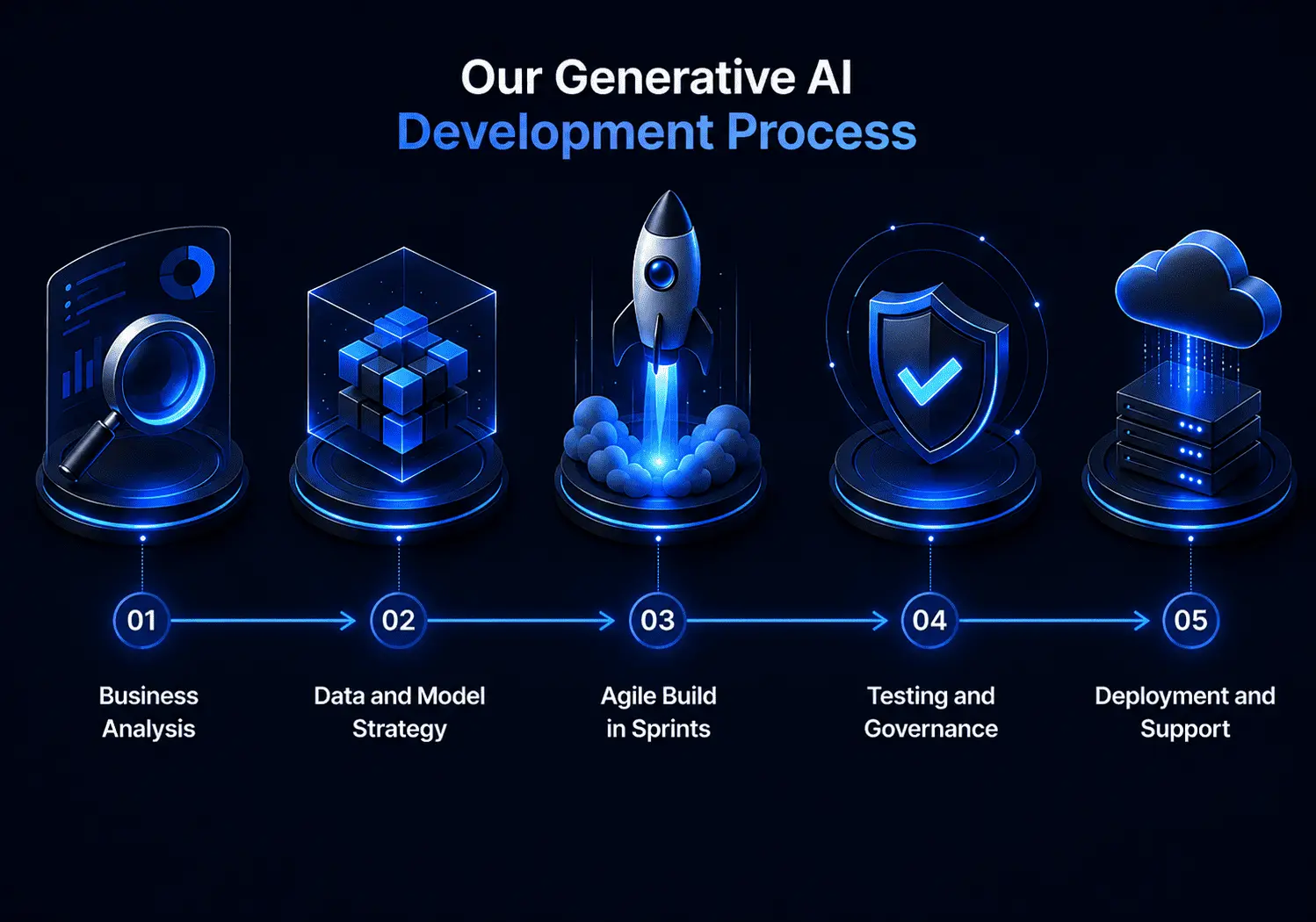
We start with your problem, not the tech. We map the workflow, set the goal, and cut any feature that does not earn its place.
We choose the right model and plan your data. Sometimes that means a custom build. Sometimes fine tuning wins. We pick what serves the result, not the buzzword.
You see progress every sprint. Short cycles, steady demos, and your feedback shape the product as it grows. No black box, no shock at the finish.
We test for accuracy, add guardrails, and review outputs before anything goes live. Your AI behaves the way it should, every single time.
We deploy to production on your cloud, then stick around. Monitoring, updates, and support keep the system sharp long after launch. This is where our custom software development discipline earns its keep. Here is a realistic look at how long AI development takes by project type.
We design for the rules your industry lives by, including HIPAA for healthcare, SOC 2 for enterprise, and PCI for payments. Your models stay private. Your data stays yours. Your compliance team stays calm. That is the standard behind every one of our generative AI development services in USA.

Every industry runs on different rules, data, and workflows. We build generative AI systems tailored to your sector's compliance requirements, operational challenges, and growth goals — so your AI works the way your business actually does.





We build custom generative AI solutions for businesses with unique workflows and compliance needs.
We build on tools you can trust at scale. Our teams work across the leading language models and deploy on AWS, Google Cloud, and Microsoft Azure. Whatever your stack looks like, our AI fits into it, not the other way around.

GPT

Claude

Gemini

Mistral

LlamaIndex

Langchain

Hugging Face

Pinecone

Weaviate

AWS

Google Cloud

Microsoft Azure
The honest answer is that it depends on scope. A small proof of concept costs far less than a full enterprise platform. Here are typical ranges to plan around.
Practical thinking on generative AI development — from build timelines and compliance to LLM architecture decisions. Written by the team that ships these systems, not by people who just write about them.
Generative AI development is the work of building custom AI systems that create content, answers, or actions from your data. It covers custom models, AI agents, chatbots, and RAG systems, all built for a specific business goal.
They cover use case discovery, model choice or fine tuning, RAG and data setup, agent and chatbot builds, integration with your tools, security and governance, and deployment to production with ongoing support.
A proof of concept runs six to ten weeks. A full production system takes three to five months. An enterprise platform with compliance and legacy integration runs six to twelve months, depending on scope, data and integrations.
Both. We use, fine tune, or build models based on what gets you the best result for the lowest cost. The goal drives the choice, not the hype.
Every build includes encryption, access controls, and multi factor authentication. We follow your industry rules, such as HIPAA, SOC 2, or PCI, and your data is never used to train public models.
A proof of concept runs $15,000 to $35,000. A production AI system runs $40,000 to $90,000. An enterprise AI platform starts at $100,000 and runs to $250,000 or more. The final number depends on scope, integrations, and compliance.
Yes. We connect AI to your CRM, ERP, and internal tools through secure APIs, with no disruption to the systems you already run.
Yes. We have a US office, work in US time zones, and have delivered software for startups and enterprises across the country.
Traditional AI analyzes data and makes predictions based on rules, like fraud detection or spam filters. Generative AI creates new content, code, or decisions by learning patterns from large datasets. In development terms, traditional AI classifies what exists, while generative AI produces what does not exist yet. Learn more about how we apply both in our AI and ML development services.
Generative AI reduces manual work, speeds up decision making, and scales operations without scaling headcount. US businesses use it to automate customer support, generate content, streamline internal workflows, and build smarter products. Companies that adopt it early gain a measurable edge in efficiency, cost savings, and customer experience.
Healthcare, fintech, retail, logistics, education, and manufacturing see the highest returns from generative AI. Healthcare uses it for documentation and triage automation. Fintech applies it to fraud detection and risk scoring. Retail leverages it for personalized recommendations and dynamic pricing. Each industry benefits differently based on its data and workflows.
RAG stands for Retrieval Augmented Generation. It connects a large language model to your private data so it retrieves real facts before generating a response. This eliminates hallucinations and ensures answers come from your own documents, databases, or knowledge base rather than the model’s general training data. We break this down in detail in our RAG implementation cost guide.
A chatbot answers questions in a conversation. An AI agent goes further. It takes actions, follows multi-step workflows, makes decisions, and completes tasks on its own. Think of a chatbot as a help desk and an AI agent as a digital employee that can actually do the work. See our guide on how to build custom AI agents for your business.
Look for a company that has shipped production AI systems, not just demos. Check for experience with your industry, ask about their security and compliance practices, review real case studies with measurable results, and confirm they use senior engineers rather than outsourcing to junior teams.
AI guardrails are rules and filters that prevent a generative AI system from producing harmful, inaccurate, or off brand outputs. They include content moderation, output validation, toxicity filters, and human review triggers. Without guardrails, AI systems can hallucinate, expose sensitive data, or give users incorrect information at scale. Learn how generative AI is shaping the future of custom software development.
Fine tuning trains a language model on your specific data so it learns your domain permanently. RAG retrieves your data at query time and feeds it to the model as context. Fine tuning changes the model itself. RAG keeps the base model intact and grounds it with live data. Most production systems use both. Read our complete LLM app development and generative AI guide for a deeper breakdown.
A typical generative AI stack includes foundation models like GPT, Claude, Gemini, or Mistral. Frameworks such as LangChain, LlamaIndex, and Hugging Face handle orchestration. Vector databases like Pinecone or Weaviate power RAG retrieval. Deployment runs on AWS, Google Cloud, or Azure with monitoring tools for model performance and drift. See our full AI and ML development cost breakdown to understand what powers these builds.
Yes. Generative AI systems can be designed for HIPAA, SOC 2, PCI, and GDPR compliance from the ground up. This requires encrypted data pipelines, role based access controls, audit logging, private model hosting, and ensuring no patient or user data is sent to public model APIs. We cover this in depth in our guide to HIPAA compliant AI development.