+1 740 762 6496
 +91 70189 46603


TABLE OF CONTENT
- Want a real price for your travel app, not a guess?
- What Changes the Travel App Development Cost in 2026
- Travel App Development Cost by App Type
- GDS Integration Cost: Amadeus, Sabre and Travelport
- Booking Engine Cost
- OTA App Pricing: Why a Full Platform Costs More
- Real Project Snapshot: The Evolution35 Travel App
- Travel App Cost by Module
- Features That Quietly Push the Price Up
- Team and Place: How Much It Moves the Bill
- Hidden Costs People Forget
- How to Cut Travel App Development Cost Without Cutting Corners
- FAQs
Overview
- Travel app development cost in 2026 runs from about $35,000 for a simple guide app to $250,000 or more for a full OTA platform.
- This guide breaks the price down three ways: by app type, by module, and by team location.
- It shows what a GDS link with Amadeus, Sabre or Travelport really adds, why the booking engine and the back office eat most of the budget, and how a cross platform build can cut the bill by 30 to 40 percent.
- It closes with plain ways to spend less, a real travel app the team shipped, and answers to the questions buyers ask most.
Travel app development cost in 2026 sits between $35,000 and $250,000 or more. A simple guide app costs $35,000 to $80,000. A booking app for flights or hotels runs $80,000 to $150,000. A full OTA platform with GDS, live payments and an admin panel costs $150,000 and up.
Here is the part most price guides skip. The number is not set by the screens you see. It is set by what sits behind them.
What Changes the Travel App Development Cost in 2026
Four things move the price. The rest is detail.
- App type. A guide app is cheap. A booking app is not. An OTA platform is the big one.
- Add ons. GDS, flight APIs, hotel feeds, maps and payment tools each add hours.
- Features. Live prices, refunds and many currencies cost more than they look.
- Team and place. The same app can cost three times more in one country than another.
That is the whole story. The trick is to know where each dollar goes. Then you do not pay for things your users never touch.
Travel App Development Cost by App Type
Pick the row that matches your idea. These are full build ranges, from design to launch, for 2026.
| App Type | What It Does | Cost Range | Rough Timeline |
|---|---|---|---|
| Travel Guide/Planner | Tips, Maps, Saved Trips, No Live Booking | $35,000 To $80,000 | 2 To 4 Months |
| Single Service Booking App | Flights Only, or Hotels Only | $80,000 To $150,000 | 4 To 7 Months |
| Full OTA Platform | Flights, Hotels, Cars, Payments, Admin Panel | $150,000 To $250,000+ | 7 To 12 Months |
See the jump from row two to row three? That gap is not the user app. It is the partner links and the admin side. More on that below.
GDS Integration Cost: Amadeus, Sabre and Travelport
A GDS is the pipe that feeds your app live flight and hotel content. The three big names are Amadeus, Sabre and Travelport. They hold huge stock. They also bring setup work, deals and a fee per booking.
Here is the honest take from building these apps. Most teams reach for a full GDS far too soon. The budget pays for it.
A direct GDS link adds about $20,000 to $60,000 in build work alone. That is before the segment fees and deal terms. Those are set by contract. They often hide behind paperwork.
There is a lighter road for launch. Newer flight APIs like Duffel and other tools sit on top of the same content. They start cheap. They charge per booking. They skip most of the heavy setup. You can move to a direct GDS later, once your volume earns it.
| Content Option | Best For | Cost Impact |
|---|---|---|
| Amadeus | Wide Global Flight and Hotel Stock | High Setup, Segment Fees |
| Sabre | Strong Air Content, Big in North America | High Setup, Segment Fees |
| Travelport | Mixed Air, Hotel and Car Content | High Setup, Segment Fees |
| Lighter APIs (Duffel and Others) | Fast Launch, Low Upfront Cost | Low Setup, Fee Per Booking |
Opinion, plain and simple: start light. Prove people book. Then move to a GDS when the math works.

Want A Real Price For Your Travel App, Not A Guess?
Get a free 24 hour estimate built around your features and add ons.Booking Engine Cost
The booking engine is the brain. It runs search, holds a seat or room, takes the payment, and deals with a cancel or refund. It is also where most of the real money goes.
Plan $25,000 to $70,000 for a strong booking engine. The range is wide for a reason. A flow that books one thing is simple. A flow that mixes flights, hotels and cars, with rules for each, is a whole other beast.
A weak booking engine shows up later. Failed payments. Double bookings. Angry reviews. This is the wrong place to cut.
OTA App Pricing: Why a Full Platform Costs More
OTA stands for Online Travel Agency. Think Booking.com or Make My Trip. Users see a clean app. The cost lives in the parts they never open.
An OTA platform needs a back office. Someone has to load listings, set prices, manage agents, watch refunds and read reports. That back office can cost as much as the user app. Sometimes more.
So when an OTA quote looks high, check the admin side. That is where the hours hide.
Real Project Snapshot: The Evolution35 Travel App
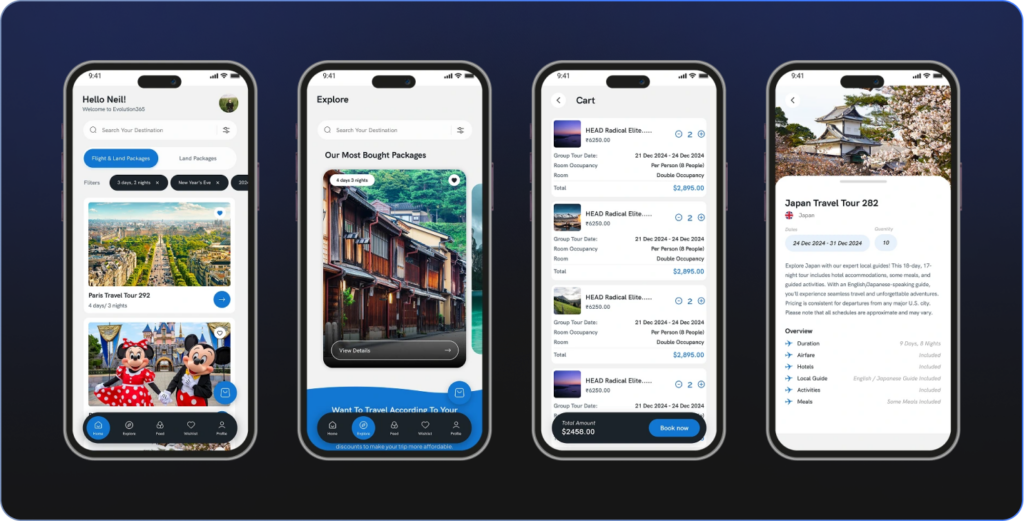
Auspicious Soft built the Evolution35 travel app, a full travel booking platform for flights, hotels and custom trips. The mobile app runs on React Native. The web store runs on Shopify. It is live on the App Store today.
Here is where the cost went, and it matches the table above. The heavy parts were the booking flow and the live flight and hotel feed. Not the screens. The team also fixed four real problems: a booking path with too many steps, a clunky jump between phone and desktop, almost no custom trip options, and a slow old platform.
The fixes were plain. A shorter booking path. One smooth ride across phone and web. Real custom trips users could shape on their own. A modern build that loads fast. After launch, Evolution35 saw higher mobile retention, more booking intent and a stronger brand. Its CEO called the team versatile, quick and easy to work with.
The big lesson sits right in your budget. Building cross platform with React Native stopped two separate app builds from becoming one giant bill. That single call is why a project like this lands in the mid range, not at the top.
Travel App Cost by Module
Want the price split into parts? Here is how a travel booking app breaks down in 2026.
| Module | What It Does | Cost Range |
|---|---|---|
| User App | Search, Profiles, Trip Screens, UI | $15,000 To $35,000 |
| Booking Engine | Search, Hold, Book, Cancel, Refund | $25,000 To $70,000 |
| GDS or Partner Feed | Live Fares and Stock | $20,000 To $60,000 |
| Payments and Refunds | Cards, Wallets, Many Currencies | $8,000 To $20,000 |
| Admin and Partner Panel | Listings, Prices, Agents, Reports | $20,000 To $45,000 |
| Maps, Push and Chat Help | Location, Alerts, Support | $10,000 To $25,000 |
Features That Quietly Push the Price Up
Some features look small and bill big. Watch these:
- Live prices and open seats. Prices shift by the second. Keeping the app in sync is hard work.
- Refunds and cancels. The rules change per airline and per hotel. Each one is logic to write.
- Many currencies and languages. Great for global reach. Heavy on testing.
- AI trip tips. Nice to have. Costly to do well.
None are wrong. Just know the cost before you say yes.
Team and Place: How Much It Moves the Bill
The same travel app can cost very different amounts. It depends on who builds it and where
| Region | Typical Hourly Rate | Notes |
|---|---|---|
| North America | $100 To $200 | Highest Cost |
| Western Europe | $80 To $160 | Highest Cost |
| Eastern Europe | $40 To $90 | Strong Value |
| India and South Asia | $25 To $60 | Best Value, Deep Talent Pool |
A word of care. The cheapest quote is often the priciest app once you count the rework. Pick a team by what they have shipped, not just by the rate. An app that books real money for real people is not the place for a learning project.
Hidden Costs People Forget
The build is not the end of the spend. Plan for these from day one.
- Upkeep. Plan 15 to 20 percent of the build cost each year. Apps break when phones and APIs change.
- Payment fees. Tools like Stripe take about 2 to 3 percent per sale.
- Safety and rules. Card data means PCI DSS rules. Skip this and you lose trust fast.
- Outside fees. GDS booking fees, map calls and texts each carry their own bill.
- Hosting. More users means a bigger server bill.
How to Cut Travel App Development Cost Without Cutting Corners
You can spend less and still ship something good. Here is the plan that works.
- Go cross platform. One codebase for iOS and Android saves 30 to 40 percent. See the real math in this guide to React Native app development cost. Or weigh it against native iOS app development.
- Launch an MVP. One core flow. One service. Get it live, learn from real bookings, then grow.
- Use lighter APIs first. Skip the GDS setup until your volume earns it.
- Cut the flashy extras. AR rooms, loyalty tiers and social feeds can wait for version two.
- Plan upkeep early. A small monthly budget beats a giant rescue bill later.
A tight first version costs less. It ships sooner. And it tells you what your users truly want. That last part is worth more than any feature list.
Want A Real Price For Your Travel App, Not A Guess?
Get a free 24 hour estimate built around your features and add ons.FAQs
Q: How much does it cost to build a travel app in 2026?
Between $35,000 and $250,000 or more. A basic guide app is $35,000 to $80,000. A booking app is $80,000 to $150,000. A full OTA platform is $150,000 and up.
Q: How much does GDS integration cost?
A direct GDS link adds $20,000 to $60,000 in build work. On top of that come booking fees set by your deal. Lighter APIs cost far less to start.
Q: Do I need a GDS for my travel app?
Not at launch. Most apps start fine with lighter APIs. They move to a direct GDS later, once bookings make the fees worth it.
Q: What is the cheapest way to build a travel booking app?
Build a cross platform MVP with one core flow. Use a light API instead of a GDS. Skip extra features until people prove they book.
Q: What is an OTA platform and why does it cost more?
OTA means Online Travel Agency, like Booking.com. It costs more due to the back office behind the app. That is where prices, listings and refunds get managed.
Q: How long does it take to build a travel app?
A simple app takes 2 to 4 months. A booking app takes 4 to 7 months. A full OTA platform takes 7 to 12 months.
Q: How much does it cost to maintain a travel app?
Plan 15 to 20 percent of the build cost each year. That covers updates, fixes and changes when phones and APIs update.
Q: Native or cross platform for a travel app?
Cross platform for most. It cuts cost by 30 to 40 percent and ships both stores from one codebase. Go native only when you need very heavy speed on the device.
Do not Miss Our Latest Tech Insights
Stay one step ahead in the fast-moving world of AI and technology. Add us as a Preferred Source on Google and get our latest articles, guides, and industry insights delivered straight to your search feed.