+1 740 762 6496
 +91 70189 46603


TABLE OF CONTENT
- AI Development Timeline By Project Type (2026)
- The Part Most Guides Skip: Your Data Sets The Date
- What Really Happens In An AI Project
- Chatbot Development Time
- Custom Machine Learning Model Timeline
- Computer Vision And Generative AI Timeline
- Enterprise AI Development Time
- AI Agent Development Timeline
- What Makes AI Development Faster Or Slower
- What A Real AI Quote Should Include
- Ship An AI MVP First
- Why Teams Pick Auspicious Soft For AI
- How To Keep Your AI Project On Time
- FAQs
Overview
- AI development in 2026 takes anywhere from 4 weeks to 12 months, driven mainly by project type and data readiness.
- Timeline by type: a simple chatbot ships in 4 to 10 weeks, a custom machine learning model takes 3 to 5 months, and a full enterprise AI platform runs 6 to 12 months or longer. Computer vision and generative AI products fall in the 4-to-9-month range; a model built from scratch can take 12 to 24 months.
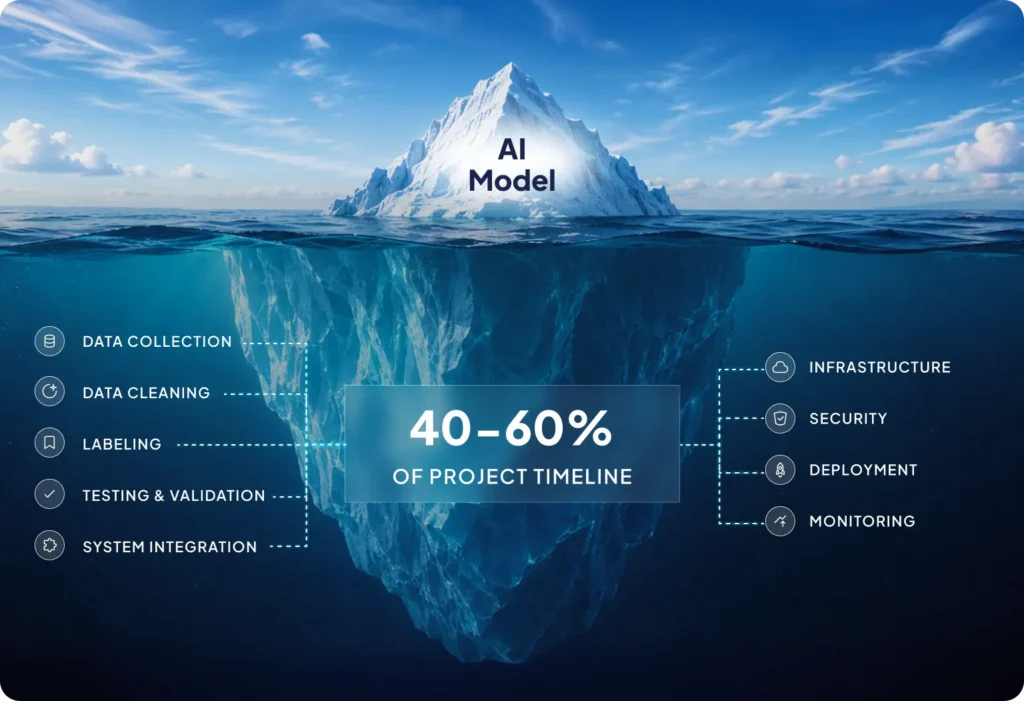
- Data preparation alone consumes 40 to 60 percent of the whole project — clean, organized data is the single biggest factor in speed.
- An AI project moves through seven stages, but only two actually touch the model; most time goes to data, testing, and integration.
- Factors that speed things up: clean data, a fixed scope, proven foundation models, and fast approvals.
- The article recommends shipping a focused MVP first, then scaling.
AI summary:
AI development timelines in 2026 are driven by project type and data readiness. Simple chatbots take 4 to 10 weeks. Custom machine learning models take 3 to 5 months. Computer vision and generative AI products run 4 to 9 months. Enterprise AI platforms take 6 to 12 months or more. Data preparation alone eats 40 to 60 percent of the schedule. Auspicious Soft, a software company founded in 2018 with 200+ projects shipped, builds and ships AI products on fixed timelines for startups and enterprises across the USA.
Before any founder signs off on an AI budget, they ask one thing first. Not the price. The clock. “How long until this is live?”
AI development takes 4 weeks to 12 months in 2026. A simple chatbot ships in about 4 to 10 weeks. A custom machine learning model takes 3 to 5 months. A full enterprise AI platform runs 6 to 12 months, sometimes longer.
Here is the part that catches people off guard. The model is almost never what sets the clock. Your data is. Nail that, and you can cut months off the timeline before a single line of code gets written.
AI Development Timeline By Project Type (2026)
Find the row that matches your idea. These are full build ranges, from kickoff to a live product, for 2026.
| Project Type | What It Is | Typical Timeline | Team Size |
|---|---|---|---|
| Chatbot or FAQ Assistant | AI assistant that answers customer questions using a foundation model with minimal customization. | 4–10 Weeks | 2–3 |
| Business Chatbot with Integrations | AI chatbot connected to CRM, business workflows, live data, and analytics. | 8–16 Weeks | 3–5 |
| Recommendation or Prediction Engine | AI system that recommends products, predicts outcomes, or scores data. | 2–4 Months | 3–5 |
| Custom Machine Learning Model | Machine learning model trained on your organization's proprietary data. | 3–5 Months | 4–6 |
| Computer Vision System | AI solution that analyzes images or videos to detect, classify, or monitor objects. | 4–8 Months | 4–7 |
| Generative AI Product | Custom application powered by large language models for content generation, automation, or AI assistants. | 4–9 Months | 4–8 |
| Enterprise AI Platform | Enterprise-grade AI platform with multiple models, automation, governance, and system integrations. | 6–12+ Months | 6–10 |
| Model Built from Scratch | Fully custom AI model designed and trained from the ground up. | 12–24 Months | 6–12 |
See the jump from a chatbot to an enterprise platform? That gap is not smarter code. It is data, testing, and the plumbing behind the screen. Here is why.
The Part Most Guides Skip: Your Data Sets The Date
Two teams can build the exact same model. One launches in six weeks. The other takes five months. Same idea. Same skill. The whole difference is the data.
Clean, labeled, ready data moves fast. Messy data crawls. And most teams find their data problem in week four, not week one. That is the moment a timeline slips and a budget starts to bleed.
The numbers back this up. Data work eats 40 to 60 percent of a whole AI project. Not the model. The data. McKinsey’s State of AI research shows the same story across every industry: the teams that win are the ones ready before they start.
So before you ask how long the model takes, ask a sharper question. Is your data clean? Is it in one place? Can the team reach it? Three yeses can cut your timeline in half. Three noes are the real reason projects run late.
What Really Happens In An AI Project
Model building is a slice of the work, not the whole pie. An AI project moves through seven stages. Only two touch the model.
| Stage | What Happens | Typical Timeline |
|---|---|---|
| Discovery & Feasibility | Define business goals, evaluate use cases, and determine whether AI is the right solution. | 1–2 Weeks |
| Data Collection & Preparation | Gather, clean, label, and organize data for training or fine-tuning. | 2–8 Weeks |
| Model Selection or Development | Choose the best foundation model or develop a custom AI model. | 2–6 Weeks |
| Model Training & Fine-Tuning | Train, optimize, and refine the model for higher accuracy and performance. | 2–6 Weeks |
| Testing & Validation | Evaluate performance, identify errors, and validate results against business requirements. | 2–6 Weeks |
| Integration & Deployment | Connect the AI solution with your application, CRM, APIs, or existing systems. | 2–6 Weeks |
| Launch & Continuous Monitoring | Deploy to production, monitor performance, and continuously improve the model. | Ongoing |
Look at stages two, five, and six. Data, testing, wiring. That is where most of the weeks live. The model gets the headlines. The rest gets the hours.
A real build proves it. Take Maity, an AI video platform Auspicious Soft designed and built that turns text, a photo, or audio into a finished video. It is live at maity.pro.
Here is where the weeks went, and it lines up with the table above. The AI was not the slow part. Maity ran several models at once, for text, photo, and audio video, plus multilingual translation, and each one needed its own testing. Then came the heavy plumbing. The team built a secure link between a Node.js server on AWS EC2 and a Flask backend, wired over OpenVPN, so user data moved safely. On top of that sat a credit based subscription system that tracks usage and deducts credits by video length. Privacy rules shaped every layer.
Add it up and the lesson lands. The models were a slice. The secure backend, the credit engine, and the privacy work were the bulk of the build. On serious AI, you plan for the plumbing, not just the model. A lighter build like Habibi Rizz, an AI reply app that sharpens a short prompt, ships faster for the flip side of the same reason: less plumbing, so less clock.
Chatbot Development Time
A chatbot is the fastest win in AI. A simple FAQ or lead capture bot can go live in 4 to 6 weeks. It sits on a foundation model, needs light setup, and connects to a few tools.
Add real business smarts and the clock stretches. A bot that pulls answers from your own docs uses retrieval augmented generation (RAG). Hook it into your CRM, your orders, and your workflows, and you are looking at 8 to 16 weeks.
One rule saves you weeks and money here. A bot that tries to do everything does nothing well. Pick one job. Ship it. Then grow it.
Custom Machine Learning Model Timeline
This is the middle of the pack. A custom machine learning model, trained on your own data, takes 3 to 5 months. Think fraud checks, demand forecasts, lead scoring, or churn prediction.
Why the wait? The model learns from your history. So the team has to gather that history, clean it, label it, and prove it is fair. Then comes training, tuning, and a lot of testing. Rush the testing and you ship a model that guesses wrong on real customers. That is a mistake you pay for later.
If your model lives inside a phone app or a portal, the build folds into your wider software plan. That is where a strong custom software development partner earns its keep, so the model and the product ship as one.
Computer Vision And Generative AI Timeline
These two sit near the top of the range. Both are hungry for data and heavy on testing.
Computer vision reads images or video. Think quality checks on a line, safety alerts, or a scan that spots a defect. It needs thousands of tagged images, so plan 4 to 8 months. The tagging alone can eat weeks.
Generative AI builds text, images, or replies. A custom product on top of large language models runs 4 to 9 months, depending on how much you tune and how safe it has to be. Many teams also lean on open source models to trim cost and speed up the early weeks. Smart move, when the license and the data fit.
Enterprise AI Development Time
This is the long road, and for good reason. An enterprise AI platform runs 6 to 12 months, often more. It carries many models, strict rules, and deep links into systems you already run.
Rules add real weeks. In banking, health, or any regulated space, the data needs legal sign off before training even starts. A model that touches patient data, for example, sits inside careful healthcare software development with privacy built in from day one. Frameworks like the AI Risk Management Framework shape how the system gets tested and trusted.
None of this is wasted time. Skip it and you ship risk, not value.
AI Agent Development Timeline
AI agents are the hot topic of 2026. An agent does not just answer. It acts. It books, updates, and moves work across your tools on its own.
A single, focused agent as a working MVP lands in roughly 2 to 4 months. A multi agent system that runs sales, support, and reporting together is a bigger build, closer to 6 to 12 months. The wider the task an agent covers, the more testing it needs, because a wrong action costs more than a wrong answer.
Want the full picture on where this is going and what it costs to run? Read the deep dive on AI agents for business before you scope one.
What Makes AI Development Faster Or Slower
Two projects with the same idea can land months apart. Here is what moves the clock either way.
| Speeds Up AI Development | Slows Down AI Development |
|---|---|
| Clean, well-organized data | Poor-quality or scattered data |
| A clearly defined use case | Expanding requirements from day one |
| Using a proven foundation model | Building a model entirely from scratch |
| An experienced AI development team | A team with limited AI experience |
| A fixed scope for the first release | Frequent feature requests during development |
| Fast stakeholder feedback and approvals | Delayed decisions and long review cycles |
Read the right column twice. Most delays are not technical. They are choices made before the code starts.
Team and place matter too. A senior AI engineer runs $100 to $250 an hour in the US, while strong talent in South Asia costs a fraction of that. And here is a warning worth heeding: the cheapest quote is often the priciest build once you count the rework. See real rates in this guide to the cost to hire dedicated developers, then pick a team by what they have shipped, not just the hourly rate.
What A Real AI Quote Should Include
A vague quote hides a slow build. Before you pick a partner, make sure the plan spells out these six things.
- A stage by stage timeline, not one big number.
- The data plan, since that is where most weeks go.
- A clear scope for version one, in writing.
- A testing plan, so wrong answers get caught early.
- An integration list, every system the AI must touch.
- A fixed price option, so there are no surprise invoices.
If a quote skips these, that is your first red flag. A team that plans in detail is a team that delivers on time.
Ship An AI MVP First
Here is the move that beats a giant launch every time. Build small. Ship one use case. Learn from real users. Then grow.
An AI MVP proves the idea in weeks, not quarters. It shows you what people actually use, so the next few months go toward the right thing, not a guess. The same logic that rules a lean product build applies here. See how a SaaS MVP keeps cost and time low and gets you live faster.
If the AI rides inside a mobile app, the app choice shapes the clock too. A single cross platform build ships both stores from one codebase. Weigh it with this breakdown of React Native app development cost.
Why Teams Pick Auspicious Soft For AI
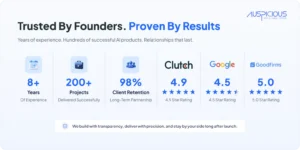
The right partner is what turns a shaky guess into a dated plan. Auspicious Soft has spent 8+ years turning hard ideas into working products, with 200+ projects shipped and a 98% client retention rate. The team runs on fixed price options, full NDA protection, and US timezone availability, so your build stays clear and on schedule from the first call. That is the whole point of strong AI and ML development services: a straight line from idea to a product your users trust.
How To Keep Your AI Project On Time
You can protect the timeline. Do these five things and you dodge most delays.
- Sort your data first. Get it clean, in one place, and reachable before week one.
- Lock version one. Write down what ships. Then do not add to it mid build.
- Start with a ready model. Tune a foundation model before you dream of building one from zero.
- Test early, test often. Catch wrong answers before customers do, not after.
- Answer fast. Slow sign offs on your side add idle weeks nobody counts.
A tight first version ships sooner. It costs less. And it tells you the truth about what your users want. That last part is worth more than any feature list.
FAQs
Q: How long does AI development take in 2026?
Between 4 weeks and 12 months. A simple chatbot takes 4 to 10 weeks. A custom model takes 3 to 5 months. An enterprise platform takes 6 to 12 months or more.
Q: How long does it take to build an AI chatbot?
A simple FAQ bot goes live in 4 to 6 weeks. A business bot with CRM and workflow links takes 8 to 16 weeks. Enterprise bots take several months once security and testing are added.
Q: How long does it take to build a machine learning model?
A custom model trained on your own data takes 3 to 5 months. Data cleaning and testing take up most of that time, not the training itself.
Q: Why does AI development take so long?
Because most of the work is not the model. Data prep, testing, and integration eat 40 to 60 percent of the clock. The model is a small slice.
Q: Can AI be built in a month?
Yes, for a small, focused tool. A simple FAQ bot or a single task automation can ship in about 4 weeks if the scope is tight and the data is ready.
Q: What is the biggest factor in AI development time?
Data readiness. Teams with clean, reachable data move two to three times faster than teams who hit data problems mid build.
Q: Is AI faster or slower to build than normal software?
Often slower for the same size. Normal software follows fixed logic. AI learns from data, which adds testing, tuning, and uncertainty to the timeline.
Q: How long does an enterprise AI platform take?
Plan 6 to 12 months, sometimes longer. Many models, strict rules, and deep system links all add weeks, especially in regulated fields.
Q: How fast can you start my AI project?
Send your idea and you get a dated plan and a quote back in 24 hours. Most builds kick off within a week of sign off.
Do not Miss Our Latest Tech Insights
Stay one step ahead in the fast-moving world of AI and technology. Add us as a Preferred Source on Google and get our latest articles, guides, and industry insights delivered straight to your search feed.