+1 740 762 6496
 +91 70189 46603

TABLE OF CONTENT
- What Is an AI Agent, In Plain Words
- Autonomous Software Agents vs Old Automation
- Where AI Business Automation Pays Off First
- Why Most Agent Projects Stall
- How to Plan an AI Agent Without Wasting Months
- AI Agents Need Real Business Tools Behind Them
- How Generative AI, Machine Learning, and Agents Fit Together
- Where This Goes Next
- FAQs
Overview
- AI agents are software that act on their own.
- They do not just answer a question, they finish the task. This guide shows where they pay off first in 2026.
- Support teams, finance teams, and IT desks lead the way.
- It also shows where most agent projects quietly stall. You get a short, real plan to launch one without wasting months.
- The post ends with the questions business owners ask most about cost, safety, and staff impact.
Most software waits for you to click. AI agents do not wait. They read a ticket. They check the data. They take action. They only call you in when something looks wrong.
That is the big shift. Old software just shows you a screen. New software finishes the job. This one change is why 2026 feels different.
Quick answer first: yes, AI agents are worth your time. But not for every task. Gartner forecasts that 40 percent of business apps will have an agent by the end of 2026. That is up from under 5 percent in 2025. A fast jump, in a short time.
But here is the catch. Most firms test an agent once. Then they never use it daily. The real money sits in that gap. So do most of the mistakes.
This guide skips the fluff. It shows where agents pay off. It shows where they quietly fail. And it shows how a small team can build one without months of wasted work.
What Is an AI Agent, In Plain Words
An AI agent is software with a goal, not a script. You do not give it ten steps. You give it one outcome.
You say: “Refund this order if it fits our policy.” An old app needs every step typed out by you. An agent finds the steps on its own. It checks the order. It checks the rule. It acts. Then it tells you what it did.
Here is a point most guides skip. An agent is only as good as the fence around it. Too much freedom, and it makes bold mistakes fast. Too little freedom, and you just built a slower version of old automation.
The real skill now is not clever prompts. It is building the right fence.
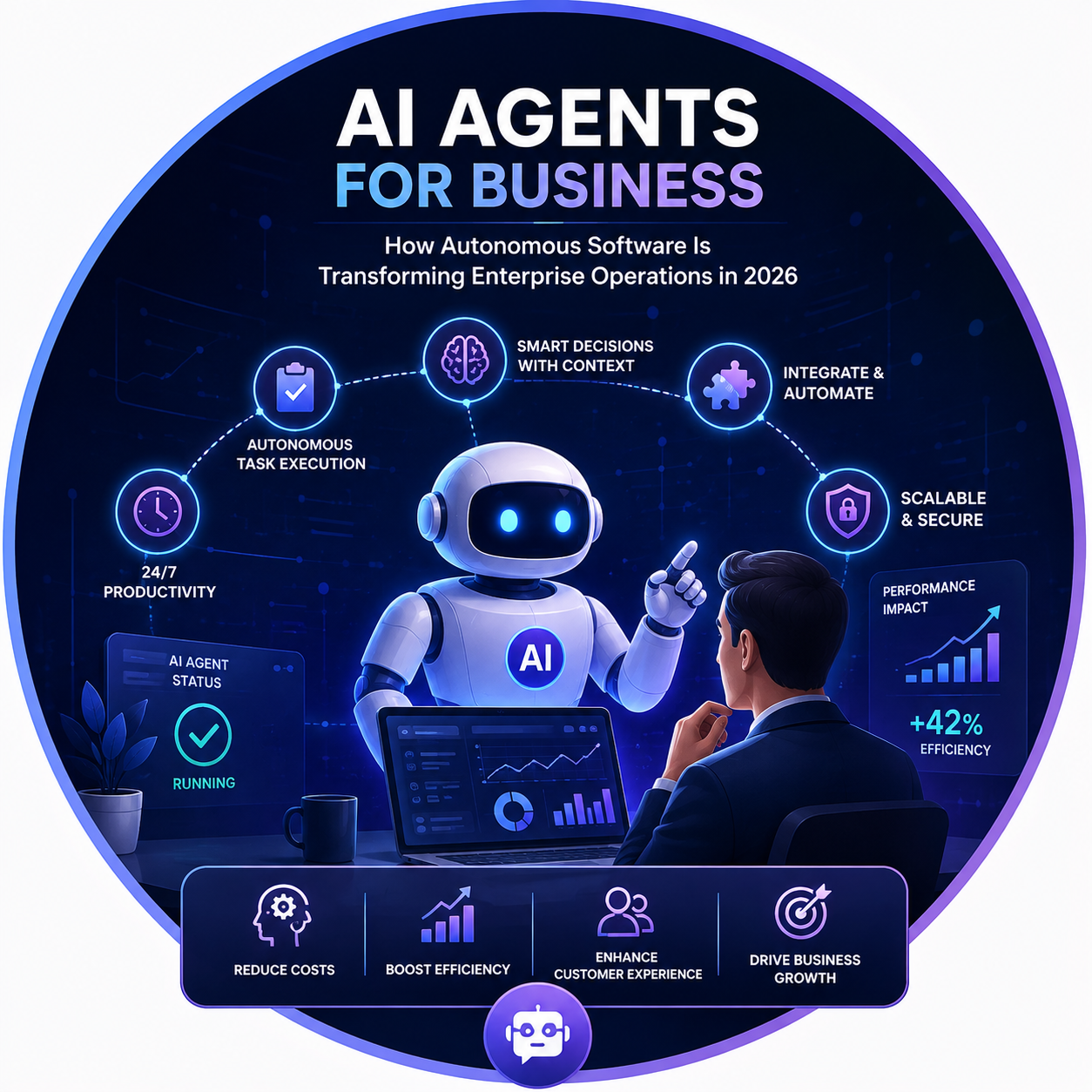
AI Agents for Business
How Autonomous Software Is Transforming Enterprise Operations in 2026Autonomous Software Agents vs Old Automation
People ask if this is just their old CRM tool with a new name. It is not. The gap here decides if your money is well spent.
| Factor | Old Automation | Autonomous AI Agents |
|---|---|---|
| Steps | Fixed Rules Set in Advance | Plans Its Own Steps |
| Surprises | Breaks or Stalls | Tries a New Path |
| Learns | No | Yes, Over Time |
| Best Fit | Same Task, Every Time | Tasks That Need a Choice |
| Setup | Quick and Simple | Needs More Care and Rules |
| Risk | Easy To Spot | Can Be Wrong At Scale |
A bot that auto-replies to any email with the word “refund” is plain automation. An agent does more. It reads the email. It checks the order. It checks the rule. It sends the refund and writes a real-sounding reply. That is an AI business agent at work.
Where AI Business Automation Pays Off First
Not every team gains the same value. Three teams lead the pack in 2026.
Customer support. Agents sort tickets and pull order history. They close most simple cases on their own. The hard cases go to a human, with full notes attached. No more “let me check and get back to you.”
Finance and back office work. Invoice checks. Expense approval. Vendor checks. These tasks need rules and small choices, and that is what agents do best. One 2026 survey puts the payback time for finance agents near nine months. That is slower than support. But the savings grow large once it scales up.
IT help desks. Password resets. Access requests. New software setup. The work is dull but high in volume. The risk is low if a human steps in once. This is often the easiest first project for a new team.
Health care, government, and strict finance groups move slower here. That is the right choice. These fields should not learn agent mistakes the hard way.
Why Most Agent Projects Stall
Here is my honest take. It comes from real client work, not a slide deck.
Firms do not fail because the AI is weak. Today’s tools are strong enough for most tasks. They fail for three plain, fixable reasons.
First, the data is a mess. It sits spread across five tools that do not talk to each other. No one cleaned it up first. Second, there is no human check. So when the agent makes an error, it makes that error fast and at full scale. Third, leaders treat launch day as the finish line. An agent left alone will drift, just like a new staff member drifts with no manager.
The fix is not fancy. Clean your data first. Add a human check on any task tied to money or to customer messages. Do this for the first ninety days. Put one person on watch each week. None of this needs a smarter model. It just needs care.
How to Plan an AI Agent Without Wasting Months
Keep the plan short. A short list beats a long strategy deck.
- Pick one task that hurts the most. Just one task, not five.
- Map each tool that task touches now. Your CRM. Your help desk. Your inbox. Your sheet.
- Decide what the agent can never do alone. A large refund. A deleted file. A risky email.
- Build a small test. Run it next to your team for two to four weeks. Compare the results.
- Grow the scope only after the test works. One small step at a time.
A strong custom software development partner walks a client through this same path first, well before any code gets built. Jumping straight to “build it all” is how budgets vanish fast.
AI Agents Need Real Business Tools Behind Them
An agent does not work on its own in thin air. It needs a home. It needs a way to read your data and act on the tools that run your firm.
If your agent should update files or message clients, it must plug into your real tools. Your CRM. Your booking tool. Your app. Your dashboard. Auspicious Soft AI/ML solutions team builds this exact link. The agent’s logic connects to tools your staff use each day. It does not stay stuck in a test space that no one ever sees.
If clients should see the agent in your own app, the logic usually sits inside a mobile app or a web page people open daily. Not a side chat box no one recalls to open.
Talk to our AI engineering team about your use case
How Generative AI, Machine Learning, and Agents Fit Together
These three terms get mixed up a lot. A quick split helps before you brief your team or a vendor.
Generative AI writes and makes things on request. Text. Notes. Images. Machine learning spots patterns in your data. It can guess who may leave, or which deal looks like fraud. An agent uses both as tools in one longer chain of work.
It might use generative AI to write the reply to a client. It might use machine learning to flag a risky account first. Then it acts on both at once. No person has to glue the steps by hand.
Auspicious Soft Generative AI and machine learning team builds these core parts. The agent layer ties them into one smooth flow, in place of three loose tools a person had to run by hand.

Where This Goes Next
By the end of 2026, one working AI agent will not be a bonus add-on. It will be the new normal, much like a mobile app became normal back in 2015. The firms that win will not be the ones with the flashiest demo. They will be the ones that picked one real task and kept it small. They watched it close and grew it with proof, not hope.
If you already know which task wastes the most hours each week at your firm, that talk is worth having now. Your rival may be having it already.
AI Agents for Business
How Autonomous Software Is Transforming Enterprise Operations in 2026FAQs
Q: What is the difference between an AI agent and a chatbot?
A chatbot replies inside a chat box. An agent takes action across tools. It can check a file, update a record, or run a task on its own, with no extra prompt from you.
Q: Are AI agents safe for client data?
Yes, if you keep access tight and ask for human checks on risky tasks. The real risk is not the AI. The risk is giving an agent more reach than the task truly needs.
Q: How much does an AI business agent cost?
Cost depends on how many tools it must touch and how much logic it needs. A small, single-task agent costs far less than a large firm-wide rollout. Starting small is also the safe money choice.
Q: Will AI agents replace staff?
For most firms, agents take the repeat steps off a person’s desk. This frees up time for choices and client work. The best results come from firms that move staff to new roles, not just cut jobs.
Q: How long does it take to launch a working AI agent?
A small test can go live in four to eight weeks. A large, firm-wide agent often takes three to six months. It depends on how messy your current tools are.
Q: Which teams adopt AI agents fastest in 2026?
Support teams, finance back office staff, and IT desks lead the way. Their tasks repeat often, run in high volume, and carry low risk if a human steps in now and then.
Do not Miss Our Latest Tech Insights
Stay one step ahead in the fast-moving world of AI and technology. Add us as a Preferred Source on Google and get our latest articles, guides, and industry insights delivered straight to your search feed.