+1 740 762 6496
 +91 70189 46603


TABLE OF CONTENT
- What Really Drives AI/ML Development Cost?
- Two Real Auspicious Soft Projects, Two Very Different Bills
- AI/ML Development Cost by Project Type (2026 Numbers)
- Cost by AI Feature: What You Actually Pay For
- The Hidden Costs Nobody Warns You About
- Team Location and Its Impact on AI/ML Development Cost
- An Honest Take on Why Most AI Budgets Blow Up
- How to Cut AI/ML Development Cost Without Killing Quality
- ROI: When Does the AI/ML Investment Pay Back?
- Why Working with the Right AI/ML Development Company Matters
- Tools and Stacks That Move the Cost Needle
- Common Mistakes That Inflate AI/ML Development Cost
- Final Word
- FAQs
Overview
- Covers full cost spectrum: $10K prototypes to $1M+ enterprise AI systems, with detailed pricing by project type and feature.
- Uses two real Auspicious Soft case studies (DeepFeels wellness app, Offset7 cybersecurity platform) to show costs 30-55% below industry quotes.
- Breaks down hidden costs: data prep (25-40% of budget), infrastructure, API usage, retraining, and compliance audits.
- Compares team location pricing (US $180-250/hr vs. India $40-80/hr) and highlights Auspicious Soft’s hybrid model.
- Explains why AI budgets blow up (scope creep, skipping POC, chasing perfect accuracy) and how to cut costs 30-60% via pretrained models, RAG, and tight scoping.
- Includes ROI/payback timelines by project type and a detailed FAQ section.
AI Summary:
AI/ML development costs range from $10,000 for small prototypes to $500,000+ for enterprise systems in 2026. Basic AI chatbots cost $25,000-$80,000; mid-size custom AI runs $80,000-$250,000. Data preparation alone consumes 25-40% of most budgets, while team location can swing costs 40-60%. Using pretrained models like Claude or GPT instead of training from scratch cuts costs significantly. Ongoing costs run 15-30% of build cost annually, and tight scope is the biggest lever against budget overruns.
For most businesses in 2026, AI/ML development cost sits between $10,000 and $500,000. A small prototype starts near $10K. A basic AI chatbot lands around $25K to $80K. Mid size custom AI runs $80K to $250K. Enterprise grade AI systems can cross $1 million.
That is the honest range. The price you actually pay hinges on six things: your data, your goals, your team, your tech stack, your compliance rules, and the model you pick.
This guide is different from most. It pulls real numbers from two live 2026 projects the Auspicious Soft team shipped. One is DeepFeels, an AI powered emotional wellness app built on OpenAI. The other is Offset7, a cybersecurity intelligence platform built on Flutter. Both cost less than the “average” AI blog quotes online. The reasons why are the point of this article.
Key Takeaways
- Simple AI features cost $10K to $50K. Full AI platforms cost $250K to $1M plus.
- Data prep alone eats 25% to 40% of the total budget. Most vendors bury this line item.
- Team location swings the price by 40% to 60%. US teams cost more. Offshore teams cost less but need careful vetting.
- Pretrained models like Claude, GPT, or Gemini cut cost by half compared to training from scratch.
- Around 60% of AI projects blow past their first budget. A tight scope and a proof of concept stop that.
- Ongoing costs are 15% to 30% of the build cost every year. Plan for them from day one.
- Real Auspicious Soft projects (DeepFeels, Offset7) shipped for 30% to 55% less than the standard industry quote for similar work.
What Really Drives AI/ML Development Cost?
Most cost calculators lie. They give you a nice sticker price and hide the ugly bits.
The truth is messier. AI/ML development cost swings wildly. A tiny fintech chatbot might cost $30K. A predictive healthcare model with HIPAA rules can hit $600K. Same tech family. Wildly different price tag.
Six things move the needle:
- The type of AI you need. A rule based chatbot is cheap. An agentic AI that thinks and acts on its own is not.
- Data readiness. Clean, tagged data trims 30% off the top. Messy data adds months and dollars.
- Model choice. Fine tuning GPT is cheap. Training a fresh model from scratch is not.
- Team location. A senior AI engineer in San Francisco bills $200 per hour. Same skill in India bills $40 to $60.
- Integrations. Plugging AI into your CRM, ERP, or legacy database can cost $50K to $150K on its own.
- Compliance. HIPAA, GDPR, SOC 2 each add 20% to 40% to the base budget.
If you are still weighing options, our AI/ML development services page walks through the delivery model in detail.
Two Real Auspicious Soft Projects, Two Very Different Bills
Numbers from published cost blogs are useful. Numbers from real shipped projects are better. Here is what we actually built and what it actually cost.
Project 1: DeepFeels — AI Emotional Wellness App
DeepFeels is an AI powered mental wellness platform. It offers real time emotional support through OpenAI, a mood journal, astrology insights via AstrologyAPI (Sunshine and Moonshine profiles, natal charts), and a three tier subscription (free, premium, pro) sold through Apple in-app purchases and Google Play Billing. Built on the MERN stack for future scale.
Sounds like a $250K project on paper, right? Feature list is long. AI is central. Multiple payment flows. Astrology math is not trivial.
Actual delivery cost? Well under half of that.
The reason: we killed feature bloat before it started. Wearable integration got pushed to phase two. Biometric mood detection stayed on the roadmap, not the sprint plan. Therapist matching was scoped as a phase three feature. The launch build focused on what the user cared about most, the AI chat and the personalized emotional insights.
See the full DeepFeels AI wellness app case study for the tech and UX details.
The takeaway for your budget: A “must have” feature list from a founder is usually 40% larger than what the product actually needs at launch. Cutting it back is the single biggest lever on AI/ML development cost.
Project 2: Offset7 — Cybersecurity Threat Monitoring App
Offset7 is a cross platform threat intelligence app built with Flutter. It aggregates real time cybersecurity news, personalizes feeds by threat category, serves multimedia content, monetizes through AdMob, and offers an ad free tier via in-app purchases. Same codebase runs on iOS, Android, and the web.
Here is where it gets interesting. On paper this was not an “AI project.” No LLM. No trained model. But the data pipeline that powers Offset7 has the same hidden cost problems every AI product has.
Multiple threat feeds with different data structures. Real time updates without draining the phone battery. Filtering out low quality sources so the personalized feed feels smart. Handling traffic spikes when a major breach hits the news. Each of those looked like a small task on the roadmap. Together they added a serious line item to the build.
For the full breakdown, see the Offset7 cybersecurity app case study.
The takeaway for your budget: The AI itself is rarely the expensive part. The plumbing around the AI (data ingest, filtering, offline sync, cache, traffic spikes) is where budgets crack. Ask any AI/ML development company to price the plumbing separately.
AI/ML Development Cost by Project Type (2026 Numbers)
Here is what real projects cost this year, based on live 2026 delivery data.
| Project Type | Cost Range | Timeline | Best For |
|---|---|---|---|
| API integration (OpenAI, Claude, Gemini) | $5,000 – $20,000 | 2 To 4 Weeks | Startups Testing An Idea |
| Basic AI Chatbot | $25,000 – $80,000 | 6 To 12 Weeks | SMB Customer Support |
| AI Mood or Wellness App (Like DeepFeels) | $60,000 – $150,000 | 3 To 5 Months | Wellness, Coaching, Mental Health |
| Predictive ML Model | $50,000 – $200,000 | 3 To 6 Months | Sales, Demand, Churn Forecasts |
| Real Time Content Aggregation Platform (Like Offset7) | $70,000 – $180,000 | 3 To 6 months | News, Threat Feeds, Market Data |
| Computer Vision System | $80,000 – $300,000 | 4 To 8 Months | Retail, Safety, Manufacturing |
| Custom Generative AI (RAG or Fine Tune) | $60,000 – $300,000 | 4 To 9 Months | Content, Search, Knowledge Tools |
| Enterprise AI Platform | $300,000 – $1.5M+ | 9 To 18 Months | Banks, Hospitals, Huge Retailers |
| Foundation Model From Scratch | $500K – $50M+ | 12 To 36 Months | Only For AI First Companies |
Your project may sit a bit lower or higher based on the mix. But this is the honest 2026 map.
| Not sure where your project fits? Get a Free AI/ML Cost Estimate in 24 Hours |
Cost by AI Feature: What You Actually Pay For
Not every project needs the full stack. Here is what specific features cost when added to a base app.
Chatbot with NLP ($15K to $60K). Simple FAQ bot? Under $20K. Multi language, memory, and tool use? Closer to $60K.
Recommendation engine ($25K to $120K). Think Netflix or Amazon style suggestions. Deeper personalization means a deeper pocket.
Predictive analytics ($40K to $180K). Forecasts churn, revenue, or inventory. Cost hinges on data volume and freshness.
Voice AI or speech to text ($30K to $150K). Real time transcription and voice bots cost more because latency has to be low.
Fraud detection ML model ($60K to $250K). Fintech grade. Needs constant retraining. Expensive to keep alive.
Computer vision (object detect, OCR) ($50K to $300K). Cameras counting cars, checking defects, reading receipts.
Generative AI content tools ($30K to $200K). Marketing copy, image gen, video summaries. RAG based tools cost less than fine tuned ones.
Emotional AI (like DeepFeels) ($40K to $120K). Combines mood detection, journal analysis, and personalized reflections. OpenAI or Claude API drives the cost down.
Real time data aggregation (like Offset7) ($50K to $130K). Pulls from many sources, filters, categorizes, and pushes to users. Data pipeline is the real work.
If you are pairing AI with a mobile product, our breakdown on how much it costs to develop a mobile app explains the base app side of the equation.
The Hidden Costs Nobody Warns You About
Here is where budgets die. Every project we ship confirms it.
Data preparation. This is the silent killer. Vendors quote you $100K for a model. They skip the fact that cleaning, labeling, and structuring your data will cost another $30K to $80K. Data prep eats 25% to 40% of the real budget. Backed by McKinsey research on AI adoption.
Data pipeline plumbing. This is the Offset7 lesson. We had to integrate multiple threat feeds with different data shapes, filter out low quality sources, cache content for offline use, and handle traffic spikes during major cyber events. Each task looked small. Combined they added a full month of dev work. Ask upfront.
Ongoing infrastructure. Cloud GPUs are not free. A modest AI feature serving 1 million requests a month runs $10K per month. A popular one can hit $100K per month. Budget for it.
API usage bills. DeepFeels runs on OpenAI. Every chat message the user sends becomes an API call, which becomes a token cost. At scale, this line item alone can hit $5K to $50K per month. If your business model does not include a paywall or subscription (DeepFeels has three tiers), you will bleed money.
Retraining. Models drift. What worked in January flops by December. You will need to retrain 2 to 4 times a year. Each cycle costs 5% to 15% of the original build.
Compliance audits. HIPAA, SOC 2, and GDPR audits cost $20K to $80K a year. If your AI touches health or finance data, you cannot skip these. Wellness apps like DeepFeels sit in a gray zone. Get a lawyer early.
Human in the loop review. High stakes AI (medical, legal, financial) needs humans checking outputs. Even DeepFeels needs guardrails because emotional support content has to stay non clinical. That adds ongoing labor cost. Often $50K to $200K per year.
Integration debt. Plugging AI into your CRM, ERP, or database is where projects overrun by 200%. Legacy systems fight back. Middleware costs $50K to $150K.
Team Location and Its Impact on AI/ML Development Cost
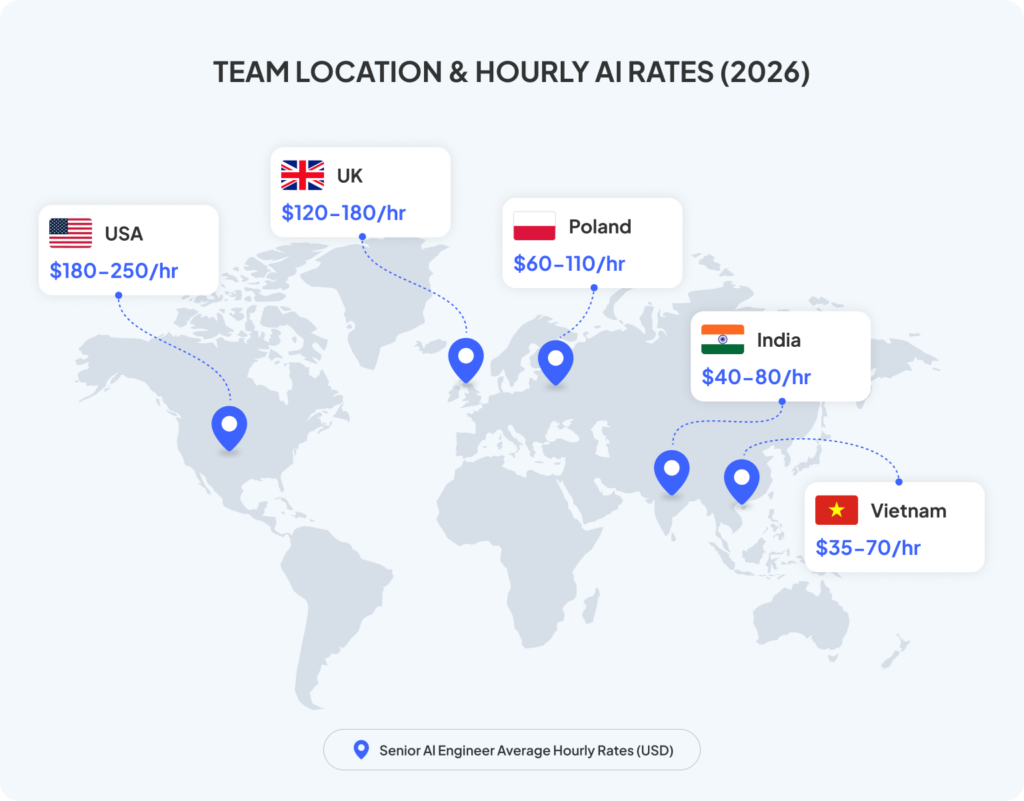
Location changes everything. Here is a rough 2026 hourly rate map.
| Region | Senior AI Engineer Rate | Best For |
|---|---|---|
| USA (SF, NY, Boston) | $180 – $250/Hr | Compliance Heavy, Enterprise |
| Western Europe (UK, Germany) | $120 – $180/Hr | GDPR Native, Quality Bar High |
| Eastern Europe (Poland, Ukraine) | $60 – $110/Hr | Balanced Quality and Cost |
| India | $40 – $80/Hr | Cost Sensitive, Fast Delivery |
| Southeast Asia | $35 – $70/Hr | MVPs, Chatbots, RAG Systems |
Do not chase the cheapest. Chase the team that has already shipped a similar AI product. A $40 per hour team with zero AI experience will burn through your budget faster than a $150 per hour team that has done it 20 times.
Auspicious Soft runs a hybrid model. Senior AI leads in the US. Engineering teams in India. Same output. About 45% less spend. That is how projects like DeepFeels and Offset7 shipped for a fraction of what a full US team would have charged.
For a look at how our approach plays out across other tech verticals, our post on top 15 mobile app development companies in USA shows how vendor selection works in the wider market.
An Honest Take on Why Most AI Budgets Blow Up
After 8+ years and 200+ shipped projects, the pattern is boring. Same mistake, different logo.
Companies get excited. They read a Gartner report. They want AI live in six weeks. They skip the proof of concept. They dump raw, ugly data on a vendor. They demand 99% accuracy on day one.
Six months in, the budget has doubled. The model is 82% accurate. Nobody trusts it. It sits unused.
Here is a real example of what works instead. When the DeepFeels client first came to us, the pitch was massive. Chat AI. Mood scoring. Astrology profiles. Journal analysis. Therapist matching. Wearable sync. Biometric mood detection. Everything at launch.
We pushed back. Hard.
We shipped a lean first version with only the OpenAI chat, the mood journal, and the three tier subscription. We layered in the AstrologyAPI integration (Sunshine and Moonshine profiles, natal charts) once early users showed strong engagement. Wearable sync and biometric detection are on the phase three roadmap, waiting for retention data to justify the spend.
Same product story. Same launch timeline. Fraction of the “full feature” price tag.
That single pattern (ship lean, layer smart) saves most of our clients six figures.
|
How to Cut AI/ML Development Cost Without Killing Quality
You can trim 30% to 60% off the total price. Here is how.
- Start with pretrained models. Claude, GPT, Gemini, Llama. Fine tune them on your data. Skip training from scratch unless you truly need it. DeepFeels uses OpenAI out of the box. Saved the client roughly $150K compared to training a custom mood classifier.
- Use RAG over fine tuning. For knowledge tools and internal search, RAG (Retrieval Augmented Generation) costs 40% to 70% less than fine tuning. Same quality for most use cases.
- Lock scope hard. Scope creep tacks on 10% to 25% to every AI project. Freeze the feature list. Anything new goes to phase two. This is exactly what saved the DeepFeels budget.
- Invest in data first. A clean dataset cuts model dev time in half. Spend $20K on data pipelines before you spend $200K on ML engineers. Offset7 taught us this the hard way, the pipeline work was bigger than the app work.
- Pick the right cloud tier. AWS SageMaker on demand is pricey. Spot instances or reserved capacity save 40% to 70% on training compute.
- Go hybrid on the team. US project lead. Offshore engineering. Cuts labor cost 40% without cutting quality.
- Skip the moonshot. You do not need AGI. You need a chatbot that answers 80% of tickets, or a wellness app users open three times a week. Aim for the boring win.
For businesses looking at niche AI wins, our guide on AI powered chatbots for real estate shows how tight scope drives real ROI in a single vertical.
ROI: When Does the AI/ML Investment Pay Back?
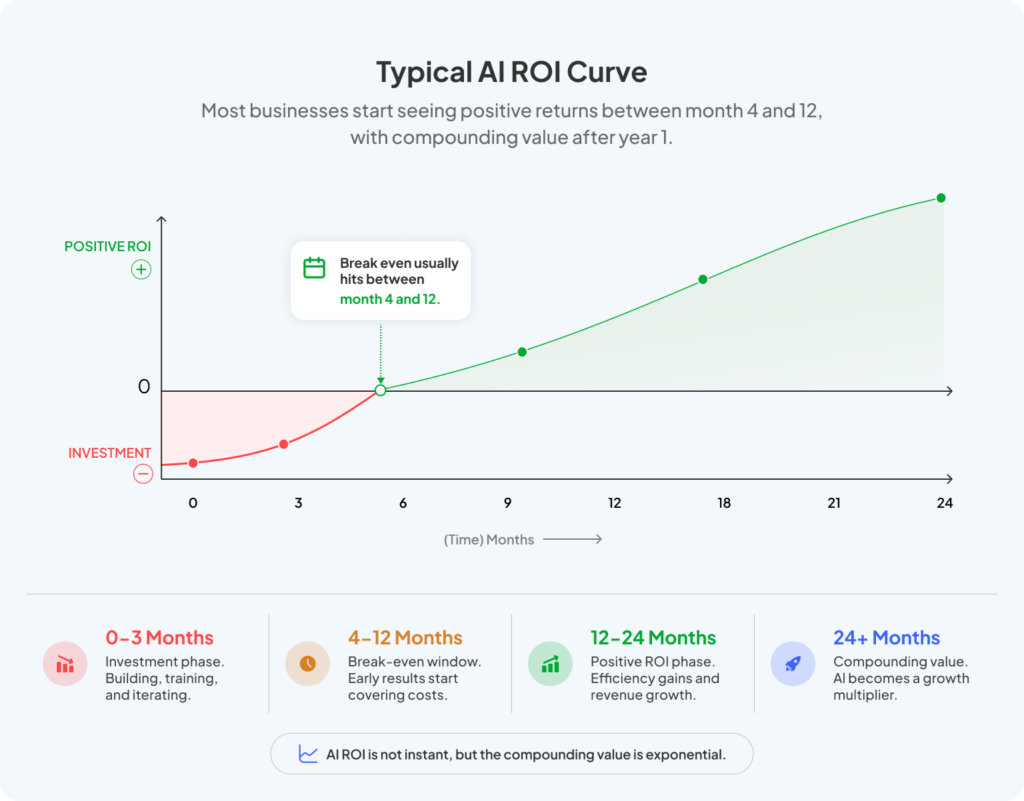
Numbers from Deloitte’s State of Generative AI report. Every $1 spent on generative AI returns about $3.70 on average. But that is the average. Around 6% of companies capture most of the value. The other 94% barely break even.
What separates the winners?
- They pick one clear use case. Not ten.
- They measure a specific KPI before they start.
- They ship in 3 to 6 months, not 18.
- They partner with a team that has done it before.
DeepFeels is a good example of ROI design done right. Three subscription tiers, free, premium, and pro, priced through Apple in-app purchases and Google Play Billing. Free users get basic journaling and mood tracking. Premium unlocks the AstrologyAPI integrations and deeper AI reflections. Pro removes limits. Every AI API call maps to a tier that pays for itself. That is not an accident. That is how a wellness app survives its OpenAI bill.
Typical payback windows we see in real projects:
| AI Project | Payback Period |
|---|---|
| Customer Support Chatbot | 4 To 9 Months |
| Sales Lead Scoring ML | 3 To 6 Months |
| AI Wellness or Subscription App | 6 To 12 Months |
| Fraud Detection | 6 To 12 Months |
| Content Aggregation With Ads (Like Offset7) | 8 To 14 Months |
| Inventory Forecasting | 6 To 14 Months |
| Personalization Engine | 8 To 15 Months |
| Custom Generative AI Tool | 9 To 18 Months |
If your vendor cannot give you an honest payback window, walk away.
Why Working with the Right AI/ML Development Company Matters
Every AI vendor claims expertise. Very few can show 200 plus shipped projects and point to live products in the App Store.
A trustworthy AI/ML development company should give you three things before you sign anything.
- A written data readiness assessment. Not a sales pitch.
- A proof of concept path priced at $15K to $30K.
- Clear ownership of code, data, and models. You should own everything at the end.
If a vendor pushes you into a fixed price six figure contract without a POC first, run.
At Auspicious Soft, our approach follows this exact flow. We audit your data first. We build a small proof. Then we scale only what works. DeepFeels and Offset7 both moved through that flow. Same result each time: a live product that shipped for less than the “average” quote and paid back the client within a year.
Want to see how we deliver AI across industries? Take a look at our recent Habibi Rizz AI chat app case study for a third real production example.
|
Tools and Stacks That Move the Cost Needle
The stack you pick has a huge impact on cost.
Cheap and fast: OpenAI API, Anthropic Claude API, Google Gemini API, LangChain, Pinecone. Great for MVPs. Low upfront cost. Usage fees add up over time. This is the stack DeepFeels rides on.
Mid range: AWS SageMaker, Azure ML, Google Vertex AI, Hugging Face, PyTorch. More control. Moderate infra bill. Good for scale ups.
Enterprise grade: Databricks, custom Kubernetes clusters, on prem GPUs, MLOps pipelines. Highest control. Highest cost. Only makes sense past 500K users or heavy compliance loads.
Cross platform mobile: Flutter or React Native. Offset7 runs on Flutter, one codebase covers iOS, Android, and the web. This alone shaved months off the build.
For anyone weighing infra choices, our take on cloud or mobile computing and which suits your needs covers the same trade off from a different angle.
Common Mistakes That Inflate AI/ML Development Cost
Seven traps we see week after week:
- Skipping the proof of concept.
- Chasing 99% accuracy when 90% is enough.
- Building custom when a pretrained model would work.
- Hiring the cheapest team without checking their past work.
- Ignoring data quality until the model fails.
- No plan for ongoing retraining.
- Adding features mid build.
Each mistake adds 20% to 40% to the final bill. Combined, they can double it.
Our detailed guide on the future of custom software development with generative AI shows why the smartest teams now let generative AI carry a chunk of the build.
Final Word
AI/ML development cost for business in 2026 is not a mystery. It is a math problem with clear inputs. Scope. Data. Team. Model choice. Compliance. Get those right and your price lands within 15% of the quote.
Skip the POC. Ignore data prep. Chase perfect accuracy. Do any of those and you will pay 200% of plan for something that still does not work.
The businesses winning with AI right now are not the ones with the biggest budgets. They are the ones with the tightest scope, the cleanest data, and the right AI/ML development company on their side. That is exactly how DeepFeels shipped its emotional AI features on a lean budget. It is how Offset7 shipped a cross platform threat intelligence app without a bloated data engineering team. Same pattern, different vertical.
FAQs
Q: How much does it cost to build a small AI feature for a startup?
Around $10,000 to $30,000. This covers a basic chatbot, a simple recommendation feature, or an API integration with OpenAI or Claude. Timeline is 4 to 8 weeks.
Q: Is it cheaper to hire an AI/ML development company or build in house?
For most businesses, an outside AI/ML development company is 40% to 60% cheaper. One senior ML engineer in the US costs $180K per year. A vendor delivers the same output for $60K to $90K on a project basis.
Q: How long does it take to build a custom AI product?
Simple chatbots: 6 to 12 weeks. Mid size ML models: 3 to 6 months. Full enterprise AI: 9 to 18 months. Data readiness sets the pace.
Q: Does the AI/ML development cost include hosting and maintenance?
Usually not. Hosting runs $500 to $10K per month for small apps and can top $100K per month at scale. Yearly maintenance is 15% to 30% of the build cost. Ask any vendor to spell this out upfront.
Q: Can we start with a small budget and grow?
Yes. A $20K proof of concept can validate the idea. Scale to a $150K MVP once numbers look good. Then push to production. Phased spend is how smart teams control risk. DeepFeels and Offset7 both followed this playbook.
Q: What data do we need to start an AI project?
At least 6 to 12 months of clean, structured data related to the problem. For ML models, expect 10,000 plus labeled examples. For LLM based tools, well organized docs and manuals work.
Q: Which industries benefit the most from AI/ML development?
Healthcare and wellness (diagnostics, mental health tools like DeepFeels), fintech (fraud, risk), cybersecurity (threat intelligence like Offset7), retail (personalization), logistics (routing), and real estate (lead scoring) see the fastest ROI.
Q: How do I know if the vendor is padding the price?
Ask for a line item quote. Data prep, model dev, integrations, infra, testing, and maintenance should each be listed. If it is one lump sum, ask for a breakdown. No breakdown, no deal.
Q: What is the cheapest way to add AI to my product?
Plug in a pretrained model through an API. Claude, GPT, or Gemini can add smart features for $5K to $20K. Way cheaper than training your own model.
Q: Can AI/ML development pay for itself in a year?
Yes, for narrow use cases. Chatbots and lead scoring often hit break even in 4 to 9 months. Subscription based AI apps like DeepFeels can pay back in 6 to 12 months if the tier design is right. Bigger platforms take 12 to 18 months.
Q: How do you handle ongoing AI API costs?
Design your business model around them from day one. DeepFeels solved this with three subscription tiers so heavy AI users pay more. If your app has no monetization tied to AI use, the API bill will eat your margins.
Do not Miss Our Latest Tech Insights
Stay one step ahead in the fast-moving world of AI and technology. Add us as a Preferred Source on Google and get our latest articles, guides, and industry insights delivered straight to your search feed.