+1 740 762 6496
 +91 70189 46603


TABLE OF CONTENT
- Role of Artificial Intelligence in E-commerce
- Transformational Application of Generative AI in the E-commerce Development
- Leveraging Generative AI for E-commerce Development
- Future Trends in AI-Driven E-commerce Development
- Benefits of Generative AI in E-commerce
- Case Study: Generative AI in Action
- How to Choose the Best Ecommerce Development Company
- Challenges and Solutions in Generative AI Implementation
- Generative AI vs Traditional E-commerce Tools
- Conclusion
- FAQs
Overview
- AI now powers every layer of e-commerce — from discovery to delivery and returns.
- GenAI writes SEO-optimized product descriptions 100x faster than human copywriters.
- AI chatbots resolve 80% of e-commerce queries instantly, reducing support costs dramatically.
- AI-driven dynamic pricing adjusts prices in real-time based on demand, inventory, and competition.
- GenAI delivers measurable gains in revenue, efficiency, personalization, and customer satisfaction simultaneously.
- Data quality, hallucination risk, and integration complexity are the top GenAI e-commerce hurdles.
The e-commerce sector has grown unprecedentedly in the last decade, with innovation by businesses to match the ever-changing nature of consumer demands. From the rundown of such technological breakthroughs, Artificial Intelligence stands out as a game-changer. Within the realm of Artificial Intelligence, generative Artificial Intelligence presents as a change-maker: reforming how e-commerce platforms operate and deliver value.
Generative Artificial Intelligence is transforming the development of e-commerce platforms by revolutionizing them in all areas, from a highly personalized user experience to the operational streamlining. This article elaborates on how generative Artificial Intelligence is transforming the industry and how an ecommerce development company can unlock its full potential to build future-ready solutions.
The global e-commerce market reaches USD 7.9 trillion in 2026. AI-driven e-commerce platforms generate 35% more revenue than non-AI platforms. 71% of US online retailers are actively investing in generative AI features in 2026.
Role of Artificial Intelligence in E-commerce
Artificial intelligence has moved from being a competitive advantage in e-commerce to a baseline expectation. In 2026, AI is embedded in every stage of the online shopping journey: it determines which products appear on your homepage, sets prices dynamically based on demand signals, writes product descriptions automatically, powers the chatbot answering customer questions at 3 AM, detects fraudulent transactions in milliseconds, and predicts which customers are about to churn so retention campaigns can launch proactively. US retailers that have deployed AI across their e-commerce stack report an average 35% lift in revenue per visitor and a 28% reduction in customer acquisition costs. The competitive question is no longer whether to use AI in e-commerce — it is which AI capabilities to prioritize first.
It has helped with automating various processes, consumer behavior prediction, and tailoring experience through artificial intelligence. Generative Artificial Intelligence is part of Artificial Intelligence where it helps the machine to come up with contents, designs, and even strategies. It would produce product descriptions, design a layout for stores, and produce tailored recommendations; it will definitely help improve the user engagement along with the efficiency in the operational area.
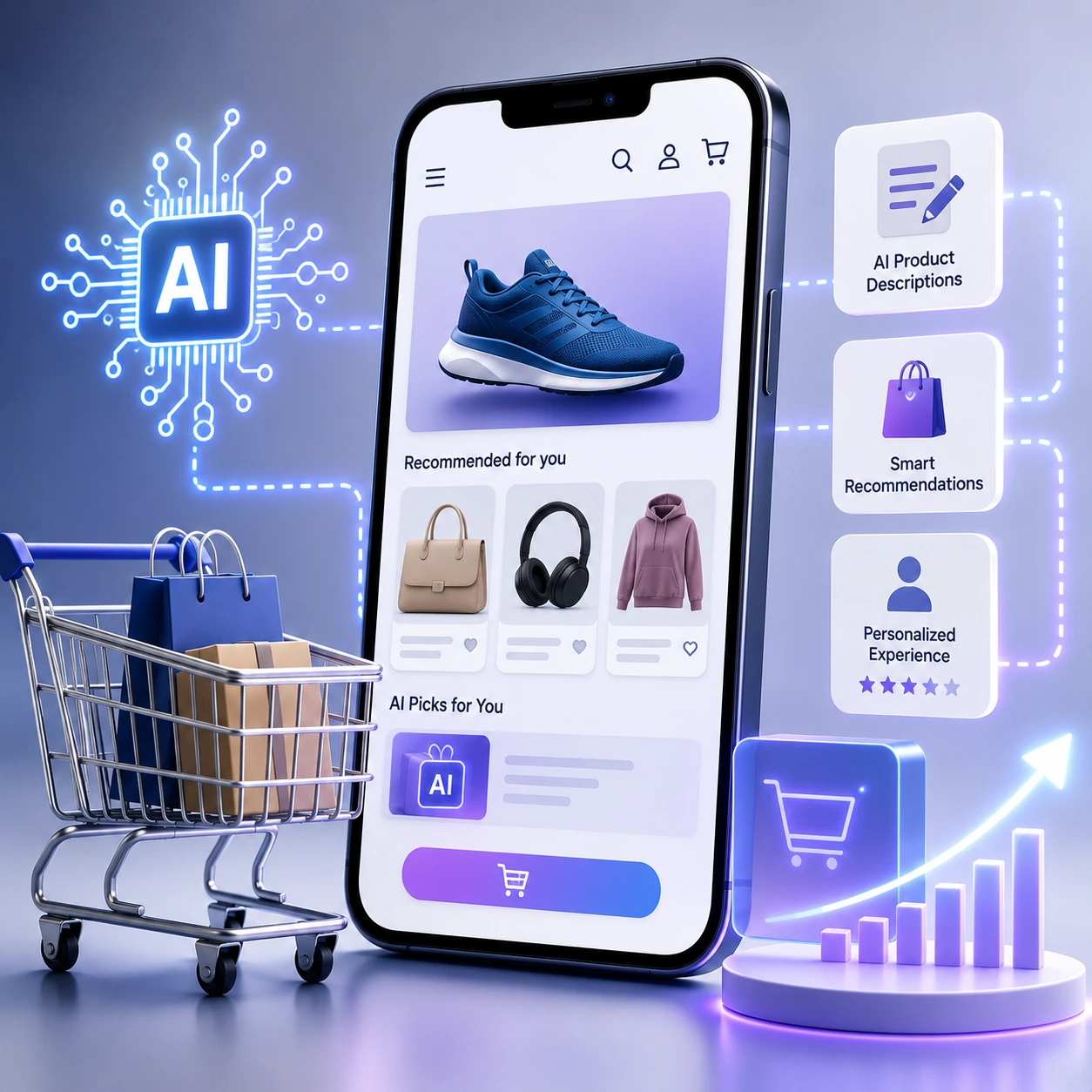
Boost Your Store's Revenue with AI — Get a Free Consultation
AI-driven stores see 35% higher revenue — see how personalization, pricing & content AI can transform your e-commerce business.Transformational Application of Generative AI in the E-commerce Development
Personalized Shopping Experience
Generative Artificial Intelligence helps create hyper-personalized journeys of shopping. Analyzing behavior, preferences, and purchase history can help them generate recommendations specific to the customers.
For example, an ecommerce development company could use AI models to:
: Show related products to customers at the time of check-out.
: Help create dynamic, personalized landing pages for every visitor.
: Create focused marketing campaigns targeting real-time insights about the customer.
More importantly, business entities can design specific email marketing campaigns that suit individual tastes, ensuring greater open and conversion rates. As Artificial Intelligence continuously learns from customer interaction, it ensures that the personalization it renders continues to be relevant and effective over a period of time. This level of customizing greatly improves user satisfaction and cultivates brand loyalty.
Improved Product Content Creation
Product content creation is where generative AI delivers the clearest, most immediate ROI for e-commerce businesses. Writing unique, SEO-optimized descriptions for thousands of SKUs is a task that previously required large content teams working for months. Generative AI — specifically large language models fine-tuned on e-commerce data — can produce high-quality product descriptions, bullet points, meta titles, and alt-text in seconds per product. Shopify merchants using AI content generation report 60% faster time-to-market for new product launches and a 23% improvement in organic search rankings due to consistently better-optimized descriptions. The quality ceiling for AI-generated product content in 2026 is high enough that A/B tests routinely show it matching or outperforming human-written alternatives.
Better Customer Support
AI-powered customer support in 2026 is not a degraded experience compared to human agents — for routine queries, it is demonstrably better. AI support agents respond in under 2 seconds, are available 24/7 across every timezone, handle unlimited concurrent conversations, remember every previous interaction with the customer, and never have a bad day. For e-commerce specifically, AI support agents handle the queries that consume 80% of support volume: order status, return initiation, product availability, size recommendations, and discount code application. This frees human agents exclusively for complex, high-emotion situations where empathy genuinely matters. E-commerce businesses deploying AI-first support report 40–60% reduction in support operational costs within the first year.
Dynamic Pricing Strategies
Dynamic pricing powered by generative AI and machine learning represents one of the highest-ROI applications in modern e-commerce. Unlike static pricing that requires manual updates, AI pricing engines continuously monitor competitor pricing, inventory levels, demand signals (search trends, cart abandon rates, time-of-day patterns), and customer segment data to automatically adjust prices in real time. Amazon updates prices 2.5 million times per day using AI pricing models. US retailers that have implemented AI dynamic pricing report 8-15% average revenue uplift with no corresponding decrease in conversion rate. The key is calibrating the algorithm to maintain price integrity — customers accept reasonable price variation but react negatively to dramatic swings without clear logic.
Leveraging Generative AI for E-commerce Development
An ecommerce development company can leverage generative Artificial Intelligence to create sophisticated platforms. Here are some areas where Artificial Intelligence has a deep impact:
a) User-Centric Design
Generative AI makes web design easier because it automatically generates user-friendly interfaces based on user feedback and preferences. For instance, Artificial Intelligence can:
: Generate mockups of landing pages.
: Optimize layouts for better usability.
: Enhance mobile responsiveness.
This way, businesses can focus on providing seamless user experiences that drive engagement and retention.
b) Inventory Management
AI systems predict the inventory needed based on past sales data, seasonal trends, and consumer demand. This predictive capability minimizes overstocking and stockouts, ensuring smooth operations. Moreover, AI-powered inventory tools help businesses:
: Automate reordering processes.
: Optimize warehouse storage.
: Improve supply chain efficiency.
These advancements translate into cost savings and improved customer satisfaction.
c) Fraud Detection and Security
Generative Artificial Intelligence enhances security by identifying suspicious activities and potential fraud. It can:
: Monitor transactions in real-time for anomalies.
: Flag high-risk behaviors.
: Strengthen payment security protocols.
This way, the approach would ensure safety in customer data and transactions, building trust and loyalty among users.
Generative AI can also provide advanced risk assessment tools to help e-commerce platforms mitigate vulnerabilities. When robust security measures are integrated into the platform, businesses can confidently expand their operations without compromising customer trust or data integrity.
Future Trends in AI-Driven E-commerce Development
1. Visual Search and AR Integration
The generative Artificial Intelligence technology enables visual search, which can upload images for instant product-finding capabilities. Augmented reality, powered by Artificial Intelligence, supports virtual try-on for clothing and furniture placements among other applications. This gives shopping an immersive quality.
2. Voice Commerce
Artificial Intelligence-powered voice commerce enables searching, selecting, and buying through smart assistants. The future is poised to redefine the convenience of online shopping.
3. Sustainability and AI
AI models can help e-commerce businesses to adopt sustainable practices by optimizing delivery routes, reducing packaging waste, and enabling transparent supply chains.
Benefits of Generative AI in E-commerce
The benefits of generative AI in e-commerce are not theoretical in 2026 — they are documented across thousands of real deployments at businesses of every size. The comprehensive advantage of GenAI is that it creates compounding returns: better product content improves SEO, which increases traffic, which feeds more behavioral data to the personalization AI, which improves conversion rates, which generates more revenue to invest in further AI capabilities. The table below summarizes the documented business impact of each GenAI capability in e-commerce contexts:
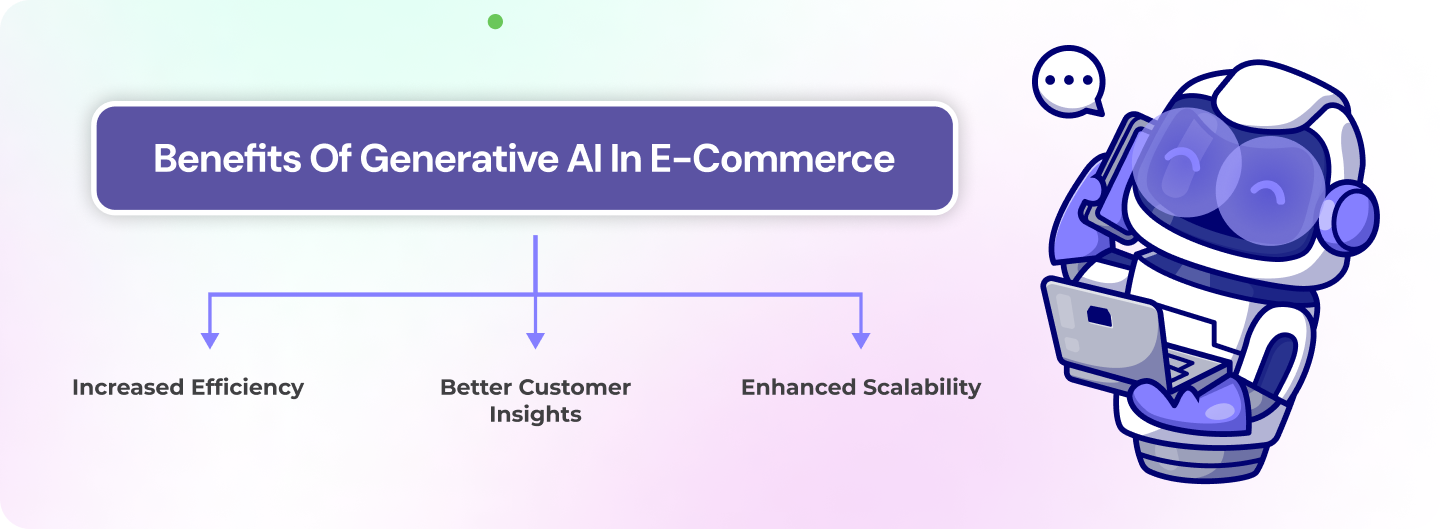
Increased Efficiency
The automation of tasks such as content creation and inventory management reduces the amount of manual effort, freeing up time for strategy.
Better Customer Insights
AI systems process massive datasets and provide actionable insights, which allows businesses to better understand their audience.
Enhanced Scalability
Generative AI will allow for scalable operations with minimum hassle as the repetitive tasks get automated and no hiccups during peak demands.
| GenAI Capability | Business Impact | Avg. US E-commerce Uplift |
|---|---|---|
| Personalized Recommendations | Higher AOV + Repeat Purchase | +26% Revenue Per Session |
| AI Product Descriptions | Better SEO + Faster Content Creation | +23% Organic Traffic |
| Dynamic Pricing AI | Revenue Maximization | +8-15% Revenue Uplift |
| AI Customer Support | Cost Reduction + Satisfaction | -45% Support Cost, +18% CSAT |
| Visual Search (AI) | Discovery Improvement | +35% Product Discovery Conversions |
| Fraud Detection AI | Chargeback Reduction | -70% Fraudulent Transactions |
| AI-Driven Email Campaigns | Higher Open & Click Rates | +41% Email Revenue |
Case Study: Generative AI in Action
Let’s just imagine how generative AI supports e-commerce companies through a basic graph:
Customer Engagement: Personalized Recommendations
Operational Efficiency: Smart Inventory Management
Revenue Growth: Dynamic Pricing
How to Choose the Best Ecommerce Development Company
While introducing generative AI to your business, it would be important to collaborate with a professional ecommerce development company. While choosing one, consider the following factors:
Experience with AI Technologies
A company should possess in-depth knowledge of artificial intelligence and its e-commerce applications, including the use of machine learning algorithms, natural language processing, and predictive analytics. A professional ecommerce development company also keeps abreast of the most recent AI trends and tools in order to present cutting-edge solutions.
Track Record in Ecommerce Development
Check out their history and achievements in completed successful e-commerce projects. What will give the first clue will be client reviews and case studies; industry recognitions will do so as well. A company capable of handling projects will not fail to indicate some experience of producing scalable, secure, user-friendly e-commerce websites for businesses across the industry.
A strong portfolio reflects the company’s ability to develop innovative and quality solutions. Go through their past projects to know how well they can integrate advanced technologies such as generative AI, AR/VR, and chatbots. This will ensure that the company can cater to your needs.
Custom Solutions
Each business is different, and your ecommerce platform should reflect your brand identity and goals. A good ecommerce development company will take the time to understand your needs and provide personalized solutions that align with your objectives. They should also be flexible in adapting to changing requirements as your business grows.
Boost Your Store's Revenue with AI — Get a Free Consultation
AI-driven stores see 35% higher revenue — see how personalization, pricing & content AI can transform your e-commerce business.Comprehensive Support Services
Post-development support is as important as the development process itself. Make sure the company provides maintenance, updates, and troubleshooting to ensure your platform remains running smoothly. A full support service can avoid downtime and help you stay ahead of the game in the competitive world of e-commerce.
Focus on Security and Compliance
In an increasing scenario of data breach and regulatory compliance, the company should focus more on robust security measures. Ensure that your platform complies with industry standards and data protection regulations, providing a safe shopping environment to your customers.
Scalability and Future Readiness
The company should develop your e-commerce platform with a scalable approach. As your business grows, it should be able to handle increasing traffic and transaction volumes. With a future-proof approach, the platform will not become outdated with the changing marketplace.
Transparency in Communication and Collaboration
Good communication is what makes a partnership successful. Pick a company that believes in collaboration and keeps you updated at every stage of development. Regular updates, clear timelines, and open channels of communication can ensure a seamless and productive working relationship.
Cost-Effectiveness
While quality should never be compromised, you have to work within your budget. A reputable ecommerce development company will give you a clear estimate of costs and help you prioritize features so that you maximize value. They should also have flexible pricing models aligned with your financial goals.
Challenges and Solutions in Generative AI Implementation
Generative AI implementation in e-commerce comes with real challenges that businesses must plan for before investing. The most common are: data quality (AI personalization is only as good as the customer data feeding it), hallucination risk (LLMs can generate inaccurate product claims that create legal liability), integration complexity (connecting AI tools to existing PIM, ERP, and CRM systems), and cost management (LLM API costs can scale unexpectedly with traffic). The solutions to each are well-documented — RAG (Retrieval-Augmented Generation) architectures dramatically reduce hallucinations; clean data pipelines are prerequisite infrastructure; phased integration starting with the highest-ROI use case reduces risk; and token budgeting strategies control API costs.
Data Privacy
AI heavily relies on huge amounts of user data. There is a need to ensure that all the compliance requirements of GDPR and other similar regulations are followed. Businesses should adopt robust encryption, anonymization, and secure storage of user information. Audits and periodic updates to the privacy policy would further strengthen the compliance and trust with customers.
Initial Investment
Although the installation of AI can be costly, the long-term ROI makes the cost worthwhile. The challenge in this regard can be overcome by beginning with scalable AI solutions customized to the specific needs of businesses. An e-commerce development company that has significant experience can help businesses optimize costs and maximize impact without overextending their budgets. The use of cloud-based AI services can reduce upfront costs and still provide cutting-edge technology.
Maintaining transparency and addressing biases in AI models is crucial for user trust. Companies should implement fairness checks and ensure their AI algorithms undergo rigorous testing for bias detection and mitigation. Establishing clear ethical guidelines and regularly updating models with diverse datasets can minimize unintended discrimination. Transparent communication about AI decision-making processes can further enhance user confidence and satisfaction.
Technological Complexity
The technical complexity of generative AI is too much for most businesses that do not have in-house expertise. This challenge can be overcome by working with a custom software development company that specializes in AI. Such partnerships can provide customized solutions and ongoing support to ensure seamless integration and optimal performance. Training internal teams to work alongside AI tools can also enhance organizational capabilities and foster a more AI-ready culture.
Generative AI vs Traditional E-commerce Tools
| Capability | Traditional Tool | Generative AI | Winner |
|---|---|---|---|
| Product Descriptions | Manual Copywriting | AI Auto-Generation From Specs | AI (10x Faster) |
| Customer Support | Scripted Chatbot | Conversational LLM Agent | AI (Human-Like) |
| Personalization | Rule-Based Recommendations | ML Behavioral Personalization | AI (2.3x Better CTR) |
| Pricing | Manual/Scheduled Updates | Real-Time AI Dynamic Pricing | AI (8–15% Revenue Lift) |
| Visual Search | Keyword Search Only | Image-To-Product Matching | AI (35% Better Discovery) |
| Content Moderation | Manual Review | AI Detection + Human Escalation | AI (90% Faster) |
Conclusion
Generative AI in e-commerce development is totally transformational; no other technology has 6ever provided such fantastic growth and innovation opportunities. With the right alliance with an e-commerce development company, the use of AI can facilitate delivery of exemplary user experiences, generate revenue, and stay ahead of the game in an ever-changing market.
As artificial intelligence adoption quickens up, the future of e-commerce looks better than ever. Businesses that embrace them today will undoubtedly lead the digital storefronts of the future. Generative AI also empowers retailers to create dynamic, engaging content tailored to individual preferences, boosting customer satisfaction and loyalty. Moreover, AI can automate repetitive tasks, freeing up resources to focus on strategic initiatives.
This transformative technology not only enhances operational efficiency but also paves the way for new business models, enabling organizations to innovate and scale effortlessly in the digital era.
FAQs
Q: How is generative AI changing e-commerce in 2026?
Generative AI in e-commerce automates product content creation, personalizes shopping experiences for every user, enables AI chatbots that handle 80% of customer queries, optimizes pricing dynamically, and detects fraud in real time. Retailers using generative AI see an average 35% increase in revenue per visitor compared to non-AI alternatives.
Q: How much does it cost to add AI features to an e-commerce store?
AI integration costs for e-commerce range from $5,000 for basic chatbot integration to $150,000+ for a full custom AI personalization engine. Many AI tools (Shopify Magic, BigCommerce AI) are available as platform add-ons for $50-$500/month. Custom AI development for mid-market retailers typically costs $30,000-$100,000.
Q: Is AI product content better than human-written content?
A/B tests consistently show AI-generated product descriptions performing equally to or better than human-written content for SEO and conversion metrics, especially at scale. AI eliminates the inconsistency that occurs when many human writers produce content across large catalogs. Human review of AI output remains best practice to catch errors.
Q: What is the best generative AI tool for e-commerce?
The best generative AI tools for e-commerce in 2026 are: Shopify Magic (for Shopify stores), Adobe Sensei (for enterprise retail), Dynamic Yield (personalization), Algolia AI (search and discovery), and Salesforce Einstein (for Salesforce Commerce Cloud users). For custom implementations, OpenAI and Anthropic APIs offer the most flexible foundation.
Q: What are the risks of using AI in e-commerce?
The main risks are: AI hallucination producing inaccurate product information (mitigated by RAG architecture and human review), data privacy compliance issues (mitigated by proper consent frameworks), over-reliance on automated pricing causing brand damage (mitigated by pricing guardrails), and integration failures disrupting existing workflows (mitigated by phased implementation).
Do not Miss Our Latest Tech Insights
Stay one step ahead in the fast-moving world of AI and technology. Add us as a Preferred Source on Google and get our latest articles, guides, and industry insights delivered straight to your search feed.