+1 740 762 6496
 +91 70189 46603

TABLE OF CONTENT
- What HIPAA Compliant AI Actually Means
- The Real Reason Most Healthcare AI Fails
- The Five Controls Every HIPAA Compliant AI Build Needs
- What Is a BAA and Why It Can Sink You
- Which AI Models Can You Use With PHI in 2026
- Where PHI Leaks in AI Apps
- How to Handle Patient Data the Right Way: De Identification, FHIR, and Minimum Necessary
- The 2026 HIPAA Security Rule Update You Should Build For
- State AI Laws Add Another Layer of Rules
- HIPAA vs GDPR: Not the Same
- What HIPAA Violations Cost in 2026
- What It Costs to Build HIPAA Compliant AI
- FAQs
Overview
- HIPAA compliant AI is a property of your whole system, not the model you pick.
- The model rarely leaks. The vector store, the logs, the tracking pixels, and the memory do.
- Every vendor that touches PHI needs a signed BAA. One gap breaks the chain.
- Free and consumer chat apps do not sign BAAs at those tiers. Never paste PHI into them.
- Five controls carry the load: encryption, access controls, audit logs, a BAA, and data minimization.
- Remove identifiers when you can, and send only the minimum necessary when you cannot.
- The 2026 Security Rule update will make encryption and MFA mandatory. Build for it now.
- State AI laws add patient disclosure rules on top of HIPAA. Serve the strictest one.
- Fines reach about $2.1 million per year, plus criminal risk. Building compliance early is cheaper than a breach.
- A lean HIPAA compliant MVP runs $40,000 to $80,000. Retrofitting compliance later can add thirty to fifty percent.
AI Summary:
HIPAA compliant AI development means building and running an AI system so it can handle protected health information (PHI) under HIPAA rules. No AI model is HIPAA compliant on its own. Compliance is a property of the deployment, not the model. A safe build needs five controls: encryption, access controls, audit logging, a signed business associate agreement (BAA), and data minimization. Any vendor that touches PHI, including AI and cloud providers, must sign a BAA first. Free and consumer chat apps do not offer a BAA, so sending PHI to them breaks HIPAA. Enterprise and API tiers with a signed BAA can be used for PHI. Where possible, remove identifiers before data reaches the model, or send only the minimum necessary. In 2026, HIPAA penalties reach about $2.1 million per year for the worst cases, plus criminal risk.
This guide is general information, not legal advice. HIPAA rules turn on your exact setup. Before you ship anything that touches patient data, run it past qualified healthcare counsel.
A single browser tab can cost you two million dollars.
That is the real shape of HIPAA risk in 2026. Not some far off audit letter. A nurse pastes a patient note into a free chatbot to save five minutes. Protected health information just left your control. The fine shows up later.
So here is the short answer. HIPAA compliant AI is not a product you buy off a shelf. It is how you build and run the whole system around the model. You need a signed business associate agreement, strong encryption, tight access rules, full audit logs, and one habit above all else: send the AI the smallest slice of data it needs. The model is the easy part. The pipes around it are where founders get burned.
This guide walks through what that really takes. The controls, the contracts, the models you can use, where data leaks, what it costs to build, and the new 2026 rules coming down the road.
What HIPAA Compliant AI Actually Means
HIPAA is the US law that protects health data. It covers hospitals, clinics, insurers, and the vendors who touch their data. That last part matters to you. If your app handles patient data for one of those groups, you are a “business associate.” You carry the same legal duty they do.
Protected health information, or PHI, is any health data tied to a real person. A name plus a diagnosis. A phone number next to a lab result. An IP address that reveals a visit type. Even a face in a photo. When AI reads, stores, or moves that data, HIPAA applies to every single step.
Now the part that trips people up. No model is HIPAA compliant on its own. Not Claude. Not GPT. Not Gemini. Compliance is a property of the deployment, not the model. The same model can be safe in one setup and a clear violation in another. What changes is the contract, the settings, and the plumbing wrapped around it.
Want the deeper build picture? Our guide to LLM app development breaks down the moving parts of these systems.
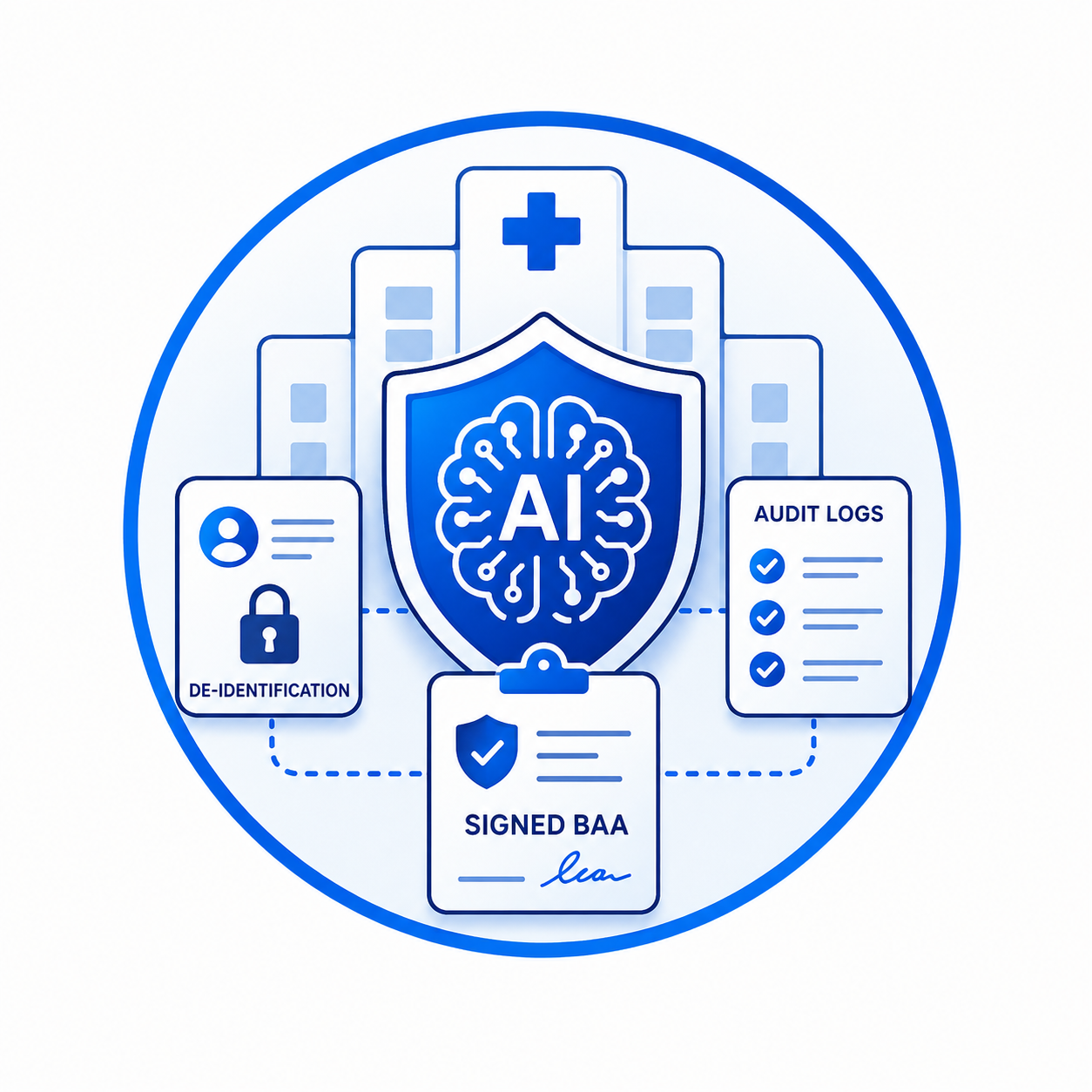
Build AI That Hospitals Actually Trust
From de identification to audit logs to a signed BAA, everything is wired in from the start. Share your idea and get an honest plan and timeline within hours.The Real Reason Most Healthcare AI Fails
Founders obsess over the model. Which one is smartest. Which one is cheapest. Which one signs a business associate agreement.
That is the wrong worry.
Picture a founder six weeks out from a hospital pilot. The demo works. The AI reads patient charts and drafts clean visit notes. Then the hospital security team sends a vendor questionnaire. Where do the embeddings live? Who signed a BAA for the vector database? Can you show an access log for one patient over the last ninety days? Three answers are missing. The pilot slips two quarters. Not because the AI was weak. Because the pipes were never built for PHI. We have watched this exact stall play out more than once.
The model is rarely the leak. The plumbing is. The same three gaps show up again and again, and none of them live inside the AI.
Gap one is the vector database. Teams sign a BAA with the model provider and feel safe. Then they load patient records into a vector store to power search or a chatbot. Those embeddings are built from PHI, so they carry the same legal weight as the source. If that store has no BAA and no encryption, you have a hole. This is the classic trap in RAG implementation, where the retrieval layer quietly becomes the riskiest part of the stack.
Gap two is the logs. Debug tools, error trackers, and dashboards love to save whatever passes through them. A prompt with a patient name lands in a third party logging tool that never signed a thing. Your monitoring stack is now a breach waiting to be found.
Gap three is memory. Chat agents that remember past turns hold PHI far longer than you meant. Broad data scopes make it worse. The agent can reach records it never needed.
The lesson is blunt. Pick the model last. Build the pipes first. A boring, locked down pipeline beats a clever model with leaks every time.
The Five Controls Every HIPAA Compliant AI Build Needs
Strip away the noise and HIPAA compliant AI comes down to five controls. Miss one and the rest will not save you.
| Control | What it means in plain words | Why it matters |
|---|---|---|
| Encryption | Scrambles data both at rest and in transit | If a laptop, server, or intercepted connection is compromised, the data remains unreadable. |
| Access Controls | Ensure only authorized users and systems can access PHI | Reduces the risk of unauthorized access, insider threats, and data breaches. |
| Audit Logging | Records who accessed, changed, or shared data and when | Creates an evidence trail for investigations, compliance audits, and security monitoring. |
| Signed Business Associate Agreement (BAA) | A legal agreement with every vendor that handles PHI | HIPAA requires BAAs; sharing PHI without one can itself be a compliance violation. |
| Data Minimization | Collect, store, and share only the minimum PHI needed | Reduces exposure, limits breach impact, and lowers compliance risk. |
Audit logs are not a nice to have. Keep them for six years, make them tamper proof, and store them apart from the raw patient data. That is the first thing an investigator will ask to see.
What Is a BAA and Why It Can Sink You
A business associate agreement is a contract that legally binds a vendor to protect PHI. It is not paperwork you file and forget. It is a chain. One broken link breaks the whole thing. Think about how many hands your data really passes through. Your app. The model provider. The cloud host. The vector store. Maybe a transcription tool. Each one needs a BAA. And each of their sub vendors needs one too. A gap anywhere upstream is a gap for you.
In 2026, a strong BAA does more than tick a box. It should stop the vendor from using your PHI to train or improve their models unless you say yes in writing. It should name the sub vendors who can see the data. It should set a clear breach notice window. It should spell out what happens to the data when the contract ends. Smart teams now add AI specific clauses too: audit rights, breach response times, and a heads up before the vendor changes the model under you. One more hard truth. Sharing PHI with a vendor who never signed a BAA is itself a violation. It does not matter if anything bad happens next. The moment the data leaves your control without that contract, the line is crossed. If a vendor will not sign one, they are not an option. Full stop.
For the official framing, HHS publishes sample business associate agreement provisions you can start from. Treat it as a frame, not a finished contract.
Which AI Models Can You Use With PHI in 2026
Plenty of models can handle PHI, but only through the right door. The paid, enterprise, and API routes sign business associate agreements. The free and consumer chat apps do not. That gap is where most accidents happen.
| AI Option | Safe for PHI? | What you need |
|---|---|---|
| Claude (via paid API, AWS Bedrock, or Google Vertex AI) | Yes | A signed BAA and zero data retention (or equivalent HIPAA-compliant settings) enabled. |
| Azure OpenAI Service or OpenAI Enterprise | Yes | A signed BAA and HIPAA-compliant configuration with the appropriate security settings. |
| Gemini through Google Vertex AI | Yes | A signed BAA and deployment within Google Vertex AI. |
| Self-hosted AI model in a private cloud | Yes | Your own security controls, including encryption, access controls, audit logging, and HIPAA-compliant infrastructure. |
| Consumer AI chat apps (free chatbots, ChatGPT Free/Plus/Team, etc.) | No | These tiers do not include a HIPAA BAA. Sending PHI through them is generally not HIPAA compliant. |
The pattern is simple. Enterprise and API paths with a BAA are fine. Consumer tabs are not. Block the consumer apps on your network and hand your team a sanctioned tool instead. That one move stops the most common failure of the year.
Building this the right way usually means custom work. See how we approach custom AI and ML development services for regulated products.
Where PHI Leaks in AI Apps
Most breaches are not dramatic hacks. They are quiet slips. Here is where they hide.
- The consumer app tab. A clinician pastes notes into a free chatbot. This is the top HIPAA failure of 2025 and 2026, and it turns up in six and seven figure settlements.
- The tracking pixel. An analytics tag on a booking page fires the patient IP and the visit type to an ad platform with no BAA. Every page load can become its own violation. This same pixel problem shows up in ADA compliance for US websites, so audit your front end too.
- The vector store. Embeddings built from PHI still count as PHI. No BAA or no encryption means a leak.
- The logging tool. Prompts with patient data get saved by a monitoring service that never signed a BAA.
- Over broad access. An agent set to “read only” can still reach far more records than its job needs.
- Sticky memory. Conversation memory holds PHI longer than intended.
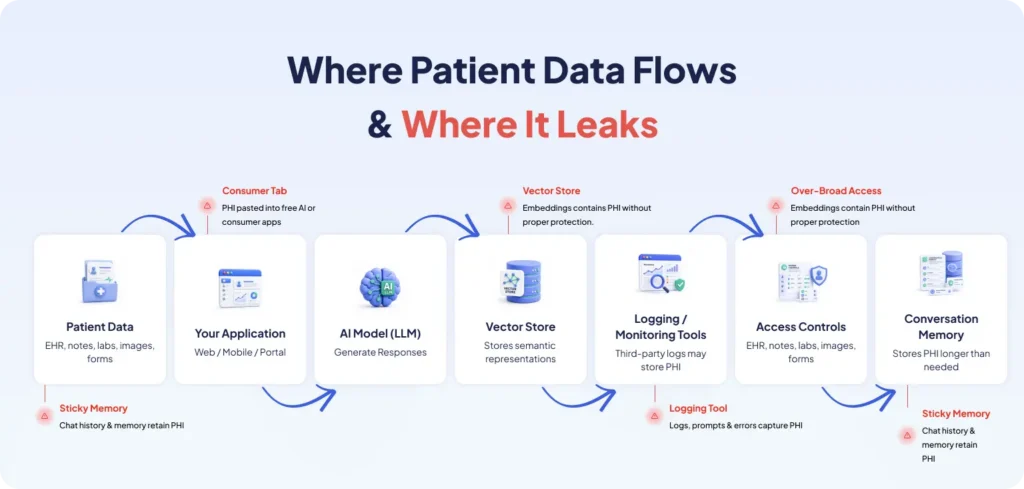
Fix these before launch, not after a breach. If your product connects to hospital systems, your API development has to respect the same minimum necessary rule as everything else. Broad data scopes are a fast way to fail an audit.
How to Handle Patient Data the Right Way: De Identification, FHIR, and Minimum Necessary
The safest PHI is the PHI you never send. Two ideas do most of the heavy lifting here.
Remove Identifiers When You Can
HIPAA gives you two accepted ways to strip health data of anything that points to a real person. The first is Safe Harbor: remove all eighteen listed identifiers, from names and dates to ZIP codes, record numbers, IP addresses, device IDs, and full face photos. The second is Expert Determination, where a qualified statistician certifies that the odds of re identifying someone are very small. Safe Harbor is a simple checklist. Expert Determination keeps more useful data. Many teams layer both. HHS explains the accepted paths in its guide to removing identifiers from health data.
One warning. Removing identifiers from a neat database column is easy. Doing it inside free text clinical notes, scanned PDFs, and image metadata is where teams slip. Check both the structured fields and the messy text. Miss one identifier and the whole dataset is no longer de identified.
Send The Minimum Necessary:
Some AI tools need live patient data and cannot use a scrubbed copy. A clinical assistant is one example. For those, design the system to pull only the exact fields the task needs. Nothing more. If you connect to hospital records through FHIR or HL7, the standards that health systems use to share data, do not grab a broad scope because it is convenient. A wide FHIR scope is one of the most common ways an AI tool quietly breaks the minimum necessary rule. Build FHIR pipelines that filter and de identify at the source, before data ever leaves the clinical system.
This discipline is the backbone of serious healthcare software development, and it is exactly the approach we used on the mental health therapy platform we built and on an emotion tracking app called Deepfeels.
The 2026 HIPAA Security Rule Update You Should Build For
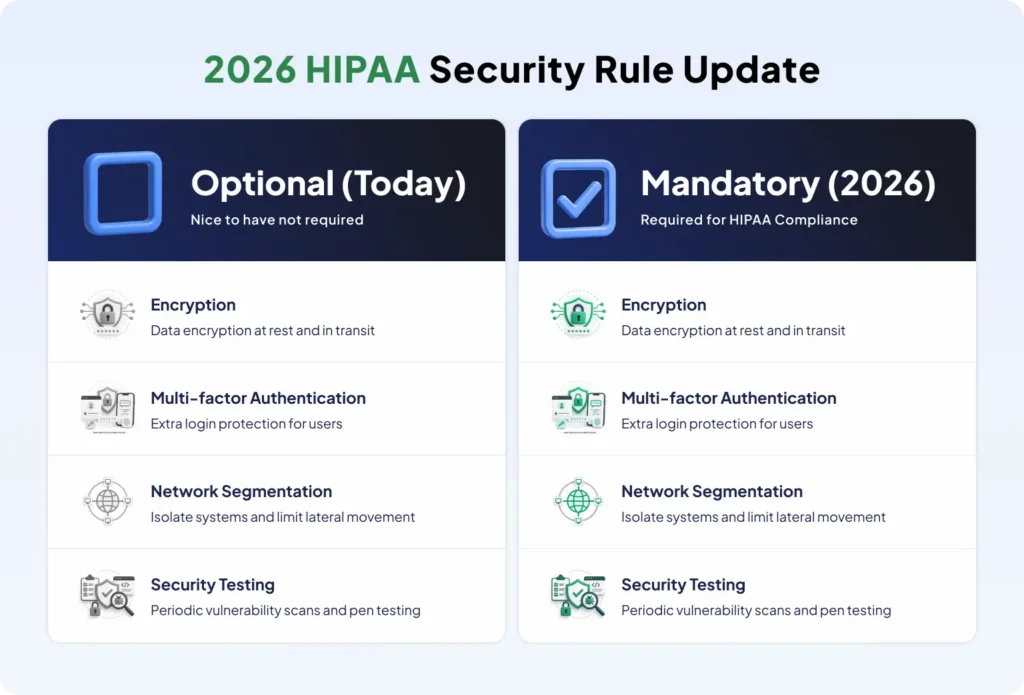
Here is a change many founders have not caught yet. In January 2025, HHS proposed the biggest overhaul of the HIPAA Security Rule in over twenty years. As of mid 2026 it is still proposed, not final, and the timing keeps moving. But the direction is clear, and most of it is smart to build now.
The proposal would turn today’s “optional” safeguards into hard requirements:
| Proposed Change | What it means for your build |
|---|---|
| Encryption becomes mandatory | Encrypt all ePHI at rest and in transit. Encryption is no longer optional or justified as impractical. |
| Multi-factor authentication (MFA) required | Require a second authentication factor for every user accessing systems that store or process ePHI. |
| Network segmentation | Isolate ePHI systems from the rest of your network to reduce the impact of security breaches. |
| Annual risk analysis | Perform a comprehensive security risk assessment every year, including evaluating AI systems and workflows. |
| Regular security testing | Schedule recurring vulnerability scans and penetration tests to identify and fix weaknesses. |
| Faster incident response | Detect, report, and respond to security incidents within defined timeframes using documented procedures. |
| Written system inventory | Maintain an up-to-date inventory of every system, application, vendor, and AI tool that stores, processes, or transmits ePHI. |
Two Practical Notes:
Once a final rule lands, teams are expected to comply within roughly eight months, and update their BAAs within a year. And the exact rules could still shift, so build to the spirit of it and watch for the final text. None of this is exotic. Encryption, MFA, and an asset list are baseline good practice. Building them in now means you are not scrambling later.
State AI Laws Add Another Layer of Rules
HIPAA is the floor, not the ceiling. States are moving fast, and a health app that serves users across the country has to meet the strictest rule that applies.
A few that matter in 2026. Texas now requires healthcare providers to tell patients when AI is used in their care. California requires a clear notice, plus a way to reach a human, when generative AI handles patient messages. Colorado passed a broad AI law, then rewrote it, with the newer version landing in 2027. Most of these state laws carve out covered entities and business associates acting within HIPAA, but the patient disclosure rules can still reach how you use AI in care.
Enforcement is real, not theoretical. Back in 2024, the Texas Attorney General settled with an AI clinical documentation company over how it described the accuracy of its tools. State attorneys general can also enforce HIPAA through their own consumer protection laws. So the risk is not only a federal fine. It is a patchwork, and it is growing.
HIPAA vs GDPR: Not the Same
If you serve US patients and EU users, you need both, not one.
HIPAA is a US law aimed at health data and the vendors who handle it. GDPR is a broad EU law covering all personal data, with its own rules like the right to be forgotten. Meeting one does not mean you meet the other. An AI product that spans both needs separate controls for each. Plan for that early, because retrofitting privacy is slow and painful.
What HIPAA Violations Cost in 2026
The numbers are not small, and HHS updated them in January 2026.
| Violation Tier | What it means | Maximum Civil Penalty (2026)* |
|---|---|---|
| Tier 1 | You did not know, and could not reasonably have known, about the HIPAA violation. | About $145 to $73,000 per violation |
| Tier 2 | You should have known about the violation, but there was reasonable cause and no willful neglect. | Higher penalties, often well into the tens of thousands per violation |
| Tier 3 | The violation resulted from willful neglect, but you corrected it within the required timeframe. | Significantly higher penalties, typically in the tens of thousands per violation |
| Tier 4 | The violation resulted from willful neglect and was not corrected. | Up to about $2.1 million per year |
And it gets worse than money. Knowing misuse of PHI can bring criminal charges, with penalties up to $250,000 and as much as ten years in prison. HHS raises these figures for inflation, so check the current numbers before you quote them.
The scale is real too. 2025 set a record with more than 770 large breaches, and over 275 million patient records were exposed in 2024. But the fine is often not the biggest cost. The breach notice, the lost hospital deal, and the broken trust usually hurt more.
What It Costs to Build HIPAA Compliant AI
Straight talk on budget, since this is what founders search for most.
| Build Type | Typical 2026 Cost | Rough Timeline |
|---|---|---|
| Lean HIPAA-Compliant MVP (one core workflow) | $40,000–$80,000 | 4–6 months |
| Mid-Size Platform with EHR integration | $150,000–$300,000 | 6–9 months |
| Enterprise AI Platform with full EHR integration | $300,000–$500,000+ | 7–12 months |
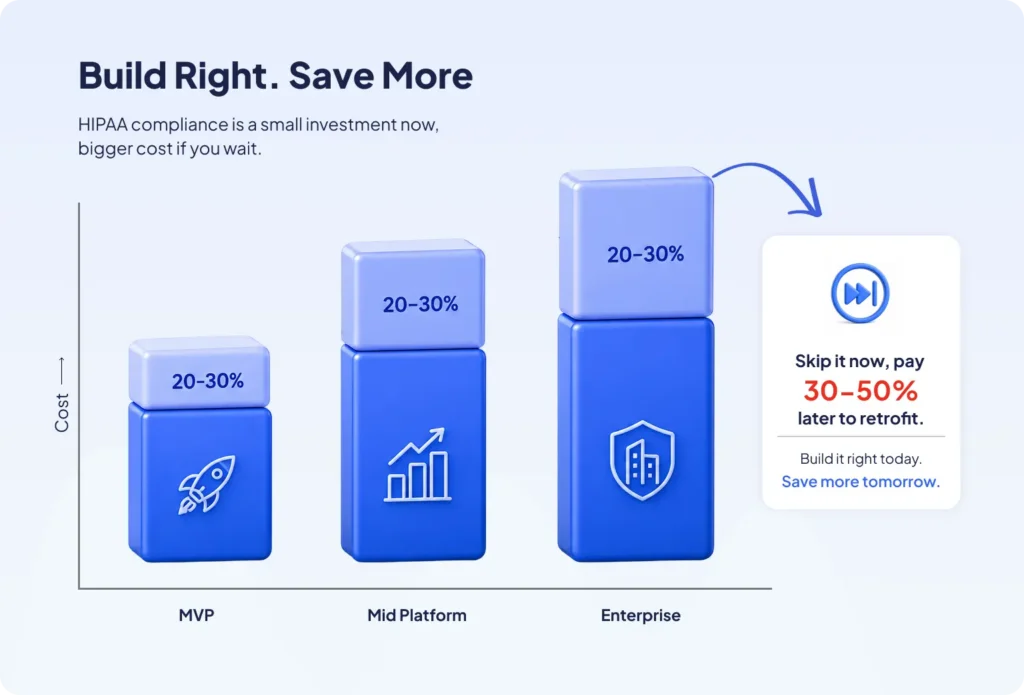
A few things that budget guides often bury. HIPAA compliance itself adds roughly twenty to thirty percent on most builds. Plan for maintenance at fifteen to twenty five percent of the build cost every year, since audits and updates never stop.
And here is the trap. Skipping compliance to get a lower quote is not a saving. It is a deferred bill. When a hospital security team finds the gap mid project, fixing it can cost thirty to fifty percent of the original build. Build compliance in from day one and you avoid that, and you can sell to health systems at all.
A skilled offshore team with real HIPAA experience can deliver the same compliant build for far less than a US only agency. That is a big part of how founders keep these budgets sane without cutting corners on security. We have shipped this kind of work, including a medical education platform used by thousands, as a custom software development company in the USA with an engineering team in India.
Build AI That Hospitals Actually Trust
From de identification to audit logs to a signed BAA, everything is wired in from the start. Share your idea and get an honest plan and timeline within hours.FAQS
Q: Is ChatGPT HIPAA compliant?
Not in its free, Plus, or Team tiers, because those do not come with a business associate agreement. The enterprise route, such as OpenAI Enterprise or Azure OpenAI with a signed BAA and the right settings, can be used for PHI.
Q: Can AI be HIPAA compliant at all?
Yes. But no model is compliant by itself. Compliance comes from the deployment: a signed BAA, encryption, access controls, audit logs, and sending the least data possible.
Q: Do I need a BAA with my AI vendor?
Yes, if that vendor creates, receives, or transmits PHI. Sharing PHI without a BAA is a violation on its own, even if nothing bad happens next.
Q: What counts as PHI in an AI app?
Any health data tied to a real person. A name with a diagnosis, a lab result with a phone number, an IP address that reveals a visit type, even a face in a photo. Embeddings built from that data count too.
Q: Can I use patient data to train my AI model?
Only with clear authorization or after removing identifiers the right way. Most standard BAAs block vendors from training on your PHI unless you allow it in writing.
Q: What is the difference between Safe Harbor and Expert Determination?
Safe Harbor is a checklist: remove all eighteen listed identifiers. Expert Determination uses a statistician to certify that re identification risk is very small. Safe Harbor is simpler. Expert Determination keeps more useful data.
Q: How much does a HIPAA violation cost in 2026?
Penalties run from around $145 per violation up to about $2.1 million per year for willful neglect that goes unfixed. Knowing misuse can also bring criminal charges.
Q: How much does HIPAA compliant AI development cost?
A lean, single workflow MVP usually runs $40,000 to $80,000. Mid platforms with EHR integration run $150,000 to $300,000. Full AI platforms with deep integration run $300,000 and up. Compliance adds roughly twenty to thirty percent.
Q: Is HIPAA compliant AI development more expensive than a normal app?
Yes, a bit more upfront to build the controls. Far less than a breach, a lost hospital contract, or a mid project scramble. Built early, it is an investment, not a tax.
Do not Miss Our Latest Tech Insights
Stay one step ahead in the fast-moving world of AI and technology. Add us as a Preferred Source on Google and get our latest articles, guides, and industry insights delivered straight to your search feed.