+1 740 762 6496
 +91 70189 46603


TABLE OF CONTENT
- What Is Agentic AI Travel Booking?
- How Autonomous Trip Agents Work
- Why Agentic AI Travel Booking Beats Old Booking Apps
- Must Have Features for AI Travel Booking Agents
- How to Build Autonomous Trip Agents
- Tech Stack for Travel Software Development with AI Agents
- Cost and Time to Build an Agentic AI Travel App
- Risks of Agentic AI Travel Booking and How to Fix Them
- Why Choose Auspicious Soft for Travel Software Development
- FAQs
Overview
- Agentic AI travel booking is software that plans, prices, and books a trip on its own, with one human approval at the end.
- The industry is racing in. Around 61 percent of travel firms are testing or scaling agentic AI, yet only about 2 percent of leisure travelers trust an agent to book for them.
- That trust gap, not model size, is the real contest. The approval step and visible guardrails are how you win it.
- Autonomous trip agents run a loop: goal, plan, tools, check, approve, book, watch.
- They beat old apps on search, price drops, rebooking, and personal fit.
- Start small, ground the agent with RAG, test with ugly inputs, and ship safety before features.
AI Summary:
Agentic AI travel booking uses autonomous trip agents that plan, price, and book travel on their own, pausing only for one human approval. Adoption is climbing fast among travel brands, yet only about 2 percent of leisure travelers trust AI to book for them, so the winning design pairs live data and strict guardrails with a visible approve step. Auspicious Soft builds these trip agents from first plan to launch.
Here is the strange part of travel tech right now. Big travel brands are pouring billions into AI that can book a whole trip for you, and yet only about 2 percent of leisure travelers say they would actually let it (Skift, 2026). That gap is the entire game. Agentic AI travel booking is software that plans, prices, and books a trip on its own, then stops and waits for you to approve before it spends a cent. Built well, it wipes out the busywork of twenty open tabs without stealing your control. This guide covers what these agents are, how they work, how to build one, and the single thing most teams get wrong. Short version up front: the winners will not be the brands with the flashiest AI. They will be the ones that earn enough trust to press book.
What Is Agentic AI Travel Booking?
Start with what it is not. A chatbot talks. A filter button reacts to a click. Neither one acts. An agent acts. Agentic AI travel booking means software that reads a goal, builds a plan, calls real booking tools, checks its own work, and only then hands you a finished trip to approve.
Picture a travel agent who never sleeps, never forgets your aisle seat, and never stops watching the fare. That is the target. The tech underneath is new, but the job is old. For the groundwork, see AI agents for business and the real agentic AI development cost teams budget for.
Build Your Own Autonomous Trip Agent?
Get a free plan and a quote this week.How Autonomous Trip Agents Work
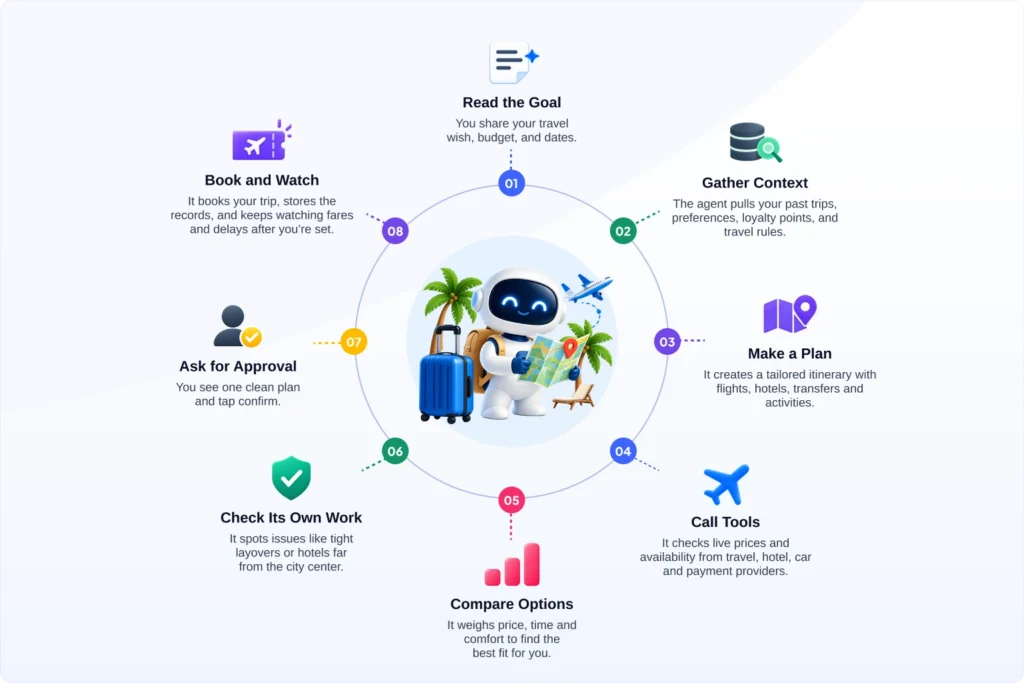
Strip away the hype and an autonomous trip agent is just a loop that repeats until the trip holds together.
- Read the goal. Someone types a wish, say a quiet beach week under 1200 dollars in May.
- Gather context. The agent pulls past trips, loyalty points, visa rules, and the dates that actually work.
- Make a plan. It breaks the wish into moves: pick a city, find flights, match a hotel, add transfers.
- Call tools. It hits flight, hotel, car, and payment APIs for live prices and real seats.
- Reason and compare. It trades off price, time, and comfort against the budget and the rules.
- Check its own work. It catches the tight layover and the hotel that sits an hour from the center.
- Ask for approval. You see one clean plan and tap confirm.
- Book and watch. It books, files the records, and keeps watching fares and delays after you close the app.
Want the engineering view of that loop? Here is how to build custom AI agents for business.
Why Agentic AI Travel Booking Beats Old Booking Apps
Here is the opinion, stated plainly. Old booking apps dump the work on the traveler and sell that as freedom. Twenty tabs, three airline sites, a scratch spreadsheet of hotel prices. That is not freedom. It is unpaid labor. Agentic AI travel booking takes the labor and leaves the control, which belongs exactly where it already sits, at the approve step.
The market already believes this. Research from Phocuswright in 2026 put most travel firms, roughly 61 percent, at experimenting with or scaling agentic AI, and IDC projects up to 30 percent of bookings could run through agents by 2030. Trust, though, has not caught up. Only about 2 percent of leisure travelers will hand an agent full booking power today, a tension Skift has reported at length. So the prize is not a smarter bot. The prize is the design that closes that trust gap.
The table shows where the old flow loses.
| Job To Be Done | Old Booking App | Autonomous Trip Agent |
|---|---|---|
| Search and compare | You do it by hand | Agent does it in seconds |
| Price Drops | You check and rebook | Agent watches and acts |
| Flight Delay or Cancel | You fix it on the phone | Agent rebooks and pings you |
| Personal Fit | Same list for everyone | Plan shaped to the traveler |
| Checkout Drop-Off | High, people bail | Low, one approve step |
The product lessons carry straight over from regular travel apps. See travel app development in 2026 and these tips to build a travel app that users love.
Must Have Features for AI Travel Booking Agents
Trust gets built or broken in the details below. Cut a corner here and the user feels it on the very first trip.
| Feature | What It Does | Why It Matters |
|---|---|---|
| Goal Input in Plain Words | Turns a wish into a task | Drops the effort to near zero |
| Live Data From Booking APIs | Pulls real fares and rooms | Kills stale and fake prices |
| Budget and Policy Guardrails | Blocks risky or costly picks | Keeps spend and rules in line |
| Human Approval Step | Shows one plan to confirm | This is how you earn the book |
| Memory of Past Trips | Learns taste over time | Every plan gets sharper |
| Live Rebooking | Handles delays and drops | Saves the trip while you sleep |
The same booking depth shows up in hotel booking app development, where rates and room counts shift by the minute.
How to Build Autonomous Trip Agents
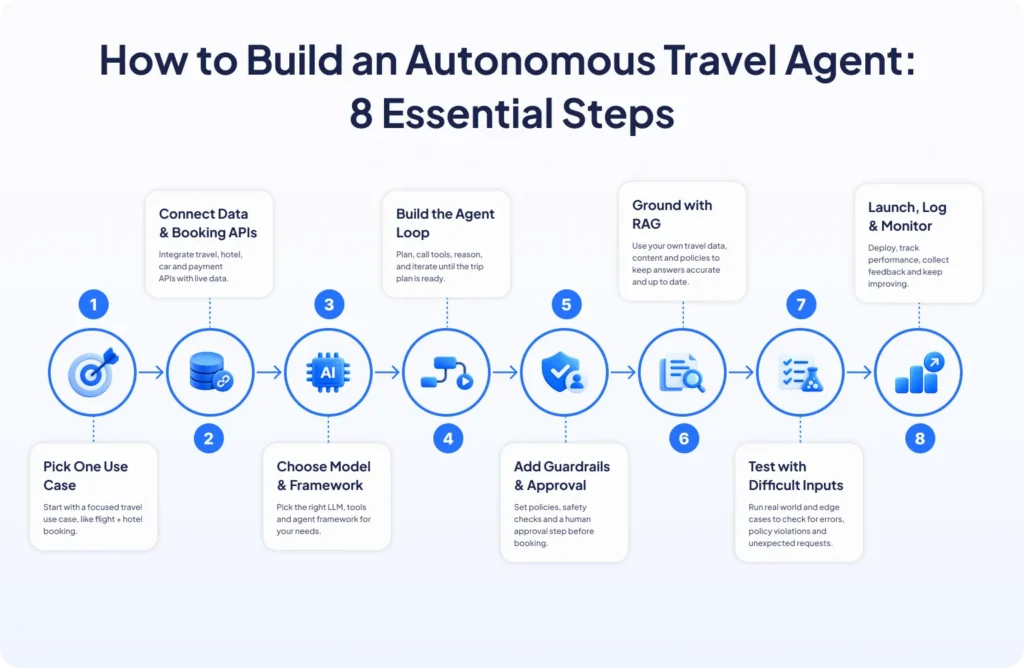
The common mistake is reaching for the biggest model first. A good agent is mostly plumbing, guardrails, and taste. Work in this order.
- Pick one sharp use case. Flights plus hotels beats trying to boil the ocean on day one.
- Connect your data and booking APIs. Wire in GDS, NDC, hotels, cars, and payments.
- Choose a model and an agent framework. Fit the model to the task, the latency, and the bill.
- Build the agent loop with tools. Give it clean tools and let it plan and call them. The OpenAI function calling guide lays out the base pattern.
- Add guardrails and the approval step. Cap spend, enforce policy, and keep a human on the final tap.
- Ground it in your real rules. Use LLM and RAG development so the agent quotes actual fare rules instead of guessing, and plan the RAG implementation cost up front.
- Test it with ugly inputs. Break it on purpose before a traveler does.
- Launch, log, and watch. Record every action so you can trace a problem and tune from real trips.
Clean APIs decide whether any of this holds up. Here is our take on API development, and for the full build, our AI agent development services.
Tech Stack for Travel Software Development with AI Agents
The stack stays lean. Every piece earns its spot.
- Model layer: a capable LLM to plan and to read plain language.
- Agent framework: the part that runs the plan, call, check loop.
- Tool protocol: the Model Context Protocol gives the agent a tidy way to reach your tools.
- Knowledge layer: a vector store plus RAG for fare rules, visa notes, and brand policy.
- Booking data: GDS plus the IATA NDC standard for live air content, with hotel and car APIs alongside. For a sense of scale, Sabre, PayPal, and Mindtrip announced an end to end agentic booking setup in 2026 running on APIs that reach 420 plus airlines and 2 million plus hotels.
- Payments: a gateway built for holds, captures, and clean refunds.
- Watch layer: logging and alerts on every single action the agent takes.
The backbone is solid AI and ML development services, joined by generative AI development and careful AI integration into the systems you already run. New to the model side? Begin with LLM app development.
Cost and Time to Build an Agentic AI Travel App
Cost tracks scope, nothing else. A tight pilot that books flights and hotels is one budget. A full agent across air, stay, cars, and live rebooking is a different animal. A first version often lands in a few months, then grows feature by feature as you learn what travelers will trust.
Skip the guesswork and plan from real ranges. Look at the travel booking software development cost, the wider travel app development cost, and the cost to build a travel app like Hopper. On the AI side, weigh the AI agent integration cost, the custom software development cost, and how long AI development takes.
Risks of Agentic AI Travel Booking and How to Fix Them
Software that spends real money deserves real caution. None of the risks are scary once you name them, and each one has a fix.
- Wrong or invented bookings. Fix it with live data, strict tools, and a human approval step.
- Overspend. Fix it with hard budget caps the agent simply cannot cross.
- Policy breaks. Fix it with RAG-grounded rules and clear blocks.
- Thin trust. Fix it with a plain plan view, so the traveler sees the moves before the agent makes them.
- Silent failures. Fix it with full logs and alerts on every action.
Ship the guardrails first and the features second. Remember the 2 percent. Travelers will not hand over the book button until the safety work is visible, so build that part like your brand depends on it, because it does.
Why Choose Auspicious Soft for Travel Software Development
Auspicious Soft has shipped custom apps, web platforms, and AI systems since 2018 for startups and large firms across India and the USA. Travel runs deep here. The team blends serious Travel Software Development with hands on agent work, so your trip agent launches fast and, more to the point, launches safe.
Build Your Own Autonomous Trip Agent?
Get a free plan and a quote this week.FAQs
Q: What is agentic AI travel booking in simple words?
It is travel software that does the work for you. It plans the trip, checks live prices, and books it, while you only approve the final plan.
Q: How is an autonomous trip agent different from a chatbot?
A chatbot answers. An agent acts. It calls real booking tools, compares live options, and finishes the booking, not just the conversation.
Q: Is agentic AI travel booking safe for payments?
Yes, when it is built right. Hard budget caps, a human approval step, and a secure payment gateway keep both the money and the data safe.
Q: Can an agent rebook me when a flight is delayed?
Yes. A good agent keeps watching your trip, rebooks fast when something breaks, and tells you exactly what it changed.
Q: How long does it take to build one?
A first version usually takes a few months. The real driver is scope and how many booking APIs you connect.
Q: Does it work with real airline and hotel data?
Yes. Agents plug into GDS, NDC air content, and hotel and car APIs for live prices and real seats.
Q: Who can build an autonomous trip agent for my brand?
A team that knows both travel and AI. Auspicious Soft builds these agents from first plan to launch. For the wider picture, read our AI trends in 2026 guide.
Do not Miss Our Latest Tech Insights
Stay one step ahead in the fast-moving world of AI and technology. Add us as a Preferred Source on Google and get our latest articles, guides, and industry insights delivered straight to your search feed.