+1 740 762 6496
 +91 70189 46603


TABLE OF CONTENT
- What Is Travel Booking Software Development
- White Label vs Custom Booking Engine: Which One Fits You
- How Much Does Travel Booking Software Development Cost in the USA
- What Drives the Price Up or Down
- The Booking Engine Features Travelers Actually Want
- GDS, OTA, and API Integrations: The Real Core of the Build
- AI Features That Give Your Booking Engine an Edge
- A Quick Look at What a Real Build Feels Like
- How to Build a Custom Booking Engine, Step by Step
- The Tech Stack Behind a Strong Booking Engine
- Payment Security and Compliance You Cannot Skip
- How Long Does Travel Booking Software Development Take
- Mistakes That Sink Travel Software Projects
- How to Choose a Travel Software Development Company
- Why Teams Pick Auspicious Soft for Travel Software Development
- FAQs
Overview
Key Takeaways
- Travel booking software development builds a booking engine around your suppliers and brand, not a rented template.
- US cost runs from about $35,000 to $150,000 and up, and higher for AI or enterprise builds.
- Most projects ship in 3 to 12 months.
- Supplier integrations and secure payments are the real core of the build.
- AI tools like dynamic pricing and a trip assistant are now a true edge, not a gimmick.
- Start lean with one niche, prove it, then scale.
AI Summary:
Travel booking software development means building your own booking engine, shaped around your suppliers, your rules, and your brand. In the US, it usually costs $35,000 to $150,000 and up, and takes 3 to 12 months. The price depends on features, the suppliers you connect, and whether you add AI.
Travelers decide in seconds. Slow search, a clunky checkout, or a booking that fails, and they are gone to the next site.
That is the whole game. Your booking engine is not a back office tool. It is the storefront, the salesperson, and the cash register all at once. If you are weighing travel booking software development, you are really asking one thing. How do you build a booking flow that converts and still turns a profit after the fees?
What Is Travel Booking Software Development
A booking engine is the software that lets people search, pick, pay, and confirm a trip. Flights, hotels, cars, tours, or all of them together.
Travel booking software development means you build your own instead of renting a fixed one. You own the code and the data. You choose which suppliers to connect. The flow fits how you sell, not how a vendor forces you to sell.
This is the route OTAs, travel agencies, tour operators, and travel startups take once they get serious. Each one sells trips in a different way. A locked template fights that difference at every turn.
White Label vs Custom Booking Engine: Which One Fits You
Let us clear this up first, because it is the biggest early decision.
A white label or ready made engine is fast. You sign up, add your logo, and launch in weeks. For testing an idea, that is smart. But you are stuck with their suppliers, their features, and a cut of every booking. Those commissions quietly eat your margin for years.
A custom engine costs more upfront and pays you back in control and profit. You keep more of each sale. You connect any supplier. You add the exact feature a client asks for. Here is the honest side by side.
| What Matters | White Label Engine | Custom Booking Engine |
|---|---|---|
| Upfront cost | Low | Higher |
| Long term cost | Ongoing fees and per booking cuts | Flatter, and you keep more |
| Features | Fixed menu | Anything you need |
| Supplier choice | Locked to their network | Connect any GDS or API |
| Branding | Limited | Fully yours |
| Your data and code | Theirs | Yours |
| Best for | Quick launch and testing | Scale, margins, and products |
If you plan to grow, protect your margin, or build a real travel product, custom wins. For a quick throwaway launch, white label is fine. Want the wider view? Read our take on custom software vs off the shelf software.
Build The Booking Engine Travelers Won’t Leave
Lightning-fast search, AI trip assistant, one-click checkout. We build it around your brand and suppliers.How Much Does Travel Booking Software Development Cost in the USA
This is the first number every buyer wants. So here are fair ballpark ranges for the US market.
| Type | Best For | What You Get | Typical US Cost | Time |
|---|---|---|---|---|
| Starter booking engine | Small agencies, one supplier type | Search, availability, booking, payments, basic admin | $35,000 to $65,000 | 3 to 5 months |
| Growth booking platform | Mid size OTAs, tour operators | The above plus multi supplier support, GDS or API links, user accounts, a channel manager | $65,000 to $150,000 | 5 to 8 months |
| AI or enterprise platform | Large OTAs, travel products | The above plus AI pricing, a trip assistant, fraud tools, and deep analytics | $150,000 to $400,000 and up | 8 to 12 months and up |
These are estimates, not quotes. Your real figure moves with scope. For the pricing logic behind any build, see our guide on custom software development cost. If you want to launch a lean first version to test demand, the SaaS MVP cost guide helps too. For travel-specific numbers, our travel app development cost breakdown is a useful sister read.
What Drives the Price Up or Down
Five things decide your final cost. Know them before you ask for a quote.
- Suppliers. One hotel feed is simple. Flights, hotels, cars, and tours together is a bigger job.
- Integrations. Each GDS, bed bank, or payment link adds build time.
- AI. Smart pricing and a trip assistant cost more, but they lift bookings.
- Traffic. A site for a few hundred users is lighter than one for peak season crowds.
- Design. A plain flow is cheap. A rich, branded one takes more craft.
Tight on budget? Trim the supplier list first. Launch one niche well. Add more later. A good team tells you what to cut, and that call can save you a fortune.
The Booking Engine Features Travelers Actually Want
Put yourself in a traveler’s seat for a second. They want it fast, clear, and trustworthy. These are the real must haves.
- Fast search with smart filters for dates, price, type, and location
- Real time availability and pricing, with no nasty surprises at checkout
- A secure checkout with several payment options
- Easy booking management to view, change, cancel, or refund
- Multi supplier support so one search shows the best options
- User accounts with booking history
- An admin dashboard with clear reports
- Automatic emails for confirmations and reminders
- A mobile friendly design that feels right on a phone
- Reviews and ratings to build trust
Here is a small opinion that saves lost sales. Do not bury the cancellation and refund flow. Travelers check it before they trust you with a card. A clear, fair policy on screen lifts conversions more than most people expect. For more on this, see our tips to build a travel app that users love.
GDS, OTA, and API Integrations: The Real Core of the Build
This is the part that makes travel software hard, and it is where the value sits.
Your engine is only as good as the content behind it. That content flows in through connections. Get these right and your platform feels alive. Get them wrong and it feels empty.
Here is what usually plugs in:
- Global Distribution Systems like Amadeus, Sabre, and Travelport for flights and more
- Bed banks and channel managers for hotel inventory
- Airline content through the IATA airline distribution standards
- Payment gateways such as Stripe and PayPal
- Maps, reviews, and a CRM to round out the trip
Most of this runs on clean, well built connections, which is why strong API development services matter so much. If you want the full picture, our complete guide to API development goes deeper.
Build The Booking Engine Travelers Won’t Leave
Lightning-fast search, AI trip assistant, one-click checkout. We build it around your brand and suppliers.AI Features That Give Your Booking Engine an Edge
More than half of all travel bookings now happen online, and that share keeps climbing. At the same time, AI is quietly changing how people search and pay. So this is where you can pull ahead.
The weak platforms bolt AI on at the end. The strong ones build around it. Big difference, and travelers feel it.
Here are the AI features worth the spend, framed by what they do for your business:
- Dynamic pricing. Prices shift with demand, so you protect margin on busy dates and fill empty ones.
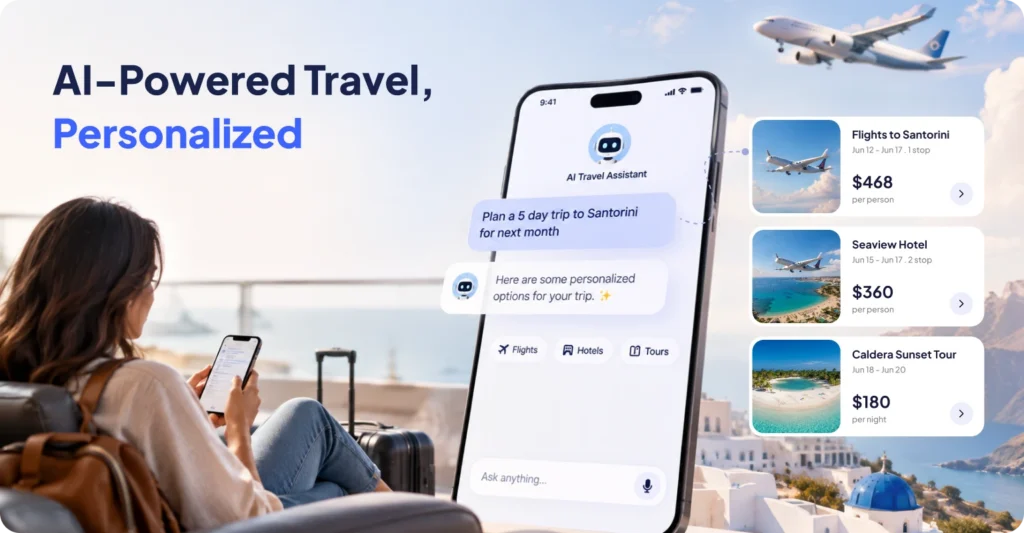
- An AI trip assistant. Travelers chat to plan and book, instead of clicking through ten pages. You can power this with AI chatbot development.
- Personalized results. The engine learns tastes and shows the right trips first.
- Fraud detection. AI flags risky bookings before they cost you money.
- Demand forecasting. You stock the right inventory for the season ahead.
- Agentic booking. AI can book, rebook, and refund inside your rules, with less staff time. See how we build custom AI agents for business.
AI in travel has moved past the pilot stage. Big players are wiring it straight into search and checkout, which means buyers now expect it. The build sits on proven AI and ML development services, so the smarts are solid, not a toy.
A Quick Look at What a Real Build Feels Like
Picture a mid size tour operator losing money to a white label tool. Three pains stood out. Commissions ate their margin on every booking. They could not add a custom package builder clients kept asking for. And peak season traffic slowed the site to a crawl.
A custom booking engine solved all three. No more per booking cuts, so margins jumped. The package builder shipped in weeks. A better cloud setup held firm through the busy season. Bookings rose, and so did repeat customers. That is the shape most projects take. A few sharp pains, then a platform that fixes them.
How to Build a Custom Booking Engine, Step by Step
No fluff. This is the path that works.
- Pick your niche and suppliers. Flights, hotels, tours, or a mix. Start focused.
- Choose core features. Keep it lean. Build a small, useful version first.
- Map the booking flow. Sketch every screen from search to confirmation.
- Set up integrations. Connect your GDS, inventory, and payment tools.
- Build the core, then the AI. Ship the base. Layer smart features on top.
- Test payments and security hard. This is travel. Money and trust are on the line.
- Launch and optimize. Watch the data, fix drop offs, and grow from there.
The classic trap is trying to sell every trip type on day one. That path drains cash and stalls. Launch one niche. Win it. Then expand.
The Tech Stack Behind a Strong Booking Engine
Keep it modern and proven. A safe, common mix looks like this.
- Front end: React, Next.js, or Vue
- Back end: Node.js, Laravel, or Python
- Database: PostgreSQL, MySQL, or MongoDB
- Cloud: AWS, Azure, or Google Cloud, through cloud based application development
- Integrations: GDS APIs, payment gateways, and airline content feeds
- AI layer: large language models, pricing models, and retrieval tools
Pick the stack that fits your plan and your traffic, not the latest trend. The right choice is one you can scale and hire for later.
Payment Security and Compliance You Cannot Skip
This part is dull until a card gets stolen or a lawsuit lands. So handle it early.
If you take card payments, you must follow the PCI DSS payment security standards. No exceptions. Your site should also meet WCAG accessibility standards, since travel sites in the US face real accessibility claims. Building this in from the start is cheap. Bolting it on later is slow and painful. Smart teams plan for it on day one.
How Long Does Travel Booking Software Development Take
Short answer: 3 to 12 months for most projects.
A starter engine is quicker. A multi supplier, AI heavy platform takes longer, because integrations and payment testing eat time. For a closer look at the AI side, see our guide on how long AI development takes.
Want it sooner? Launch with one supplier type. Ship the core. Add the rest in phases.
Build The Booking Engine Travelers Won’t Leave
Lightning-fast search, AI trip assistant, one-click checkout. We build it around your brand and suppliers.Mistakes That Sink Travel Software Projects
A few traps drain good budgets. Dodge these and you are halfway to a win.
- Outgrowing white label too late. Switching after you scale is costly. Plan for custom early if growth is the goal.
- Ignoring mobile. Most trips get booked on a phone. Design for that first.
- Weak payment security. One breach can end a travel brand. Never cut here.
- No multi supplier plan. One empty feed makes the whole site feel thin.
- Chasing the cheapest bid. The lowest quote often becomes the priciest project once rework piles up.
How to Choose a Travel Software Development Company
The wrong partner is the most expensive choice you can make. So vet them hard.
Look for these:
- Real travel or OTA work in their portfolio
- True experience with GDS and API integrations
- Proven AI skills, not just buzzwords
- Strong payment and security know how
- Clear pricing and steady communication in your time zone
Our guide on how to choose a software development company digs deeper. If you need skilled people fast, you can hire a dedicated development team in the USA, and the cost to hire dedicated developers guide shows what to budget.
Why Teams Pick Auspicious Soft for Travel Software Development
Auspicious Soft builds custom booking engines that scale. Founded in 2018, with teams in India and the USA, the company ships web platforms, custom software, and AI tools for travel startups and large brands alike.
What you get is simple. Honest pricing. A dedicated team that stays with you. And full support from first idea to launch and beyond. See the full travel software development offer, browse the wider software development services, or look through our software development case studies to see the work.

FAQs
Q: How much does it cost to build travel booking software?
In the US, most builds run from $35,000 to $150,000 and up. The price depends on suppliers, features, and AI.
Q: How long does travel booking software development take?
Usually 3 to 12 months. A starter engine is faster. A multi supplier, AI driven one takes longer.
Q: What is a travel booking engine?
It is the software that lets people search, pick, pay for, and confirm a trip, whether flights, hotels, cars, or tours.
Q: Custom or white label, which is better?
Custom wins for growth, margin, and control, because you own it and keep more of each booking. White label is fine for a quick test.
Q: Can my engine connect to Amadeus or Sabre?
Yes. A custom build can integrate with major GDS networks and other supplier APIs to pull live content and pricing.
Q: Can AI be added to a booking engine?
Yes. You can add dynamic pricing, a trip assistant, personalization, or fraud tools to a new or existing platform.
Q: Is it secure for card payments?
It should be. A proper build follows PCI DSS from the start, so payments stay safe and compliant.
Q: Can one platform handle flights, hotels, and cars together?
Yes. With the right integrations, a single search can show options across many suppliers and trip types.
Q: Can it handle heavy, seasonal traffic?
Yes. Built on the right cloud setup, it can scale from quiet months to peak season crowds without crashing.
Do not Miss Our Latest Tech Insights
Stay one step ahead in the fast-moving world of AI and technology. Add us as a Preferred Source on Google and get our latest articles, guides, and industry insights delivered straight to your search feed.