+1 740 762 6496
 +91 70189 46603

TABLE OF CONTENT
- What Is AI Agent Integration?
- AI Agent Integration Cost in 2026: The Real Numbers
- What Drives Your AI Agent Integration Cost?
- AI Agent Integration Cost: Buy vs Build
- Real Platform Pricing: What Salesforce Agentforce Costs in 2026
- The Hidden Costs Behind the AI Agent Integration Price
- A Real AI Agent Integration Cost Example
- How to Lower Your AI Agent Integration Cost
- 7 Questions to Ask Before You Pay for an AI Agent
- Where US Businesses Waste Money on AI Agents
- FAQs
Overview
- AI Agent Integration cost in 2026 spans roughly $50 per month to $150,000 or more for a custom build.
- Gartner puts the integration work at $1,000 to $1,500 per agent, and up to $2,000 for complex ones.
- Most US business websites spend $500 to $5,000 per month once the agent runs.
- The sticker price is almost never the real price. Setup, upkeep, data, and usage all stack on top.
- Buy a platform for a fast, cheap start. Build custom when you need deep control, your own data, or real scale.
- Even the best agents solve about half to two thirds of chats alone. Keep a human in the loop.
AI Summary
In 2026, AI Agent Integration cost for a US business website runs from about $50 per month for a simple bot to $150,000 or more for a full custom build. Most small and mid size sites spend $500 to $5,000 per month once the agent is live and doing real work. Gartner pegs the integration work alone at $1,000 to $1,500 per agent, and up to $2,000 for the tricky ones.
That spread is not marketing fluff. What you pay depends on a short list of choices you make before anyone writes a line of code. This guide turns AI Agent Integration cost into plain numbers, shows real platform pricing, and points out where US businesses quietly burn money. Auspicious Soft is a US focused software development company that builds and wires up these agents, so the figures here come from real projects and public data, not a wishlist.
Ask ten vendors what an AI agent costs. You get ten different numbers. One says fifty bucks a month. One says half a million. Both can be right, and that gap is the whole problem.
What Is AI Agent Integration?
An AI agent is software that acts. Not just chats. Acts. It reads a question, picks an answer, then takes a step for you. Book a slot. Pull an order. Send a hot lead to sales. A plain bot talks and stops. An agent finishes the job.
AI Agent Integration means wiring that agent into the tools you already run. Your website. Your help desk. Your CRM. Your payment stack. That wiring is the part that costs money, not the chat box. A basic bot answers FAQs. AI powered chatbots go further and can qualify a lead. A real agent takes action across your systems.
This is not a lab demo anymore. Big platforms ship real agents today. Salesforce Agentforce runs inside sales and service teams, and Anthropic computer use agents can click through software on their own. Gartner expects one in three enterprise software tools to include agentic AI by 2028. The tech is here. The bill is the part people trip on.
AI Agent Integration Cost in 2026: The Real Numbers
Here is the honest lay of the land. These figures reflect what US businesses pay in 2026, split by the type of agent.
| Type of AI Agent | What You Get | Typical 2026 Cost |
|---|---|---|
| No-Code or SaaS (Small Business) | FAQ bot, lead capture, simple routing | $50–$200/month |
| Mid-Tier SaaS | Natural language, CRM integration, multi-channel support | $500–$2,000/month |
| Enterprise SaaS | Deep integrations, SLAs, compliance, enterprise security | $1,000–$10,000/month |
| Pay-Per-Resolution | Charged only when the AI agent successfully resolves a conversation | $0.50–$6 per resolved chat |
| Custom Rule-Based Build | One-time custom development for simple workflows and automation | $5,000–$30,000 (one-time) |
| Custom AI Agent Build | Deep integrations, custom workflows, proprietary data, AI reasoning | $75,000–$150,000 (one-time) |
| Advanced Enterprise Build | Multi-agent systems, enterprise automation, complex integrations | Up to $500,000+ (one-time) |
Why spend at all? The math still works for most sites. By 2026, Gartner expects conversational AI to cut contact center labor costs by about $80 billion, since labor eats up to 95% of what a support desk costs. The wider market backs the trend too. Statista Market Insights puts the global AI market near $244 billion in 2025, on the way to over $800 billion by 2030, with the US as the single largest slice. Demand keeps rising, vendors keep bolting on features, and the price spread keeps stretching.
What Drives Your AI Agent Integration Cost?
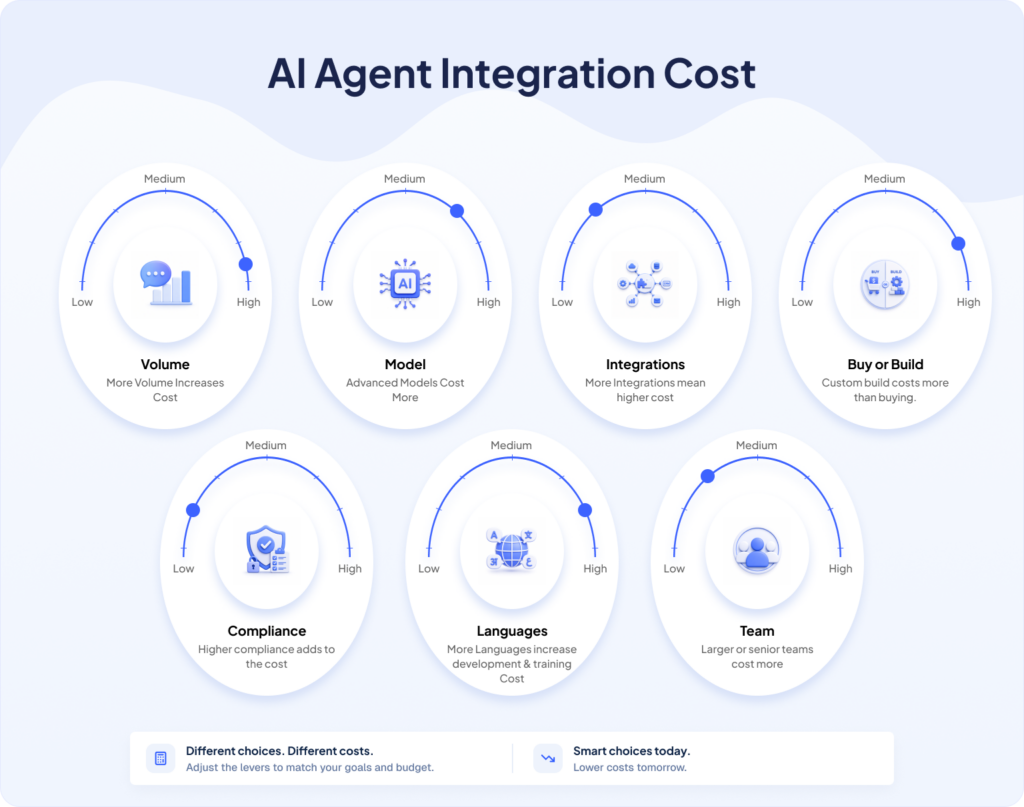
Two sites can pay wildly different amounts for the same idea. These are the levers that move the number:
- Chat volume. A site with 500 chats a month is cheap. One with 50,000 is not. Volume drives almost everything on usage plans.
- Model choice. A light model costs pennies. A top model with reasoning costs more per reply. Small pick, big monthly swing.
- Number of integrations. One tool is easy. Wiring the agent into five systems is where the hours pile up.
- Buy or build. Rent a platform and pay monthly. Build your own and pay upfront, then keep paying to run it.
- Compliance. HIPAA, SOC 2, and finance rules add testing, guardrails, and cost. Skip them and you cannot ship in some fields.
- Languages and channels. English on the web only is one price. Five languages across web, WhatsApp, and app is another.
- The team. A custom build leans on senior engineers, and the cost to hire dedicated developers shapes a big chunk of the final bill.
Agents do not live only on websites either. Plenty of US brands drop them into apps, which folds into mobile app development budgets. And a clean handoff needs a site that can host it well, so web development and agent work often ship as one project.
AI Agent Integration Cost: Buy vs Build
This is the fork in the road. Rent, or own. Both work. They just fit different needs.
| Factor | Buy a Platform | Build Custom |
|---|---|---|
| Upfront Cost | Low, $50–$200/month | High, $5,000–$150,000+ |
| Time to Launch | Days | Weeks to months |
| Control | Limited to what the platform allows | Full, top-to-bottom control |
| Ongoing Cost | Predictable subscription | Maintenance, infrastructure, and usage costs |
| Data & Privacy | Data lives on the vendor's infrastructure | Data stays within your own environment |
| Best For | Fast deployment and simple business needs | Deep customization, scalability, and unique workflows |
The short read. Buy first if you just need to answer questions and grab leads. Build when the agent must do something no platform does, or when your data cannot leave the building. Renting an enterprise plan forever can quietly cost more than a build would have. A custom agent is really an AI project, which sits under AI and ML development services. For a look at a shipped AI product, see the AI chat app we built.
Real Platform Pricing: What Salesforce Agentforce Costs in 2026
Ranges are useful. Real prices are better. Here is what one of the biggest AI agent platforms charges right now, straight from public 2026 pricing.
| Salesforce Agentforce Model | Price | Good For |
|---|---|---|
| Foundations (Free Tier) | $0 to test | Trials, proofs of concept, and small pilots |
| Per Conversation | About $2 per conversation | Predictable traffic with a steady number of conversations |
| Flex Credits | About $500 per 100,000 credits (≈ $0.10 per action) | High-volume automation with many action steps |
| Per User License | From $125 per user/month | Teams that prefer flat monthly licensing over usage-based billing |
Now the catch, and this is the number most buyers miss. Agentforce leans on Salesforce Data Cloud, which starts near $60,000 per year and often climbs past $100,000. Independent 2026 write ups peg a real mid market year one at $50,000 to $250,000 once you add setup, the platform, and usage. Rollouts often take five to eleven months, and fewer than one in ten buyers report it fully scaled. The point is simple. The headline price and the real price are two different animals.
The Hidden Costs Behind the AI Agent Integration Price
Here is the part vendors skip on the sales call. The number on the homepage is the start, not the finish. One 2026 service report found real chatbot costs landed at about 2.3 times the listed subscription over a full year. Plan for these:
| Hidden Cost | Typical Cost |
|---|---|
| Upkeep on a Custom Build | 15%–20% of the original build cost per year |
| Integration Maintenance | $500–$1,500 per month |
| Data Plumbing & Vector Database | From $50/month, increasing with data volume and scale |
| Model & API Usage | Usage-based (metered), with higher costs during heavy-traffic months |
| Human Backup Seat | $29–$169 per month, plus employee salary or staffing costs |
That data plumbing line matters. If the agent reads orders or updates a record, it has to connect to your CRM and ERP software, and that link adds setup and monthly cost. The human line matters even more. No agent solves everything. Even a top performer resolves only about 51% to 65% of chats alone, and McKinsey figures generative AI can shave up to 30% of customer support hours, not 100%. Anyone selling you full automation is selling a story.
Not sure whether to buy or build your AI agent?
A 20 minute call and our team tells you straight, plus a rough number for your setup. Talk to our AI team
A Real AI Agent Integration Cost Example
Numbers land better with a face on them. Picture a mid size US SaaS website getting about 3,200 chats a month. Before AI, it burned roughly $4,500 a month on two part time reps answering the same questions over and over.
Then it switched to a hybrid AI agent plan. Here is the monthly math.
| Line Item | Cost |
|---|---|
| Base Plan | $280/month |
| Extra Chats (Over Plan Limit) | About $180/month |
| Setup & Integration | $2,500 (one-time) |
| Monitoring & Optimization | $150/month |
| Recurring Monthly Total | About $610/month |
The Result: The agent handled around 68% of the simple, tier one questions. Support cost dropped from $4,500 to roughly $2,000 a month. The one time setup paid for itself in about six weeks. That is the shape of a healthy AI Agent Integration cost. Small recurring spend, fast payback, people freed for the hard stuff.
How to Lower Your AI Agent Integration Cost
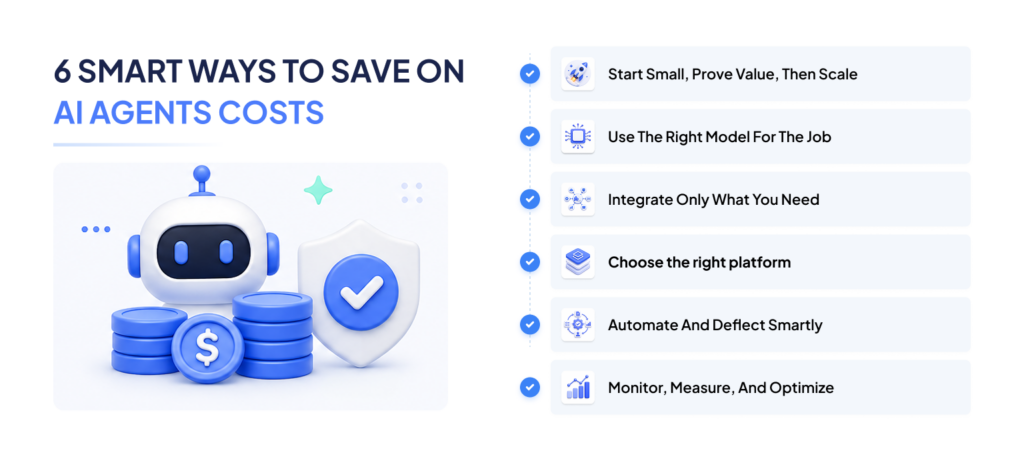
You can trim this bill a lot without gutting the agent. A few moves that work:
- Start with a pilot. Point the agent at your top ten questions first. Prove it. Then widen.
- Cap your usage. Turn on billing alerts at 70% and 90% of budget. Usage plans creep up fast and quiet.
- Reuse what you own. Every tool the agent already talks to is one you do not pay to rebuild.
- Model both bills. On per resolution plans, run the napkin math at a low and a high solve rate before you sign. A low rate can flip a cheap plan into a pricey one.
- Phase the build. Ship the core agent, then add flows. A staged build spreads cost and cuts risk.
- Match the tier to the need. Do not pay enterprise money for FAQ work. That is the most common overspend of all.
7 Questions to Ask Before You Pay for an AI Agent
Most nasty surprises come from questions nobody asked. Bring these to every vendor call:
- What is the price after usage, seats, and add ons, not just the sticker?
- Do I pay per conversation, per action, or per seat, and which is cheaper at my volume?
- What extra products does this need to work, like a data platform?
- What share of chats does the agent solve on its own, in real numbers?
- Who owns the data, and where does it live?
- What does year two cost, not just launch?
- How long is the rollout, start to fully live?
If a vendor dodges the money questions, that is your answer.
Where US Businesses Waste Money on AI Agents
Time for the blunt part. Across these builds, Auspicious Soft sees the same mistakes on repeat.
Businesses pay enterprise prices for a bot that only answers questions. They pick per conversation billing, then get shocked when traffic spikes and the bill triples. They build custom before proving anyone wants the thing. They forget the human handoff and watch angry customers pile up when the agent stalls. And they chase full automation, which does not exist, instead of the two thirds an agent can actually deliver today.
Here is the flip side, and the real point. The cheapest AI Agent Integration cost is not the lowest sticker. It is the setup that fits your traffic, drops your support load, and pays for itself. Sometimes that is a $99 plan. Sometimes it is a $90,000 build. The trap is guessing instead of scoping.
FAQs
Q: How much does AI Agent Integration cost for a small business website in 2026?
Most small US sites pay $50 to $200 per month on a no code platform, or a one time $5,000 to $30,000 for a simple custom bot. Start on a plan. Move to a build only when the plan stops fitting.
Q: Is it cheaper to buy or build an AI agent?
Buying is cheaper to start and faster to launch. Building costs more upfront but can win long term if you have deep, unique needs or strict data rules. For most websites, buy first and build later.
Q: What is the monthly cost of an AI agent in 2026?
Small business plans run $50 to $200 per month. Mid tier with CRM links runs $500 to $2,000. Enterprise setups run $1,000 to $10,000 per month. Usage and extra seats add to all of these.
Q: How much does Salesforce Agentforce cost?
About $2 per conversation, or roughly $500 per 100,000 Flex Credits, or from $125 per user per month. Watch the Data Cloud requirement, which starts near $60,000 per year and pushes a real year one to $50,000 or more.
Q: Why does an AI agent cost more than a normal chatbot?
An agent does more than talk. It connects to your systems, takes real actions, needs guardrails for when it is wrong, and needs monitoring so the bill stays sane. That extra work is the extra cost.
Q: How long does AI Agent Integration take?
A platform agent can go live in days. A custom build usually takes a few weeks to a few months, depending on how many systems it touches and how strict the compliance is.
Q: Can an AI agent fully replace my support team?
No. The best agents solve about 51% to 65% of chats alone. The rest need people. Plan the agent as a force multiplier, not a full swap.
Q: What hidden costs should I plan for?
Budget for upkeep at 15% to 20% of the build per year, integration maintenance of $500 to $1,500 per month, usage fees, a vector database from $50 per month, and at least one human seat for backup.
Do not Miss Our Latest Tech Insights
Stay one step ahead in the fast-moving world of AI and technology. Add us as a Preferred Source on Google and get our latest articles, guides, and industry insights delivered straight to your search feed.