+1 740 762 6496
 +91 70189 46603


TABLE OF CONTENT
- Why AI Trends in 2026 Matter for Every Business
- AI Market Snapshot 2026: The Numbers That Matter
- The Top 14 AI Trends in 2026 to Watch
- AI Trends in 2026 by Industry: A Quick Impact Table
- AI Trends in 2026: Sector by Sector Breakdown
- AI Trends in 2026 Meet Other Big Tech
- The 2026 AI Reality Check: What Most Trend Lists Will Not Tell You
- AI Trends in 2026 for Small Business: Where to Start
- How Much Do AI Trends Cost to Adopt in 2026?
- What Are the Future Trends in AI Beyond 2026?
- How Auspicious Soft Helps Businesses Ride the AI Trends in 2026
- FAQs
Overview
- Covers the 14 top AI trends in 2026, led by agentic AI.
- Backs each trend with fresh 2026 stats from McKinsey, Gartner, IBM, and PwC.
- Breaks down AI impact across 10 industries with real reported results.
- Shows how AI pairs with IoT, blockchain, 5G, and AR/VR.
- Gives an honest reality check on why most AI projects fail.
- Flags which trends are hype and not worth the cash yet.
- Includes cost ranges and timelines for common AI builds.
- Answers 8 common FAQs on AI trends, costs, and safety.
AI Summary:
The top AI trends in 2026 are agentic AI, multimodal AI, small language models, and vertical generative AI, plus RAG, digital twins, sovereign AI, and edge AI. Gartner says 40% of business apps will ship with task specific AI agents by end of 2026, but only about 31% of firms run them in production. That gap is the real opportunity. Between 80 and 95% of AI projects fail, mostly on data and planning, not the model. Winners pick one job, clean their data, name an owner, and measure results.
The top AI trends in 2026 are agentic AI, multimodal AI, small language models, and vertical generative AI. Add to that RAG, digital twins, sovereign AI, and AI agents built into daily apps. Gartner says 40 percent of business apps will ship with task specific AI agents by the end of 2026, up from under 5 percent a year ago. But here is the catch most reports skip. Only about 31 percent of firms run those agents in real production. That gap between hype and shipping is exactly where sharp businesses win in 2026.
Key Takeaways
- 88 percent of firms now use AI in at least one function. Only about 31 percent run AI agents in real production. That gap is a wide open door for teams who act now.
- Agentic AI is the defining trend of 2026. It moves AI from tools you prompt to tools that plan, act, and report on their own.
- The generative AI market alone is worth 67 billion dollars in 2026 and is tracking toward 1.3 trillion dollars by 2032.
- AI pays back when done right. IBM pegs the average return at 3.5 dollars for every 1 dollar spent, with most firms seeing ROI inside 14 months.
- Here is the blunt truth. Between 80 and 95 percent of AI projects fail to deliver real value. Most fail on data and planning, not the model.
- Not every trend is worth your cash. Quantum AI and fully autonomous agents are still mostly hype for day to day work.
- Every AI trend in 2026 needs guardrails. Good governance is the new firewall.
Why AI Trends in 2026 Matter for Every Business
The AI wave has fully broken. It has washed over every industry, every team, and every budget line. Firms that waved AI off two years back now scramble to catch up. That is the plain state of play in 2026.
The numbers make the point. Per the McKinsey State of AI survey, 88 percent of firms now use AI in at least one business function. Generative AI use alone jumped from 33 percent in 2024 to 65 percent in 2026. The shift was fast. Model costs dropped. The wins got obvious. And the fear of falling behind grew louder than the fear of trying.
Here is the part most lists skip. Use does not equal a win. Plenty of firms plug in AI, watch it flop, and blame the tech. A PwC survey found 56 percent of CEOs saw zero measurable ROI from AI in the past year. Read that again. More than half.
So why the gap? The winners in 2026 pick AI trends that fix a real, painful problem. The losers chase whatever has the loudest press release. This guide walks through the AI trends in 2026 that move the needle, what they cost, which industries feel them first, and the ones that are more sizzle than steak.
AI Market Snapshot 2026: The Numbers That Matter
Before the trends, here is a quick snapshot of where the AI market sits right now. These are the figures worth quoting in a board meeting.
| Metric | The Number | Source |
|---|---|---|
| Firms using AI in at least one business function | 88% | McKinsey State of AI |
| Firms running AI agents in production | ~31% | S&P Global, McKinsey |
| Generative AI market size (2026) | $67 Billion | Bloomberg Intelligence |
| Business applications expected to include AI agents by the end of 2026 | 40% | Gartner |
| Average ROI for every $1 invested in AI | $3.50 | IBM |
| Median time to achieve measurable AI ROI | ~14 Months | McKinsey |
| AI projects that fail to deliver business value | 80–95% | RAND, MIT Project NANDA |
| CEOs reporting no measurable AI ROI | 56% | PwC Global CEO Survey |
The Top 14 AI Trends in 2026 to Watch
The AI space moves at a brutal pace. Some trends fade in a single season. Others reshape whole industries. Here are the 14 that matter most for business, in rough order of impact.
1. Agentic AI: The Defining AI Trend of 2026
If you take only one thing from this guide, make it agentic AI.
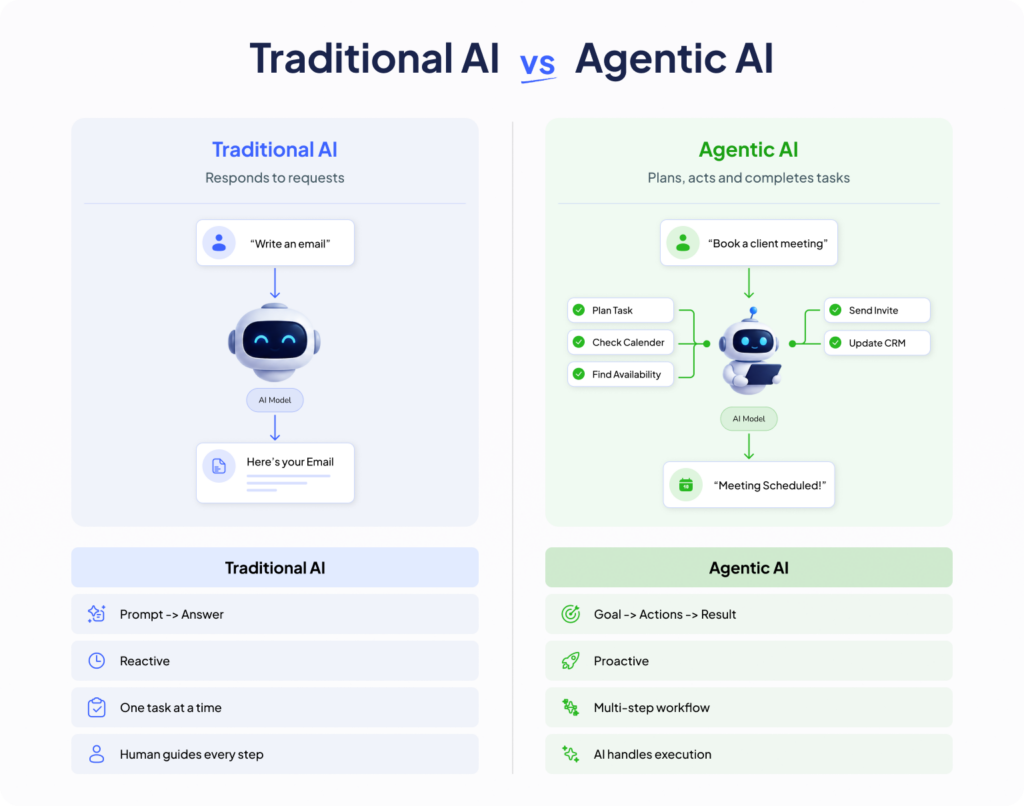
Regular AI waits for you to ask. Agentic AI decides, acts, and reports back. Think of a sharp junior teammate who owns a whole task from start to finish. Book the meeting. Send the follow up. Update the record. Flag the risk. All with no human clicking through each step.
The scale of this shift is hard to overstate. The Gartner Hype Cycle for Agentic AI says 40 percent of business apps will hold task specific AI agents by the end of 2026. A year back that figure sat under 5 percent. That is a rocket climb, not a slow drift.
What it opens up for business:
- Support that closes routine tickets on its own, with no human handoff
- Supply chains that spot a delay and reroute the shipment before it lands
- Sales tools that draft, send, score, and follow up on leads with no rep
The proof is already landing. AtlantiCare rolled out an agentic AI clinical assistant that hit an 80 percent adoption rate among its test doctors and cut documentation time by 42 percent. That freed up about 66 minutes per clinician per day. In another case, a Fortune 500 firm used an agentic reporting system to slash report time from 15 days to 35 minutes, dropping the cost per report from 2,200 dollars to just 9 dollars.
Now the honest part. Only about 31 percent of firms run agents in production. Most stall at the pilot stage. Data access, governance, and fuzzy ownership trip them up. Gartner even warns that more than 40 percent of agentic AI projects will be scrapped by 2027. That sounds grim, but it is the opportunity. The firms that get the plumbing right will lap the ones stuck in demo mode.
2. Multimodal AI: One Model, Many Senses
Multimodal AI reads text, sees images, hears speech, and watches video. All at once. All inside one model.
This matters because real work is messy. A field engineer sends a photo of a broken part, a voice note on the issue, and a ticket number. A multimodal system reads all three and files a full report. A single mode chatbot cannot keep up with that.
Google DeepMind, OpenAI, and Meta have all shipped major multimodal upgrades in the past year. For business, this unlocks smarter search, richer support, and quality checks that mix camera feeds with text logs. Multimodal is fast becoming the default, not the exception.
3. Small Language Models: The Quiet Winner
Not every task needs a giant model. Small language models run on phones, laptops, and edge devices. They are cheaper, faster, and far safer with private data because the data never leaves the device.
For startups and mid size firms, this is a huge unlock. A small model tuned for one specific job often beats a giant model trying to do five things. And it costs a fraction of the price to run. Expect the smart money in 2026 to flow toward focused small models, not just headline grabbing large ones.
4. Vertical Generative AI: Industry Specific Models Take Over
The first wave of generative AI was general. Write me a blog. Draw me a cat. The 2026 wave is vertical. Draft me a legal brief. Design me a molecule. Build me a payment flow.
Industry specific models trained on domain data now beat general models on real tasks. Law firms use them for contract review. Hospitals use them for clinical notes. Banks use them for risk memos. The quality gap is wide and growing.
Auspicious Soft builds these vertical systems for clients through its AI and ML development services practice. The recipe rarely changes. Pick a narrow job. Train a focused model on clean domain data. Ship it. Measure it. Then expand only what proves out.
5. Retrieval Augmented Generation (RAG) Becomes the Standard
RAG lets an AI pull from a company own docs, wikis, and databases before it answers. It stops the model from inventing facts on the spot.
In 2026, RAG is table stakes. Gartner found that data, not the model, is the usual blocker for failed AI projects. A chatbot rolled out with no RAG is one made up answer away from an ugly headline. Every serious enterprise AI project now bakes RAG in from day one. To go deeper on the plumbing, the AI ML development services team scopes RAG setups often.
6. Conversational AI: Chatbots Grow Up
Conversational AI has come a long way from the clunky bots of a few years back. Today these systems catch intent, read tone, and even pick up on emotion. They handle complex back and forth requests without breaking a sweat.
The results are real. Support teams using modern AI chat now resolve around 68 percent of routine tickets with no human ever stepping in. For any business with a support queue, that is a direct hit to cost and a lift to speed. Voice agents are the next front, booking, qualifying, and resolving calls in real time.
7. Sovereign AI: The Geopolitics of Code
Sovereign AI means countries build and control their own AI stacks. Data stays home. Models train on local laws and values. Compute runs on native soil.
The EU AI Act, US export controls, and China aggressive AI push all fit this pattern. For business, picking vendors now carries more weight than ever. A model banned in one market becomes a live risk in another. Firms that work across borders need to watch this space closely in 2026.
8. Physical AI and Robotics: AI Steps Off the Screen
AI is walking out of the browser and into the real world. Warehouse robots, surgery aides, drone inspectors, and self driving trucks all count as physical AI. Chip makers call it the next trillion dollar chapter of the AI story.
Logistics, manufacturing, and healthcare feel this first. Robots that lift, sort, and inspect for long hours without fatigue change the math on labor and safety. Every other industry will feel the ripple soon after.
9. Digital Twins: Virtual Copies That Predict Reality
A digital twin is a live virtual copy of a physical asset, process, or whole system. Feed it real sensor data and it lets you test, monitor, and tune without touching the real thing.
Factories use digital twins to predict machine failure before it happens. Cities use them to model traffic. Drug makers use them to test molecules. In 2026, the twist is that these twins now link with AI to run scenarios on their own and suggest fixes. For asset heavy industries, this is one of the highest ROI AI trends around.
10. Responsible AI and Governance: The New Firewall
Every AI trend on this list needs guardrails. Bias, drift, made up answers, and privacy leaks are real, costly risks. In 2026, boards ask about AI governance the same way they used to ask about cybersecurity.
This is not red tape for its own sake. Gartner warns that 40 percent of agentic AI projects will be canceled by 2027, and the ones that survive have audit trails, kill switches, and a human in the loop. Firms with no clear AI policy will face slower deals, higher insurance, and tougher hiring. Governance is now an edge, not a chore.
11. Shadow AI: The Risk Hiding in Plain Sight
Shadow AI is the use of AI tools with no IT sign off. A marketer pastes customer data into a free chatbot. A sales rep runs deals through an app nobody approved. It happens in almost every company now.
The upside is speed and grassroots ideas. The downside is data leaks, compliance gaps, and zero oversight. Smart firms in 2026 do not ban shadow AI outright. They bring it into the light with clear rules and safe, approved tools that people actually want to use.
12. Low Code and No Code AI: Everyone Becomes a Builder
You no longer need a data science team to ship an AI feature. Drag and drop platforms now come with AI baked in. This puts custom AI in the hands of marketers, ops leads, and product managers.
Interestingly, this is why small and mid size firms now adopt AI faster than some giants. Turnkey tools let them move with no huge budget or big team. Pair a no code platform with a solid remote development team for the tricky bits, and even a lean company can compete on smart features.
13. Edge AI: Smart at the Source
Edge AI runs models on the device itself, not in the cloud. Faster. Cheaper. More private. Perfect for wearables, IoT sensors, and mobile apps that cannot wait on a round trip to a server.
If your product lives or dies on speed or privacy, edge AI belongs on your 2026 roadmap. This is where a strong mobile app development partner earns their keep, since squeezing a model onto a phone takes real craft.
14. Sentiment AI: Machines That Read Emotion
Sentiment AI reads human emotion from text, speech, and facial cues. It tells a support system whether a customer is calm or about to churn. It tells a marketer which campaign lands and which falls flat.
For support, marketing, and even mental health apps, this trend adds a layer of empathy that raw data misses. Used well, it makes every chat feel more human. Used with no care, it raises real privacy questions, so guardrails matter here too.
AI Trends in 2026 by Industry: A Quick Impact Table
Different sectors feel different AI trends first. Here is a snapshot of where the impact hits hardest in 2026, backed by real reported results.
| Industry | Top AI Trend | Real Reported Impact |
|---|---|---|
| Healthcare | Agentic AI + RAG | 42% less documentation time for clinicians |
| Retail | Personalization + Vision AI | 20–30% higher average basket size |
| Finance | Agentic AI + Fraud Detection Models | Real-time fraud prevention with 47% AI agent adoption |
| Manufacturing | Physical AI + Digital Twins | 45% less downtime and 25% lower maintenance costs |
| Education | Generative AI Tutors | Personalized learning at each student's pace |
| Real Estate | Vision AI + AI Chatbots | Faster lead qualification and more accurate property pricing |
| Travel | Agentic AI Booking Assistants | End-to-end trip planning handled by AI |
| Fitness | Wearable AI Coaching | Personalized workouts with real-time form correction |
| Logistics | Edge AI + IoT | Proactive route optimization before delays occur |
| Legal | Vertical Generative AI | Contract review completed in minutes instead of hours |
AI Trends in 2026: Sector by Sector Breakdown
AI in Healthcare: Where AI Trends Save Real Time
Doctors save time. Patients get better care. That is the short version of AI in healthcare.
The AtlantiCare case says it plainly. Clinicians there saved 66 minutes a day with an agentic AI note taker, and adoption hit 80 percent among the pilot group. That is a full lunch break and a coffee handed back to overworked staff. Across the sector, physician adoption of AI has crossed 63 percent.
Beyond notes, AI reads scans, spots rare disease patterns, and drafts treatment plans. It does not replace the doctor. It hands the doctor time to be a doctor.
Auspicious Soft has shipped health platforms like Black Therapy, a mental therapy platform built for African American patients, and Deepfeels, an app that helps users understand and regulate their emotions. Both show how AI can support sensitive health work with care and safety at the core.
AI in Retail and eCommerce: Every Click Learns
Retail runs on AI now. Every touchpoint has an AI layer. Recommendation engines. Chatbot support. Visual search. Dynamic pricing. Fraud checks. The result is bigger baskets and stickier customers.
The giants set the pace, but mid size shops now get similar tools from app ecosystems and open models. Auspicious Soft built Distacart, a cross border eCommerce app serving over 500,000 Indian products to a global audience, which shows how the right tech scales a store fast. Teams building on Shopify get an extra edge with a solid Shopify development services partner behind them.
For eCommerce founders, the smart play is to nail one or two AI wins first. A great recommendation engine beats a mediocre everything.
AI in Finance: Speed, Safety, and Smart Money
Banks use AI to spot fraud in milliseconds. Insurers use it to price policies. Wealth firms use it to draft plans. Fintech startups use it to score credit for people the banks ignore.
Finance leads the pack on agentic AI, with roughly 47 percent of banking and insurance firms running AI agents in production. The biggest 2026 shift is agentic AI in back office ops. Reconciliation, reporting, and compliance shrink from days to minutes. That Fortune 500 example of cutting report time from 15 days to 35 minutes came straight from this world.
AI in Manufacturing: Factories That Think
Digital twins, predictive maintenance, and robot arms have been around a while. What is new in 2026 is that they now talk to each other. Physical AI systems share data across the shop floor in real time. Reported results are strong, with predictive maintenance cutting downtime by 45 percent and upkeep costs by 25 percent.
For factory owners, the ROI math is finally simple. Cost to install, months to payback, and hard savings you can put on a spreadsheet.
AI in Real Estate: Faster Deals, Sharper Pricing
AI helps buyers find homes faster and sellers price them right. Chatbots handle first contact. Vision AI values properties from photos. Virtual tours use generative video to sell a home before anyone visits. Auspicious Soft supports agencies with tailored real estate software development that fits their market and budget.
AI in Travel: One Sentence, Full Trip
Travel apps now book full trips from a single sentence. “Plan me a five day trip to Tokyo under 2000 dollars” returns flights, hotels, and a day by day plan. That is agentic AI at work. For travel firms, AI cuts booking friction and flags high value guests before they book. Building for this space? The travel software development team has the playbook.
AI in Education: A Coach for Every Learner
AI tutors adapt to each learner. Slow readers get more support. Fast learners get harder puzzles. Teachers claw back hours a week from grading and scheduling. The 2026 trend is AI as a coach, not a replacement. Kids still need humans, but humans backed by AI teach better. See how education software development teams bring these ideas to life.
AI in Fitness: Your Coach in Your Pocket
Fitness apps read your form, count your reps, and suggest tweaks on the fly. Wearables track sleep, stress, and recovery. AI ties it all into a plan that shifts with your body. Firms working with fitness software development teams get to compete with the big brands on smart features, not just budget.
AI Trends in 2026 Meet Other Big Tech
AI plays well with others. Its power multiplies when paired with the right technology. Here are the pairs that matter most in 2026.
AI Plus IoT: Devices That Actually Learn
Smart devices get smarter. A thermostat that learns your habits is worth ten that just heat on a fixed schedule. This pair powers smart homes, smart cities, and smart factories, with AI reading the patterns and IoT sensors feeding the data.
AI Plus Blockchain: Trust You Can Prove
Log every model call, data source, and output on a chain and fraud gets harder while proof of origin gets easier. This matters most in finance, supply chain, and any field where trust is the product. Firms exploring this pair often lean on a blockchain development services team to link the two safely.
AI Plus 5G and Edge: Real Time Everywhere
Self driving cars. Live translation. Smart cities. All lean on this pair. The bandwidth of 5G plus the speed of edge AI creates a class of apps that simply were not possible a few years ago. Real time calls, made at the source, at scale.
AI Plus AR and VR: Immersive Intelligence
Try on clothes with no fitting room. Walk through a home from your couch. Train a surgeon in a headset with AI as the guide. This pair is quiet in 2026 but building steam fast, mostly in retail, real estate, and training.
The 2026 AI Reality Check: What Most Trend Lists Will Not Tell You
Time for some straight talk that most vendor blogs skip.
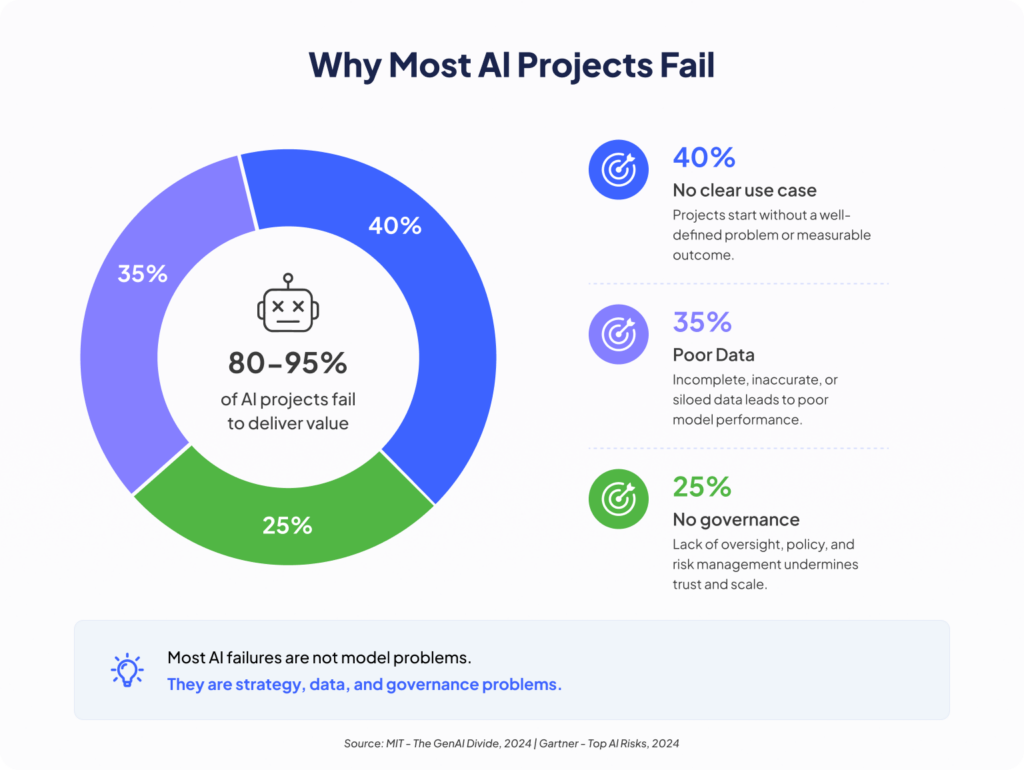
Every trend list makes AI sound like a magic wand. It is not. Most AI projects fail. MIT Project NANDA studied over 300 deployments and found 95 percent produced no measurable profit. RAND puts the failure rate around 80 percent, roughly twice the flop rate of normal IT projects. Either way, the odds are ugly.
Here is an opinion Auspicious Soft will stand behind. A big slice of the agentic AI buzz right now is marketing, not shipped product. The demos dazzle. The production numbers are thin. Only about 31 percent of firms run agents live, and Gartner expects 40 percent of agentic projects to die by 2027. Anyone selling you a fully self running business by next quarter is selling a dream, not a plan.
And two trends on every hype list deserve a cold splash of water. Quantum AI is real science, but for day to day business it is still years out. Fully autonomous agents that run with no human in the loop are a liability, not a feature, for most firms today. Chase these now and you will spend a lot to learn a little.
So why do so many projects fail? Three reasons show up again and again:
- No clear use case. Teams fall for the tech and go hunting for a problem after. That path ends in a slick demo and no business case.
- Bad data. Gartner found data, not the model, is the usual blocker. Garbage in, costly garbage out.
- No governance. Pilots stall because nobody owns the risk, and with no audit trail or human in the loop, leadership pulls the plug.
The firms winning with AI trends in 2026 do the dull stuff well. They pick one job. They clean their data. They give one person the wheel. They measure results against a hard number set before they start. That is the whole secret, and it is not glamorous.
Auspicious Soft has watched startups burn real cash on trendy models that solved nothing. The fix never changes. Start small. Ship fast. Measure hard. Then scale only what proves out. Dull, yes. But dull is what pays back inside 14 months instead of never.
AI Trends in 2026 for Small Business: Where to Start
Not every business needs a chief AI officer. Most small firms win big with three simple moves:
- Add AI chat to your site. Fast to launch and it lifts lead quality right away.
- Automate one back office task. Invoicing, scheduling, or reporting. Pick one and watch the payback.
- Use AI for content. Blogs, product copy, and emails all speed up with no extra headcount.
Beyond those quick wins, get expert help for anything custom. Building your own AI from scratch is like building your own car. Fun to try, painful to ship. A smart move is to hire a team that has done it many times. Auspicious Soft works across mobile app development, web development, and custom software development so you get one team for the whole build.
How Much Do AI Trends Cost to Adopt in 2026?
This is the question every founder asks first. The honest answer is that it depends on scope, data, and team. But here are rough ranges for the most common AI builds in 2026 to help you plan a budget.
| AI Build Type | Rough Cost Range (USD) | Estimated Time to Ship |
|---|---|---|
| AI Chatbot with RAG | $10,000 – $30,000 | 4–8 weeks |
| Custom Small Language Model (SLM) | $25,000 – $75,000 | 8–16 weeks |
| Vertical Generative AI Tool | $50,000 – $150,000 | 12–24 weeks |
| Agentic AI System | $75,000 – $250,000+ | 16–32 weeks |
| Full AI-Powered Mobile App | $40,000 – $200,000 | 12–28 weeks |
| AI Integration in CRM or ERP | $30,000 – $120,000 | 10–20 weeks |
Rates swing based on region, tech stack, and team size. For a deeper look at pricing by role and location, see the Cost To Hire Dedicated Developers in 2026 guide.
What Are the Future Trends in AI Beyond 2026?
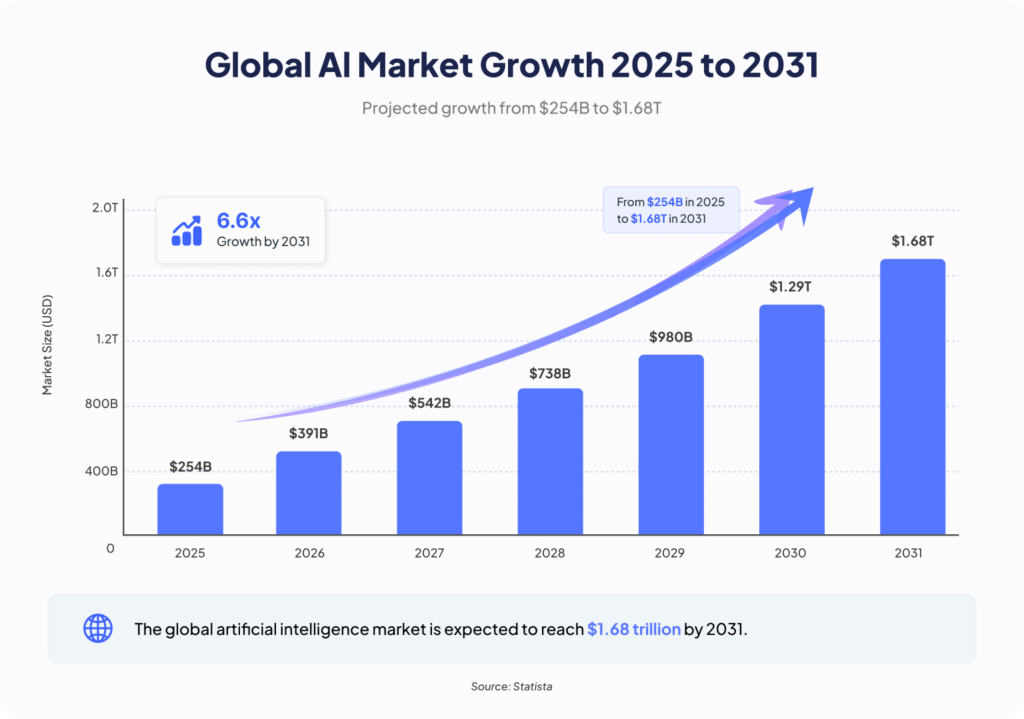
The AI story is only in its opening chapter. Statista projects the global AI market to hit 1.68 trillion dollars by 2031, a jump of more than six times from 2025.
A few things worth watching on the horizon:
- AI reasoning models that crack harder problems in fewer steps
- Quantum AI slowly moving from the lab toward real workloads
- AI agents that talk to other AI agents with no human bridge in between
- Tighter laws on AI safety, both in the US and the EU
- More jobs shaped around working with AI, from prompt engineer to AI safety analyst
Per IDC forecasts, spending on AI is set to more than double from 307 billion dollars in 2025 to 632 billion dollars by 2028. The money is flowing hard. The real question is who turns that spend into results and who just burns it.
How Auspicious Soft Helps Businesses Ride the AI Trends in 2026
Auspicious Soft builds AI powered apps, sites, and software for clients across the USA. The team has shipped more than 200 projects since 2018 and brings over 8 years of hands on AI and ML delivery. Recent work spans healthcare, eCommerce, and social platforms, from Distacart to Black Therapy and beyond.
What sets the team apart:
- Practical AI, not theory. Every build ties back to a hard business goal.
- Full stack know how. Backend, mobile, and AI live under one roof.
- Clear pricing. Get a quote in two hours, not two weeks.
- 100 percent NDA cover from the very first call.
- A use case first approach that dodges the traps sinking most AI projects.
Whether it is an AI chatbot, a custom small model, or a full agentic system, the team scopes it fast and ships it right. Explore the full range of AI ML development services or browse recent work in the case studies section.
FAQs
Q: What are the top AI trends in 2026?
The top AI trends in 2026 are agentic AI, multimodal AI, small language models, vertical generative AI, RAG, conversational AI, sovereign AI, physical AI, digital twins, responsible AI, shadow AI, low code AI, edge AI, and sentiment AI. Agentic AI leads the list for enterprise impact.
Q: How much does it cost to build an AI product in 2026?
Costs vary by scope. A simple AI chatbot with RAG may run 10,000 to 30,000 dollars. A full agentic AI system can run 75,000 dollars or more. For a full breakdown by region and role, see the Cost To Hire Dedicated Developers in 2026 guide.
Q: Which industries benefit most from AI trends in 2026?
Healthcare, finance, retail, manufacturing, and logistics see the biggest ROI from AI trends in 2026. Finance leads on agentic AI adoption at around 47 percent. But every sector now has AI use cases that can pay back within a year.
Q: Is agentic AI safe for business use?
Agentic AI is safe when paired with strong governance. That means human oversight, clear rules, audit trails on every action, kill switches, and a plan for when the agent gets it wrong. With no guardrails, agentic AI can cause real harm, which is why Gartner expects many ungoverned projects to be canceled by 2027.
Q: How can small businesses use AI trends in 2026?
Small firms should start with chatbots, content tools, and simple back office automation. Then add custom AI as they grow. The low code and no code wave means smaller firms can now move faster than some large enterprises, with no big data team.
Q: What is the difference between generative AI and agentic AI?
Generative AI creates content when you ask for it. Agentic AI takes actions on its own to hit a goal. Generative AI writes the email. Agentic AI writes it, sends it, tracks the reply, and books the meeting. Agentic AI is the bigger leap.
Q: Why do so many AI projects fail?
Studies put the AI failure rate between 80 and 95 percent. The top three causes are no clear use case, poor data quality, and weak governance. Most failures are about the plumbing, not the model itself. Firms that fix data and pick one focused job first see far better odds.
Q: Will AI trends in 2026 replace human jobs?
AI will change many jobs. It will replace some tasks, not most whole jobs. People who work well with AI will win. People who ignore it will fall behind. New roles like prompt engineer, AI trainer, and AI safety analyst are growing fast.
Q: How does Auspicious Soft help businesses adopt AI trends in 2026?
Auspicious Soft offers AI consulting, custom model builds, and full stack app work. The team helps clients pick the right trend, dodge the common traps, and ship real value fast. Contact the team here for a free scoping call.
Do not Miss Our Latest Tech Insights
Stay one step ahead in the fast-moving world of AI and technology. Add us as a Preferred Source on Google and get our latest articles, guides, and industry insights delivered straight to your search feed.