+1 740 762 6496
 +91 70189 46603


TABLE OF CONTENT
- Why US Agents and Brokers Need Custom Real Estate Apps in 2026
- Real Estate App Market: What the Numbers Say for 2026
- Must-Have Features in a Real Estate App for US Agents
- Real Estate Software Development Tech Stack for 2026
- How Much Does Real Estate App Development Cost in 2026?
- Real Estate App Development Process — Step by Step
- Real Estate App Types: Which One Does Your Brokerage Need?
- AI in Real Estate Apps: What Actually Works
- Real Estate App vs Real Estate Website: What to Build First?
- How to Choose the Right Real Estate App Development Company
- Trusted Resources on Real Estate App Development
- Final Take: What US Brokers Should Do Right Now
- FAQs
Overview
- Real estate apps range from $20K–$35K (MVP) to $150K+ (full-featured platform), depending on features, platforms, and AI depth. Timelines run 2–8 months.
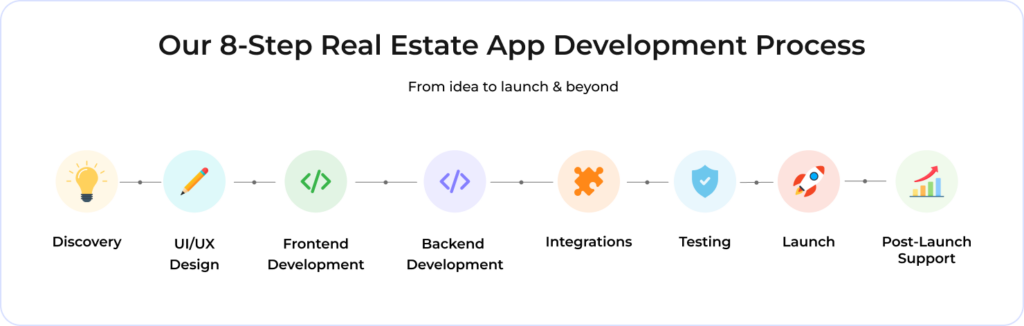
- Follows 8 stages — discovery, UI/UX design, frontend/backend build, AI and third-party integrations, QA testing, launch, and post-launch support.
- US apps must address Fair Housing Act (including AI bias audits), CCPA privacy rules, ADA accessibility, and strict MLS/IDX data agreements.
- Options include property search, property management, CRM, investment analysis, rental platforms, and commercial real estate apps.
- Predictive recommendations, automated valuation models, 24/7 chatbots, and natural language search — as opposed to superficial “AI-labeled” search bars.
- Websites drive SEO-based discovery; apps drive retention via push notifications and daily engagement. Recommendation: build the web portal first.
- Prioritize proven MLS/IDX experience, fixed-price contracts, and compliance expertise.
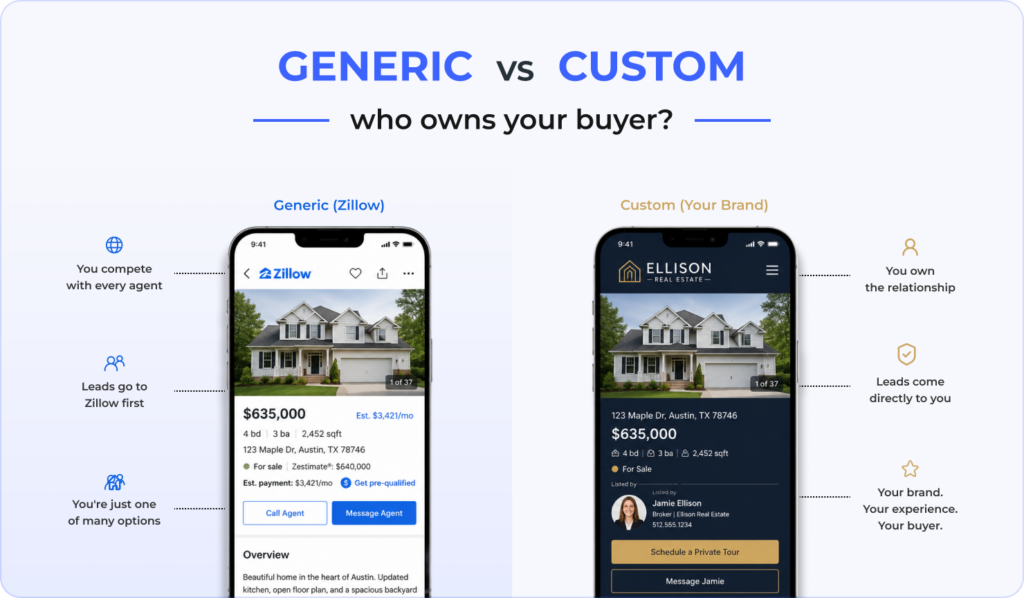
Most US agents and brokers know they need a real estate app. What they do not know is whether to build one, which features actually matter, and what it realistically costs. Generic platforms like Zillow and Realtor.com own the consumer relationship. Custom real estate software development lets brokers take that relationship back — with branded apps, AI property search, live MLS data, and tools built for how agents actually work.
This guide covers everything: features, tech stack, cost, compliance, and the honest difference between what gets built and what actually gets used.
Key Takeaways
- 83% of US home buyers use a mobile app at some point during their property search.
- The global real estate app market is forecast to reach $6.32 billion by 2027, growing at 18.2% annually.
- Custom real estate apps give brokers full control over branding, data, and the buyer relationship — something no off-the-shelf platform offers.
- Core features that drive engagement: MLS integration, AI search, virtual tours, in-app messaging, and mortgage calculators.
- A production-ready real estate app costs between $30,000 and $150,000 depending on scope and complexity.
- Flutter and React Native are the top cross-platform choices for real estate app development in 2026.
- Fair Housing Act, CCPA, ADA, and IDX compliance must be designed in from day one — not added later.
- Brokers who invest in custom apps consistently report stronger repeat business because buyers remember the brand, not the platform.
Why US Agents and Brokers Need Custom Real Estate Apps in 2026
Real estate in the US has shifted fast. Buyers and renters now expect to search properties, book tours, check mortgage numbers, and message agents — all from one app, on their phone, at any hour. Waiting until business hours is not how Gen Z buyers think about anything, including buying homes.
Off-the-shelf tools like Zillow, Realtor.com, or Redfin work well for consumers. For brokerages, though, they create a problem. Every lead that comes through those platforms belongs to the platform. Custom real estate software development flips that dynamic. The buyer downloads your app, signs in to your platform, and books tours through your system. That data stays with you.
Gen Z is now the largest growing buyer demographic, and 68% of them use mobile apps during their home search. If another brand’s app is the one they open first, another brand owns that relationship. It is that direct.
Brokers who invest in custom real estate software development are not just building an app. They are building the infrastructure to own their buyer pipeline long term.
Real Estate App Market: What the Numbers Say for 2026
| Metric | Data Point |
|---|---|
| Global Real Estate App Market (2027 forecast) | $6.32 billion |
| Annual Growth Rate (CAGR) | 18.2% |
| US Home Buyers Using Mobile Apps | 83% |
| Gen Z Buyers Using Apps During Search | 68% |
| AR Property Visualization Engagement Boost | Up To 100% Increase in User Session Time |
| AI-Powered Features: Retention Boost | 43% Higher vs Traditional Apps |
These numbers point in one direction. Mobile-first real estate is not a trend anymore — it is the baseline. Brokers building on this now will have a two to three year head start on those who wait.
Must-Have Features in a Real Estate App for US Agents
Not every feature is worth building. The ones below are either expected by buyers in 2026 or are strong enough differentiators to justify the investment. Skip the ones that do not match your specific audience — but know why you are skipping them.
1. MLS Integration and Live Listings
Without MLS integration, a real estate app is just a brochure with a nice UI. Buyers need live listing data — accurate pricing, real-time availability, and status changes the moment a property goes under contract or drops in price. The Multiple Listing Service is the single source of truth for US property data, and connecting to it directly (through IDX or RETS/RESO Web API) is non-negotiable for any serious property app. Stale data kills trust faster than any bad design decision.
2. AI-Powered Property Search and Recommendations
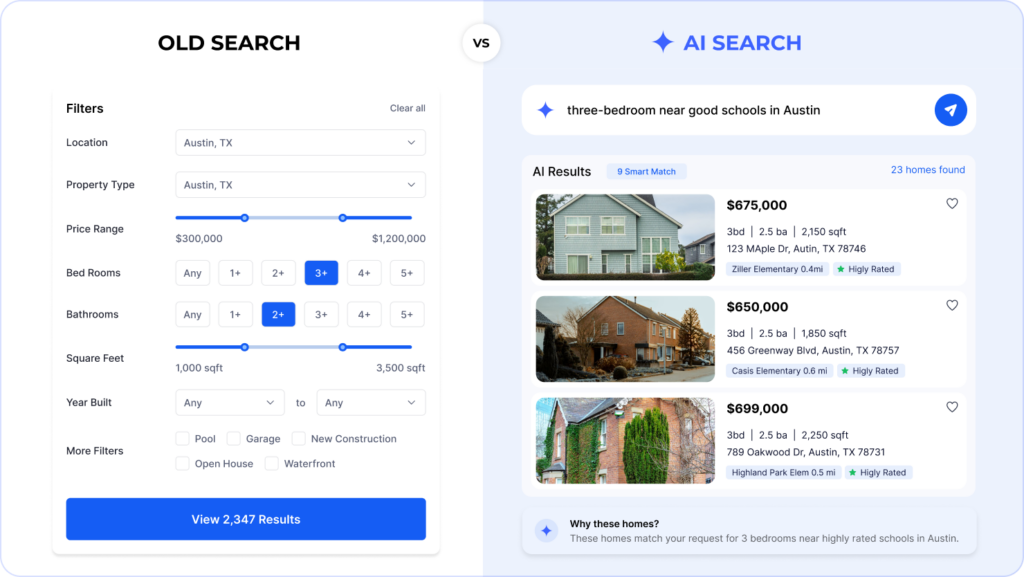
This is where the gap between a good app and a great one becomes visible. Standard search gives buyers a filter menu. AI property search learns from what they click, save, skip, and spend time reading. It then surfaces listings that match what they actually want — not just what they typed. Think of it as Netflix for properties. Buyers spend longer in the app, return more often, and convert at higher rates. The investment in a proper recommendation engine pays back through engagement metrics that free platforms simply cannot match.
3. Interactive Maps with Neighborhood Data
US buyers make decisions based on neighborhoods as much as properties. School ratings, walkability scores, commute times, nearby amenities — all of this information needs to be surfaced alongside listings, not buried in a separate tab. Google Maps API or Mapbox with geolocation filters and polygon search (draw a shape around the area you want) is now the standard. Apps without strong map integration feel incomplete to buyers who have used Zillow or Redfin even once.
4. Virtual Tours and AR Property Visualization
For out-of-state buyers — and there are a lot of them in markets like Florida, Texas, and Arizona — virtual tours are not a nice-to-have. They are the reason someone will consider a property before flying in. AR visualization goes further: buyers can see how their furniture would look in the space, or visualize a renovation before it happens. Apps that offer 360-degree tours consistently see longer session times and higher tour booking rates. For premium listings, this feature is now expected.

5. In-App Messaging Between Buyers and Agents
Phone calls for property questions are nearly dead among buyers under 40. In-app messaging keeps the conversation tied to a specific listing, so context is never lost. Agents can see exactly which property a buyer is asking about without playing 20 questions. Push notifications for new messages are critical — without them, response times slip and buyers go elsewhere. Build message history storage so nothing disappears when a user upgrades their phone.
6. Mortgage Calculator and Pre-Qualification Tools
A buyer who opens a mortgage calculator inside your app is a buyer thinking about buying. Monthly payment estimates, interest rate inputs, down payment sliders — these are engagement tools as much as utility features. Connecting to live mortgage rate APIs (like Optimal Blue or Bankrate) makes the calculator feel real rather than hypothetical. Some apps go further and offer basic pre-qualification flows that collect buyer information and route it to a partner lender. That is a lead-generation feature disguised as a calculator.
7. Saved Searches and Instant Alerts
Buyers search the same market multiple times before making a move. Saved searches with real-time alerts — price drop on a saved listing, new property matching saved criteria, status change on a favorited home — are what keep buyers coming back to your app instead of checking Zillow. Without this feature, retention drops sharply. With it, buyers develop a daily habit around your platform. The alert mechanism also gives agents a natural touchpoint: when a buyer gets an alert, it is a good moment to reach out and offer more context.
8. Multi-Role Dashboard
A real estate app typically serves four different user types at once: buyers, sellers, agents, and administrators. Each role needs a completely different experience. Buyers want to browse and save. Sellers want to track activity on their listing. Agents need lead management, tour scheduling, and message history. Admins need content control and user management. Building a single app that serves all four roles without cluttering any one of them requires modular architecture from the start — not a retrofit after the fact.
9. Push Notifications and Real-Time Alerts
Price drops, new listings, tour reminders, document updates, agent messages — each of these is a reason to send a push notification that brings a buyer back into the app. The key is relevance and timing. Poorly timed or irrelevant push notifications get disabled fast, and once a user turns them off, they rarely turn them back on. Build notification preferences into the onboarding flow so buyers control what they receive. Personalized alerts based on saved searches perform significantly better than broadcast notifications.
10. Secure Document Management
Digital contract signing, secure document upload, and offer management are becoming standard features in real estate apps targeting serious buyers and full-service brokerages. Integration with DocuSign or a built-in e-signature flow removes the friction that kills deals at the final stage. All document storage must use encrypted cloud infrastructure with role-based access — agents see their clients’ documents, not each other’s. For brokerages handling high transaction volumes, this feature alone can justify the cost of the entire app.
Real Estate Software Development Tech Stack for 2026
| Layer | Technology Options | Why It Works |
|---|---|---|
| Frontend (Mobile) | Flutter, React Native | Cross-platform — One Codebase Covers iOS and Android |
| Frontend (Web) | React.js, Next.js | Fast, SEO-Friendly, Scalable For Property Portals |
| Backend | Node.js, Laravel, Python | API-Driven Architecture Handles High Concurrent Load |
| Database | PostgreSQL, MongoDB | Relational For Listings; NoSQL For User Behavior Data |
| Cloud Infrastructure | AWS, Google Cloud, Azure | Scalable Storage For Images, Videos, and 3D Tour Files |
| Maps | Google Maps API, Mapbox | Geolocation, Polygon Search, Neighborhood Overlays |
| AI/ML | Python, TensorFlow, OpenAI APIs | Property Recommendations, Chatbots, Price Prediction |
| Real-Time | WebSockets, Firebase | Live Messaging, Instant Notifications, Listing Updates |
| Authentication | OAuth 2.0, JWT, MFA | Secure Login For Buyers, Agents, and Admins |
| Payments | Stripe, Plaid | Booking Deposits, Subscription Plans, Agent Billing |
Want To Build a Real Estate App? Get a Free Tech Consultation
How Much Does Real Estate App Development Cost in 2026?
Cost is the first question most brokers ask. The answer depends on features, platforms, and integrations — but the ranges below reflect realistic projects, not theoretical ones.
| App Type | Estimated Cost | Timeline | Best For |
|---|---|---|---|
| Basic Property Listing App | $30,000 – $50,000 | 2 – 3 Months | Small Brokerages, Local Agents |
| Mid-Level App with AI Features | $50,000 – $90,000 | 3 – 5 Months | Growing Teams, Regional Brokers |
| Full-Featured Real Estate Platform | $90,000 – $150,000+ | 5 – 8 Months | Large Brokerages, Enterprise Firms |
| MVP (Minimum Viable Product) | $20,000 – $35,000 | 6 – 10 Weeks | Startups, Testing New Markets |
These ranges assume a dedicated development team, custom UI/UX design, MLS integration, and core AI features. Costs increase with AR/VR tours, blockchain-based document handling, or multi-state MLS coverage. The MVP path is worth considering for brokerages entering a new market — ship a focused version first, learn what buyers actually use, then build from there.
Working with a real estate app development company that already understands MLS data, IDX compliance, and how US brokers operate saves significant time and rework. The difference between a team learning real estate on your project versus one that already knows it is typically four to six weeks of development time and one to two rounds of compliance fixes.
Real Estate App Development Process — Step by Step
Every production-ready real estate app follows a similar path. The order matters. Skipping steps early creates expensive fixes later — especially when MLS agreements and compliance reviews get pushed to the end.
1. Discovery and Requirement Gathering — Define user roles (buyer, seller, agent, admin), map out features, identify which MLS boards you need access to, and confirm compliance requirements (ADA, Fair Housing, CCPA, IDX rules). This phase sets the scope. Changes here cost hours. Changes during development cost weeks.
2. UI/UX Design — Wireframes first, then interactive prototypes, then user testing with real agents and buyers if possible. Real estate apps live or die on search usability and listing presentation. A beautiful app with a confusing search flow will get uninstalled.
3. Frontend Development — Build the mobile app using Flutter or React Native, and the web portal using React.js. Speed and mobile responsiveness are not optional. A listing page that takes more than two seconds to load on a mobile connection loses buyers.
4. Backend Development — Set up APIs, MLS data pipeline, user authentication system, messaging infrastructure, and the admin dashboard. The backend architecture decisions made here determine how the app scales at 10,000 users versus 100,000.
5. AI and Third-Party Integration — Connect the property recommendation engine, Google Maps or Mapbox, mortgage rate APIs, DocuSign or e-signature flow, and payment gateways. Each integration needs testing independently before the full system is assembled.
6. QA Testing — Test on iOS, Android, and web browsers. Run the app under realistic MLS data load. Check every user flow against Fair Housing guidelines. Accessibility testing for ADA compliance is done here, not after launch.
7. Launch and App Store Submission — Deploy to AWS, Google Cloud, or Azure. Submit to Apple App Store and Google Play Store. Both stores review real estate apps carefully, so prepare documentation for data handling and MLS attribution requirements.
8. Post-Launch Support and Iteration — Monitor performance, fix issues reported by agents and buyers, and push updates as MLS APIs change or new features are prioritized. Real estate apps are not a one-time build. They need ongoing attention.
US Compliance and Legal Must-Knows for Real Estate Apps
This section gets skipped in most real estate app guides. For US agents and brokers, that is a serious mistake. Compliance failures in real estate apps are not just technical problems — they carry legal exposure and can result in HUD investigations or app store removal.
Fair Housing Act
No aspect of the app — including its AI algorithms — can discriminate based on race, color, religion, sex, national origin, disability, or familial status. This is not just about listing display. If an AI recommendation engine learns from biased historical data and starts suppressing certain neighborhoods for certain users, that is a Fair Housing violation. Algorithmic audits are a required part of any AI-powered real estate app built for the US market. Document the audit. Keep the records.
CCPA — California Consumer Privacy Act
Any real estate app serving California users must include a clear privacy policy, a data deletion request process, and an opt-out mechanism for data sharing. This applies regardless of where the brokerage is based. If a buyer in Los Angeles downloads the app, CCPA applies. Build these controls into the user account settings from day one — retrofitting them is time-consuming and messy.
ADA Accessibility
US courts have consistently ruled that mobile apps fall under the Americans with Disabilities Act. Practically, this means: sufficient color contrast for text, screen reader compatibility, tap targets large enough for users with limited dexterity, and descriptive alt text on property images. ADA compliance is not just ethical — it expands the app’s usable audience and protects against litigation that has become increasingly common in the US app space.
MLS Rules and IDX Compliance
MLS data access comes with strict contractual terms covering how listings are displayed, how they are attributed, how frequently the data must refresh, and what search filters are permitted. IDX (Internet Data Exchange) feeds vary by MLS board — what is allowed in one region may be restricted in another. Build the data layer with compliance baked in from the start. Legal issues with MLS data are among the most common and most avoidable problems in real estate app development.
Real Estate App Types: Which One Does Your Brokerage Need?
| App Type | Who Needs It | Core Function |
|---|---|---|
| Property Search App | Brokerages, Agents | Search, Filter, and Browse MLS Listings with AI recommendations |
| Property Management App | Property Managers, Landlords | Lease Tracking, Maintenance Requests, Rent Collection |
| Real Estate CRM App | Sales Teams, Brokers | Lead Management, Deal Pipeline, Agent Performance tracking |
| Investment Property App | Investors, House Flippers | ROI Calculators, Cap Rate Tools, Market Trend Analytics |
| Rental Platform App | Landlords, Renters | Listing, Applications, Lease Signing, Online Payments |
| Commercial Real Estate App | CRE Brokers, Tenants | Office and Retail Listings, Lease Comparisons, LOI Tools |
AI in Real Estate Apps: What Actually Works
Every real estate app pitch in 2026 includes AI somewhere. Most of those implementations are a search bar with autocomplete. Here is what actually moves the needle — and what separates shallow AI from features buyers and agents genuinely use.
Predictive Property Recommendations
The recommendation model observes what a user clicks, saves, skips, and spends time reading. Over a few sessions, it builds a preference profile and starts surfacing properties the buyer has not searched for but would likely be interested in. Done well, this keeps users inside the app longer and drives tour bookings from listings they would never have found on their own. Done poorly — with a model trained on too little data — it feels random and gets ignored.
Automated Valuation Models (AVM)
AVM tools provide instant property value estimates based on recent comparable sales, current market conditions, and property-specific attributes. They are not as accurate as a licensed appraisal, and buyers generally understand that. What they do is give buyers and agents a fast, shared reference point during early conversations. Agents who can pull up an AVM estimate inside the same app they use for listings close conversations faster because the data is already trusted and already in context.
AI Chatbot for 24/7 Lead Capture
An AI chatbot embedded in a real estate app handles the questions that come in at 9pm — What is the HOA fee? Is this listing still available? Can I schedule a tour for Saturday? A well-built bot answers these immediately, qualifies the lead, and creates a handoff record for the agent to follow up during business hours. The drop-off rate between a buyer asking a question and getting a response is extremely high. A chatbot closes that gap without requiring agents to be available around the clock.
Natural Language Property Search
Type ‘three-bedroom house near good schools under $600k in Austin with a garage’ and get results — no filter menus, no slider adjustments, no dropdown selections. Natural language search powered by NLP (natural language processing) is still rare in independent brokerage apps, which makes it a genuine differentiator in 2026. It is particularly valuable for first-time buyers who do not yet know the right terminology to use in a standard search interface.
Build a Smarter Real Estate App with AI — Talk to Auspicious Soft Today
Real Estate App vs Real Estate Website: What to Build First?
Agents and brokers ask this more than almost any other question. The answer is not what most development companies will tell you, because most development companies want to build both at the same time.
| Factor | Mobile App | Web Portal |
|---|---|---|
| Buyer Behavior | 83% of Buyers Search On Mobile During The Process | Desktop Preferred For Research and Document Review |
| Agent Tools | Field Use — Tours, Messaging, On-The-Go Alerts | Back-Office Work, CRM, Performance Reporting |
| Development Cost | Higher Upfront Investment | Lower Upfront, Generally Easier To Update |
| SEO Value | Limited — Only Discoverable Via App Stores | Strong — Every Listing Page is Indexable By Google |
| Push Notifications | Yes — High Engagement Driver | Browser Push Only — Much Lower Opt-in rates |
| Best For | Ongoing Buyer Relationship and Retention | Top-of-Funnel Lead Capture and Listing Discovery |
build the web portal first. A property website with strong SEO generates leads from day one. It also reveals what buyers actually search for in your market — data that directly shapes which mobile app features to prioritize. Building a full mobile app before understanding your buyer’s behavior is guesswork. Build the portal, learn from it, then build the app with confidence.
How to Choose the Right Real Estate App Development Company
Most development companies say they build real estate apps. Very few have actually shipped one into a live MLS environment, dealt with IDX compliance reviews, or built role-based dashboards that agents use daily in the field. The questions below separate companies with real experience from ones who are learning on your project.
- Real estate domain experience — ask to see deployed apps, not mockups or prototypes.
- MLS and IDX integration track record — this involves data agreements, API access, and legal compliance, not just a technical connection.
- Post-launch support commitment — MLS APIs change, app store requirements change, and Fair Housing guidelines evolve. The relationship does not end at launch.
- Cross-platform mobile expertise — Flutter or React Native for mobile, React.js for the web portal.
- AI capability depth — can they build a recommendation engine trained on your listing data, or are they proposing a basic search API with an AI label on it?
- Transparent, fixed-price contracts — scope creep is the most common way real estate app budgets double. Fixed-price protects brokerages.
- US compliance knowledge — Fair Housing Act, CCPA, ADA, and IDX rules are non-negotiable. Ask directly how they handle compliance audits.
At Auspicious Soft, real estate is one of the core industry practices. The team builds on Flutter, React Native, and React.js with backend architecture designed for MLS data volume. Projects include compliance-first design, fixed-price contracts, and US timezone communication throughout. If building a real estate app is the goal, the conversation starts with the features that matter most to your specific market — not a feature list copied from the last project.
Trusted Resources on Real Estate App Development
For MLS data standards and IDX compliance rules, the National Association of Realtors (NAR) publishes up-to-date guidance for technology providers and brokerages. Fair Housing Act requirements as they apply to technology and algorithmic tools are documented by the US Department of Housing and Urban Development (HUD). CCPA compliance requirements for apps collecting California user data are maintained by the California Privacy Protection Agency.
Final Take: What US Brokers Should Do Right Now
Real estate in the US is not going back to phone calls and paper listings. Buyers are mobile-first, AI-assisted, and have no patience for slow apps or stale data. Brokerages that build their own branded real estate platforms now are buying something that no off-the-shelf tool can sell them: direct ownership of the buyer relationship.
The technology stack for this is mature. Flutter and React Native make cross-platform development genuinely affordable. AI recommendation engines are no longer reserved for companies with data science teams. MLS integration is well-documented. Virtual tour infrastructure is available as an API. None of these are frontier technologies — they are proven tools waiting to be assembled into a product that fits a specific brokerage’s market.
What actually separates a real estate app that agents use every day from one that gets abandoned after two months is not budget. It is domain knowledge in the team building it — specifically, understanding how US brokerages operate, what Fair Housing compliance means in practice, and how to build a search experience that buyers find intuitive. That is the work that Auspicious Soft focuses on. Fixed-price contracts, US timezone collaboration, and a development process built around what agents and buyers actually need — not a feature checklist copied from the last project.
FAQs
Q: How long does it take to build a real estate app?
A basic real estate listing app takes 2 to 3 months from kickoff to launch. A mid-level app with AI features, in-app messaging, and MLS integration typically runs 3 to 5 months. A full-featured brokerage platform — with virtual tours, multi-role dashboards, and document management — can take 5 to 8 months. The biggest timeline variable that most companies do not mention upfront: MLS data agreements and API access approval can add 2 to 4 weeks on their own, separate from development time.
Q: What is the cost of real estate app development in 2026?
Realistic budgets range from $30,000 for a basic listing app to $150,000 or more for a full-featured brokerage platform. An MVP — built to test a specific market or concept — can often be scoped for $20,000 to $35,000. Cost is driven by feature count, platform choice (iOS, Android, or both), AI integration depth, and whether a web portal is included alongside the mobile app. Brokerages that try to build everything at once often overspend on features buyers never use. Start focused.
Q: What is MLS integration and why does it matter?
MLS (Multiple Listing Service) integration pulls live property data directly into your app through IDX feeds or the RESO Web API. Without it, listings must be entered and updated manually — which means data is always slightly out of date. In a fast-moving US real estate market, a listing that shows as available when it went under contract yesterday destroys buyer trust. MLS integration is the most important technical requirement for any serious real estate app in the US, and also one of the more complex ones to set up due to board-specific access agreements.
Q: Should I build an iOS or Android real estate app first?
Build both simultaneously using Flutter or React Native. These cross-platform frameworks share a single codebase across iOS and Android, which means you are not doubling your development budget to reach both platforms. US buyers use both iOS and Android at roughly equal rates depending on market and demographic. Launching on one platform only means leaving buyers out from day one — and the cost of adding the second platform later is higher than building cross-platform from the start.
Q: Can a real estate app replace a real estate website?
No — and the two should not compete with each other. A website built with strong SEO captures search traffic from Google: buyers looking for properties in a specific area find the site organically. A mobile app handles what comes after: engagement, saved searches, push alerts, in-app messaging, and tour booking. The best-performing real estate brands treat the website as their top-of-funnel tool and the app as their retention and relationship tool. One without the other leaves a gap that competitors will fill.
Q: What features do real estate agents need in an app versus buyers?
Buyers need: property search with AI recommendations, saved listings and alerts, virtual tours, mortgage calculator, in-app chat with agents, and push notifications. Agents need: a lead management dashboard, full message history tied to specific listings, tour calendar and scheduling tools, performance analytics on their listings, and document management. A well-architected real estate app separates these roles cleanly so neither experience is cluttered by features that belong to the other role.
Q: Is it safe to store real estate documents and contracts in an app?
Yes, when the app is built with security as a core requirement rather than an afterthought. Production-ready real estate apps use SSL encryption for data in transit, AES-256 encryption for data at rest, multi-factor authentication for all user accounts, and role-based access control so agents can only see their own clients’ documents. Cloud storage should carry compliance certifications relevant to your business (SOC 2, ISO 27001). E-signature integrations via DocuSign or similar tools add a legal layer on top of the technical one.
Q: What makes a real estate app different from a real estate website?
An app lives on a device. It can send push notifications that appear on a lock screen. It can access the phone’s camera for AR property visualization. It can work with cached listing data when the buyer is in a neighborhood with poor signal. It builds a permanent presence on the buyer’s home screen in a way that a browser bookmark never does. A website is indexed by Google and drives discovery. An app drives daily habits and repeat engagement. Both are valuable — they serve adjacent parts of the same buyer journey.
Do not Miss Our Latest Tech Insights
Stay one step ahead in the fast-moving world of AI and technology. Add us as a Preferred Source on Google and get our latest articles, guides, and industry insights delivered straight to your search feed.