+1 740 762 6496
 +91 70189 46603


TABLE OF CONTENT
- An Overview of Estimated Average Mobile App Development Costs
- The Most Popular Global Apps and the Cost of Development
- Factors Affecting The Cost Of Developing An App
- Mobile App Development Cost by Industry (2026)
- Mobile App Development Cost by Developer Location (2026)
- Hidden Cost Factors In Mobile App Development
- How Can You Cut the Costs of Mobile App Development?
- How to Reduce Mobile App Development Costs Without Compromising Quality
- Top App Platforms:
- FAQs
Overview
- Mobile app development cost in 2026 ranges from $10,000 for a simple single-platform utility app to over $500,000 for an enterprise-grade, AI-powered platform — with the average mid-complexity app landing between $50,000 and $150,000.
- At Auspicious Soft, we have delivered over 200 apps across iOS, Android, and cross-platform in 2025–2026, and the cost is almost never a single number. It depends on six key variables: the platform you build for (iOS, Android, or both), the complexity of your feature set, where your development team is located, the tech stack you choose, the design requirements, and post-launch maintenance commitments.
- This guide breaks down every factor using real data from our 2026 client projects. Whether you are a startup planning your first MVP, a product manager reviewing a vendor quote, or a business owner trying to understand why two agencies gave you wildly different numbers, this article gives you a transparent, complete picture.
- We cover average costs by app type, a region-by-region developer rate comparison, hidden costs most guides ignore, and practical strategies to reduce your app budget without compromising quality.
AI Summary:
2026 Cost Summary: Simple App — $10,000–$30,000 | Medium Complexity — $30,000–$80,000 | Complex App — $80,000–$200,000 | Enterprise — $200,000–$500,000+ | Scaled Platform (Uber/Airbnb tier) — $1M–$5M+.
How much does it cost to build a mobile app in 2026? It is the most common question we receive at Auspicious Soft — and the answer is never a single number. Mobile app development costs span from $10,000 for a simple utility app to $5 million+ for a platform like Uber or Instagram.
This guide — the most comprehensive app development cost guide we publish, updated quarterly from our active 2026 client projects — breaks down every factor that influences cost: platform, complexity, team location, development stage, maintenance, and hidden costs that most guides ignore. By the end, you will be able to estimate your own app’s cost with confidence.
The table below gives you an instant cost benchmark. Scroll down for a full breakdown of every factor that moves your number up or down.
| App Type | Complexity | Estimated Cost (2026) | Timeline | Typical Platform |
|---|---|---|---|---|
| Simple Utility App | Low | $10,000 – $30,000 | 2–4 months | iOS or Android |
| MVP / Startup App | Low–Medium | $25,000 – $60,000 | 3–5 months | Cross-platform |
| Business App | Medium | $50,000 – $100,000 | 4–7 months | iOS + Android |
| Marketplace / On-Demand | Medium–High | $80,000 – $180,000 | 5–9 months | iOS + Android + Web |
| SaaS / Platform App | High | $150,000 – $350,000 | 7–14 months | All platforms |
| Enterprise / AI Platform | Very High | $300,000 – $500,000+ | 12–24 months | All platforms + backend |
| Super App (Uber/Airbnb tier) | Extreme | $1,000,000 – $5,000,000+ | 18–36 months | All platforms |
An Overview of Estimated Average Mobile App Development Costs
In a nutshell, the estimated cost of developing a mobile app ranges from $35,000 to $150,000 and can exceed $300,000 in the case of customized complex apps. We used the word “probable” because the cost of custom mobile app development is determined by various factors such as the app’s complexity, features and functionalities, development approach, and so on.
But don’t worry. We’ve thoroughly analyzed all the important factors that influence the cost of mobile app development.
Once you’re familiar with these factors, you can use the standard calculation formula to estimate how much it costs to build an app. The formula or answer to how much it costs to create an app lies in calculating the hours required for each development process and multiplying it by the billable hours of resources.
The Most Popular Global Apps and the Cost of Development
The apps listed below have redefined and transformed the concept of client experience and are currently leading the app market. Here is the average cost of some of the popular apps.
| App Category | Cost Range (2026) | Timeline | Key Cost Driver |
|---|---|---|---|
| Taxi App (Hala / Uber model) | $35,000–$120,000 | 5–9 months | GPS tracking + driver/passenger apps |
| Hotel Booking App | $30,000–$150,000 | 3–10 months | OTA platform vs single hotel |
| Grocery Delivery App | $40,000–$150,000 | 4–9 months | Three-panel marketplace complexity |
| Fitness App | $15,000–$150,000 | 3–10 months | Basic tracker vs AI coaching platform |
| Payment App (Venmo model) | $40,000–$200,000 | 5–12 months | Compliance costs are major variable |
| Banking / Neobank App | $80,000–$500,000+ | 6–24 months | BaaS vs chartered bank drives cost |
| Travel App (Hopper model) | $50,000–$250,000 | 5–14 months | GDS integration is biggest cost driver |
| Car Rental App (Ekar model) | $25,000–$150,000 | 3–10 months | IoT telematics adds significant cost |
| Home Services App (Handy) | $25,000–$120,000 | 3–8 months | Three-panel marketplace |
| Logistics / Delivery App | $20,000–$200,000 | 3–12 months | Fleet management complexity varies |
| Workout & Training App | $20,000–$120,000 | 3–9 months | Video infrastructure is key cost |
| E-Commerce App | $30,000–$150,000 | 4–9 months | Catalogue complexity + payment |
| Social Media App | $50,000–$300,000+ | 5–14 months | Feed algorithms + scalability |
| Healthcare / Telemedicine | $60,000–$250,000 | 6–14 months | HIPAA compliance adds 20–30% cost |
Custom Workout App
For businesses looking to develop specialized fitness solutions, we’ve created detailed cost breakdowns for various app types. If you’re specifically interested in developing a comprehensive workout platform, check out our guide on cost to build a custom workout app, which includes exercise tracking, video demonstrations, and progress analytics.
Nutrition App
To understand the complete development process and features required for nutrition tracking apps, explore our detailed guide on how to build a fitness and nutrition app like MyFitnessPal.
On-Demand Apps Comparison
Similar cost structures apply across different app categories. For instance, grocery delivery apps like Instacart share comparable development phases with fitness apps, including user authentication, real-time tracking, and payment integration. The cost to build a pickup and delivery app follows similar principles with features like route optimization and scheduling.
Comparing Fitness Apps with Service Platforms
The development approach for fitness apps shares similarities with on-demand service platforms. For example, home services apps like Handy require similar booking systems and user matching algorithms. Similarly, the cost to develop a taxi app like Hala demonstrates how real-time location tracking technology applies across different industries.
Industry-Specific App Development Costs
Understanding fitness app development costs becomes clearer when comparing them with other industries:
Travel & Transportation:
- Travel apps like Hopper require flight tracking APIs and booking systems ($50,000-$120,000)
- Car rental apps like Ekar need vehicle management and GPS tracking ($40,000-$100,000)
Financial Services:
- Mobile banking apps like Revolut and Chase have stringent security requirements ($80,000-$200,000)
- Payment apps like Venmo focus on transaction processing ($60,000-$150,000)
Logistics & Delivery:
- Logistics mobile apps require fleet management and route optimization ($50,000-$140,000)
Sports & Entertainment:
- IPL score or betting apps need real-time data feeds and secure payment gateways ($45,000-$110,000)
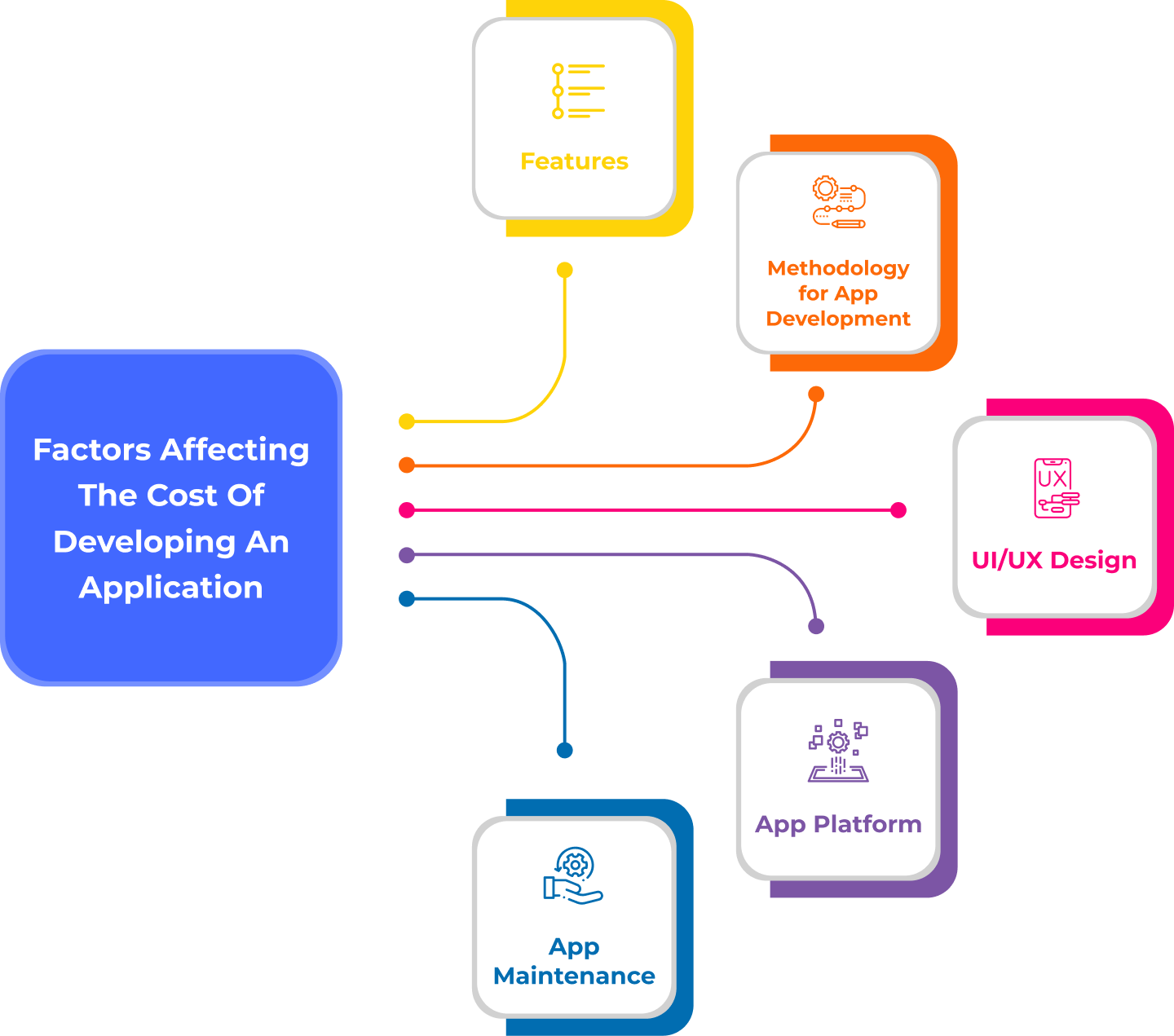
Factors Affecting The Cost Of Developing An App
Creating a fitness app that not only outperforms the market competition but also generates revenue is difficult. It necessitates a comprehensive strategy considering numerous factors that can impact the overall time and budget. Let’s go over some of the factors that have a direct impact on the total cost of developing a fitness app.
Features
The features of an app play a significant role in determining the overall cost. If you choose basic features, you will pay less than if you choose advanced features. This is because advanced features are more complex and require more time to complete than basic features.
Methodology for App Development
The cost of developing a mobile fitness app is primarily determined by the app development method used. The price varies depending on the platform. Going with a single platform, such as Android or iOS, will cost you more than going cross-platform because these apps take more time and are more difficult to build.
User Interface/UX Design
Design details and complex screens automatically increase the cost of developing a mobile fitness app. Aside from the time it takes to create such a design, the prototype development cost is distinct from the visual design cost and plays a significant role in the overall price of a fitness app.
App Platform
Selecting a platform before beginning the mobile app development process is critical. You can create an iOS, Android, web, or cross-platform application based on your target audience. If you are a startup with a limited budget, starting with one platform and then expanding to multiple platforms later is best.
App Maintenance
Expenses do not cease to exist at the end of the mobile application development process. Businesses will have to keep changing their apps to keep up with changing market trends and new device and operating system versions, which will come at a cost. What is your budget after app development?
- Fixing Bugs For The App
- Design Modifications
The cost of app maintenance is calculated yearly at a rate of 20% of the total cost of mobile app development.
Mobile App Development Cost by Industry (2026)
Not all apps in the same complexity bracket cost the same. The industry you build for significantly changes your cost structure — primarily because of compliance requirements, third-party API costs, and the depth of backend logic each sector demands. Here is what our 2026 project data shows across key verticals.
| eCommerce | $30,000 – $150,000 | Product catalogue + payment gateway | PCI-DSS | Amazon, Shopify, Etsy |
|---|---|---|---|---|
| Healthcare / Telemedicine | $60,000 – $250,000 | HIPAA compliance + EHR integration | HIPAA, FDA | Teladoc, Zocdoc, Headspace |
| Fintech / Banking | $80,000 – $500,000+ | Security, encryption, BaaS or banking licence | PCI-DSS, SOC 2 | Revolut, Chime, Venmo |
| On-Demand / Logistics | $40,000 – $200,000 | Real-time GPS + three-panel architecture | Varies by region | Uber, DoorDash, Lalamove |
| EdTech | $30,000 – $150,000 | Video streaming + adaptive learning engine | FERPA (US) | Duolingo, Coursera, Udemy |
| Real Estate / PropTech | $40,000 – $180,000 | Map APIs + MLS data integration | Varies | Zillow, Trulia, Redfin |
| Fitness & Wellness | $20,000 – $150,000 | Video infrastructure + wearable sync | None (general) | MyFitnessPal, Peloton, Whoop |
| Travel & Hospitality | $50,000 – $250,000 | GDS / OTA API integration | PCI-DSS | Hopper, Booking.com, Airbnb |
Key Insight: Healthcare and Fintech apps consistently cost 40–60% more than apps in other verticals at the same feature complexity level. The extra cost comes from compliance engineering, security audits, and third-party integrations with regulated data systems — not from extra screens or features.
Mobile App Development Cost by Developer Location (2026)
Your development team’s geography is often the single biggest variable in your total budget. The same app spec can cost $40,000 with an Indian team, $120,000 with a US team, and $70,000 with an Eastern European team. Here is a full rate comparison for 2026, based on current market data and our own partner network rates.
| Region | Developer Rate/hr | Designer Rate/hr | PM Rate/hr | QA Rate/hr | Best For |
|---|---|---|---|---|---|
| United States | $100 – $200 | $80 – $150 | $80 – $140 | $60 – $100 | Enterprise, regulated, US-based compliance |
| Western Europe | $70 – $150 | $60 – $120 | $65 – $120 | $50 – $90 | High-quality, similar time zone to US |
| Eastern Europe | $35 – $75 | $30 – $60 | $30 – $60 | $25 – $45 | Strong talent, good English, reasonable cost |
| India | $15 – $45 | $12 – $35 | $15 – $35 | $12 – $30 | Large talent pool, best cost efficiency |
| Southeast Asia | $20 – $50 | $15 – $40 | $18 – $40 | $15 – $30 | Growing quality, competitive rates |
| Latin America | $30 – $70 | $25 – $55 | $30 – $60 | $20 – $45 | US time zone overlap, good English |
Example: A medium-complexity mobile app requiring 1,200 billable hours would cost approximately $54,000 with an Indian team at $45/hr average, $84,000 with an Eastern European team at $70/hr, and $168,000 with a US team at $140/hr average. The spec is identical. Only the team location changes.
Hidden Cost Factors In Mobile App Development
In this section, we will go over the most common hidden costs associated with mobile app development projects. Understanding these factors will help you reduce risks while also saving you time and money. So, without further ado, let’s go over each one in-depth!
Infrastructure Expenses
Infrastructure expenses include data storage, data delivery, and app hosting. All of this raises the project’s cost and complexity. Servers, data storage, and development tools and libraries are examples of infrastructure costs.
App Safety
The security of apps is a major concern. Users must have faith in your app with their personal information. As a result, you should have a solid security strategy in place. Everything will be fine if you consider this point at the outset and allow time for testing and security checks. If this is not the case, the costs will be higher, and there may be financial and reputational losses as well.
Quality Control
Depending on the size of your app, you may also require the services of a quality assurance agent or a project manager. You may also require the services of business analysts to assist you in keeping development costs low and within your app development budget.
IT Support Fees
A high-quality app cannot be created without IT support services and ongoing technical support. However, the costs of support may rise over time. IT support services include iOS and Android updates, bug fixes, and API upkeep.
Cost Of Publishing An App
When app developers create apps, they keep the app store requirements in mind. It is not a big deal when it comes to app store fees. When you submit an Android app to the Play Store, you must pay a one-time fee of $25. In comparison, Apple charges $99 per year.
If you want to distribute your app solely within your organization, you must join the Apple Developer Enterprise Program and submit your app to the App Store for $299 per year. Google Play does not charge for its services.
App Complexity — The Biggest Single Variable
| Complexity | Cost Range | Dev Hours | Timeline | What It Includes |
|---|---|---|---|---|
| Simple | $10,000–$30,000 | 100–300 hrs | 1–3 months | Static content, basic UI, no backend, 1–3 screens. Examples: calculator, timer, info app. |
| Moderate | $30,000–$80,000 | 300–700 hrs | 3–6 months | User auth, database, payment, API integrations. Examples: e-commerce, job board, news app. |
| Complex | $80,000–$200,000 | 700–1,500 hrs | 6–12 months | Real-time features, GPS, multi-role users, custom admin. Examples: ride-hailing, delivery, marketplace. |
| Enterprise | $200,000–$500,000+ | 1,500+ hrs | 12–24 months | AI/ML, IoT, ERP integration, compliance, multi-region. Examples: banking, healthcare, logistics ERP. |
How Can You Cut the Costs of Mobile App Development?
Fortunately, business owners and entrepreneurs can cut the costs of developing mobile apps by adhering to a few industry’s best practices and employing a few useful tricks.
In this section, we’ll look at the steps that businesses can take to reduce overall custom app development costs.
Prioritizing Features From The Beginning
When developing an app, it is critical to correctly prioritize your app’s features. It’s a wise decision to prioritize your app’s functionalities in order to begin driving business value as soon as possible. The nice-to-have elements can be saved for later stages of development. As a result, it’s best to start with a minimum viable product (MVP).
Making Plans For The Future
The app created today may not look the same in the future. For example, if you create an MVP, you may want to modify some features based on customer feedback. Your target market may change completely, forcing you to change your product as well.
That is why, when developing an application, it is important to consider both short-term and long-term goals. It will save you a significant amount of money in the long run.
Include Quality Assurance From The Start
You must address bugs and errors as soon as possible because your application is prone to them. By involving QA professionals early on, you can identify major issues and bugs before the development phase begins.
As a result, you will save a substantial sum that could otherwise become very high in the middle of your project.
Choosing Outsourcing Or In-House
The kind of mobile app development staffing structure you use is an important part of your project planning. Your final decision will have an impact on budget costs, workflow structure, and even the concept of product maintenance. So, the ultimate decision is whether to outsource or develop in-house.
Development Stages and What They Each Cost
| Stage | What Happens | % of Total Budget |
|---|---|---|
| Discovery & Planning | Requirements analysis, competitor research, tech stack decision, project roadmap | 5–10% |
| UI/UX Design | Wireframes, interactive prototypes, visual design system, accessibility review | 10–15% |
| Frontend Development | All user-facing screens, animations, transitions, navigation flows | 25–30% |
| Backend Development | REST APIs, database design, server logic, third-party integrations, admin panel | 25–35% |
| QA & Testing | Unit testing, integration testing, UAT, device compatibility, performance testing | 10–15% |
| Launch & Deployment | App Store / Google Play submission, server deployment, monitoring setup, SSL | 5–8% |
| Post-Launch Maintenance | Bug fixes, OS updates, security patches, new feature rollouts (annual recurring) | 15–20% of build cost/yr |
Hidden Costs Most Guides Miss
| Hidden Cost | Details | Annual Budget |
|---|---|---|
| Third-Party API Fees | Google Maps ($2–$10/1,000 calls), Twilio SMS ($0.0079/message), Stripe (2.9% + $0.30/transaction) | $500–$5,000/month at scale |
| App Store Fees | Apple: $99/year. Google Play: $25 one-time. Both take 15–30% of in-app purchase revenue. | $124+ setup + revenue share |
| Server / Cloud Hosting | AWS, GCP, or Azure — scales with users. Simple app: $50–$200/month. Complex: $500–$5,000/month. | $600–$60,000/year |
| SSL Certificates | Free (Let's Encrypt) or $100–$500/year for premium EV certificates | $0–$500/year |
| Push Notification Service | Firebase free tier covers most apps. OneSignal free up to 10K subscribers. | $0–$500/month |
| Data Compliance (GDPR/HIPAA) | Legal audit, DPA setup, consent management platform, annual review | $5,000–$30,000/year |
| App Store Optimisation (ASO) | Keyword research, screenshot design, A/B testing, localisation | $2,000–$10,000 one-time |
| Crash Monitoring | Crashlytics (free) or Sentry ($26–$80/month for teams) | $0–$960/year |
| Customer Support Tool | Intercom, Zendesk, or Freshdesk for in-app chat support | $500–$3,000/month |
How to Reduce Mobile App Development Costs Without Compromising Quality
Build an MVP first — validate core assumptions before adding features. Every feature you defer saves $2,000–$20,000.
Choose React Native or Flutter — one codebase for both iOS and Android saves 30–40% vs native development.
Partner with an experienced offshore team — Indian development agencies deliver the same quality as US teams at 60–70% lower cost, with senior-level English-speaking project managers.
Prioritise features by user value — use a MoSCoW framework (Must Have, Should Have, Could Have, Won’t Have) to cut scope to the essentials before starting development.
Reuse open-source components — authentication systems, payment modules, and map integrations have robust open-source options that reduce custom development time by 20–40%.
Top App Platforms:
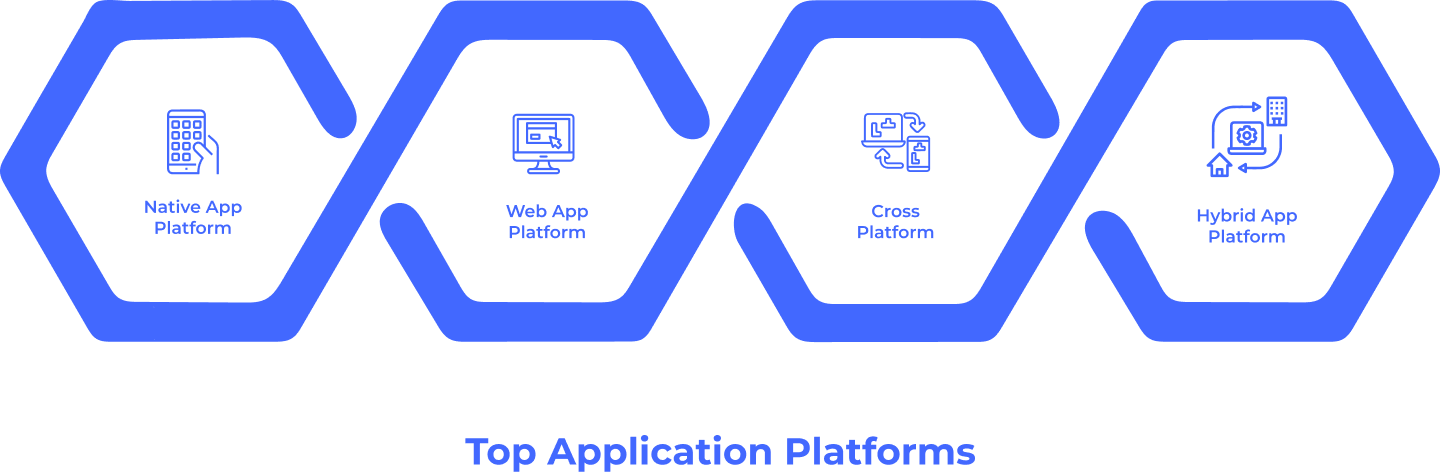
Selecting a platform before beginning the mobile app development process is critical. Depending on your target audience, you can create an iOS, Android, web, or cross-platform application. If you are a startup with a limited budget, starting with one platform and then expanding to multiple platforms is best.
Here are the most popular app development platforms from which to choose:
Native App Platform
iOS app development is done in Swift and Objective C, whereas Android app development is done in Java and/or Kotlin.
Web App Platform
Progressive Web Apps and other web apps are far less expensive than native apps. In terms of development, a web app costs between $15,000 and $50,000.
Cross-Platform
The new cost-effective trend is to have an app developed for both iOS and Android at the same time. The platform has a number of advantages, including the use of a single code base and less development effort.
Hybrid App Platform
Hybrid apps are a combination of native and web apps. It is installed as a native app, but it runs as a web view component.
How Do Apps Generate Revenue?
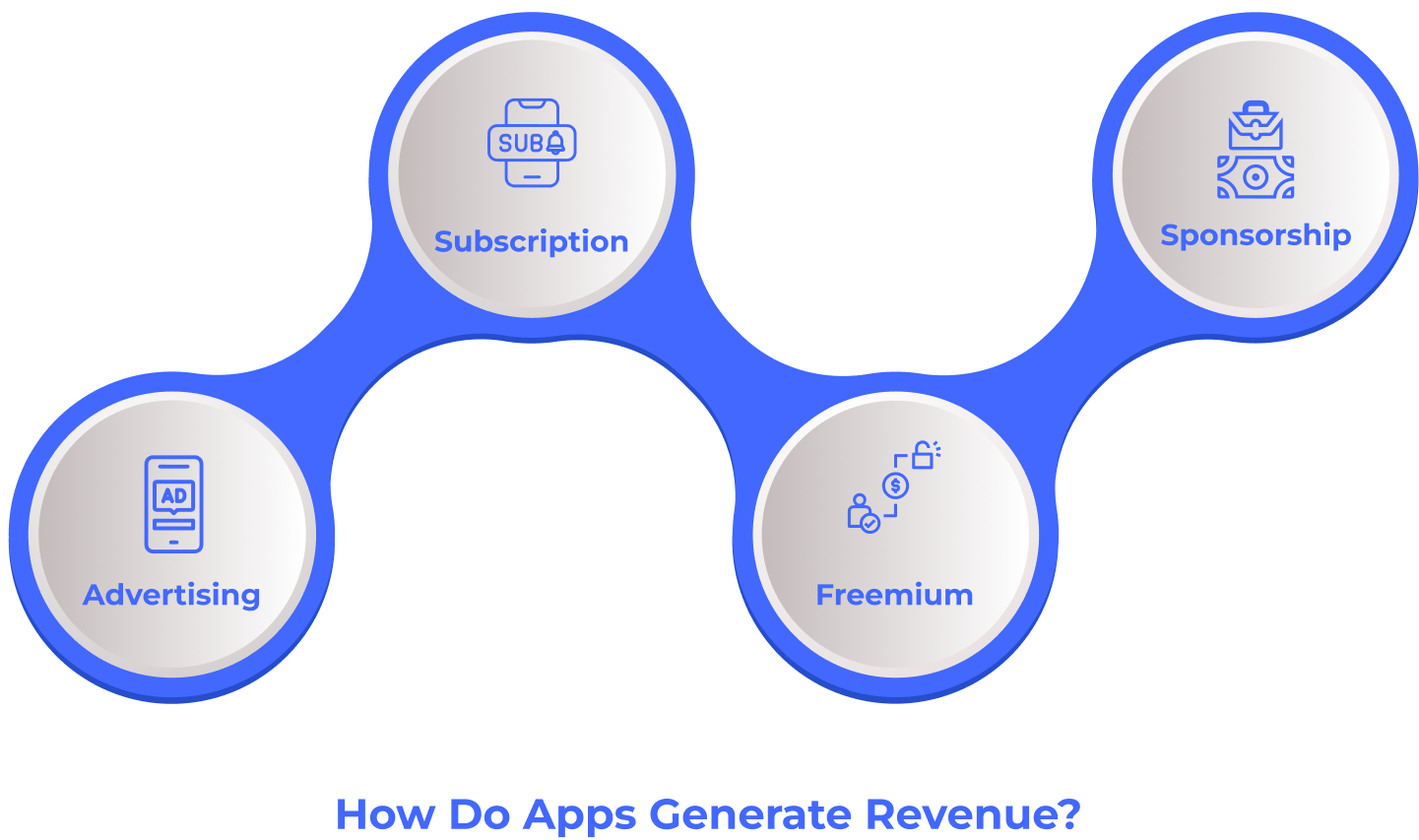
While there are numerous ways to monetize an app, we will discuss a few of the most popular revenue channels for apps in this section, which you can use individually or in combination to earn more revenue and increase customer value.
Advertising
It is a common method of earning money from a mobile app. In this monetization model, you promote services or products for third-party clients on your app and receive payment in exchange.
Subscription
In this model, a user must purchase a subscription plan in order to access the app’s most popular features. This model may include a monthly subscription, a yearly subscription, or a per-day subscription. Subscriptions can be managed through major platforms such as Google and Apple.
Freemium
Users can access basic features for free under this monetization model. They must pay a fee in order to gain access to premium features. Freemium also allows for the implementation of secondary revenue channels, such as in-app advertising.
Sponsorship
The sponsorship model involves finding a sponsor related to your niche and striking up a compensation structure. In return for monetary compensation, the app could include the sponsor’s brand, advertise its products, or send users to its website.
FAQs
Q: How much does it cost to build a mobile app in 2026?
Mobile app development in 2026 costs between $10,000 for a simple single-feature app and $500,000+ for an enterprise-grade platform. The most common range for a business-quality app with standard features is $50,000–$150,000. Cost is determined by platform (iOS, Android, or both), feature complexity, development team location, and ongoing maintenance requirements.
Q: What is the cheapest way to build a mobile app?
The lowest-cost approach is building a single-platform MVP (iOS or Android only) with a cross-platform framework like Flutter or React Native, using an offshore development team. A focused MVP with three to five core features can be built for $15,000–$35,000. Avoid scope creep — every added feature adds development hours linearly.
Q: How long does it take to build a mobile app?
Simple apps take 2–4 months. Medium-complexity business apps take 4–7 months. Complex platforms with custom backend, third-party integrations, and multi-user roles typically take 7–14 months from kickoff to App Store launch. These timelines assume a full-time team of 4–6 people.
Q: Why do some agencies quote $5,000 for an app?
Agencies quoting $5,000–$15,000 for complex apps are either planning to use no-code/template tools (which have severe long-term limitations), significantly underscoping the project, or operating with very low-cost offshore teams without adequate QA and project management. This routinely results in incomplete apps, long delays, and costly rebuilds.
Q: What are the hidden costs of mobile app development?
The most commonly overlooked costs are: App Store fees ($99/year Apple Developer Program, $25 one-time Google Play), third-party API subscriptions (Google Maps $2–$7 per 1,000 calls, payment processor fees), cloud server costs ($50–$500/month depending on traffic), post-launch bug fixes (typically 15–20% of initial build cost in year one), and app update cycles required with each new iOS/Android OS version.
Q: Should I build a native app or a cross-platform app to save money?
Cross-platform development (Flutter or React Native) costs 30–45% less than building separate native apps for iOS and Android. For most business use cases, cross-platform apps perform on par with native. Choose native-only development for apps with complex graphics, AR/VR, or deep hardware integration requirements. For everything else, cross-platform delivers better ROI.
Do not Miss Our Latest Tech Insights
Stay one step ahead in the fast-moving world of AI and technology. Add us as a Preferred Source on Google and get our latest articles, guides, and industry insights delivered straight to your search feed.