+1 740 762 6496
 +91 70189 46603

TABLE OF CONTENT
- How Much Does It Cost To Build A Grocery Delivery App Like Instacart?
- Primary Features Of Grocery Delivery App:
- Benefits Of Building A Grocery Delivery App:
- How To Use A Grocery Delivery App?
- Factors That Affect The Cost Of Building A Grocery Delivery App
- How Much Does It Cost To Build A Grocery App Like Instacart?
- Final Words
- FAQs
Overview
- Explains the cost of developing grocery delivery apps with features like product listings, order tracking, and payment integration.
- It covers user, delivery, and admin panels.
- Costs depend on app complexity, real-time tracking, and third-party integrations.
- The article emphasizes logistics and inventory management.
- It concludes with cost optimization strategies such as MVP development and efficient tech stack selection.
We get this question roughly twice a month. A regional grocery chain or a food delivery startup lands on a call and asks the same thing: what does it actually cost to build something like Instacart, and is it worth it at our scale? The honest answer depends on what “like Instacart” means to you. A single-store MVP with a customer app, a basic shopper app, and an admin panel — that is a $40,000 to $60,000 build. A multi-store platform with real-time inventory, shopper substitution workflows, loyalty programmes, and scheduled delivery slots runs $65,000 to $100,000. A full enterprise system with AI demand forecasting and dynamic pricing across multiple cities pushes past $110,000. This guide breaks down all three tiers. We have built delivery and commerce apps for clients including Distacart (cross-border grocery with 500,000+ SKUs) and we are drawing on that experience, not on numbers pulled from a Google search.
This 2026 guide by Auspicious Soft covers what it takes to build a grocery delivery app like Instacart: the three-panel architecture (customer + shopper + store), must-have features, technology stack choices, and a fully updated cost breakdown based on our 2026 project rates.
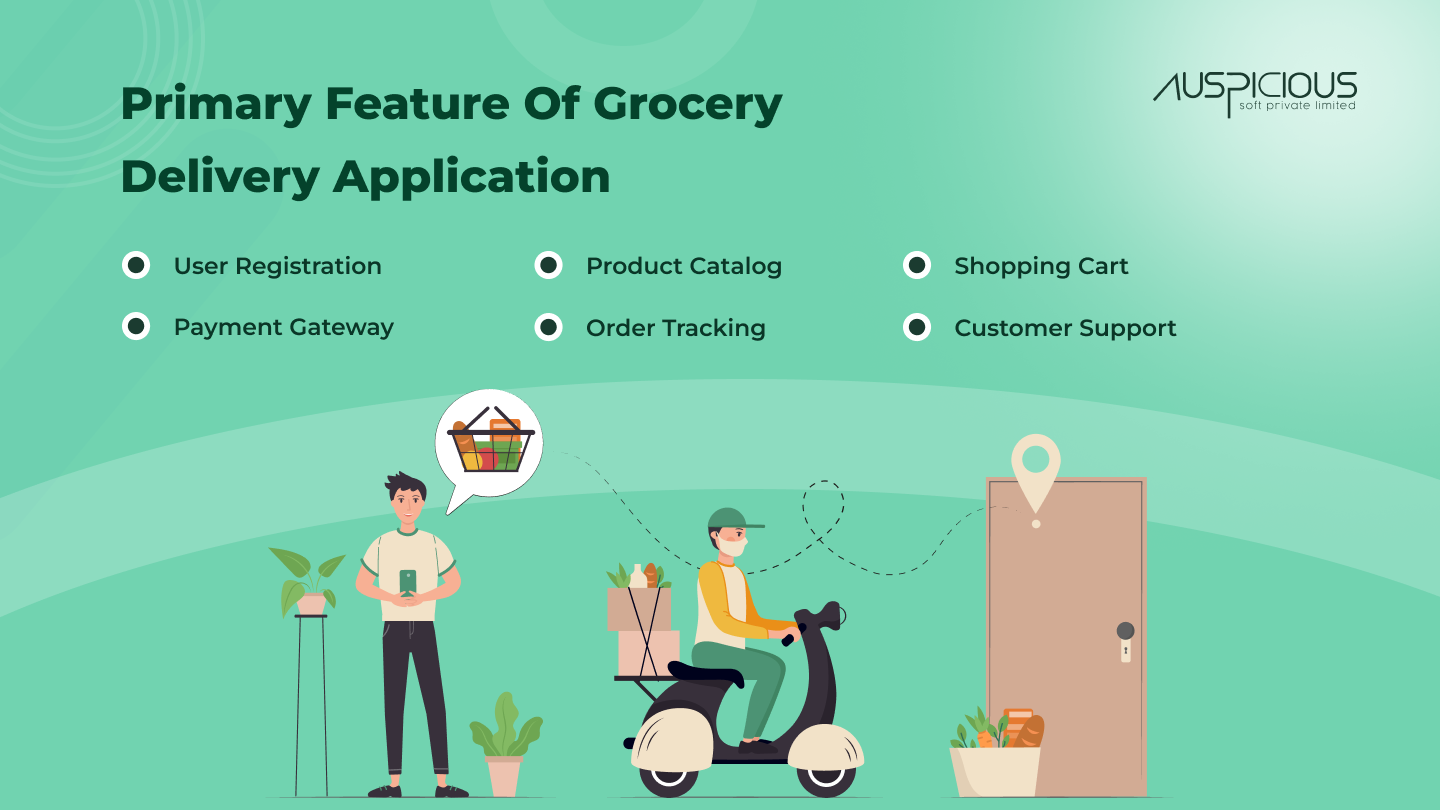
Primary Features Of Grocery Delivery App:
Every grocery delivery app must have certain features to ensure a seamless user experience. Some of these features include:
● User Registration:
Registration needs to be fast and forgettable. Social logins (Google, Apple, Facebook) plus phone-number OTP. Nobody should spend more than 20 seconds getting in. We have seen conversion drop by 30 percent on grocery apps that force a full email-and-password registration before letting someone browse. Let them look around first, and gate registration at checkout.
● Product Catalog:
The catalog is where grocery apps get complicated. A supermarket carries 30,000 to 60,000 SKUs. Products have weight variants, pack sizes, brand alternatives, dietary tags (gluten-free, keto, halal), and images that need to actually look like what the shopper is picking off the shelf. Most MVP builds underestimate this. If your catalog management is clunky, your store partners will not keep it updated, and customers will see items that are out of stock or wrongly described. Build a bulk CSV import from day one and plan for direct POS integration at scale.
● Shopping Cart:
The shopping cart is another critical feature of the grocery delivery app. Users should be able to add items to their shopping cart, adjust the number of items, and remove items from the cart. The app should also calculate the total price of the order, including taxes and delivery fees.
| Feature | Description | Priority |
|---|---|---|
| Smart Product Search | Search By Name, Brand, Diet Type (Vegan, Gluten-Free, Keto), Barcode Scan | Essential |
| Real-Time Inventory | Live Stock Levels From Store — Prevents "Item Unavailable" Frustration | Essential |
| Flexible Delivery Slots | Schedule Delivery: Express (30 Min), Same-Day, or Next-Day Time Slots | Essential |
| Shopper Chat | In-App Messaging For Substitution Approval ("Your Avocados Are Out — OK With These?") | High |
| Real-Time Order Tracking | GPS Map Showing Shopper Picking Items, Then en Route To Customer | Essential |
| Smart Substitutions | AI Suggests Closest Alternatives When Items Are Out Of Stock | Competitive Edge |
| Loyalty & Subscriptions | Monthly Pass For Free Delivery (Instacart+ Model) Drives Retention | High |
| Multi-Store Ordering | Shop From Multiple Stores in a Single Cart — Major Differentiator in 2026 | Competitive Edge |
| Secure Multi-Payment | Card, Apple Pay, Google Pay, SNAP EBT (US), UPI (India) | Essential |
| Ratings & Review | Rate Each Shopper and Each Store — Drives Quality Control | High |
● Payment Gateway:
The payment gateway is the backbone of the grocery delivery app. The app should provide a secure payment gateway that accepts various payment methods like credit cards, debit cards, mobile wallets, or net banking. The payment process should be seamless, and the app should provide users with receipts and invoices for their orders.
● Order Tracking:
Customers want to see two things: is my shopper picking items yet, and how far away is the delivery? Real-time GPS tracking on the delivery leg is expected in 2026. But the underrated part is the shopping stage — letting the customer see “12 of 18 items picked” with live substitution approvals. Instacart does this well, and it is the feature that builds the most trust. Without it, the customer is just waiting and hoping.
● Customer Support:
Customer support is an essential feature of the grocery delivery app. The app should provide users with various ways to contact customer support, like live chat, email, or phone. The customer support team should be available 24/7 to assist users with any issues or concerns related to their orders.
These features are vital for building a successful grocery delivery app that provides a seamless user experience. The features should be designed and developed keeping in mind the user’s needs, preferences, and expectations. With these features, grocery delivery apps can help customers save time, and effort, and provide a competitive advantage to grocery stores.
Factors That Affect The Cost Of Building A Grocery Delivery App
The biggest cost driver is not the feature list — it is the number of panels. A grocery delivery app is really three apps sharing a backend: the customer app, the shopper or delivery partner app, and the store or admin dashboard. Each panel has its own user flows, its own edge cases, and its own testing requirements. That is why costs jump significantly between a single-panel MVP and a full three-panel build. After that, the factors that actually move the budget are:
Real-time inventory sync. If you are pulling stock levels from a store’s POS system in real time, that integration alone can cost $10,000 to $25,000 depending on the POS vendor’s API quality. Some vendors have clean modern APIs. Others require screen scraping or batch file exports. We have dealt with both. Substitution workflow. When a shopper cannot find an item, the system needs to suggest alternatives, notify the customer, wait for approval, and handle refunds — all in real time, all while the shopper is standing in the aisle.
This is 2 to 3 weeks of development on its own, and it is the feature most teams underestimate. Platform choice. Building natively for both iOS and Android roughly doubles your frontend cost. Cross-platform with React Native or Flutter covers both for 60 to 70 percent of the cost. For an MVP, cross-platform is almost always the right call. Payment complexity. Stripe or Razorpay integration for standard card payments is straightforward. Adding wallets, cash on delivery, split payments, or tipping adds $5,000 to $10,000.
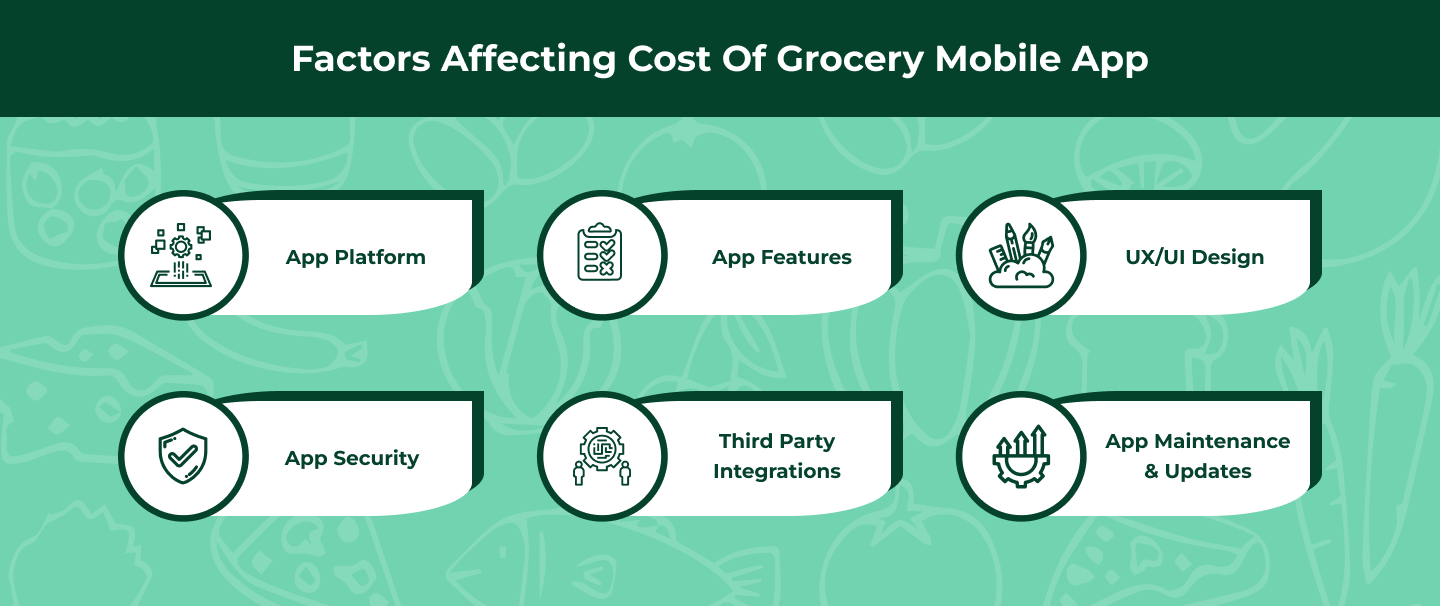
● App Platform:
One of the primary factors that can affect the cost of app development is the platform on which the app will be built. There are two main platforms to consider – iOS and Android. Developing for both platforms will require more resources and development time, which can drive up the overall cost of app development. However, it’s important to consider the target audience and their preferred platform when deciding which platform to develop for.
● App Features:
Another critical factor that can impact the cost of app development is the features and functionality required for the app. The more complex features and functionalities required, the higher the cost of app development will be. Some essential features that every grocery delivery app must have include user registration, product catalog, shopping cart, payment gateway, order tracking, and customer support. Other advanced features such as real-time GPS tracking, push notifications, and personalized recommendations can also add to the cost of development.
● User Interface and User Experience (UI/UX):
A good UI/UX design is crucial for a successful app, as it affects how users interact with the app. A well-designed and intuitive UI/UX can help attract and retain users, while a poorly designed interface can drive them away. Hiring a skilled UI/UX designer can increase the cost of app development, but it’s a worthwhile investment to ensure a seamless and user-friendly app.
Build a Grocery Delivery App Like Instacart — Get a Free Cost Estimate
See real 2026 pricing, must-have features & business models for grocery apps — then get a custom quote in 24 hours.
● App Security:
App security is critical for any app, but it is especially important for an app that deals with sensitive user data such as payment information. Implementing robust security features such as encryption, two-factor authentication, and secure payment gateway integration can increase the cost of app development but it is necessary to ensure user privacy and data protection.
● Third-Party Integrations:
Integrating with third-party services can add extra functionality to the app, such as payment gateways, social media login, or analytics tracking. However, these integrations can also add to the overall cost of app development. It’s important to carefully consider which third-party services are necessary and which can be avoided to reduce development costs.
● App Maintenance and Updates:
Maintaining and updating the app is an ongoing process that can also add to the cost of app development. The app must be regularly maintained and updated to fix bugs, improve performance, and keep up with changing user needs and preferences. Failure to keep the app updated and maintained can result in user dissatisfaction and abandonment of the app.
In simple words, building a grocery delivery app like Instacart requires careful consideration of various factors that can impact the final cost of app development. It’s important to prioritize essential features, hire skilled designers and developers, and maintain the app regularly to ensure its success. At Auspicious Soft, we have a team of skilled designers and developers who can help you build a high-quality grocery shopping delivery app that meets your business needs and budget. Contact us today to discuss your app development project.
How Much Does It Cost To Build A Grocery App Like Instacart?
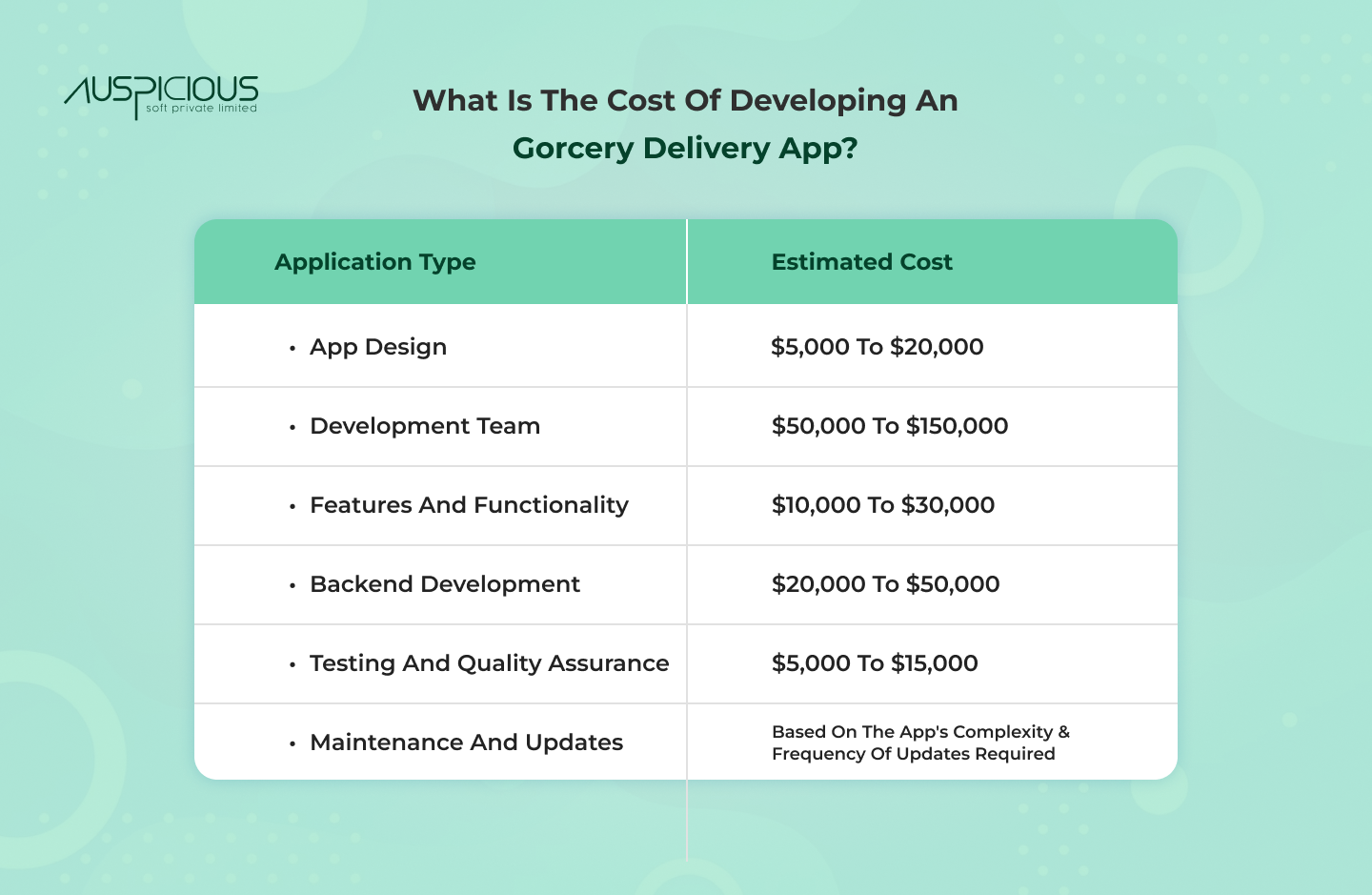
The cost of building a grocery delivery app like Instacart can vary depending on several factors, such as the complexity of the app, the development team’s experience and location, and the time required for the development.
Generally, the cost of developing a grocery shopper app like Instacart can range from $50,000 to $250,000. However, it is important to note that this is just an estimate and the actual cost can vary based on the app’s specific requirements.
Here is a breakdown of the cost based on different aspects of the app:
● App Design:
The design of the app plays a crucial role in its success. The cost of designing an app like Instacart can range from $5,000 to $20,000, depending on the complexity of the design.
● Development Team:
The cost of hiring a development team can vary depending on their experience and location. Generally, a team of experienced developers can cost anywhere from $50,000 to $150,000.
● Features and Functionality:
The cost of building the features and functionality of the app is another significant aspect that can affect the overall cost. The more complex features and functionality required, the higher the cost. For instance, integrating real-time tracking, push notifications, and in-app chat can cost anywhere from $10,000 to $30,000.
| Tier | Scope | Timeline | Cost (USD) |
|---|---|---|---|
| MVP (Single Store, 1 city) | Customer app + basic shopper app + admin | 3–4 months | $40,000–$60,000 |
| Standard (Multi-Store) | + Shopper substitutions, scheduling, loyalty, ratings | 5–7 months | $65,000–$100,000 |
| Enterprise (Multi-City) | + AI demand forecasting, dynamic pricing, franchise model | 8–12 months | $110,000–$150,000+ |
● Backend Development:
Building the backend of the app can also be a significant cost factor. The cost of developing the backend can range from $20,000 to $50,000, depending on the complexity of the backend infrastructure required.
● Testing and Quality Assurance:
Testing and quality assurance are essential to ensure that the app is functioning as expected and free from bugs and errors. The cost of testing and quality assurance can range from $5,000 to $15,000.
● Maintenance and Updates:
Once the app is launched, it will require regular maintenance and updates to keep it functioning properly. The cost of maintenance and updates can vary based on the app’s complexity and the frequency of updates required.
It is important to note that the cost of developing a grocery shopping delivery app like Instacart can vary significantly based on the specific requirements and features of the app. Therefore, it is advisable to consult with a professional app development company to get a more accurate estimate of the cost based on your specific needs.
Final Words
Building a grocery delivery app like Instacart can be a complex and costly process, but it can also provide numerous benefits. With the right features and functionality, a grocery delivery app can provide convenience to customers and increase sales for grocery stores. Factors like the app platform, design, features, location, and development timeline can all impact the cost of app development. If you’re looking for a reliable app development company to build your grocery delivery app, Auspicious Soft is a great option. They have a team of experienced developers who can create a high-quality app that meets your specific needs and requirements.
What Actually Goes Wrong
We have seen enough of these projects — ours and others’ — to know where they break. First, teams launch across too wide an area with too few delivery partners. A grocery delivery app needs density. If you have 10 drivers covering an entire city, every delivery takes 90 minutes, and your customer does not come back. Launch in 3 to 5 zones with concentrated coverage.
Expand once your delivery times are consistently under the promise. Second, catalog accuracy gets neglected after launch. Products go out of stock, prices change, seasonal items rotate — and nobody updates the app. Within two months, 15 to 20 percent of what customers see is wrong. Build store-side catalog tools that are easy enough that a store manager uses them, not just a developer. Third, the shopper experience gets deprioritised. Founders obsess over the customer app because it is the one they demo to investors.
But the shopper app determines whether orders arrive accurately and on time. A poorly designed pick list adds 15 to 20 minutes per order. Multiply that across 100 daily orders and you have burned through your delivery margin before the first month is over. Fourth, post-launch costs surprise people. Hosting, payment processing fees, ongoing bug fixes, app store updates, OS compatibility patches — budget 15 to 20 percent of the build cost annually for maintenance. If the budget ends at launch, the app starts decaying immediately.
FAQs
Q: How much does it cost to build a grocery delivery app like Instacart in 2026?
It depends on what you actually need. A single-store MVP with a customer app, basic shopper app, and admin panel typically costs $40,000 to $60,000 and takes 3 to 4 months. A multi-store platform with substitution workflows, delivery scheduling, and loyalty features runs $65,000 to $100,000 over 5 to 7 months. An enterprise-grade multi-city platform with AI-powered demand forecasting and dynamic pricing starts at $110,000 and can take 8 to 12 months. The biggest cost variable is how many panels you are building — customer app, shopper app, and admin dashboard each add roughly $15,000 to $30,000 to the total.
Q: How long does it take to build a grocery delivery app?
A basic MVP takes 3–4 months. A full-featured three-panel app with scheduling, substitutions, and loyalty programmes takes 5–7 months. An enterprise multi-city platform takes 8–12 months.
Q: What is the business model for a grocery delivery app?
Primary models: delivery fee per order ($2–$8), monthly subscription (free delivery pass), commission from partner stores (5–15%), in-app promoted product placements, and surge pricing during peak demand windows.
Q: What is the hardest technical challenge in building a grocery delivery app?
Real-time inventory accuracy is the hardest problem — grocery stock changes by the minute, and showing customers an item that is actually out of stock destroys the user experience. The solution requires direct POS (Point of Sale) integration with partner stores or a dedicated inventory API layer.
Q: How do I handle out-of-stock items in a grocery app?
Implement a three-option model:
(1) Smart AI substitution suggestion — the shopper sees a ranked list of alternatives;
(2) Customer approval via in-app chat before substitution;
(3) Refund the item automatically if no acceptable alternative exists. This reduces order cancellations by 40–60%.
Q: Should I build natively for iOS and Android or use cross-platform?
For a grocery delivery MVP, cross-platform (React Native or Flutter) is almost always the right call. You get both platforms from a single codebase at roughly 60 to 70 percent of the cost of building two native apps. The performance difference is negligible for this type of app — grocery delivery does not require the kind of hardware-level access where native development gives a real advantage. Go native only if you have specific requirements around background GPS tracking or camera-intensive features that cross-platform frameworks handle poorly.
Q: Do I need a separate shopper app or can the same app serve both customers and shoppers?
You need a separate app. The customer experience is about browsing, ordering, and tracking. The shopper experience is about pick lists, barcode scanning, substitution approvals, and delivery routing. Trying to combine both into one app creates a confusing interface for both user types and adds significant complexity to your codebase. Keep them separate from day one — it is cleaner to build, easier to maintain, and better for both user groups.
Do not Miss Our Latest Tech Insights
Stay one step ahead in the fast-moving world of AI and technology. Add us as a Preferred Source on Google and get our latest articles, guides, and industry insights delivered straight to your search feed.