
TABLE OF CONTENT
- Why This Framework Choice Matters More Than Ever in 2026
- What Is Flutter App Development?
- What Is React Native App Development?
- Flutter vs React Native 2026: Side by Side Comparison Table
- Performance in 2026: Which Feels Smoother?
- Development Speed: Who Ships Faster?
- User Interface: Custom Look or Native Feel?
- Cost of Flutter App Development vs React Native App Development
- Community, Talent Pool, and Hiring: Who Has the Bigger Team?
- Real Client Story 1: Building Disstrikt with Flutter
- Real Client Story 2: Building Werover with React Native
- Popular Apps Built with Flutter (2026)
- Popular Apps Built with React Native (2026)
- When to Pick Flutter for Your App Development Project
- When to Pick React Native for Your App Development Project
- The Auspicious Soft Verdict: Which One Wins in 2026?
- Ready to Build Your Next App with Flutter or React Native?
- FAQs
Overview
- Choosing between Flutter and React Native in 2026 shapes your app’s cost, speed, and long term success. Flutter, made by Google, holds 46% of the cross platform market.
- It shines for design led apps with smooth animations and pixel perfect UI. React Native, made by Meta, holds 35 to 38% market share. It wins for teams already writing JavaScript and apps that must feel truly native on iOS and Android.
- Both frameworks save 30 to 60% versus native development. Both power apps used by billions of daily users.
- This guide compares performance, cost, hiring, and use cases with real 2026 benchmarks.
- It also walks through two real client projects delivered by the Auspicious Soft team: Disstrikt, a Flutter talent platform for models and actors in Europe, and Werover, a React Native IoT app for wind turbine monitoring across wind farms.
Quick Answer: Flutter wins when your app must feel premium, animate smoothly, and look identical on every phone. React Native wins when your team already writes JavaScript, when you need a huge library of ready made tools, and when you plan to push updates the moment users need them. Both are safe picks in 2026. Both power apps used by billions. The right one for your project comes down to team skills, business timelines, and what your app must actually do on day one.
Now let’s dig into the full comparison — with real numbers, real client projects, and a clear verdict at the end.
Why This Framework Choice Matters More Than Ever in 2026
The mobile app market crossed $330 billion in 2025. Precedence Research expects it to hit $1.23 trillion by 2035. That is a wild growth curve. And here is the shift most people miss: 80% of new mobile apps in 2026 are no longer built once for iPhone and once for Android. They are built once for both, using cross platform mobile development.
Two names lead this space by a huge margin. Flutter, created by Google in 2017. React Native, created by Meta (Facebook’s parent) in 2015. Together, these two power the vast majority of new cross platform apps launching in the USA today.
Picking one is not a small tech decision. It shapes how fast you can launch. It shapes how much you spend. It even shapes who you can hire in your local job market. Get it wrong, and you may rewrite the whole thing 18 months in. Get it right, and you save six figures.
This guide is different from the templated comparisons flooding search results. It draws on actual apps the Auspicious Soft team has built and shipped for clients in the USA and Europe. Two of those apps appear later in this piece with real technical detail. If you want a wider look at what else exists, see the current list of the most popular cross platform app development frameworks in use today. For context on how the field has shifted since the last big wave of comparisons, our earlier take on Flutter vs React Native covered the 2024 state of play.
What Is Flutter App Development?
Flutter is Google’s open source toolkit for building apps. It uses a language called Dart. Here is the part that makes Flutter different from almost every other framework on the planet: Flutter paints every single pixel on the screen using its own rendering engine. That engine is called Impeller. It replaced the older Skia engine in 2025 and delivers roughly 50% faster frame rasterization according to independent benchmarks.
Because Flutter draws the screen itself, your app looks exactly the same on an iPhone 15 Pro as it does on a five year old Samsung. No weird spacing surprises. No mysterious layout bugs.
Flutter also stretches beyond phones. From one codebase, you can ship to iOS, Android, web, Windows, macOS, Linux, and even embedded devices. That is six platforms from one team.
Auspicious Soft offers dedicated Flutter app development services for US clients who need this level of design consistency and multi platform reach.
Best for: Apps that need pixel perfect design, complex animations, or one strong brand look across every device your users touch.
What Is React Native App Development?
React Native runs on JavaScript, the language behind most of the modern web. That single fact matters enormously for hiring. Roughly 67% of professional developers already know JavaScript, according to the Stack Overflow 2024 Developer Survey. Finding React Native talent in Los Angeles, New York, or Austin takes days. Finding a senior Dart developer? Can take weeks.
React Native does not draw its own UI. It uses each platform’s real components. A button on iOS looks and feels like an iOS button. A button on Android follows Google’s Material Design. Users feel at home instantly.
In late 2024, React Native shipped a huge upgrade called the New Architecture. It brings three new pieces: Fabric (a new renderer), JSI (a JavaScript interface that skips the old slow bridge), and TurboModules (lazy loaded native modules). In plain talk, React Native in 2026 is dramatically faster than the version people wrote off two years ago.
The React Native app development team at Auspicious Soft has shipped React Native apps for wind energy, travel, fintech, and healthcare clients across the USA.
Best for: Teams with existing web developers, apps that must feel native on each OS, and startups shipping their first MVP under a tight timeline.
Flutter vs React Native 2026: Side by Side Comparison Table
| Feature | Flutter | React Native |
|---|---|---|
| Made By | Meta (Facebook) | |
| Language | Dart | JavaScript / TypeScript |
| 2026 Market Share (Statista) | 46% | 35–38% |
| Rendering | Own engine (Impeller) | Native platform UI |
| Frame Rate on Complex UI | 58–60 FPS, up to 120 FPS on ProMotion | ~51 FPS on Fabric |
| App Startup Time | Slightly slower | ~200 ms faster on average |
| Battery Drain | Higher on some devices | ~12% less in benchmark tests |
| App Size | 4–8 MB larger | Smaller |
| Learning Curve | 2–3 weeks for Dart | Days for JavaScript developers |
| USA Talent Pool | Growing, but still smaller | Massive |
| Hot Reload Speed | Under 1 second | Fast Refresh (small lag) |
| Web & Desktop Support | Strong across six platforms | Weaker beyond mobile |
| Average Senior Developer Salary (USA) | $135K–$180K | $125K–$160K |
| Time to MVP | 12–16 weeks | 14–20 weeks |
| Over-the-Air (OTA) Updates | Limited (Shorebird only) | Strong (Expo EAS) |
| Best For | Design-led, animation-heavy apps | JavaScript teams, fast iteration, native feel |
Want a broader look at where these two sit next to Xamarin, Ionic, and Kotlin Multiplatform? Read the top platforms for high performance mobile apps breakdown.
Performance in 2026: Which Feels Smoother?
Flutter still edges out React Native on raw performance. Just barely. And with meaningful nuance.
Here is what independent 2026 benchmarks show:
- Flutter hits 58 to 60 FPS on heavy animation. On phones with 120Hz ProMotion screens, it often runs at a full 120 FPS.
- React Native (with the new Fabric renderer) hits around 51 FPS on the same tests.
- React Native opens the app about 200ms faster on cold start.
- React Native uses roughly 12% less battery in extended sessions.
So who really wins?
For animation heavy products like games, video editors, trading dashboards, or fintech apps with rich charts, Flutter feels visibly crisper. Not by a small amount. By a noticeable amount.
For everyday apps like shopping, chat, news, booking, or SaaS companions, users cannot tell the difference. Even seasoned developers struggle to spot the gap in blind tests. Both frameworks are that close in 2026.
The performance debate that dominated blog comparisons in 2022 and 2023 is essentially over. Both are production grade. Both are used by companies serving hundreds of millions of daily users.
Development Speed: Who Ships Faster?
Speed of development is where framework choice hits your budget hardest.
Flutter has hot reload. Save your file. See the change on screen in under a second. Its widget system means less code for the same UI. In practice, Flutter MVPs from the Auspicious Soft team typically launch in 12 to 16 weeks for straightforward products.
React Native has Fast Refresh. Solid, but a hair slower than Flutter’s hot reload. Where React Native truly pulls ahead is post launch. Through Expo EAS, teams can push a JavaScript bundle update to millions of users in minutes. No app store review. No waiting week for Apple to approve a hotfix.
Simple verdict? Flutter is faster during the build phase. React Native is faster to patch, iterate, and A/B test after launch. Both matter. Which one matters more depends on your product lifecycle.
User Interface: Custom Look or Native Feel?
Flutter gives designers freedom. Full freedom. Want a purple button with a rainbow gradient shadow that bounces when tapped? Easy. Same result on every device. This is why brands like BMW and Google Pay leaned toward Flutter for their consumer apps.
React Native uses each phone’s real UI parts. So iOS users get iOS style controls. Android users get Material Design controls. This looks natural but limits how far your designers can push. If your brand demands a very custom look, expect to write more custom native code in React Native.
Rule of thumb:
- Brand first product where design is the differentiator? Flutter.
- Native feel first product where consistency with OS conventions matters most? React Native.
For businesses building a fully custom mobile app development services USA product rather than a template app, this choice becomes even more important.
Cost of Flutter App Development vs React Native App Development
Money time. Let’s cut through the vague estimates most blogs give.
Both frameworks save 30 to 60% versus building two separate native apps (one for iOS, one for Android). For a typical US project between $50,000 and $150,000:
- React Native usually saves $5,000 to $15,000 on developer rates because the talent pool is larger.
- Flutter usually shaves weeks off the timeline, which lowers total build cost.
Hiring cost differences in the USA in 2026:
- Senior Flutter developer: $135,000 to $180,000 per year.
- Senior React Native developer: $125,000 to $160,000 per year.
Offshore rates in India, Poland, or Ukraine run $18 to $60 per hour for both frameworks.
Real answer? The cost gap between the two is far smaller than clickbait blogs suggest. Pick based on product fit and team skills. Do not pick based on saving a few thousand dollars in hiring.
For a real world cost example, the cost to build a logistics app guide by Auspicious Soft walks through what the numbers actually look like across framework choices.
| Get a Free App Cost Estimate in 24 Hours |
Community, Talent Pool, and Hiring: Who Has the Bigger Team?
React Native wins this one. It is not even close.
- Roughly 67% of professional developers already know JavaScript.
- npm hosts over one million ready made packages you can plug straight in.
- Every technical question about React Native has been asked and answered on Stack Overflow, often multiple times.
Flutter’s community has grown fast. Google backs it hard. Its GitHub activity outpaces most other Google projects. But the talent pool is still three to five times smaller than React Native’s. If your app development plan depends on quickly hiring a US based senior developer next month, React Native is easier.
For companies with existing web engineering teams, React Native offers something Flutter cannot: your React developers can start writing mobile code within days. That single fact has driven React Native adoption across Meta, Shopify, Discord, Coinbase, and hundreds of Silicon Valley startups.
Real Client Story 1: Building Disstrikt with Flutter
Theory is fine. Real projects are better.
Disstrikt is a talent agency platform based in the Netherlands. It gives aspiring models and actors direct access to casting agents, coaching, studio time, and a structured way to grow a portfolio. Traditional agencies gatekeep this access. Disstrikt opens it up.
When the Disstrikt founding team approached Auspicious Soft, they had a big vision and two hard problems no template solution could fix.
Problem 1: Users had no clear progression. They joined the platform and got lost. Which task first? Which skill next? No answer.
Problem 2: Zero feedback loop. Members couldn’t see where they stood, what casting agents thought of their profile, or what their next milestone was.
Why Flutter Was the Right Call: Disstrikt needed a visual product. Fashion. Modeling. Acting. The app had to look premium. It had to feel identical on every device a model might carry, from budget Android phones common in one market to the latest iPhones in another. That is a Flutter use case if there ever was one.
What the Auspicious Soft team built:
- A cross platform mobile app for both iOS and Android using Flutter for the frontend
- A responsive companion website
- A MERN backend using Node.js, Express, MongoDB, and React for high speed page loading
- Portfolio management, networking, job applications, casting agent connections
- A predictable admin workflow for the client to manage members without a tech team
- Structured task progression that solved the original confusion
- A visible feedback loop so members always know their status
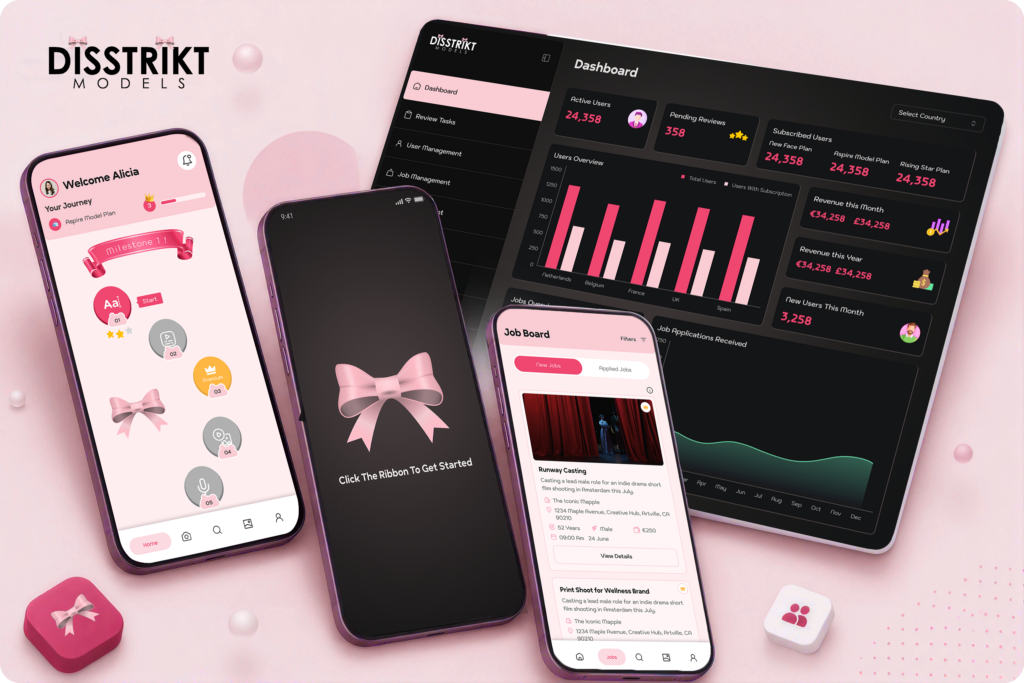
Result: The Disstrikt app launched to a warm response from aspiring artists across Europe. Members can now filter and shape their experience toward personal career goals. The client’s admin team runs the platform themselves through the clean admin workflow, with no daily engineering handholding.
Quote from Jaimy, Founder of Disstrikt: “We’re truly grateful for Dinesh and his team’s dedication, patience, and consistent support throughout our app development journey. They delivered a high quality product with great value, and we look forward to working together long term.”
The full breakdown lives in the Disstrikt case study with more screens and technical detail.
Takeaway for your project: If your product’s success depends on how it looks and feels, Flutter is worth the small extra ramp up time. Design led products almost always pay Flutter back.
Real Client Story 2: Building Werover with React Native
Now the flip side. A completely different kind of product. A completely different framework choice.
Werover is an IoT company that monitors the health of wind turbines across wind farms. Their end users are wind farm operators and maintenance teams. Their end goal is real time turbine data in the palm of a field technician’s hand, plus a full admin panel for centralized control.
When Werover came to Auspicious Soft, three technical fires needed putting out.
Fire 1: Legacy AWS Gateway code was duplicated and insecure. Every endpoint needed a full audit before anything new could ship safely.
Fire 2: New turbines were defaulting to a “Healthy” status before receiving any real sensor data. Admins were being fed a false picture of turbine health. Dangerous for a live energy infrastructure product.
Fire 3: Push notifications were firing duplicates across iOS and Android. Users were receiving three emails for one event. Trust in the notification system was collapsing.
Why React Native Was the Right Call: Werover needed to move fast. The client had an existing backend team writing JavaScript. The mobile app had to feel native on both iOS and Android because field techs use whatever phone their employer issues. React Native delivered on all three fronts.
What the Auspicious Soft team built in 2 to 3 months with a lean team:
- A cross platform React Native mobile app for iOS and Android
- A full featured Admin Panel using React 18, TypeScript, TailwindCSS, and Vite
- Real time turbine sync with color coded SVG visuals for damage severity
- Firmware upload and deployment through AWS S3
- Automated PDF report generation with blade damage visuals and pie charts
- Custom FCM push notification implementation with per platform tuning
- Role based notification filtering so Level 1 and Level 2 users only get alerts they need
- A full refactor of the legacy AWS Gateway code into secure, reusable endpoints
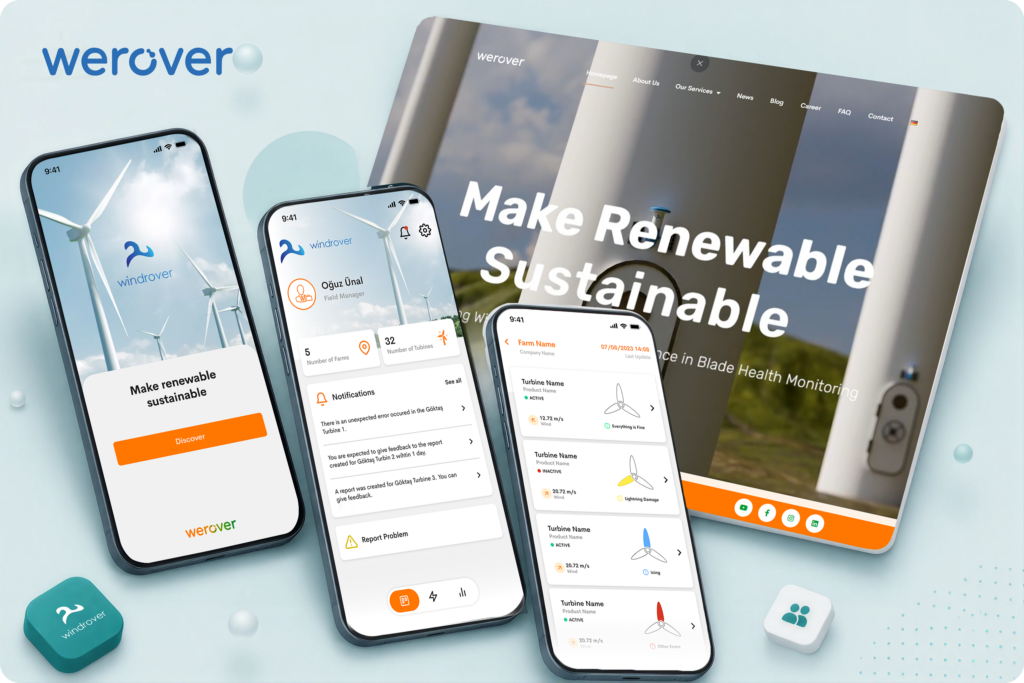
Result: Admins gained centralized control over every device, SIM card, and firmware update from one panel. Field users receive only relevant notifications, cutting alert noise sharply. PDF reports for clients now generate automatically with no manual formatting. Weekly push reminders drove consistent app logins across all user roles.
The full engineering breakdown, including the tech stack diagrams and challenge to solution mapping, lives in the Werover case study.
Takeaway for your project: If your product depends on speed, backend heavy real time data, and a native OS feel over custom design, React Native is often the pragmatic winner. Especially when your team already lives in JavaScript.
Popular Apps Built with Flutter (2026)
Real brands trust Flutter in production:
- Google Pay used by hundreds of millions of users across India
- BMW built its My BMW app entirely in Flutter
- Alibaba Xianyu serves 400 million plus users
- eBay Motors for buying and selling cars
- talabat food delivery across the Middle East
- YouTube Create video editing on the go
- Nubank the biggest digital bank in Latin America
- Reflectly journaling app with millions of downloads
- Karaca ships features twice as fast to over a million monthly users
- NotebookLM built and shipped a 4.8 star Flutter app in seven months
Popular Apps Built with React Native (2026)
React Native powers some of the most used apps on the planet:
- Facebook and Instagram yes, Meta uses it in its own core products
- Discord gaming and community chat used by hundreds of millions
- Shopify all merchant mobile apps
- Tesla the vehicle control app
- Uber Eats the complete order and delivery flow
- Coinbase crypto trading
- Pinterest, Flipkart, PUMA, NerdWallet, Wix and hundreds more
Both lists are packed with names most Americans open every day. That proves both frameworks are ready for real business, real revenue, and real scale.
When to Pick Flutter for Your App Development Project
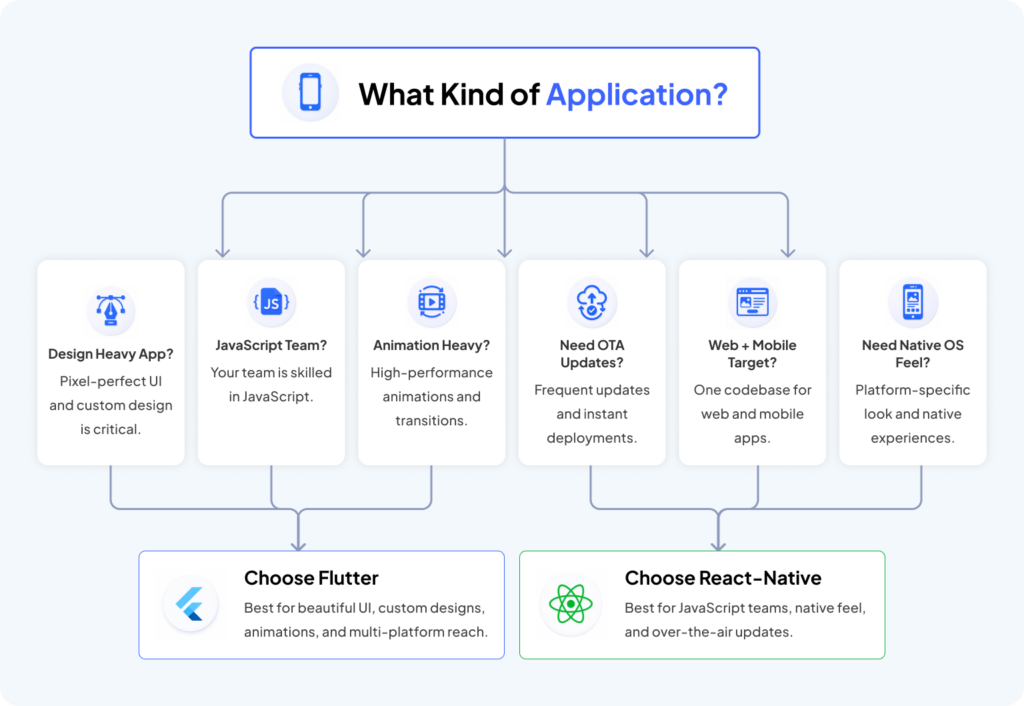
Choose Flutter if:
- Your app needs stunning custom UI or heavy animation.
- You want the exact same look across iOS, Android, web, and desktop.
- Your product is design led and brand consistency matters more than blending in with OS defaults.
- Your team is willing to invest two to three weeks learning Dart.
- You are planning to expand beyond mobile into web or desktop later.
- Long term performance under complex UI load is a business requirement.
Common Flutter use cases in 2026 include fintech apps, video and creative tools, fitness apps, education app development, food delivery, healthcare, and enterprise dashboards. Flutter is also a strong pick for high stakes booking products like hotel booking app development where the UI must feel premium from the first screen.
When to Pick React Native for Your App Development Project
Choose React Native if:
- Your team already writes React or JavaScript for the web.
- You want the largest possible library of ready made tools and packages.
- You need over the air updates to push fixes to users fast.
- You want the app to feel truly native on each OS.
- You plan to share code between your mobile app and web app.
- Your product roadmap includes rapid iteration and frequent A/B testing.
Common React Native use cases in 2026 include e commerce apps, social apps, SaaS mobile companions, on demand apps like ride hailing or delivery, content apps, and IoT dashboards like Werover. It is also a solid pick when your product includes emerging features like a face recognition mobile app module or on device machine learning, since JavaScript has strong library support for both.
The Auspicious Soft Verdict: Which One Wins in 2026?
Neither. And that is the honest answer, straight from a team that has built and shipped apps in both frameworks across the USA and Europe.
After the Disstrikt build in Flutter and the Werover build in React Native, plus dozens of other projects, one truth keeps repeating itself. The right framework is the one that fits the shape of your specific project. Not the one with more GitHub stars. Not the one your favorite tech podcaster prefers this month.
Here is what the Auspicious Soft team tells clients during scoping calls:
If you are a startup with a small team, a tight budget, and you want to test an idea inside six months, and your app is mostly forms, lists, real time data, and standard user flows, go with React Native. The hiring is easier. The launch is quicker. The tools are already built.
If you are a brand where design is the moat, or you need one visual identity across every device your users touch, or your app is animation heavy, go with Flutter. The end result is worth the extra two to three week ramp up.
If your app is a companion to an existing web product built in React, React Native saves months by letting your web team ship the mobile app too.
If your app has heavy real time data, IoT integration, or backend heavy logic (like Werover), React Native’s native module ecosystem gives you a cleaner path.
If your app must look and feel premium across cheap Android phones and flagship iPhones alike (like Disstrikt), Flutter almost always wins.
There is no shame in picking either framework. Both are backed by trillion dollar companies. Both will still be around in ten years. Both power apps used by billions of daily active users right now.
The genuinely wrong move is picking based on a Reddit thread, a Twitter debate, or what a random developer likes. That choice will cost real money when you scale, exactly the same way the wrong tool ruins any custom project. It is the same lesson learned from choosing between custom vs off the shelf mobile apps. Right tool. Right project. Every time.
For businesses in California and the Bay Area, Auspicious Soft offers on the ground mobile app development in San Francisco with both Flutter and React Native specialists on one team. Businesses in Southern California can also work with the mobile app development in Los Angeles division.
| Not Sure Which Framework Fits? Book a Free 30 Minute Strategy Call |
Ready to Build Your Next App with Flutter or React Native?
Still not sure which framework fits your idea? Talk to a real developer. Not a chatbot. Not a template.
The Auspicious Soft team has shipped over 200 apps across ten countries using both Flutter (Disstrikt, Offset7, and more) and React Native (Werover, and more). From napkin sketch to App Store launch, the team helps founders in the USA pick the right tool and ship the right product on the right budget.
FAQs
Q: Is Flutter better than React Native in 2026?
Flutter is better for apps that need custom design and smooth animations. React Native is better for teams with existing JavaScript experience and apps that must feel native to each OS. Neither is universally “better” — the answer depends on your project.
Q: Which is faster: Flutter or React Native?
Flutter runs slightly faster on animations and complex UI (58 to 60 FPS versus 51 FPS on Fabric). React Native opens the app 200ms faster on cold start and uses about 12% less battery in sustained sessions. In real world use, most users cannot tell the difference in daily apps.
Q: Is Flutter cheaper than React Native for USA projects?
Costs are close. React Native developers cost roughly 10 to 15% less on average in the USA due to a bigger talent pool. Flutter builds a bit faster, which offsets the salary gap. Both cut your total build cost by 30 to 60% compared to building two separate native apps.
Q: Will Flutter or React Native become obsolete in 2027 or 2028?
Neither. Google keeps funding Flutter aggressively. Meta keeps funding React Native. Both frameworks power apps used by billions of daily active users. Both are safe technology bets for the next five to ten years.
Q: Which framework has more jobs in the USA in 2026?
React Native. By roughly three to five times. Because JavaScript is the world’s most popular language. Flutter jobs are growing quickly but the raw job count is still smaller across US cities.
Q: Can I build a web app with Flutter or React Native?
Flutter has strong web and desktop support from a single codebase, including native compilation. React Native for web exists through libraries like React Native Web but is less mature. If web parity is a serious business need, Flutter has a clear edge.
Q: Which framework do big American companies prefer?
Both. Google, BMW, and Alibaba prefer Flutter. Meta, Shopify, Tesla, Discord, and Coinbase prefer React Native. Some large companies like ByteDance use both simultaneously for different product lines.
Q: How long does it take to build an app in Flutter or React Native?
A simple MVP takes 12 to 16 weeks in Flutter and 14 to 20 weeks in React Native. A medium app with real backend logic takes 4 to 7 months. A complex enterprise app can run 6 to 12 months in either framework. The Werover React Native project shipped in 2 to 3 months with a lean team.
Q: Do I need separate iOS and Android developers with Flutter or React Native?
No. That is the entire value proposition of cross platform development. One team writes the code once. Both iOS and Android get the app. This is why startups love these frameworks so much.
Q: Which is better for a startup MVP in 2026?
React Native, if you already have any web talent. Flutter, if you are starting fresh and want your app to look great from day one. Both can deliver a working MVP in three to four months for a straightforward product.
Q: Is Flutter or React Native better for iOS app development?
Both work extremely well on iOS in 2026. React Native has a slight edge if you want a pure iOS feel. Flutter has an edge if you want a bold custom UI. For pure Apple ecosystem builds, dedicated iOS app development services using Swift may still be the best choice for products that will never touch Android.
Q: What about Android? Which framework is better for Android app development?
Both handle Android well in 2026. Flutter often produces smoother animation on older Android hardware because it renders directly to the GPU. React Native feels more natural on Android because it uses real Material Design components. For pure Google Play products, dedicated Android app development services using Kotlin may still make sense.
Q: Can Flutter or React Native handle AI and machine learning features?
Yes, both. Flutter has strong on device ML through Dart’s FFI and TensorFlow Lite bindings. React Native has broader library support since JavaScript ML tools are more mature. Auspicious Soft also offers dedicated AI ML development services that integrate cleanly with both frameworks.
Q: How does Auspicious Soft compare to other USA app development companies?
Auspicious Soft was recently included on the list of top 15 mobile app development companies in USA for 2026, with 8+ years of experience, 65 certified specialists, and 200+ projects delivered across 10 countries.