+1 740 762 6496
 +91 70189 46603

Overview
- Platform choice determines your app’s performance ceiling, hiring options, and long-term maintenance cost.
- iOS native leads raw performance; Flutter leads cross-platform speed; React Native leads team flexibility.
- Team skills, target audience, performance needs, and budget together determine the optimal platform choice.
High-performance mobile applications are being in huge demand as businesses and individuals use them for everything, from shopping to productivity. Be it e-commerce, entertainment, or enterprise-level solutions, selecting the right platform for development becomes critical in achieving success.
High-performing apps do not only meet user expectations but also help organizations gain a competitive edge. This article identifies the leading platforms for strong mobile app building and why an experienced app development company is necessary to deliver with a successful outcome.
The Right Choice of Development Platform to Deliver More
The mobile development platform you choose today will define your app’s performance, scalability, and competitive positioning for the next 3-5 years. This is not a decision to make based on a developer’s personal preference or a sales pitch — it should be made based on your specific app’s requirements, your team’s existing skills, your budget, and your long-term expansion plans. The four viable platforms for high-performance mobile apps in 2026 are: native iOS (SwiftUI), native Android (Jetpack Compose), cross-platform Flutter, and cross-platform React Native. Each has genuine strengths, real limitations, and specific use cases where it outperforms the alternatives.
Many businesses navigate these choices with the help of mobile app development services offered by experienced developers. These services guarantee that the app is built on a platform that maximizes its potential while staying aligned with business objectives.

Not Sure Which Platform to Build On? Get a Free Consultation
Compare Flutter, React Native & native performance — then get expert guidance on the right platform for your app.Best Platforms for Fast Mobile Applications
Performance in mobile apps is measured along multiple dimensions: app launch time, frame rate during animations, memory consumption, battery usage, and responsiveness to user input. Native iOS (SwiftUI) achieves the absolute performance ceiling because Apple controls both the hardware and software stack, enabling optimizations impossible in cross-platform frameworks. Native Android with Jetpack Compose follows closely. Flutter in 2026, with its Impeller rendering engine as default on iOS and rolling out on Android, now delivers consistent 60-120fps performance that is functionally indistinguishable from native for 95% of app use cases. React Native with the New Architecture (JSI, Fabric, TurboModules) closes the gap significantly from the legacy bridge system.
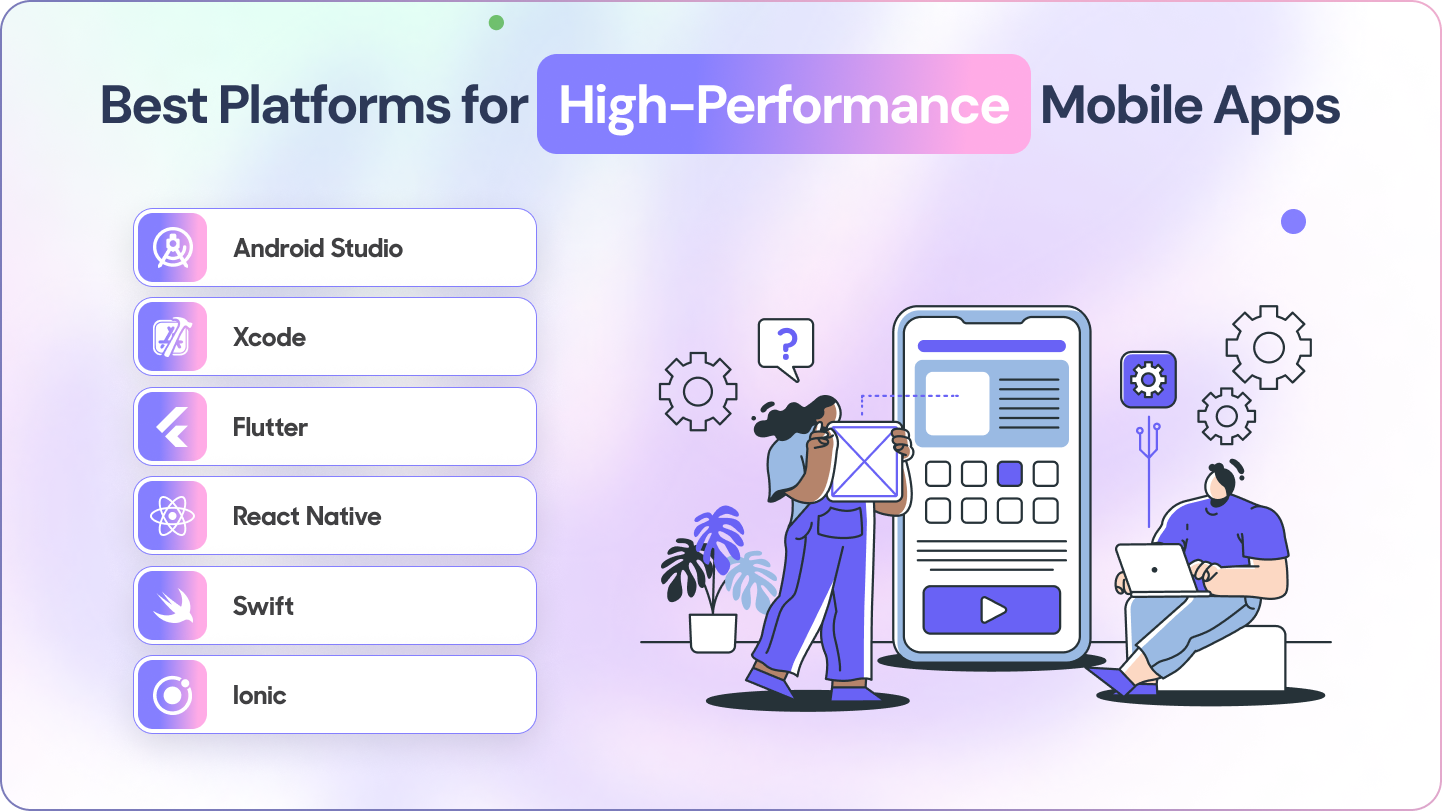
1. Android Studio
Android Studio is the official IDE for Android applications developed by Google. It features powerful tools for developing, testing, and deploying optimized Android applications.
Pros:
-Native execution support for Java, Kotlin, and C++
-Access to rich sets of Android APIs and libraries
-Built-in debugging and testing tools
For businesses targeting the Android user, collaborating with an app development company that specializes in Android Studio can result in apps that are extremely optimized for the platform.
2. Xcode
Xcode is Apple’s official IDE for developing iOS applications. With support for Swift and Objective-C, it enables the creation of sleek, high-performance iOS apps tailored to Apple devices.
Benefits include:
-Seamless integration with Apple’s hardware and software
-User-friendly interface with advanced debugging tools
-Cross-device testing for Apple apps
For iOS users, mobile app development services that apply Xcode would mean that the app complies with Apple’s high-quality and performance demands.
| Platform | Launch Time | Animation FPS | Memory Efficiency | Best Performance Use Case |
|---|---|---|---|---|
| Native iOS (SwiftUI) | Fastest | 120fps (ProMotion) | Excellent | AR, gaming, camera, wearable |
| Native Android (Compose) | Fast | 90fps standard | Very Good | Android-specific hardware features |
| Flutter (Impeller) | Near-native | 60-120fps | Good | UI-heavy cross-platform apps |
| React Native (New Arch) | Near-native | 60fps standard | Good | Business apps, JS team projects |
| PWA (Web-based) | Slower | 60fps max | Lower | Content-heavy, low interactivity apps |
3. Flutter
Flutter is Google’s open-source framework used to make natively compiled applications for mobile, web, and desktop from a single codebase.
Pros
-Real-time change of code- Hot Reload
-High performance rendering engine for smooth animation
-Wide range of customizable widgets
Flutter is a popular choice for businesses looking to minimize development time without sacrificing quality. Partnering with an app development company experienced in Flutter can streamline the development process while delivering a seamless user experience.
4. React Native
React Native, developed by Facebook, is a powerful framework for building cross-platform mobile apps. By using JavaScript, developers can create apps for both Android and iOS simultaneously.
Advantages:
-Code reusability across platforms
-Large developer community for support
-Cost-effective solution for startups and SMEs
Mobile app development services that are highly skilled in React Native will help businesses launch apps fast with great performance and functionality.
5. Swift
Swift is a modern programming language created by Apple for iOS, macOS, watchOS, and tvOS. It has powerful features to build fast and secure applications.
Advantages
-Highly optimized for Apple’s hardware
-Easier to read and maintain than Objective-C
-Rich safety features to minimize coding mistakes
A Swift-experienced app development company can design customized iOS applications that utilize the Apple environment to the fullest.
6. Ionic
Ionic is an open-source, hybrid app development framework with the use of web technologies such as HTML, CSS, and JavaScript. This allows for the development of cross-platform apps with a native appearance.
Advantages:
-Ready access to a library of pre-designed components
-Support for integrations with Angular, React, and Vue.js
-Affordable for startups
Ionic mobile application development services can help deliver visually rich apps that are responsive on various platforms.
Factors to Consider When Choosing a Platform
Choosing a mobile platform is a multi-variable decision that requires weighting factors specific to your business situation. The framework below distills the most important decision criteria into an actionable decision guide.
1. Target Audience
If your target users primarily use Android devices, Android Studio would be the way to go. If they are mainly iOS users, then Xcode and Swift is the best choice.
2. Cost
Cross-platform frameworks such as Flutter and React Native are cheaper for startups and small businesses. They allow the development of apps for multiple platforms using a single codebase.
3. Performance Needs
For resource-intensive apps, native platforms such as Android Studio and Swift provide better performance than cross-platform options.
| Factor | Native iOS | Native Android | Flutter | React Native |
|---|---|---|---|---|
| Dev Cost (US rates) | High ($30-50K+) | High ($25-50K+) | Medium ($20-40K+) | Medium ($20-40K+) |
| Time to Market | Slow (iOS only) | Slow (Android only) | Fast (both) | Fast (both) |
| Performance | Best | Best (Android) | Near-native | Near-native |
| Hiring Ease (US) | Medium (Swift) | Medium (Kotlin) | Growing (Dart) | Easy (JavaScript) |
| AI Feature Access | Apple Intelligence (best) | Google AI (best) | Via cloud APIs | Via cloud APIs |
| Best For | US-first premium apps | Android-specific features | UI-heavy, design-first | JS teams, business apps |
4. Time to Market
If time-to-market is the priority, then frameworks such as Flutter and React Native provide faster development cycles.
5. Expertise of Your Development Partner
Working with a professional app development company ensures that the platform chosen matches your app’s specific needs.
How an App Development Company Provides Value
Working with an experienced app development company provides you with several advantages:
1. Professional Guidance
A good team guides you to select the appropriate platform based on your business objectives and technical specifications.
2. Cost Savings
Professional mobile app development services ensure that the development process is streamlined, saving time and resources.
3. Quality Control
Experienced developers prioritize testing and optimization, ensuring your app delivers a seamless user experience.
4. Future Scalability
By selecting a platform that supports future updates and integrations, your app can grow alongside your business.
Conclusion
In the rapidly evolving digital landscape, high-performance mobile apps are critical for success. Whether you’re targeting Android, iOS, or both, choosing the right platform is a decision that can significantly impact your app’s performance, user experience, and ROI.
The decisions to be taken are navigated by collaborating with a trusted app development company. With access to expert mobile app development services, you can ensure that your app stands out in today’s competitive market and meets the expectations of your users.
With platforms such as Android Studio, Xcode, Flutter, and React Native, among others, business houses can create apps that are fast, reliable, and scalable. Whether a startup or an enterprise, it is the right platform and a development partner that will lay down the foundation for long-term success in the mobile app arena.
Not Sure Which Platform to Build On? Get a Free Consultation
Compare Flutter, React Native & native performance — then get expert guidance on the right platform for your app.FAQs
Q: Which mobile platform is best for high-performance apps in 2026?
A: For maximum performance, native iOS (SwiftUI) or native Android (Jetpack Compose) deliver the best results. For most business apps where near-native performance is sufficient and cross-platform reach matters, Flutter (with Impeller) is the best choice in 2026. React Native (New Architecture) is the best choice for teams with JavaScript expertise who need solid performance across platforms.
Q: Is Flutter or React Native faster in 2026?
A: Flutter with the Impeller renderer generally has a slight performance edge over React Native, particularly for complex animations and custom UI. However, React Native with the New Architecture (JSI/Fabric) has closed the gap significantly. For most business applications, both platforms deliver performance that is indistinguishable to end users. Flutter wins on UI customization; React Native wins on team size and hiring ease.
Q: How important is app performance for user retention?
A: App performance is the single most important technical factor in user retention. Google data shows 53% of mobile site visits are abandoned if a page takes more than 3 seconds to load — the same patience applies to apps. Apps with crash rates above 1% receive significantly more 1-star reviews. Improving app launch time by 1 second increases user retention by 8%. Performance is not a nice-to-have — it is a core product metric.
Q: Can cross-platform apps match native performance?
A: In 2026, Flutter and React Native deliver near-native performance for 95% of app use cases. The exceptions are graphics-intensive applications (AR, 3D rendering, real-time video processing), apps that require deeply platform-specific hardware access (advanced camera APIs, biometric systems), and games — all of which still benefit from native development. For typical business, consumer, and productivity apps, cross-platform performance is indistinguishable to users.
Q: What platform do most successful apps use?
A: The most successful apps span all platforms. Instagram uses React Native for some features alongside native code. Alibaba uses Flutter. BMW’s MyBMW app uses Flutter. Google Pay uses Flutter. Shopify’s merchant apps use React Native. The pattern among successful apps is: they choose the platform that fits their team and use case, invest in performance optimization, and maintain it consistently.
Do not Miss Our Latest Tech Insights
Stay one step ahead in the fast-moving world of AI and technology. Add us as a Preferred Source on Google and get our latest articles, guides, and industry insights delivered straight to your search feed.