+1 740 762 6496
 +91 70189 46603

TABLE OF CONTENT
- What Is FHIR Development for a CBT App?
- Why Behavioral Health Is Harder Than the Rest of Healthcare
- Which Companies Build Behavioral Health Apps With FHIR in the US?
- Five Opinions on FHIR Development for Therapy Apps
- What Black Therapy Network Taught the Team
- 2026 US Rules That Change FHIR Development for Behavioral Health
- How to Build a FHIR Ready CBT App
- How to Choose a FHIR Development Company: 8 Questions
- How Much Does FHIR Development Cost for a CBT App?
- Why Clinics and Founders Choose Auspicious Soft for Healthcare Software Development
- The Bottom Line
- FAQs
Overview
- FHIR is how health apps and clinic charts share data. A CBT app needs it to put scores and notes in front of the therapist.
- Pulling data out of an EHR is fairly easy. Sending scores and notes back in is where most projects get stuck.
- Behavioral health EHRs trail the rest of healthcare, and many keep their FHIR access locked or read only.
- 2026 brought real change. The updated Part 2 rule became enforceable on February 16, 2026, and health plans must have four FHIR APIs live by January 1, 2027.
- Shape your data for FHIR from the first sprint, then connect EHRs one paying clinic at a time.
- A yes on PHQ 9 question 9 is a safety alarm. Build the alert path before launch.
AI Summary:
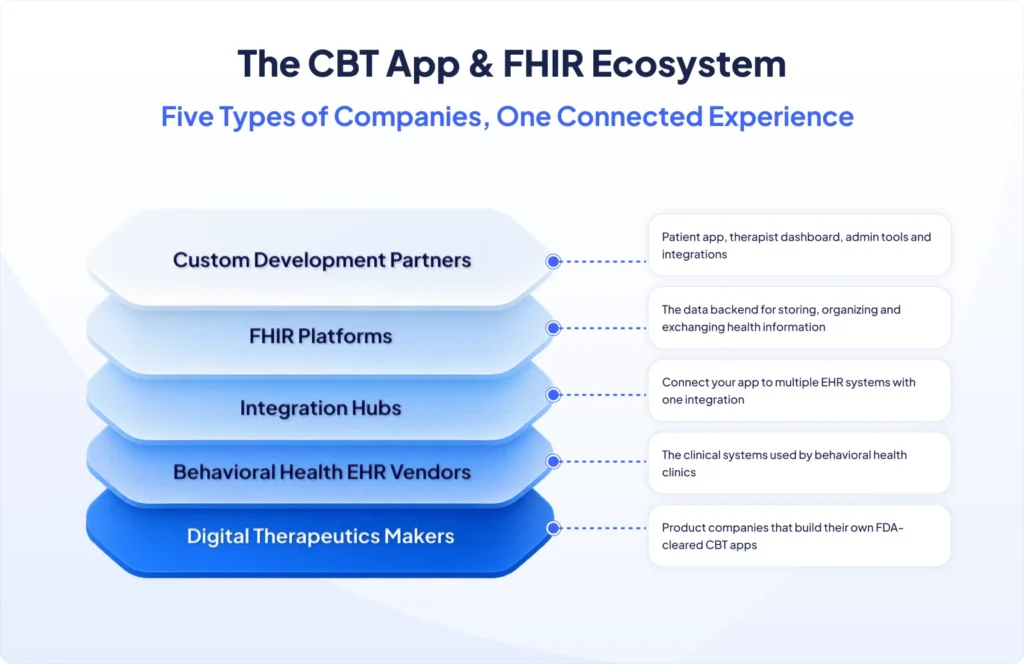
In the US, five types of companies do this work:
- Custom development partners build the whole app and the FHIR layer under it. Auspicious Soft is one. Mindbowser, ScienceSoft, MindK, IT Craft and Emorphis are others.
- FHIR platforms such as Medplum and Aidbox give you the data backend, but not the app itself.
- Integration hubs such as Redox and Health Gorilla plug one app into many EHRs.
- Behavioral health EHR vendors such as Netsmart and Qualifacts. You don’t hire them, but you can’t avoid them.
- Digital therapeutics makers such as Big Health build their own FDA cleared CBT products.
Teams that get this right usually use a mix: a build partner they trust, a proven FHIR backend, and a clear plan for each EHR their clinics run.
A CBT app that can’t talk to the clinic’s chart is basically a diary with a login screen. The patient writes in it. The therapist never sees a word. The Auspicious Soft team learned this firsthand while building Black Therapy Network, a platform that connects Black and African American clients with licensed therapists for online care. Video calls were the easy part. The hard part was getting the right data to the right person at the right moment.
That’s what FHIR development is really about. FHIR is the format US health systems use to share records. If your CBT app can’t speak it, clinics will politely pass. Below you’ll find who builds these apps, what changed in 2026, what it costs, and a few opinions some vendors won’t love.
What Is FHIR Development for a CBT App?
FHIR (people say “fire”) is the HL7 FHIR standard for health data. It cuts a health record into small, labeled pieces. One piece holds the patient. Another holds a test score. Another holds an appointment. Apps send and fetch these pieces over the web, much like a weather app grabs a forecast.
SMART on FHIR sits on top of that. It handles login and lets your app open inside an EHR like Epic with the right patient already loaded.
For a CBT app, FHIR development comes down to three jobs:
- Saving your app’s data in FHIR’s format,
- Connecting to each clinic’s EHR,
- Moving data both ways with the patient’s consent.
None of it is glamorous, but all of it decides whether a clinic buys. It’s also the part of healthcare software development that gets cut first when budgets are tight. That’s usually a mistake.

Build a Smarter, FHIR-Ready Behavioral Health App
Connect CBT apps with EHRs through secure FHIR integration. Let's turn your mental health app idea into a scalable solution.Why Behavioral Health Is Harder Than the Rest of Healthcare
Money, mostly. When Washington paid doctors and hospitals to adopt EHRs under the 2009 HITECH Act, most behavioral health providers didn’t qualify. Their tech fell behind, and a lot of it still shows.
Today, most behavioral health EHRs offer little or no open API, and the ones that do often only let you read. So when a vendor says “we integrate with any EHR,” ask which ones. By name.
Which Companies Build Behavioral Health Apps With FHIR in the US?
1. Custom Development Partners
These teams design, code and launch the full product: patient app, therapist dashboard, admin tools, and the FHIR layer underneath.
- Auspicious Soft builds HIPAA ready telemedicine, EHR and remote patient monitoring software with FHIR and HL7 integration. Its Black Therapy Network build covered four connected experiences and more than 50 screens, and went live in roughly six months. The work spans custom mobile app development for iPhone and Android, plus web.
- Mindbowser says it has more than 200 people trained in HIPAA and FHIR, a SOC 2 Type II audit, and a ready connection layer for Epic and athenahealth.
- MindK builds its mental health apps on top of Medplum.
- IT Craft and Emorphis both offer HL7 and FHIR work. IT Craft connects mental health apps to EHRs, and Emorphis focuses on EHR links and HL7 to FHIR gateways.
- ScienceSoft shows up often on US lists for CBT apps.
Best for: clinics and founders who want one team to own the product. This is the usual route for anyone serious about mental health app development.
2. FHIR Platforms
Nobody should build a FHIR server from scratch in 2026. Pick one.
- Medplum is mostly open source under the Apache 2.0 license, including its FHIR server, core APIs and developer kits.
- Aidbox by Health Samurai is a paid product with a free license for development.
- Cloud options include AWS HealthLake, Google Cloud Healthcare API and Azure Health Data Services.
Best for: teams with their own developers. Think of these as engines, not finished cars.
3. EHR Integration Hubs
Redox, Health Gorilla, Particle Health and 1upHealth sit between your app and many EHRs. You get one contract instead of dozens.
Best for: apps that sell to lots of clinics on lots of different EHRs. Keep an eye on fees, which can climb with every new connection.
4. Behavioral Health EHR Vendors
You won’t hire these companies to build your app. You’ll still spend months working with them.
- Netsmart became the first EHR for human services and post acute care to be named a QHIN under TEFCA, sharing data through FHIR based standards.
- Qualifacts runs CareLogic, Credible and InSync. Its Credible FHIR documentation says only registered developers get access, and live use requires a customer who has licensed the API.
5. Digital Therapeutics Makers
Big Health makes SleepioRx for insomnia and DaylightRx for anxiety, both FDA cleared and both built on CBT. DaylightRx was the first FDA cleared digital treatment for generalized anxiety disorder, and it runs for 90 days.
These companies build their own products, not yours. What they prove is that people will pay for clinical grade CBT.
All Five at a Glance
| Company Type | Examples | Best For | Watch Out For |
|---|---|---|---|
| Custom Development Partner | Auspicious Soft, Mindbowser, ScienceSoft, MindK | A full CBT app plus EHR links | Vague “any EHR” promises |
| FHIR Platform | Medplum, Aidbox, AWS HealthLake | A strong data backend | You still need app builders |
| Integration Hub | Redox, Health Gorilla, 1upHealth | Reaching many EHRs fast | Fees that grow per link |
| Behavioral Health EHR Vendor | Netsmart, Qualifacts | The chart your data must reach | Locked or read only access |
| Digital Therapeutics Maker | Big Health | Proof of a paying market | Not a build partner |
Five Opinions on FHIR Development for Therapy Apps
These views come from shipping real therapy software, not from reading spec sheets.
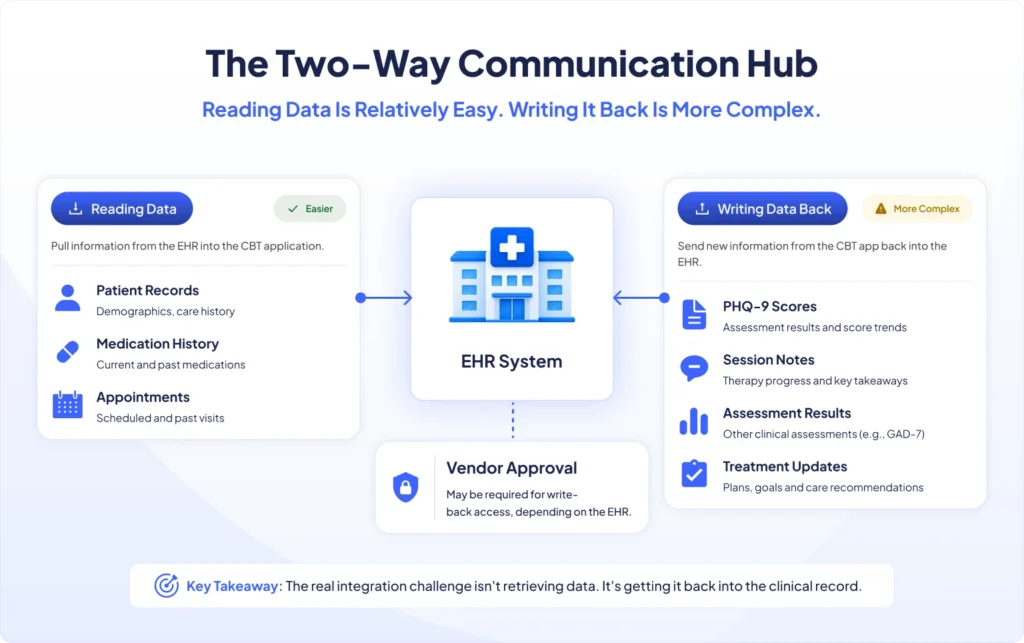
1. Reading Data Is Easy. Writing It Back Is the Real Work.
Most demos look the same. A patient list pulls in from a test EHR, everyone nods, and the project gets marked “integrated.” Then a therapist asks where the PHQ 9 score went, and nobody has an answer.
It’s a common trap. Many EHRs offer a decent way to read data but a weak way to write it, so anything the patient enters has nowhere clean to go. Washington has noticed. ONC says its new HTI 5 rule clears the way for future FHIR APIs that do more than read.
Plan for writing data back from the first week. If a vendor won’t allow it yet, send the score as a filed document the chart accepts, and upgrade later. That’s the hard core of behavioral health EHR integration, and it’s why many teams end up needing custom software built around your EHR.
2. PHQ 9 Question 9 Is a Safety Alarm
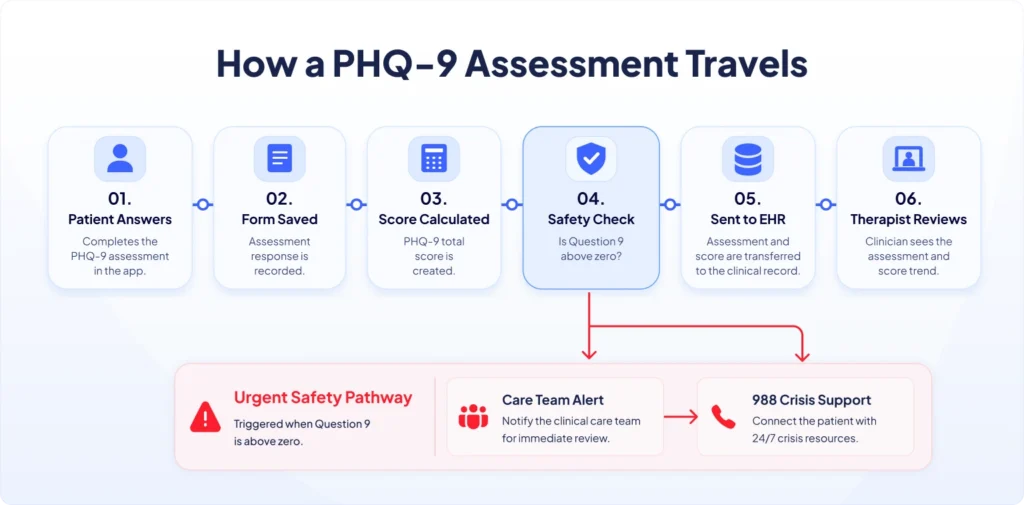
Question 9 on the PHQ 9 asks about thoughts of self harm. Any answer above zero needs a fast look from a clinician, whatever the total score says. An app that just saves that answer and moves on has a dangerous gap. Before launch, decide who gets the alert, how fast they must respond, and what the patient sees on screen. At the very least, show the 988 Suicide & Crisis Lifeline right away.
3. Shape Data for FHIR on Day One. Connect EHRs Later.
Building five EHR connections before you have one paying clinic is a fast way to burn through a seed round. There’s a better path. Save every piece of data in FHIR format from the first sprint. Then build each EHR connection when a real customer signs. Your data stays clean, and your money goes to things customers actually asked for.
4. HIPAA Is the Floor. Part 2 Is the Exam.
If your app touches addiction treatment records from a federally assisted program, HIPAA alone won’t cover you. HHS has required compliance with the updated Part 2 rule since February 16, 2026, and anyone can now file a Part 2 complaint.
Read the 42 CFR Part 2 rules from HHS before you design how data gets shared. Adding 42 CFR Part 2 compliant software features later costs far more than building them in from the start.
Build a Smarter, FHIR-Ready Behavioral Health App
Connect CBT apps with EHRs through secure FHIR integration. Let's turn your mental health app idea into a scalable solution.5. Time Zones Will Bite You
Sounds dull. It isn’t. On Black Therapy Network, the hardest problem wasn’t video or payments. It was making sure a client in California and a therapist in New York showed up for the same session at the same moment.
What Black Therapy Network Taught the Team
To be clear, Black Therapy Network wasn’t a FHIR project. It runs on Next.js, Node.js and MongoDB. But almost every hard problem in it shows up again in FHIR work:
- Time: every session is saved against one world standard clock, and each person sees it in their own local time. FHIR appointment times need exactly the same care.
- Licenses: therapist matching puts the most weight on whether the therapist is licensed in the client’s state. In FHIR, that information lives in the clinician’s role records. Anyone building therapist matching software should copy this order.
- Locked notes: session notes lock once they’re final. In FHIR, you never edit a final note in place. You add a new version with a record of who changed it.
- Private files: documents are shared through secure links that expire.
2026 US Rules That Change FHIR Development for Behavioral Health
A lot moved this year. Here’s what matters for a CBT app:
| Date | What Changed | What It Means For Your App |
|---|---|---|
| Jan 1, 2026 | Medicare’s digital mental health treatment codes also cover FDA cleared ADHD therapy devices. | FDA cleared CBT apps keep a clear Medicare billing path. |
| Feb 2, 2026 | ONC chose nine pilots to test a behavioral health data set and FHIR guide in real clinics. | A behavioral health FHIR guide is coming. Build close to it now. |
| Feb 16, 2026 | The updated Part 2 rule became mandatory and complaints opened. | Addiction data needs consent records and labels. |
| Oct 26, 2026 | The HTI 5 final rule drops 14 certification criteria and revises 7, while keeping privacy and security rules. | EHR certification now leans on FHIR APIs more than ever. |
| Nov 4, 2026 | CMS released the 2027 fee schedule: remote monitoring now needs a first visit, and remote therapy monitoring is limited to established patients. | Clean onboarding matters more for monitoring revenue. |
| Dec 28, 2026 | HTI 5 takes effect, with some parts starting January 1, 2027. | Ask your EHR vendors about their FHIR plans. |
| End of 2026 | Pilot results are due, with a behavioral health resource planned for 2027. | Expect fresh federal guidance next year. |
| Jan 1, 2027 | Health plans must run Patient Access, Provider Access, Payer to Payer and Prior Authorization FHIR APIs. | With patient permission, apps can pull claims and prior auth history. |
| Through Dec 31, 2027 | The in person visit rule for Medicare telehealth mental health visits stays waived. | Virtual CBT stays workable for Medicare, for now. |
Worth bookmarking: the nine behavioral health data pilots, the HTI 5 final rule, and the CMS Interoperability and Prior Authorization rule.
How to Build a FHIR Ready CBT App
Match Each CBT Feature to FHIR
Print this table and argue over it with your team. Then build.
| CBT App Feature | FHIR Resource | What It Means |
|---|---|---|
| Mood checks and intake forms (PHQ 9, GAD 7) | Questionnaire + Questionnaire Response | The blank form, and the filled form |
| Score the therapist sees | Observation | One number, one date, one code |
| Weekly homework (thought record, exposure step) | Task | A job with an owner and a due date |
| Treatment plan and goals | CarePlan + Goal | What you’re working on, and how you’ll know |
| Therapist and license state | Practitioner + PractitionerRole | Who the clinician is and where they can practice |
| Sessions | Appointment + Encounter | When you meet, and what happened |
| Secure messages | Communication | Messages that belong in the record |
| Consent to share | Consent | Who sees what, and for how long |
| Session note file | Document Reference | A file the chart can point to |
| Change History | Provenance + Audit Event | The paper trail |
How a PHQ 9 Score Should Travel
- The patient answers the PHQ 9 in your app.
- The app saves the filled form.
- The app adds up the score and saves it as its own record, tagged with the LOINC code for the PHQ 9 total score.
- If question 9 is above zero, the app creates an urgent task for the care team and shows crisis help on screen.
- The score goes into the EHR. If the EHR won’t accept it directly, it goes in as a filed document.
- Before the next session, the therapist sees the trend, not just one number.
That loop is exactly what measurement based care software is supposed to do. Get it right and therapists open your app every day. Get it wrong and they quietly stop.
A Tech Stack That Won’t Trap You
- Standard: FHIR R4 with the US Core profiles.
- Data backend: Medplum, Aidbox, or a cloud FHIR service from AWS, Google or Azure.
- Mobile apps: React Native app development or Flutter app development, so one codebase covers iPhone and Android.
- Connections: API development services to tie your app, your FHIR store and outside systems together.
- EHR launch: plan SMART on FHIR app development early, so clinicians can open your tool from inside the chart.
Where AI Helps and Where It Doesn’t
AI is good at first drafts. An ambient AI medical scribe can write a first pass of session notes. Careful AI chatbot development can handle simple questions between sessions. AI nudges plus human coaches can keep CBT homework on track.
The rule is simple: AI suggests, and the clinician decides. Tag everything a model writes so the chart shows where it came from.
How to Choose a FHIR Development Company: 8 Questions
Ask these before you sign anything:
- Which behavioral health EHRs have you connected to? Did you only read data, or write it back too?
- Can you show how one CBT feature maps to FHIR, like the table above?
- How do you handle Part 2 consent and data labels?
- What happens in your app when PHQ 9 question 9 is positive?
- Which FHIR backend do you use, and who owns the code after launch?
- Will you sign a BAA?
- How do you test against EHR sandboxes?
- Who handles vendor approvals and paperwork?
Warning Signs
- “Full FHIR support,” but no EHR names.
- No plan for writing data back.
- A blank stare when you ask about question 9.
- Plenty of HIPAA talk and no mention of Part 2.
Real HIPAA compliant app development shows its work: named EHRs, real sandboxes, signed BAAs. Stuck with an older therapy platform that can’t speak FHIR at all? legacy app modernization is often cheaper than starting over.
How Much Does FHIR Development Cost for a CBT App?
CBT app development cost depends mostly on two things: how many EHRs you need to reach, and whether you need to write data back or only read it.
| What You Build | Typical Budget | Typical Time |
|---|---|---|
| CBT Starter App With FHIR Shaped Data, No EHR Link Yet | $50,000 To $90,000 | 3 To 4 Months |
| Add One EHR Read Link With SMART On FHIR | Add $15,000 To $40,000 | Add 4 To 8 Weeks, Plus Vendor Approval |
| Add Writing Scores And Notes Back | Add $20,000 To $60,000 | Depends On The Vendor |
| Add Part 2 Consent And Data Labels | Add $10,000 To $30,000 | Add 3 To 6 Weeks |
| Full Therapy Platform With Video, Billing, Matching and EHR Links | $150,000 to $500,000+ | 6 To 14 Months |
These ranges line up with the wider market. US healthcare apps run from about $50,000 for a simple patient app to over $500,000 for a full clinical platform with EHR links. For a real number: a team of about seven took Black Therapy Network from idea to launch in roughly six months.
Add video, billing and matching, and you’re into full telehealth app development. For a wider look at timelines, read this guide to building healthcare apps in 2026.
Why Clinics and Founders Choose Auspicious Soft for Healthcare Software Development
- Real therapy software, shipped. Black Therapy Network went from a blank page to a live platform, and the team still supports it today.
- FHIR and HL7 skills in house. The FHIR development services cover data design, SMART on FHIR launch, EHR links and Part 2 consent.
- You own the code. Clients own 100% of the source code, and fixed price contracts are offered for well defined projects.
- US hours, smart cost. A Los Angeles sales office works alongside a senior engineering team in India.
- Building since 2018, for startups and enterprises across the USA.
The Bottom Line
FHIR isn’t a feature you bolt on at the end. It’s the shape your data takes from day one. Pick a partner who has shipped real therapy software. Ask hard questions about writing data back, question 9 and Part 2. Then connect one clinic at a time, and let real customers decide which EHR comes next.
Build a Smarter, FHIR-Ready Behavioral Health App
Connect CBT apps with EHRs through secure FHIR integration. Let's turn your mental health app idea into a scalable solution.FAQs
Q: What is FHIR development in behavioral health?
It’s the work of building apps that store and share mental health data in the FHIR format. That covers forms, scores, care plans, notes and consent, plus the links to EHRs.
Q: Does a CBT app need FHIR?
A simple self help app doesn’t. Any CBT app used by clinics, health plans or health systems does. Without FHIR, scores never reach the chart.
Q: FHIR vs HL7: What Is the Difference?
HL7 is the group that writes health data standards. HL7 v2 is its older message format, still common in labs and hospitals. FHIR is its newer, web friendly standard.
Q: Can a CBT app send PHQ 9 scores to Epic?
Yes, through SMART on FHIR, if the health system allows your app to write data. Each health system decides. Start Epic EHR integration early, because reviews can take weeks.
Q: Does my therapy app need to follow 42 CFR Part 2?
Only if it handles addiction treatment records from a Part 2 program. If it does, full compliance has been required since February 16, 2026.
Q: Can a CBT app get paid by Medicare?
Some can. FDA cleared digital CBT products like SleepioRx and DaylightRx have been billable under Medicare since new codes took effect on January 1, 2025. Remote therapeutic monitoring software is another path, but CMS tightened those rules for 2027.
Q: How much does FHIR development cost for a mental health app?
A FHIR ready starter app often begins near $50,000. Each EHR link and write back path adds more. Full platforms can pass $500,000.
Q: How long does a FHIR ready CBT app take to build?
A starter app takes about 3 to 4 months. A full platform with EHR links takes 6 to 14 months.
Q: Which FHIR server should a startup use?
Medplum suits teams that want open source and full control. Aidbox suits teams that want a paid product with support. Cloud FHIR services suit teams already on AWS, Google or Azure.
Q: What health plan data can a CBT app pull with FHIR in 2027?
From January 1, 2027, health plans must offer FHIR APIs for patient access, provider access, payer to payer sharing and prior authorization. With patient permission, your app can pull claims and prior auth history. The same APIs help with patient portal development too.
Do not Miss Our Latest Tech Insights
Stay one step ahead in the fast-moving world of AI and technology. Add us as a Preferred Source on Google and get our latest articles, guides, and industry insights delivered straight to your search feed.