+1 740 762 6496
 +91 70189 46603

TABLE OF CONTENT
- The Growing Importance of Healthcare Mobile Apps
- Steps to Design a Healthcare App in 2026
- Challenges in Developing Healthcare Apps
- Best Practices to Achieve Success
- Future Trends of Healthcare Mobile App Development
- Why Choose the Best Mobile App Development Company in USA?
- Conclusion: Partner for Success
- Ready to Revolutionize Healthcare?
- FAQs
Overview
- Digital health apps reduce hospital readmissions by 40% and enable preventive care at scale.
- Healthcare app design requires clinical workflow validation, HIPAA compliance, and EHR integration first.
- HIPAA compliance, EHR integration, FDA oversight, and clinical accuracy create unique development hurdles.
- AI diagnostics, ambient clinical intelligence, and remote patient monitoring will define healthcare apps through 2028.
The healthcare industry is witnessing an era of monumental change with the advancement of technology. In 2026, it is expected that healthcare apps would become a critical tool in bridging the gap between patients and providers as innovative solutions to the problems of modern healthcare will arise. This guide walks you through the essentials of healthcare mobile app development, high lighting best practices, trends, and insights to help you create a robust and user-centric healthcare application.
The global digital health market reaches USD 660 billion by 2026. 350,000+ health apps are available in app stores. 88 million Americans used a health app at least once in 2026.
The Growing Importance of Healthcare Mobile Apps
Healthcare mobile apps have crossed from convenience feature to clinical necessity. In 2026, they serve as the primary interface between patients and their care teams for 88 million Americans — for appointment scheduling, prescription management, lab result delivery, chronic disease monitoring, and mental health support. The business case is equally compelling: healthcare apps reduce missed appointments by 38%, decrease hospital readmissions by 40% through continuous monitoring and medication adherence reminders, and lower patient acquisition costs for healthcare providers by 28% compared to traditional marketing channels. For healthcare businesses, the question in 2026 is not whether to build a mobile app — it is how to build one that achieves HIPAA compliance, integrates with EHR systems, and delivers clinical value rather than just marketing visibility. Here’s why they are vital:
Remote Accessibility: They enable patients to access healthcare services from anywhere, reducing the need for physical visits.
Personalized Healthcare: Apps can offer tailored recommendations based on individual health data, making healthcare more effective.
Streamlined Communication: This means the app has streamlined communication between patients, health care providers, and caregivers, which promotes trust and coordination.
Cost Reduction: These apps help minimize the cost of administration for service providers, and they provide economical solutions for healthcare for the patient.
Build Your HIPAA-Compliant Healthcare App
Get a free consultation with our healthcare app experts — EHR integration, FHIR APIs, and compliance handled from day one.Steps to Design a Healthcare App in 2026
Designing a healthcare app in 2026 follows a more structured process than general consumer apps because of clinical, regulatory, and interoperability requirements that have no parallels in other industries. The steps below reflect best practice based on successful digital health launches in the US market.
Know your Market and Target Audience
Perform detailed market research in determining the target audience. For developing effective health care mobile apps, the pains of the patients, providers, or administrators are required.
Determine Core Features
Select features that fit within your application’s goals. Some prevalent features include:
: Telemedicine
: Setting up and scheduling appointments
: Accessing electronic health records (EHR)
: Reminder for medication or prescription fillings
: Exercise and health monitoring
Healthcare compliance:
Compliance with laws of healthcare, mainly HIPPA in the US and GDRP in Europe is beyond question. A good mobile development company ensures that your developed app has the same conformance level as required; this provides protection to the respective user’s data.
Attention to UX:
A user-friendly interface is critical for app adoption. Make sure that your app is simple and easy to use, not just for those who know technology but for all ages, including those who don’t know much about it.
| Step | Activity | Critical Requirement | Timeline |
|---|---|---|---|
| 1. Discovery | Define clinical use case, user types, regulatory category | FDA classification review | 2-4 weeks |
| 2. HIPAA Analysis | Map all PHI data flows, define compliance architecture | BAA with cloud providers | 1-2 weeks |
| 3. EHR Strategy | Choose FHIR API integration approach (Epic, Cerner, etc.) | HL7 FHIR R4 compliance | 2-3 weeks |
| 4. Clinical UX | Design for clinical workflow, not just consumer UX | Usability testing with clinicians | 4-6 weeks |
| 5. Development | Build with HIPAA-compliant architecture from day one | Encrypted at rest + in transit | 12-24 weeks |
| 6. QA + Security | Penetration testing, HIPAA technical safeguards audit | 3rd party security audit | 4-6 weeks |
| 7. App Store | Apple HealthKit compliance, Google Health Connect integration | Special category submission | 2-4 weeks |
Advanced Technologies:
AI and Machine Learning: For predictive analytics, chatbots, and personalized recommendations.
IoT Integration: Smartwatches and fitness trackers can be connected to your app to collect real-time health data.
Blockchain: Adds security and guarantees data integrity.
Testing and Quality Assurance:
Thoroughly test your app in all the aspects to reduce bugs, ensure functionality, and provide a smooth interface experience across different platforms.
: Categories of Healthcare Apps in High Demand
: Healthcare mobile apps range from the most versatile kinds. Here are the main categories:
: Telemedicine Apps help patients in doing virtual consultations, and then there is no necessity of visiting in person.
: Chronic Disease Management Apps help a patient monitor and manage chronic diseases, such as diabetes and hypertension.
: Mental Health and Wellness Apps provide stress management through meditation and counseling.
: Fitness and Nutrition Apps track physical activity, diet, and overall wellness.
: Pharmacy and Medication Apps help users order prescriptions and set reminders for medication.
: Healthcare Administration Apps help streamline operations such as patient records management and appointment scheduling.
Challenges in Developing Healthcare Apps
Healthcare app development challenges are fundamentally different from consumer app development challenges — and more consequential. Getting a fitness app wrong results in a bad review; getting a healthcare app wrong can result in patient harm and significant legal liability. The top five challenges in US healthcare app development in 2026 are: HIPAA compliance architecture (every data storage, transmission, and access point must meet technical safeguards), EHR integration (connecting to Epic, Cerner, or Athenahealth via FHIR APIs requires specialized expertise and sometimes lengthy credentialing), FDA classification (apps that qualify as Software as a Medical Device face Pre-Market Submission requirements that can add 6-18 months to your timeline), interoperability (data from wearables, lab systems, and imaging systems must be normalized into consistent formats), and clinical validation (claims made by your app may require clinical evidence to satisfy both FDA reviewers and hospital procurement committees). Healthcare apps have several challenges despite their benefits:
Data Security and Privacy:
Protecting sensitive health information from cyber threats is of utmost importance.
Compliance with Regulations:
Meeting legal requirements can be complex and time-consuming.
Interoperability:
Your app must integrate easily and harmoniously with existing healthcare systems and devices.
User Engagement:
Ensure the users to adopt and make it a habit to use your app.
Best Practices to Achieve Success
Partner with Experts:
Get to partner with the best mobile app development company in USA that offers access to expertise and industry knowledge.
Emphasize Security:
Encryption, multi-factor authentication, and secure data storage of information protect the users.
Prioritize Scalability:
Ensure that your app will have an increased number of users and additional features with business growth.
Gather User Feedback:
Collect and incorporate feedbacks regularly to enhance the functionality and experience of your app.
Future Trends of Healthcare Mobile App Development
The healthcare app development roadmap through 2028 is defined by three technological shifts. Ambient clinical intelligence — AI that passively captures clinical documentation from patient-provider conversations without the physician needing to type — is being deployed by Epic, Nuance (Microsoft), and Abridge across hundreds of US health systems in 2026, reducing documentation burden by 70% per visit. Remote patient monitoring (RPM) apps connected to continuous vital sign monitors are becoming reimbursable under Medicare and commercial insurance plans, creating a new revenue model for health app businesses. And on-device AI diagnostics — apps that can analyze skin lesions, eye images, or audio recordings for clinical signs — are receiving FDA clearances at an accelerating rate, with 150+ AI-powered medical devices cleared by the FDA through 2026.
Telehealth Growth:
The demand for teleconsultations and virtual care is going to increase.
AI-Powered Healthcare:
AI will be leading in diagnostics, treatment planning, and patient monitoring.
Integration of Wearable Tech:
Apps will use data from wearables for real-time health monitoring.
Personalized Medicine:
Apps will use user data to provide personalized healthcare services.
Blockchain for Security:
Data integrity and security of sensitive information will continue to be of utmost importance.
Why Choose the Best Mobile App Development Company in USA?
Choosing the right development partner can make all the difference. Here’s why working with the best mobile app development company in USA is essential:
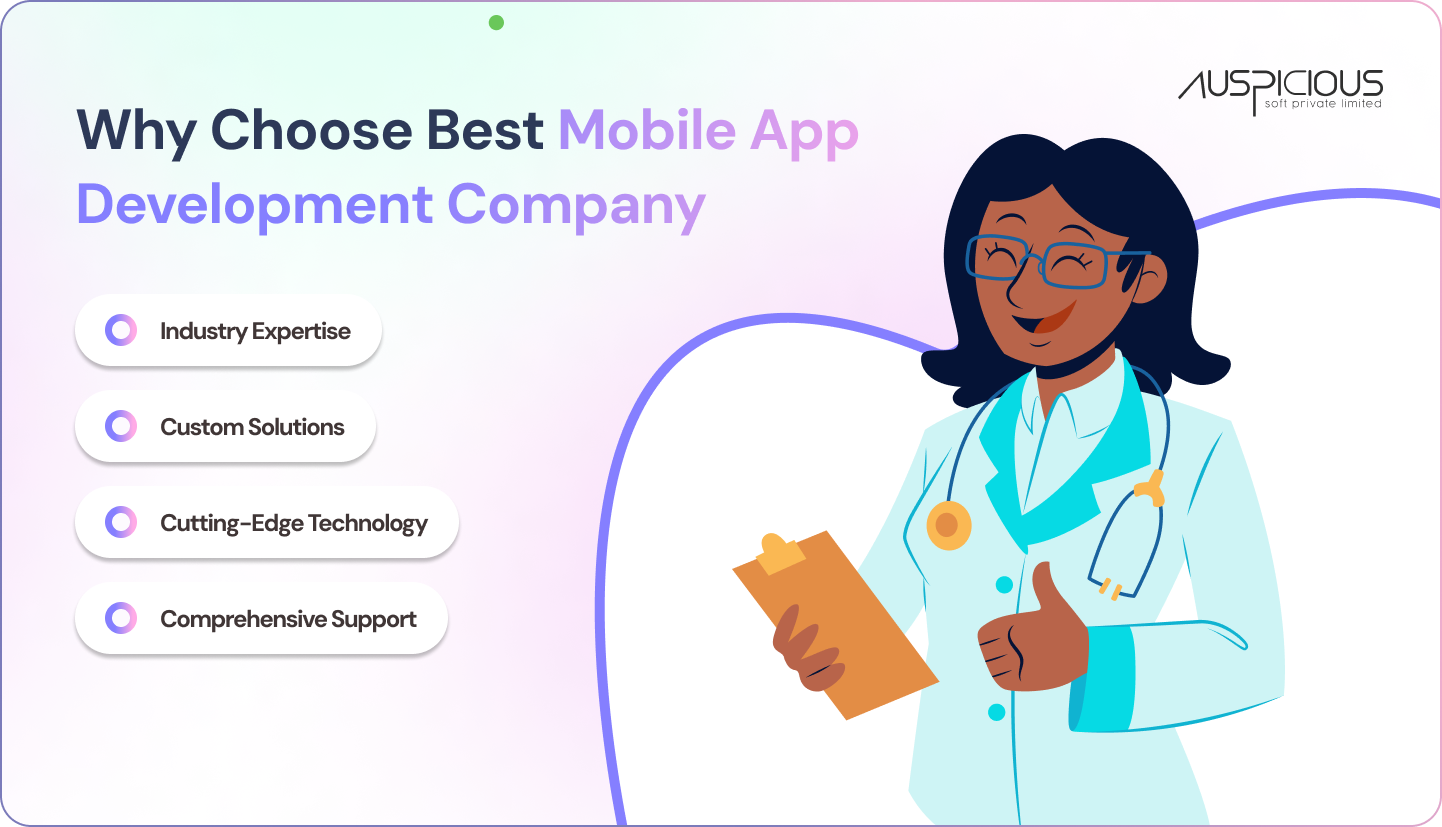
Industry Expertise:
Experienced developers understand the nuances of healthcare regulations and user expectations.
Custom Solutions:
They provide tailored apps that meet your specific business needs.
Cutting-Edge Technology:
The latest tools and frameworks ensure your app stays ahead of the competition.
Comprehensive Support:
From ideation to post-launch maintenance, they offer end-to-end services.
Conclusion: Partner for Success
The healthcare sector is an area that is full of innovation opportunities. You can contribute to transforming patient care and operational efficiency by investing in healthcare mobile app development. However, success depends on strategic planning, advanced technology, and regulatory compliance.
Build Your HIPAA-Compliant Healthcare App
Get a free consultation with our healthcare app experts — EHR integration, FHIR APIs, and compliance handled from day one.Ready to Revolutionize Healthcare?
Let us help you transform your vision into reality by hiring the best mobile app development company in USA. Specializing in secure, complaint, and user-friendly healthcare applications tailored to your needs, get in touch with us to begin your journey in developing healthcare mobile apps and revolutionize the healthcare industry with your creation. Let’s innovate together!
FAQs
Q: How much does it cost to build a healthcare app in the USA?
A: Healthcare app development costs in the USA range from $50,000 for a basic patient-facing scheduling app to $500,000+ for a full clinical platform with EHR integration, telemedicine, and remote patient monitoring. The premium over general app development (typically 30-50% higher) reflects HIPAA compliance architecture, security auditing, and EHR integration complexity.
Q: Does my healthcare app need to be HIPAA compliant?
A: If your app creates, receives, maintains, or transmits Protected Health Information (PHI) — which includes names, dates, diagnoses, or any data that could identify a patient — HIPAA compliance is legally required. This applies to appointment booking apps, telehealth platforms, prescription management tools, and any app that connects to a healthcare provider. Violating HIPAA carries fines of $100 to $50,000 per violation.
Q: How long does it take to build a healthcare app?
A: A basic healthcare app (appointment scheduling, provider directory) takes 4-6 months. A telehealth platform with video consultations and EHR integration takes 8-14 months. A full clinical decision support or remote patient monitoring platform takes 12-24 months, including FDA pre-submission review if required.
Q: What is FHIR and does my healthcare app need it?
A: FHIR (Fast Healthcare Interoperability Resources) is the federal standard API format for sharing electronic health records. CMS regulations effective 2021 require most US health insurers and providers to make patient data accessible via FHIR APIs. Any healthcare app that needs to access or share patient records from hospitals, clinics, or insurance companies needs FHIR integration. Working with experienced healthcare app developers familiar with Epic’s FHIR API is essential.
Q: What makes a healthcare app successful in the US market?
A: The most successful US healthcare apps share four characteristics: clinical validation (evidence-based features that clinicians trust and recommend), frictionless EHR integration (data flows to and from existing clinical systems without manual entry), reimbursement model alignment (features that help providers bill Medicare/Medicaid or reduce costly events like readmissions), and consumer-grade UX (patients expect the same ease-of-use they get from consumer apps, even in clinical contexts).
Do not Miss Our Latest Tech Insights
Stay one step ahead in the fast-moving world of AI and technology. Add us as a Preferred Source on Google and get our latest articles, guides, and industry insights delivered straight to your search feed.