+1 740 762 6496
 +91 70189 46603

TABLE OF CONTENT
- Why AI Medical Scribe Development Still Pays Off in 2026
- The Big EHRs Built Their Own Scribes. Here’s Where You Win.
- How An Ambient AI Scribe Works
- How To Build an AI Medical Scribe in 7 Steps
- Design for the Errors Doctors Can’t See
- Consent Is The New HIPAA
- Every Auspicious Soft Scribe Ships With:
- The Running Cost Nobody Puts in the Proposal
- AI Medical Scribe Development Cost
- What a Real Build Taught the Auspicious Soft Team
- Why Healthcare Teams Choose Auspicious Soft
- FAQs
Overview
- Generic scribes now compete with tools bundled into major EHRs. Specialty depth is where custom builds win.
- Consent, not HIPAA, is driving the newest lawsuits. Build it into the product.
- Omissions are the most common AI note error. Your review screen has to catch them.
- Managed speech services can cost more per clinician than you plan to charge. Model this early.
- An MVP runs $35,000 to $70,000. A full product runs $80,000 to $150,000 or more.
AI Summary:
To build an ambient AI medical scribe, you capture consent, record the visit, convert speech to text with a medical speech model, label each speaker, draft the note with a large language model, send it to the clinician to review and sign, and write it back to the EHR. A focused MVP takes 3 to 5 months and typically costs $35,000 to $70,000. The products winning right now are specialty-focused, consent-first, and built for workflows the big EHR vendors overlook.
Picture a family doctor at 9 pm. Kids asleep. Laptop open. Fourteen notes still unsigned. Doctors have a name for those hours: pajama time. Ambient AI scribes were built to end it, and the tools spread fast. At UCSF, 70% of physicians now use AI scribes in daily practice.
So here’s the real question for 2026. Not “do AI scribes work?” They do. The question is: what’s still worth building?
Why AI Medical Scribe Development Still Pays Off in 2026
Three studies tell the story.
| Study | What It Found |
|---|---|
| JAMA Network Open study (2025) | Across 263 clinicians in six health systems, burnout fell from 51.9% to 38.8% after 30 days with an ambient scribe. |
| UCLA Randomized Trial (2025) | One scribe cut time in notes by 9.5% versus usual care, while a second showed no significant change. |
| JAMA Network Open (January 2026) | dopters generated 1.81 more RVUs and saw about one more patient a week, with no rise in claim denials. |
Look at the middle row. Two well-known scribes, two very different results. Product quality varies a lot, and that’s your opening. A scribe tuned to one specialty can beat a generic tool on the numbers buyers care about.
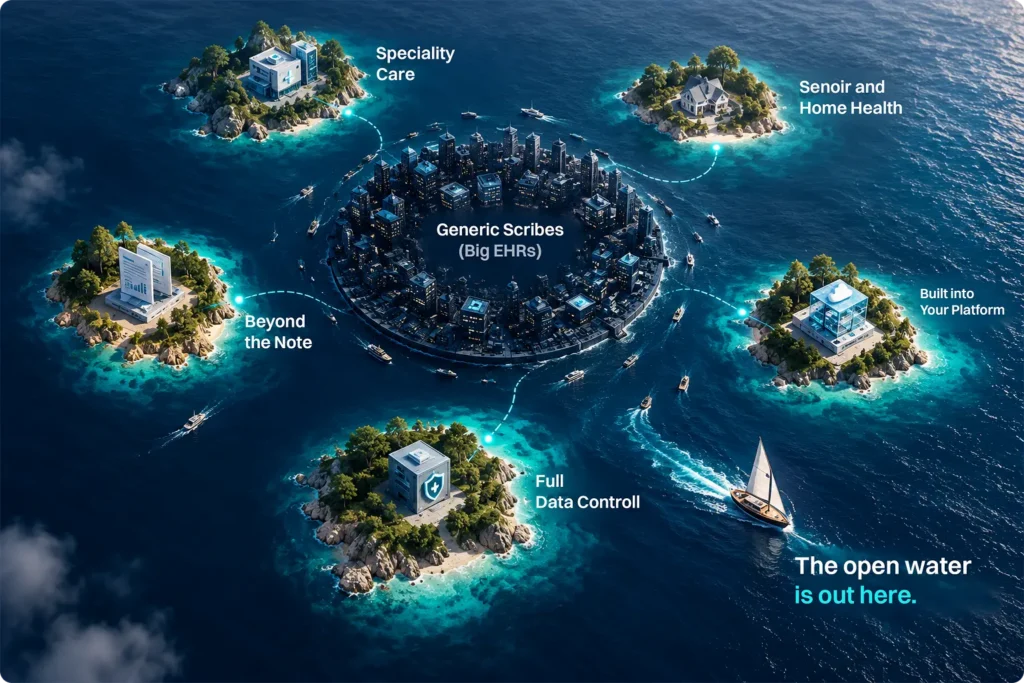
The Big EHRs Built Their Own Scribes. Here’s Where You Win.
In early 2026, Epic launched AI Charting, a built-in feature that listens to visits and drafts notes and orders. athenahealth rolled out athenaAmbient too. That kills the case for a me-too scribe. It doesn’t kill the case for a smart one. In KLAS research, Epic customers expected Epic to become their main ambient vendor, but some leaders planned to keep specialty-specific tools alongside it.
Custom scribes win in five places:
- Specialty-specific tools fumble: behavioral health, physical therapy, dental, oncology, veterinary care.
- Settings outside big hospital EHRs: senior care, home health, urgent care chains, small practices.
- Work beyond the note: coding hints, prior auth drafts, referral letters, patient instructions.
- Platforms that need a built-in scribe: think of a telemedicine app development project or a practice management system.
- Teams that want data control: self-hosted models, custom retention, no outside audio sharing.
The market is already moving this way. Most leading ambient vendors now bundle coding support, authorization workflows, and clinical decision help. The note gets you in the door. The workflow keeps you there.
How An Ambient AI Scribe Works
| Step | What Happens |
|---|---|
| Consent | Everyone in the room agrees, and the app logs it. |
| Capture | A phone or tablet records the visit. |
| Speech-To-Text | A medical speech model turns audio into words. |
| Speaker Labels | The system tags the clinician, patient, and caregiver. |
| Note Draft | An LLM writes the note in your template. |
| Review | The clinician checks flags, edits, and signs. |
| EHR Sync | The note lands in the right chart section. |
How To Build an AI Medical Scribe in 7 Steps
1. Pick One Specialty and One Setting (Weeks 1 to 3)
This is the biggest decision in AI medical scribe software development. Therapy notes and orthopedic notes share almost nothing. Choose one specialty, one setting, one note type. Own it before you expand.
2. Shadow Real Visits
Who hits record? Who else is in the room? Which note sections do clinicians rewrite most? Those answers shape every screen you design.
3. Make Consent a Feature, Not a Form
The app shouldn’t record a single second until consent is captured and logged for every person in the room. Treat it like a core feature, because legally it is.
4. Build for Noisy Rooms (Weeks 4 to 13)
HVAC hums. Doors slam. Toddlers cry. Use noise filtering, stream short audio chunks, and test on ordinary phones. Solid mobile app development pays for itself here.
5. Draft Notes With Strict Rules
Use a medical speech model, then hand the transcript to an LLM with three firm rules: write only what was said, never infer a diagnosis, and flag anything unclear. This is the core of AI medical scribe development, and it’s where seasoned AI development services teams spend most of their tuning time.
6. Connect to the EHR (Start in Week 1)
Use HL7 FHIR and SMART on FHIR where possible, plus vendor ambient APIs. Suki, for example, connected to Epic through Epic’s ambient APIs so finished notes flow back into the right sections. Vendor approval is slow, so start it on day one. Smooth EHR integration is where most timelines slip.
7. Pilot With an Error Audit
Put the scribe in front of 5 to 20 clinicians. Track edit rate, time saved, daily usage, and errors by type. Then fix what hurts before you scale.
Design for the Errors Doctors Can’t See
A wrong word is easy to spot. A missing one isn’t.
A 2026 JMIR study reviewed 7,545 AI-drafted notes. Omissions showed up in 18%, hallucinations in 11.5%, and accidental inclusions in 9.3%. Most errors were mild to moderate, and only 2.5% of notes carried a serious risk.
That’s mostly good news. But omissions hide. A dropped allergy looks exactly like “no allergies.” So build three safeguards:
- Audio-linked sentences. Tap any line, hear exactly where it came from.
- Specialty checklists. If meds, allergies, or follow-up timing came up in the visit, confirm they made the note.
- Confidence flags. Highlight shaky numbers and drug names.
One more rule: keep the scribe in documentation mode. Australia’s regulator, for instance, treats a scribe as a medical device once it generates a diagnosis or recommendation the clinician never stated. In the US, the FDA’s approach to generative AI devices was still a discussion paper as of August 2026. Add clinical suggestions later, and only after a regulatory review.
Consent Is The New HIPAA
HIPAA is the floor. Consent is where the lawsuits are.
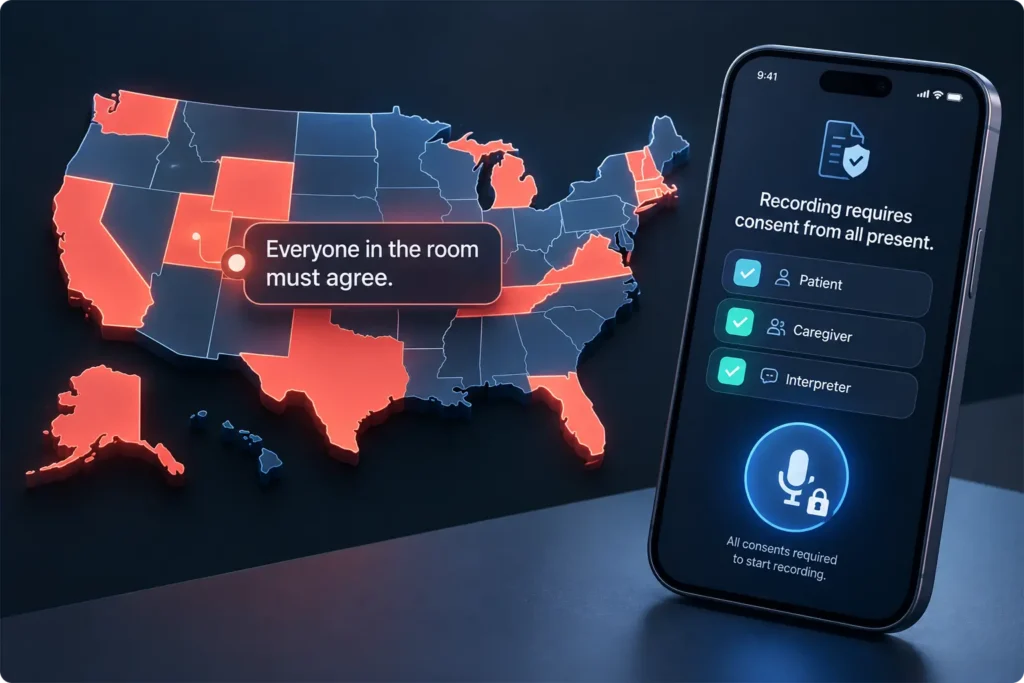
A patient filed a proposed class action against Sharp HealthCare, alleging a clinic recorded his visit with an ambient scribe without his consent. California generally requires all-party consent for this kind of recording. A second suit followed in April 2026, and since the vendor signs BAAs, the claims rest on state privacy law and the federal Wiretap Act rather than HIPAA.
At least seven states, including California, Illinois, Pennsylvania, Florida, Massachusetts, Washington, and Maryland, require everyone being recorded to consent before recording starts. That can include relatives, interpreters, caregivers, students, and other clinicians.
New AI laws are stacking up too. Rhode Island became the first state with a law aimed at ambient scribes, requiring disclosure, an opt-out, and provider review of AI-drafted notes. Texas now requires conspicuous written disclosure when AI is used in diagnosis or treatment.
And the HIPAA Security Rule update is coming. As of July 2026, it was still proposed, with final action targeted for July 2027, and it would require encryption for all ePHI plus multifactor authentication. Build to that bar now.
Every Auspicious Soft Scribe Ships With:
- Logged consent before audio starts, for every person in the room
- State-aware disclosure text
- A Business Associate Agreement with every vendor touching patient data
- Encryption plus multifactor authentication
- Short audio retention by default
- Role-based access and full audit logs
Want the full checklist? Read our guide on HIPAA-compliant app development.
The Running Cost Nobody Puts in the Proposal
Build cost gets all the attention. Running cost decides whether you make money.
Take one full-time clinician: 20 visits a day, 15 minutes each, 20 workdays a month. That’s about 6,000 minutes of audio.
| Speech Option | List Price | Monthly Cost Per Clinician |
|---|---|---|
| AWS HealthScribe (Transcription Plus Note Drafting) | $0.10 Per Minute | About $600 |
| Medical Speech API, Transcription Only | About $0.0043 Per Minute | About $26, Before LLM, Hosting, and Support Costs. |
Now compare that with the market. Budget scribe apps start as low as $40 per clinician per month. If you plan to sell anywhere near that range, an all-in-one managed service won’t leave you a margin. A composed pipeline costs more to build but far less to run.
Neither path is wrong. One of them is wrong for your price point. Auspicious Soft models this in discovery, before a line of code gets written.
AI Medical Scribe Development Cost
| Package | What You Get | Cost | Timeline |
|---|---|---|---|
| MVP | 1 Specialty, Consent Flow, App, Note Drafting, Export | $35,000 To $70,000 | 3 To 5 Months |
| Growth | Web & Mobile, Multiple Templates, 1 EHR Integration, Error Audit Tools | $80,000 To $150,000 | 5 To 8 Months |
| Enterprise | Multiple Specialties & EHRs, Coding & Referral Workflows, Analytics | $150,000 and Up | 8 to 12+ months |
Want to spend less? Launch one specialty, use managed speech during the pilot, and follow a lean MVP development plan.
Engagement options: fixed-price MVPs, dedicated teams, or time and materials. With teams in the USA and India, you get US time zone overlap at a lower blended rate.
What a Real Build Taught the Auspicious Soft Team
Auspicious Soft recently built an ambient AI scribe for a US healthcare client. The details are under NDA. The lessons aren’t.
Shorter notes won. Early drafts captured everything, and clinicians hated it. They wanted the note they’d have written themselves. Research backs this up: in a 2026 Mass General Brigham study, AI scribes produced longer notes than human scribes did. Tightening the template beat switching models.
Drug names needed backup. Everyday words were fine. Medications and doses needed an extra check and visible flags.
The vendor queue was slower than the code. The EHR integration itself was simple. Waiting for approval wasn’t. Now every Auspicious Soft healthcare build starts that process in week one.
Trust came from one button. Once clinicians could tap a sentence and hear its source, review sped up and confidence jumped.
Why Healthcare Teams Choose Auspicious Soft
Since 2018, Auspicious Soft has built custom software for startups and enterprises, with offices in California and India. For healthcare teams, that means:
- Full-cycle healthcare software development, from discovery to launch and beyond.
- Real experience with ambient AI, medical speech models, and LLM note generation.
- Consent-first, HIPAA-focused architecture from sprint one.
- A flexible Software Development Service for startups and enterprises alike.
- Running cost modeling, so your pricing works at scale.
- US time zone overlap, weekly demos, and an NDA from the first call.
FAQs
Q: Is it still worth building an AI scribe now that major EHRs have their own?
Yes, if you target a specialty, care setting, or workflow general tools don’t serve well. A generic scribe is a tough sell in 2026. A specialized one isn’t.
Q: How long does AI medical scribe development take?
A focused MVP takes 3 to 5 months. A full product with EHR integration takes 5 to 8 months.
Q: How much does it cost to build an AI medical scribe?
An MVP typically costs $35,000 to $70,000, and full products run $80,000 to $150,000 or more. Budget for monthly speech and AI costs per clinician as well.
Q: Do patients have to consent to AI scribe recording?
Often, yes. At least seven states require everyone in the room to consent before recording starts, and some states have AI-specific disclosure laws. Build consent capture into the app.
Q: Is an AI medical scribe a medical device?
A scribe that only documents what was said is generally treated as a documentation tool. Features that suggest diagnoses or treatments may raise regulatory questions, so review them before you add them.
Q: How accurate are AI medical scribes?
Most notes are high quality, but errors happen. Omissions are the most common, so every note needs clinician review before signing.
Q: Can a custom AI scribe integrate with Epic?
Yes, through FHIR, SMART on FHIR, and Epic’s ambient APIs. Vendor approval takes time, so start early.
Q: Who owns the code, and will you sign an NDA?
You own the source code, data, and IP once the project is complete. Auspicious Soft signs an NDA before any detailed discussion.
Do not Miss Our Latest Tech Insights
Stay one step ahead in the fast-moving world of AI and technology. Add us as a Preferred Source on Google and get our latest articles, guides, and industry insights delivered straight to your search feed.