+1 740 762 6496
 +91 70189 46603

TABLE OF CONTENT
- That Single Equation is What Broke in 2025
- What Modernization Actually Is
- Why The Pressure Became Unbearable
- The Seven Moves — And Roughly What Each Costs
- How AI Rewrote The Economics of Every R
- What It Actually Costs: You Do Not Pay For The Code
- Modernize or Replace? Two Questions Beat Any Checklist
- The £330 Million Lesson: Never Go Big-Bang
- Your First 90 Days
- The Bottom Line
- FAQs
Overview
- For fifty years, the hardest part of enterprise software wasn’t writing code — it was understanding it, which is why companies let aging systems stay in place and grow more fragile every year.
- That changed in 2025, when AI made reading and documenting decades-old legacy code fast and cheap for the first time.
- Modernization ≠ cloud migration: migration changes where an app runs, while modernization changes its architecture, data model, and integrations — a lift-and-shift keeps all the technical debt.
- The 7 R’s — retain, retire, rehost, replatform, refactor, re-architect, and replace — are the menu of approaches, ranging from cheap rehosting to a full rebuild, and real programs use three or four at once.
- AI reshaped the economics of every approach by collapsing the slow, expensive discovery-and-documentation phase — but it barely touches integration testing and parallel-run work, which stay human.
- Modernize or replace comes down to two questions: does the system still do the right thing, and can you still safely change it?
- Never go big-bang: TSB’s single-event migration in 2018 locked out roughly 2 million customers and cost about £330 million — the safer path is the strangler fig pattern, replacing piece by piece.
- Your first 90 days should start with an assessment (not a rewrite), then prove the pattern on one high-value, low-complexity system before scaling to harder ones.
- The throughline: AI knocked down the wall but didn’t cross the room — understanding legacy code is no longer the barrier, but the judgment about what’s safe to change, and who owns the risk when it breaks, is still human.
AI Summary
AI knocked down the wall — but it didn’t cross the room. Understanding legacy code, the barrier that stalled modernization for 50 years, is now fast and cheap. The risky calls on the other side are still human.
- Modernizing ≠ migrating: migration moves your app; modernization rebuilds it. A lift-and-shift keeps all the debt.
- AI reads code, humans rewrite it: Morgan Stanley’s AI saved ~280,000 dev hours; Toyota cut discovery ~75% — neither let AI make the call.
- AI alone fails: Gartner says 70%+ of AI-led mainframe exits started in 2026 will miss.
- Cost lives in integrations, data, and compliance — not the code.
- Modernize or replace? Two questions: does it still do the right thing, and can you still safely change it?
- Never go big-bang: TSB’s 2018 flip cost ~£330M. Replace piece by piece.
For fifty years, the hardest problem in enterprise software wasn’t writing code. It was reading it. A bank would look at three million lines of COBOL nobody fully understood, price out an army of consultants and a multi-year timeline, and conclude that working-but-ancient beat risky-and-expensive. So the system stayed. It aged. It got more fragile and more dangerous every year — not because anyone chose that, but because understanding it cost more than enduring it.
That Single Equation is What Broke in 2025
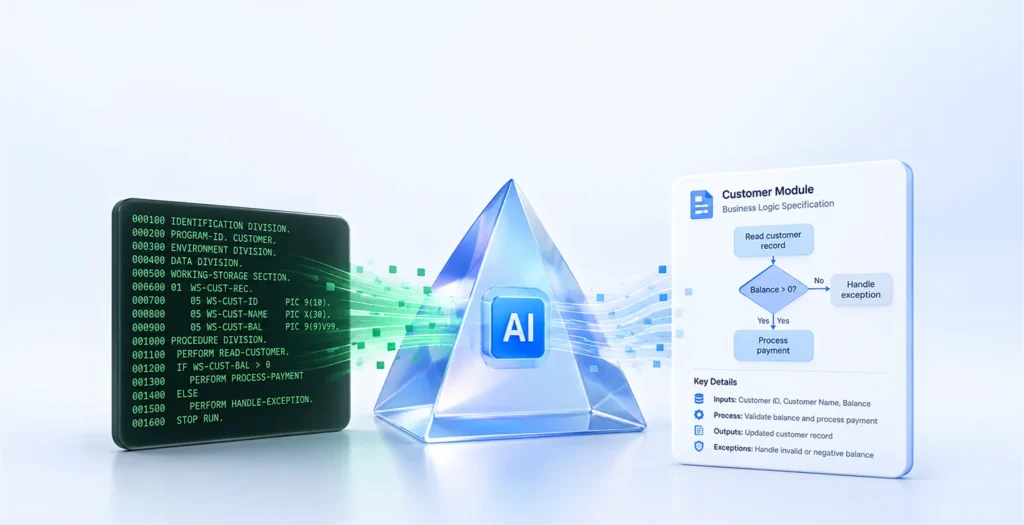
Morgan Stanley rolled out an in-house tool called DevGen.AI, built on OpenAI’s models. Within months, it processed roughly nine million lines of legacy code. It saved an estimated 280,000 developer hours—not by rewriting anything, but by translating decades-old COBOL and Perl into plain-English specs its 15,000 engineers could rebuild from. Toyota Motor North America aimed AWS’s new agentic modernization service at more than 40 million lines of COBOL and, by AWS’s account, compressed the discovery-and-planning phase — always the slowest, most expensive part — by roughly 75%.
Here’s the thesis of this entire guide, and the thing the standard explainer misses: AI knocked down the wall, but it didn’t cross the room. Understanding legacy code — the barrier that stalled modernization for half a century — is now fast and cheap. The judgment on the other side of it, deciding what’s safe to change and who answers for it when it breaks, is exactly where AI stops and exactly where projects still live or die. Everything below follows from that.
What Modernization Actually Is
Legacy application modernization means updating, restructuring, or replacing aging software to meet current needs — while preserving the business logic that’s kept the company running. That last clause is the whole game. The value was never the code; it’s the decades of rules, exceptions, and institutional memory fossilized inside it.
The costliest confusion in the field is treating modernization and cloud migration as the same move. They aren’t. Lifting a fifteen-year-old app from your data center to a cloud VM changes its address, not its nature — you’ve swapped an electricity bill for a cloud bill and kept every ounce of technical debt. Modernization changes the architecture, the data model, the integrations. Migration just changes where the debt lives.

Talk To A Legacy Modernization Expert
Get a free, no-obligation roadmap with real costs and timelines.Why The Pressure Became Unbearable
Aging software stopped being an IT line item and became a board-level risk, for four reasons that compound:
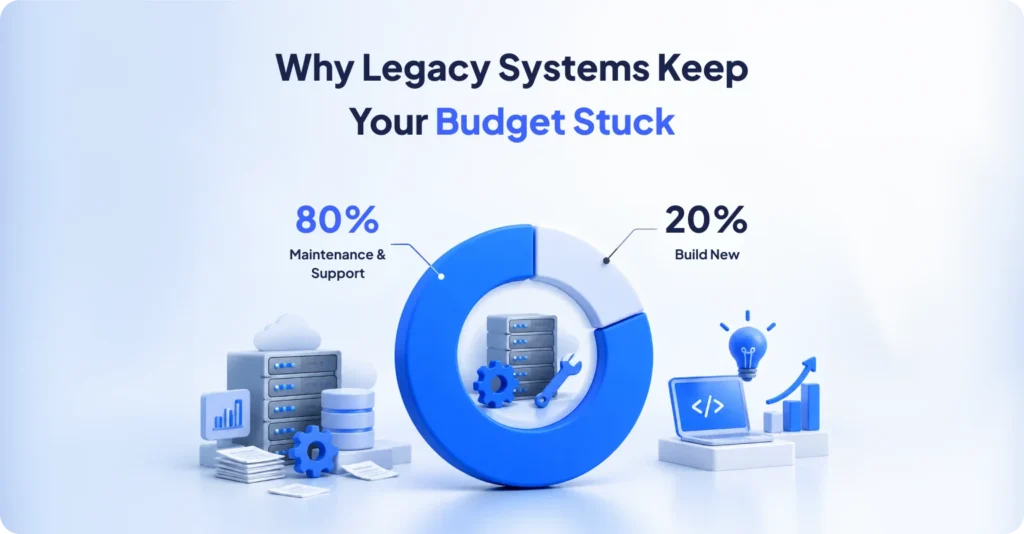
- Cost. Legacy systems can consume 60–80% of an IT budget on maintenance — the U.S. government alone spends roughly 80% of its IT budget just keeping old systems alive, according to the GAO. That’s money that never reaches anything new.
- Money in motion. The modernization market runs somewhere between $25 and $30 billion in 2025 across the major research firms, growing 15–18% a year. Exact figures differ; the direction doesn’t. Your competitors are already spending here.
- People. The engineers who built these systems are retiring, and nobody’s lining up to learn COBOL — which still handles an estimated 95% of U.S. ATM transactions, by Anthropic’s reckoning. Shrinking expertise, mission-critical exposure.
- The AI ceiling. You can’t build real-time analytics or AI features on a rigid monolith. The kind of AI and ML development a modern architecture unlocks and a rigid monolith simply can’t support.
The Seven Moves — And Roughly What Each Costs
Modernization isn’t one decision; it’s a menu. The industry calls it the 7 R’s, and choosing the wrong R for a given system is how budgets detonate.
| Approach | What It Means | Best When | Relative Cost |
|---|---|---|---|
| Retain | Leave it as-is, keep monitoring | It's stable and still does the job | None |
| Retire | Decommission it | It's redundant or unused | Saves money |
| Rehost (lift-and-shift) | Move it unchanged to new infrastructure | You need infra wins fast; debt can wait | $ |
| Replatform | Move it with targeted tweaks (managed DB, new runtime) | Small changes unlock outsized gains | $$ |
| Refactor | Restructure the code without changing behavior | Performance and maintainability are the pain | $$$ |
| Re-architect | Redesign with modern patterns, keep the logic | The architecture itself is the ceiling | $$$$ |
| Replace | Rebuild from scratch or buy new | The system no longer fits the business | $ |
Real programs use three or four of these at once. The skill isn’t modernizing everything to the same standard — it’s matching each system to the cheapest R that actually solves its problem. A full rebuild runs from mid six figures into the millions — here’s what custom software development costs broken down by scope.
How AI Rewrote The Economics of Every R
The expensive part was never the typing — it was the archaeology. Traditionally, understanding a COBOL system meant consultants spending months, sometimes years, hand-mapping workflows. AI collapses that. Anthropic’s Claude Code can map dependencies across thousands of lines, document business rules, and flag risks automatically; it published this approach as a COBOL modernization playbook in February 2026. AWS’s agentic service, launched May 2025, was built to cut the same timelines from years to months. This is where generative AI development earns its keep — mapping dependencies, documenting business rules, and flagging risks in hours instead of months.
But look closely at what actually happened in those two flagship cases, because it’s the whole lesson: neither AI rewrote the systems. Morgan Stanley’s tool translated old code into English so humans could rebuild it. It scans, maps, drafts. What it does not do is decide whether a regulated workflow is safe to touch, weigh competing business priorities, or answer for the outage when a payments system goes dark at 2 a.m. That judgment still belongs to engineers who carry the regulatory context, the operating constraints, and the risk.
So here’s the principle to run your program on: AI is a brilliant translator and a poor decision-maker. Use it as the fastest junior engineer you’ve ever hired — extraordinary at the grunt work, dangerous without supervision. It compresses discovery and first-draft translation across every R, from rehost to rebuild. The architecture, the test strategy, the governance — still yours.
What It Actually Costs: You Do Not Pay For The Code
No one can quote you honestly without seeing your system. But one principle keeps you from overpaying: you don’t pay for the code — you pay for what it’s wired to.
The R you pick sets the floor. Rehosting is cheapest because the code doesn’t change — mostly migration labor, often low tens of thousands per app, done in weeks. Replatforming: tens to low hundreds of thousands. Refactoring, which rewrites parts of the codebase: low-to-mid six figures over months. A full rebuild: mid six figures into the millions for a large system, measured in quarters or years.
Then reality writes the real invoice, from three places:
- Connections. Every integration is a contract you must preserve or renegotiate — which is why a clean API layer often does more for a legacy system than the code work itself.
- Data. Dirty records, mismatched schemas, or zero tolerance for downtime during cutover can cost more than the code work itself.
- Compliance. Where regulated data is in scope, you carry controls, evidence, and validation through the whole project instead of bolting them on at the end.
Talk To A Legacy Modernization Expert
Get a free, no-obligation roadmap with real costs and timelines.Ask for estimates as ranges tied to those three, never a single number — a quote that ignores them is a guess in a suit. And know where AI helps: it slashes the discovery and documentation cost, the phase that usually blows the budget, while barely touching integration testing and parallel-run work, which stay stubbornly, expensively human.
Modernize or Replace? Two Questions Beat Any Checklist
Most guides hand you a checklist of signals and leave you to juggle them. There’s a cleaner way. The decision reduces to two questions:
- Does it still do the right thing? Is the business logic inside still what the business needs?
- Can you still safely change it? Is the foundation — language, stack, the people who understand it, the integrations — still viable?
Cross them, and every system lands in one box:
- Right job, sound foundation → leave it. Not every old system is a problem. If it works and you can safely change it, modernizing is solving a problem you don’t have.
- Right job, rotten foundation → modernize. The classic case. The logic is worth saving; the platform isn’t. Rehost through re-architect, depending on how deep the rot goes.
- Wrong job, sound foundation → extend, don’t rebuild. The bones are fine; the requirements moved.
- Wrong job, rotten foundation → replace. Nothing worth preserving, and it no longer fits. Rebuild or buy.
Every signal people agonize over — end-of-life runtimes, rising release failures, the one graybeard who understands it eyeing retirement, a web of brittle point-to-point links — is just evidence feeding question two. Answer the two questions, place the system, and the path is usually obvious. When it straddles two boxes, phase the work and start with the riskiest piece.
The £330 Million Lesson: Never Go Big-Bang
Before you plan anything, sit with one story. In April 2018, TSB Bank attempted a single-event migration of about 5.2 million customers to a new core platform. Roughly 1.9 million were locked out of their accounts, and the episode is widely reported to have cost around £330 million. The cause wasn’t exotic technology. It was the decision to reproduce decades of undocumented behavior and switch it all on at once.
The alternative has a name: the strangler fig pattern. Wrap the old system and replace it piece by piece — each increment delivering something measurable, each one reversible, the legacy system live until its replacement is proven. Slower to start, dramatically cheaper to finish, because you never bet the whole estate on one Saturday night. And in 2026, with AI accelerating each piece, incremental modernization is more practical than ever. There is almost no defensible reason left to go big-bang.
Your First 90 Days
Most guides end at “hire experts.” Here’s what to actually do in quarter one, whoever you hire.
Start with an assessment, not a rewrite. Inventory every application — stack, versions, true maintenance cost, dependencies, compliance exposure. This is exactly the archaeology AI now accelerates, so do it thoroughly; it’s cheaper than it used to be.
Then pick one system to modernize first, deliberately: high enough in business value to matter, low enough in complexity to win — few dependencies, clean boundaries, a team that can absorb change. You’re not fixing the estate. You’re proving a pattern the organization can trust and repeat.
Prove it. Measure it. Run the same play on the harder systems. That’s how the companies with real results work — not one heroic migration, but a repeatable method, one system at a time.
The Bottom Line
The wall came down. Understanding legacy code — the thing that blocked modernization for fifty years — is finally fast and cheap, and the enterprises moving first have the receipts. But AI only knocked down the wall; it didn’t cross the room. The judgment on the other side is still human, still hard, and still where every project is won or lost. The teams that win in 2026 pair AI’s speed on the grunt work with human ownership of the decisions that carry real risk — and they do it one provable system at a time. Assess honestly, pick a first system you can win, and build the pattern from there.
Talk To A Legacy Modernization Expert
Get a free, no-obligation roadmap with real costs and timelines.FAQs
Q: What is legacy application modernization?
It’s updating, restructuring, or replacing aging software so it fits how your business runs today — without throwing away the business logic that’s kept it running for years. The value was never the code; it’s the decades of rules and edge cases fossilized inside it. Modernization can be as light as a cloud move or as deep as a full rebuild.
Q: Is application modernization the same as cloud migration?
No — and treating them as the same is one of the most expensive mistakes teams make. Moving a 15-year-old app to a cloud server changes where it runs, not how it’s built; you’ve swapped an electricity bill for a cloud bill and kept every ounce of technical debt. Modernization changes the architecture, data model, and integrations. Migration just changes the address.
Q: What are the 7 R’s of application modernization?
They’re the seven ways to handle a legacy system: Retain (leave it), Retire (shut it down), Rehost (lift-and-shift), Replatform (move it with small tweaks), Refactor (restructure the code), Re-architect (redesign with modern patterns while keeping the logic), and Replace (rebuild or buy). Most real programs use three or four at once. The skill is matching each system to the cheapest R that actually solves its problem.
Q: How much does it cost to modernize a legacy application?
There’s no honest single number — cost tracks what the system is wired to, not the code itself. As a rough floor: rehosting often runs in the low tens of thousands per app, replatforming tens to low hundreds of thousands, refactoring into six figures, and a full rebuild from mid-six figures into the millions for large systems. The real invoice comes from three places — integrations, data quality, and compliance — so ask any vendor for ranges tied to those three, never a flat quote.
Q: How long does legacy modernization take?
It scales with scope. A simple rehost can take a few weeks, a complex re-architecture usually three to six months, and an enterprise-wide program 12–24 months in waves of a handful of apps at a time. Anyone promising to modernize a large estate in one quick project is selling you risk.
Q:Can AI modernize legacy code on its own?
Not today. AI is genuinely transformative at the hard part — reading old code and translating it into plain-English specs, work that used to take consultants months. But deciding what’s safe to change, weighing business priorities, and answering for the outage when a payments system goes dark are still human jobs. Gartner expects more than 70% of AI-led mainframe exit projects started in 2026 to fall short precisely because teams overestimate the tools. Treat AI as your fastest junior engineer, not your architect.
Q: Will AI replace the developers who do modernization?
It’s changing what they do, not removing them. When Morgan Stanley’s in-house tool processed nine million lines of legacy code and saved an estimated 280,000 hours, it didn’t rewrite the systems — it freed 15,000 engineers to focus on the judgment and rebuilding. The grunt work compresses; the accountability doesn’t.
Q: Should I modernize my legacy system or replace it?
Answer two questions. One: does it still do the right thing — is the business logic still what you need? Two: can you still safely change it — are the language, stack, team, and integrations still viable? Logic worth keeping on a rotten foundation means modernize; neither holding means replace; both fine means leave it alone. Modernizing a system that works is solving a problem you don’t have.
Q: Why is a “big-bang” migration so risky?
Because switching everything on at once bets your whole operation on one night going perfectly. TSB’s single-event migration of 5.2 million customers in 2018 locked out roughly two million and is widely reported to have cost around £330 million. The safer path is the strangler fig pattern — wrap the old system and replace it piece by piece, each step reversible, the legacy system live until its replacement is proven.
Q: Is COBOL still used, and why is it hard to modernize?
Very much so — IBM estimates COBOL still handles around 95% of ATM transactions and most in-person card payments. It’s hard to modernize not because the language is exotic, but because the engineers who understand these systems are retiring, the business rules were never documented, and the systems are mission-critical, so mistakes are costly. That’s exactly why “understand it first” beats “rewrite it fast.”
Q: What are the biggest risks in a modernization project?
The technical risk is real, but the budget-killers are integrations you didn’t fully map, dirty or mismatched data during cutover, and compliance controls bolted on at the end instead of carried through. Underestimating any of the three — or trying to cut over everything at once — is how a project doubles in cost or takes a system offline.
Q: Where should I start a modernization program?
With an assessment, not a rewrite. Inventory every application, its true maintenance cost, dependencies, and compliance exposure. Then pick one system that’s high enough in business value to matter but low enough in complexity to win. You’re not fixing the whole estate on day one — you’re proving a repeatable pattern the organization can trust.
Do not Miss Our Latest Tech Insights
Stay one step ahead in the fast-moving world of AI and technology. Add us as a Preferred Source on Google and get our latest articles, guides, and industry insights delivered straight to your search feed.