TABLE OF CONTENT
- How Much Does Android App Development Cost in USA in 2026?
- Where Your Android App Budget Actually Goes
- Six Factors That Drive Android App Development Cost
- Android App Development Cost by App Type in 2026
- Android App Development Cost by Team Location
- Hidden Costs Most Android App Blogs Skip
- Android App Cost vs iOS App Cost: Side by Side
- Six Red Flags of a Bad Android App Quote
- The Truth About Cheap Android App Quotes
- Native Android vs Cross Platform: Which Saves Money?
- How to Cut Android App Development Cost Without Cutting Quality
- Real Auspicious Soft Android Project Costs
- Android App Development Cost Formula
- Android App Development Cost by USA City
- Payment Terms and Milestones: What Fair Looks Like
- What You Should Own After Launch
- Android App Development Timeline in 2026
- Auspicious Soft’s Take on 2026 Android App Costs
- What to Do in the Next 24 Hours
- FAQs
Overview
- Android app development cost in USA sits between $25,000 and $300,000 in 2026, but the total price depends on far more than a headline number.
- Simple utility apps start at $25,000. Mid range business apps land at $60,000 to $150,000. Complex enterprise and AI heavy builds cross $250,000 fast.
- USA developer rates now run $80 to $200 per hour, while offshore teams charge $20 to $55. Design and backend eat up 55% of the average budget.
- Google Play takes 15% of yearly revenue up to a million. Yearly maintenance adds another 20% on top of the build cost.
- This guide breaks down every real number, red flag, and cost cutting move for 2026. It also shows why the cheapest quote almost always ends up as the most expensive build over three years.
AI Summary:
Android app development in the USA costs $25,000-$300,000+ in 2026: simple utility apps run $25,000-$50,000, mid-level business apps $60,000-$150,000, and complex AI/enterprise apps $200,000-$500,000+. US developer rates run $80-$200/hour versus $20-$55 offshore. Backend and design eat roughly 55% of the budget. Google Play takes a $25 one-time fee plus 15% of first-year revenue. Annual maintenance runs 15-20% of build cost, and cross-platform tools can cut costs 30-50%.
Android app development cost in USA sits between $25,000 and $300,000 in 2026.
- Simple utility apps: $25,000 to $50,000
- Mid range business apps: $60,000 to $150,000
- Complex enterprise or AI apps: $200,000 to $500,000+
Hourly rates for USA developers run $80 to $200. Offshore teams charge $20 to $55. Google Play charges a one time $25 fee and keeps 15% of the first million in yearly revenue.
That is the short version. Now the real story.
Key Takeaways
- Basic Android apps start at $25,000. Complex ones cross $300,000.
- USA developer rates: $80 to $200 per hour in 2026.
- Team location alone changes the total bill by 3x or more.
- Design plus backend eat up 55% of the average build budget.
- Google Play Store charges $25 once, then keeps 15% of yearly revenue up to $1M.
- Yearly maintenance runs 15 to 20% of the build cost. Every year.
- Cross platform builds like Flutter can cut the price by up to 40%.
- 2026 pushed senior USA rates up because AI replaced most junior dev work.
- The cheapest quote almost never wins on total cost over three years.
How Much Does Android App Development Cost in USA in 2026?
Here is what businesses actually paid in 2026:
| App Type | Cost Range | Time to Build | Team Size |
|---|---|---|---|
| Simple Utility App | $25,000 – $50,000 | 2 – 3 months | 3 – 4 people |
| Mid-Level Business App | $60,000 – $150,000 | 4 – 6 months | 5 – 7 people |
| Complex Enterprise App | $150,000 – $300,000 | 6 – 9 months | 7 – 10 people |
| AI or IoT-Heavy App | $250,000 – $500,000+ | 9 – 12 months | 10 – 15 people |
According to Clutch’s 2026 App Development Pricing Report, average agency rates jumped 8% year over year. Statista projects the global mobile app market will hit $781 billion by 2029, up from $469 billion in 2024. Demand keeps rising. Rates follow.
Businesses looking for custom Android app development services should plan for a floor of $25,000 for anything shippable. Below that, quality drops fast.
Where Your Android App Budget Actually Goes
Most cost guides skip this. Yet it matters more than the total price. Here is where every dollar of a typical $100,000 Android build gets spent:
| Budget Category | % of Total | On a $100K Build |
|---|---|---|
| Backend & API Development | 30% | $30,000 |
| Frontend Android Development | 25% | $25,000 |
| UI & UX Design | 15% | $15,000 |
| QA & Testing | 12% | $12,000 |
| Project Management | 10% | $10,000 |
| DevOps & Deployment | 5% | $5,000 |
| Third-Party Licenses | 3% | $3,000 |
Two things pop out. Design costs way more than most founders expect. And QA eats a real chunk of budget, which is exactly why cheap builds skip it and fail six months later.
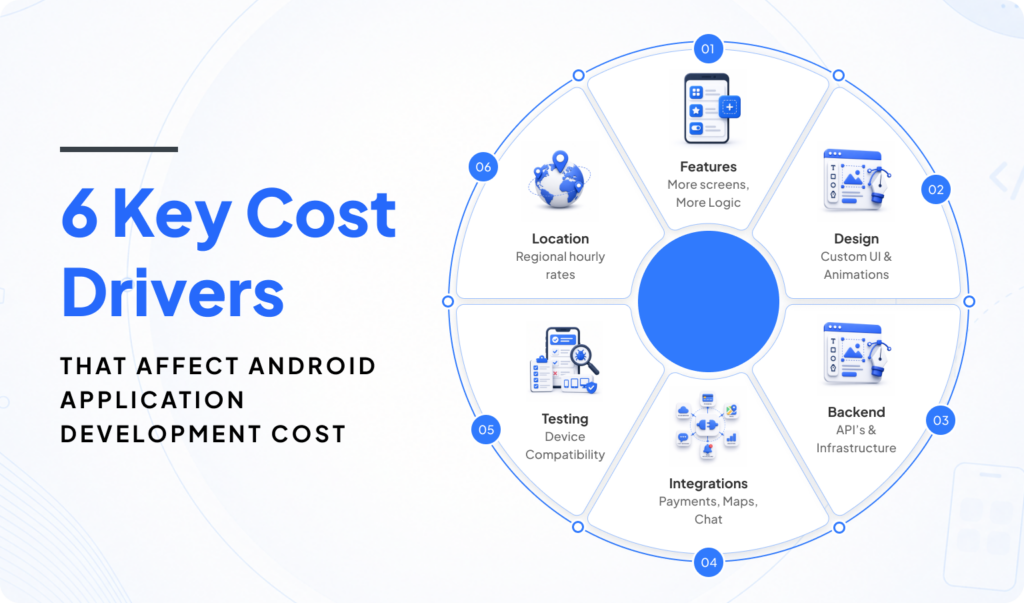
Six Factors That Drive Android App Development Cost
Six things move the price. They stack.
Feature Depth: More screens, more logins, more money. A basic app has 5 to 10 screens. A large one hits 40 or more. Each screen adds 15 to 40 hours of work.
Design Sophistication: Template design costs $5,000 to $15,000. Custom design with animations and micro interactions runs $30,000 to $60,000. Motion design adds another layer if the brand needs it.
Backend Complexity: Servers, databases, and APIs make up around 30% of the budget. Real time data pushes this higher. Chat, live tracking, video streaming all bump this line up fast.
Third Party Integrations: Payment gateways, mapping services, chat SDKs, push notifications, analytics. Each integration adds hours plus recurring license fees.
Testing Scope: Android runs on more than 24,000 distinct device models. Testing across the important ones is not cheap. Skip this and users on Samsung, OnePlus, Xiaomi, and Pixel all see different bugs.
Team Location: The biggest lever of all. Same app scope, wildly different bills. Covered in detail below.
Android App Development Cost by App Type in 2026
Different apps carry different price tags. Here is what businesses spent in 2026:
| App Category | Cost Range | Common Features |
|---|---|---|
| Ecommerce App | $50,000 – $180,000 | Cart, payments, product catalog, wishlist |
| On-Demand App (like Uber) | $80,000 – $250,000 | Real-time tracking, dual apps, payments |
| Fintech App | $100,000 – $300,000 | KYC, banking APIs, PCI DSS security |
| Healthcare App | $80,000 – $250,000 | HIPAA compliance, patient records, video calls |
| Social Media App | $60,000 – $200,000 | Feed, chat, media uploads, notifications |
| Booking App | $40,000 – $150,000 | Calendar, payments, alerts, reviews |
| Fitness App | $35,000 – $120,000 | Workout plans, activity tracking, HealthKit sync |
| Education App | $50,000 – $180,000 | Video lessons, quizzes, progress tracking |
| Food Delivery App | $70,000 – $220,000 | Live tracking, dual apps, payments |
| Real Estate App | $60,000 – $180,000 | Maps, property listings, virtual tours |
Compliance heavy categories cost more. Fintech and healthcare apps carry the biggest legal overhead in the USA. Skip that overhead and lawsuits follow.
For an Ecommerce App, a Fitness App, or an Education App, Auspicious Soft has case studies showing real numbers on real projects.
Android App Development Cost by Team Location
Where the team sits changes everything. A Manhattan agency and a Punjab team can ship the same app for radically different prices.
| Region | Hourly Rate | Quality Level | Best For |
|---|---|---|---|
| USA / Canada | $80 – $200 | Elite | Enterprise and regulated apps |
| Western Europe | $70 – $150 | High | Mid-sized to large projects |
| Eastern Europe | $40 – $80 | High | Mid-range app development |
| Latin America | $35 – $75 | Solid | USA time zone collaboration |
| India / Southeast Asia | $20 – $55 | High (with vetted teams) | Most business applications |
| Africa | $25 – $60 | Growing | Cost-sensitive projects |
Most USA startups run a hybrid setup in 2026. USA project manager plus offshore engineering team. That model cuts costs 40 to 60% without losing accountability.
From the Auspicious Soft engineering desk:
The cost gap between USA and offshore is not about talent. It is about overhead. Rent, taxes, insurance. Our senior engineers write the same clean Kotlin as any San Francisco team. The only real difference is who is billing the client.
— Anil Thakur, Delivery Head at Auspicious Soft
Curious how much a full dedicated Android team would run across regions? The regional pricing breakdown is worth reading before signing any contract.
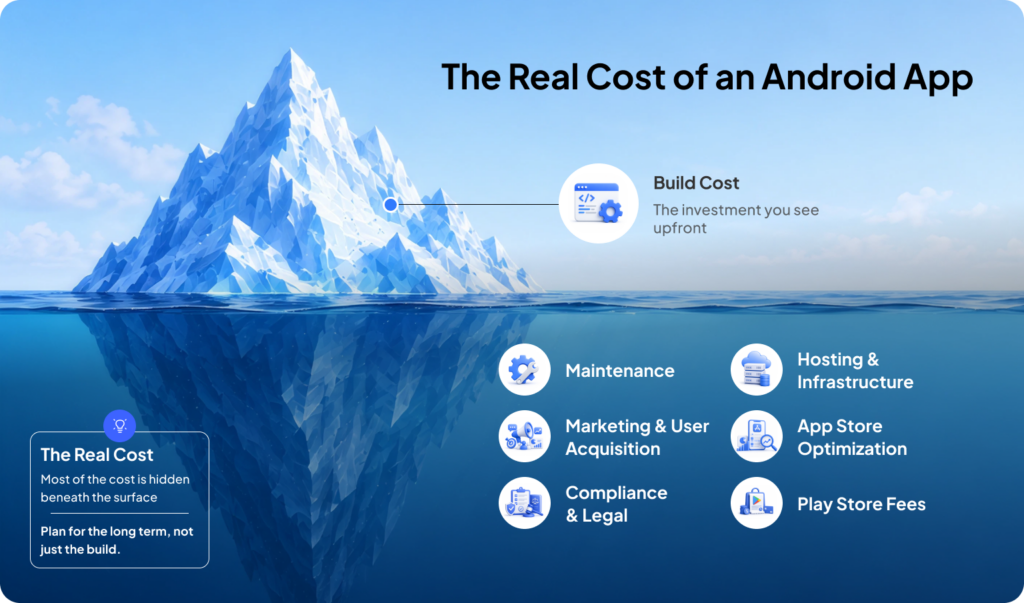
Hidden Costs Most Android App Blogs Skip
The build price is not the full picture. These extras hit later, usually at the worst possible time.
- Google Play Store Fee: $25 one time. Google takes 15% of the first million in yearly revenue and 30% above that.
- Servers and Hosting: $30 to $500 per month based on traffic and features.
- Yearly Maintenance: 15 to 20% of build cost. Every single year.
- App Store Optimization: $500 to $5,000 per month if done properly.
- Marketing and User Acquisition: Often larger than the build itself. A single install can cost $2 to $8 through paid channels.
- Compliance: GDPR, CCPA, HIPAA all add $5,000 to $50,000.
- Analytics Tools: Firebase, Mixpanel, Amplitude paid tiers. $100 to $2,000 monthly.
- Legal Docs: Privacy policy, terms of service, cookie compliance. $500 to $5,000 one time.
Ignore these during planning and the project runs out of money halfway through year one.
Android App Cost vs iOS App Cost: Side by Side
A common question. Here is the honest comparison for 2026:
| Factor | Android | iOS |
|---|---|---|
| Average Build Cost | $25,000 – $300,000 | $30,000 – $320,000 |
| Development Language | Kotlin or Java | Swift |
| Testing Complexity | High (many device models) | Lower (fewer device models) |
| App Store Fee | $25 (one-time) | $99 per year |
| Store Commission | 15% (up to $1M annual revenue) | 15% (up to $1M annual revenue) |
| Approval Time | 3 – 7 days | 1 – 3 days |
| Design Cost | Slightly lower | Slightly higher |
Android is usually 5 to 10% cheaper on design. iOS is usually 10 to 15% faster to test. Total cost lands close. Most businesses now build for both platforms using Flutter vs React Native and cut the combined price by 30 to 50%.
Six Red Flags of a Bad Android App Quote
Not every quote is honest. Watch for these six warning signs:
1. Round Numbers That Feel Random
Your app will cost $12,000.” No breakdown. No hours. Just a number. That is a made up figure designed to close the sale.
2. No Discovery Phase
Any agency that quotes without a 30 minute discovery call is guessing. Real quotes come after real questions.
3. Missing QA and Testing Line Item
If the quote does not include a testing phase with real device coverage, expect a broken app.
4. Zero Source Code Access
Any deal that hides the code from the buyer is a vendor lock in trap. Walk away.
5. No Written Contract or NDA
Verbal agreements protect nobody. Especially the founder.
6. Prices Below $15,000 for a Real App
That budget cannot cover proper development, testing, and support. What comes out will not survive six months.
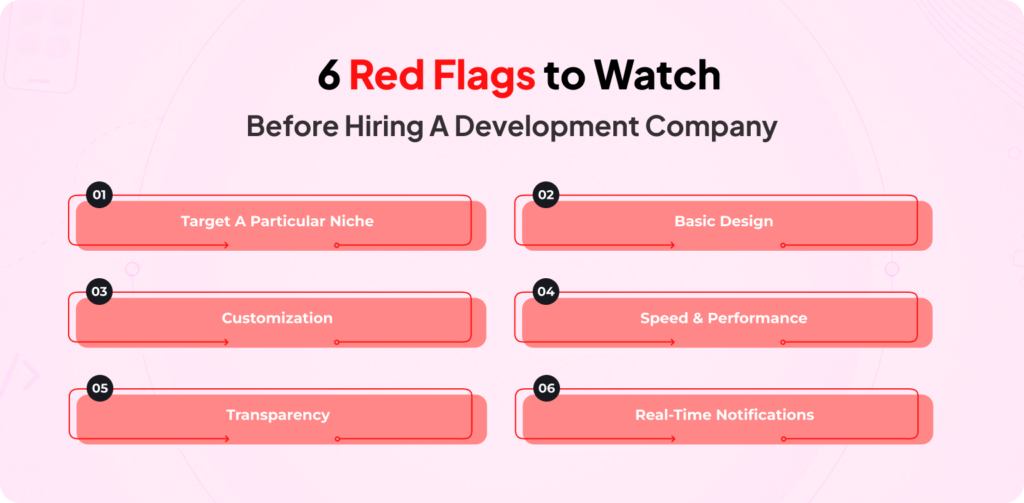
The fix for all six: work with an experienced team that offers a written scope, real milestones, and full IP transfer. A guide on how to choose a software development company covers the full vetting checklist.
Ready to Get a Real Android App Cost Estimate?
Skip the guesswork. Book a free 30 minute consultation with Auspicious Soft. Share the idea, get a fair price range, and walk away with a real plan even if hiring the team is not the next step. Get Your Free Estimate →
The Truth About Cheap Android App Quotes
Here is the part nobody prints.
A $5,000 Android app quote sounds like a win. It never is. That price buys a template, copy paste code, no proper testing, zero support after launch. Six months in, the app crashes on new phones. Fixing it costs three times the original build.
A $15,000 quote from a random freelancer is only slightly better. The freelancer often vanishes after payment. The codebase is a mess. The next agency charges more just to understand what the last one wrote.
Real production Android apps start around $25,000 for a reason. That budget covers proper planning, clean code, testing on real devices, and support for at least a few months. Anything below that number is a false saving.
Auspicious Soft has rescued dozens of failed cheap builds since 2018. The rescue project almost always costs more than doing it right the first time. That pattern shows up in every industry. Fintech. Healthcare. Ecommerce. Same story every time.
Native Android vs Cross Platform: Which Saves Money?
Two paths. Two different bills.
Native Android (Kotlin or Java)
- Top performance for complex tasks
- Full hardware access
- Cost: 100% of the base price
- Best for: games, hardware apps, real time apps
Cross Platform (Flutter App Development or React Native Development)
- One codebase for both Android and iOS
- 30 to 50% cheaper overall
- Slightly less native feel
- Best for: business apps, MVPs, content apps
For most 2026 projects, cross platform wins. Flutter has closed the performance gap. React Native has stabilized. Pick native only if the app truly needs it.
How to Cut Android App Development Cost Without Cutting Quality
Smart moves that actually save money:
- Start with an MVP. Ship the core feature first. Add more later based on real usage data.
- Pick cross platform. Unless native is truly needed, Flutter or React Native saves 30 to 50%.
- Hire offshore with a USA project lead. Real accountability. Real savings.
- Use ready APIs. Do not rebuild what a $50 per month subscription already solves.
- Skip fancy animations in version one. Add them later when paying users are already onboard.
- Test early and often. A bug caught in week two costs $10. In production it costs $10,000.
- Plan for maintenance from day one. Set aside 20% of build cost yearly.
- Own the source code from day one. Prevents vendor lock in later.
- Push for milestone based payments. Never pay 100% upfront. Ever.
- Use existing UI kits. Material Design 3 saves 20 to 40 design hours per screen.
Real Auspicious Soft Android Project Costs
Here is what recent Android builds actually cost at Auspicious Soft. Numbers are rough but honest:
- Distacart: Cross border ecommerce app moving 500K+ Indian products to USA buyers. Complex build. Landed in the $85,000 to $120,000 range.
- Vcare Project Management: PMI exam prep mobile app with mock tests and tracking. Mid level. About $40,000 to $65,000.
- Werover: Real time tracking with IoT and admin dashboard. IoT builds like this run $120,000 and up.
- Disstrikt: Event discovery and social connection app. Feature heavy. $70,000 to $110,000 range.
Every project varies. These give a real world floor to plan from, instead of the fantasy numbers freelance marketplaces throw around.
Android App Development Cost Formula
Skip the fancy calculators. Here is the math:
Total Cost = Development Hours × Hourly Rate
Then add:
- 15% for project management
- 20% for QA and testing
- 10% buffer for scope changes
Real total: about 45% more than the raw dev estimate. Any agency skipping these line items is either lying or about to blow the budget.
Quick Examples
Uber Style App in Los Angeles
- Base dev: 2,200 hours × $130 = $286,000
- Plus 45% for PM, QA, buffer = $414,700
- Realistic budget: $400,000 to $450,000
Fitness App in Austin
- Base dev: 1,200 hours × $110 = $132,000
- Plus 45% = $191,400
- Realistic budget: $180,000 to $210,000
MVP Booking App with Offshore Team
- Base dev: 800 hours × $45 = $36,000
- Plus 45% = $52,200
- Realistic budget: $50,000 to $60,000
Same app scope. Same features. Wildly different bills based on team choice. That is the real leverage in Android budgeting.
Android App Development Cost by USA City
Rent is high in some cities. Talent competition is fierce in others. Both push the rate up.
| City | Average Hourly Rate |
|---|---|
| San Francisco / Bay Area | $150 – $250 |
| New York | $130 – $220 |
| Los Angeles | $110 – $200 |
| Austin | $100 – $180 |
| Seattle | $110 – $200 |
| Boston | $110 – $190 |
| Chicago | $90 – $170 |
| Miami | $85 – $160 |
| Denver | $95 – $170 |
| Atlanta | $85 – $160 |
| Remote USA | $80 – $160 |
Businesses in Los Angeles and San Francisco often work with Auspicious Soft to get Bay Area quality without Bay Area prices. Local presence, offshore engineering. That combo is why the hybrid model keeps beating both extremes.
Get a Custom Quote for Your Android App
Every app is different. Every budget is different. Auspicious Soft gives an honest cost breakdown based on real needs. No generic price sheet. No lock in. Talk to Our Android Experts →
Payment Terms and Milestones: What Fair Looks Like
Most first time app owners get burned by bad payment structures. Fair looks like this:
| Milestone | Payment | What Gets Delivered |
|---|---|---|
| Kickoff | 20% | Signed scope, project plan, and team assigned |
| Design Approval | 20% | Wireframes, UI screens, and interactive prototype |
| Alpha Build | 25% | Core features completed and internal testing finished |
| Beta Build | 25% | All features completed and QA testing finalized |
| Launch | 10% | App published on the Google Play Store and project documentation delivered |
Anyone asking for 100% upfront is a red flag. Anyone offering 0% upfront is either desperate or scamming. Real agencies split payment by risk. That structure protects both sides.
What You Should Own After Launch
The app costs money. The rights matter more. Any deal should include:
- Full source code with commit history
- Design source files (Figma, Adobe XD, Sketch)
- API documentation and backend architecture
- Play Store console transferred to the client account
- All third party account access (Firebase, analytics, servers)
- Signed NDA covering the entire engagement
- IP assignment clause in the master agreement
Auspicious Soft transfers all of this on day one of every project. Some agencies quietly hold code hostage to force future work. That trap is real. Ask for the transfer terms in writing before signing.
Android App Development Timeline in 2026
Rough time by app type:
- Simple utility app: 2 to 3 months
- Mid level business app: 4 to 6 months
- Complex app: 6 to 9 months
- Enterprise or AI app: 9 to 12 months
Speed costs money. Rushing a 6 month build into 3 months usually doubles the price. Not always worth it. Better to plan a realistic timeline than pay overtime rates just to hit an arbitrary launch date.
Auspicious Soft’s Take on 2026 Android App Costs
Something big shifted in 2026. AI tools replaced most junior dev work. Senior developers became more valuable than ever. That split pushed USA rates up while making offshore engineering even more competitive.
The smart move for most businesses is neither the cheapest quote nor the most expensive one. It is finding a team that mixes senior USA project leadership with strong offshore engineering. That model ships real products at fair prices.
Auspicious Soft has run this model since 2018. Head office in India. Delivery for USA clients. Senior engineers on every project. It works because it must. Cheap tricks and cut corners always cost more later.
The right question is not “what is the cheapest way to build my Android app”. The right question is “what will this app cost over three years, including the mistakes I have not made yet”. Answer that honestly and the price tag suddenly makes sense.
What to Do in the Next 24 Hours
For anyone serious about launching an Android app:
- Write a one page brief. Describe the problem the app solves, the users, the core three features.
- Set a budget range, not a fixed number. $50K to $80K, not “under $60K”.
- Book two or three agency consultations. Skip anyone who quotes without asking questions.
- Ask for milestone based payment terms. Never pay full upfront.
- Check the case studies. Real work beats slick sales decks every time.
- Ask about IP and source code. Get the transfer terms in writing.
That six step checklist takes one afternoon. It saves months of pain later.
FAQs
1. What is the minimum cost of Android app development in USA in 2026?
The lowest realistic price for a working Android app is around $25,000. Anything below that means a template job or a poor build that needs rework fast.
2. Why do Android apps cost more in the USA than in India?
USA developers charge $80 to $200 per hour. Indian developers charge $20 to $55 per hour. The gap comes from cost of living, taxes, and hiring competition. Not skill.
3. Is Android app development cheaper than iOS?
Usually 5 to 10% cheaper on design. But testing costs more for Android because of the massive device range. Total cost ends up close to iOS in most cases.
4. How much does Google Play Store charge developers?
Google Play charges a one time $25 registration fee. Google then takes 15% of the first $1 million in yearly revenue and 30% above that. After the 2026 Epic Games settlement, subscription fees dropped to 10% in the USA, UK, and EEA.
5. What is included in Android app maintenance cost?
Bug fixes, OS updates, security patches, server costs, and small feature updates. Plan for 15 to 20% of build cost every single year.
6. Can I build an Android app for under $10,000?
Not a good one. That budget only buys a template or a very limited MVP. Most cheap builds fail within a year and cost more to rescue than to build fresh.
7. How long does Android app development take in 2026?
Simple apps take 2 to 3 months. Mid level apps take 4 to 6 months. Complex ones take 6 to 12 months. Timelines depend on scope, team size, and how ready the specs are on day one.
8. Should I choose native or cross platform Android development?
Cross platform works for most business apps and saves 30 to 50% of the cost. Pick native only for top performance needs or deep hardware access.
9. Does Auspicious Soft build custom Android apps for USA businesses?
Yes. Auspicious Soft is a mobile app development company that builds Android, iOS, and cross platform apps for USA startups and enterprises with over 8 years of experience.
10. What is the biggest hidden cost of Android app development?
Long term maintenance. Most first time app owners forget it. That single mistake can double the total cost of the app over three years.
11. How much does it cost to hire an Android developer in USA?
Freelancers charge $40 to $100 per hour. Agency developers charge $75 to $200 per hour. Fully dedicated engineers cost more upfront but usually save money over the full project.
12. What programming language is used for Android app development in 2026?
Kotlin is the main language for native Android. Java still works for legacy systems. For cross platform, Flutter uses Dart and React Native uses JavaScript.
13. What are common mistakes that inflate Android app cost?
Vague scope, no wireframes before dev, mid project feature changes, skipping QA, no maintenance plan, and picking the cheapest bidder. Each mistake compounds the next.
14. Is it cheaper to build the Android app first or both platforms together?
Cross platform tools now make building both together cheaper than sequential native builds. Total cost drops 30 to 50% versus doing Android first, then iOS.
15. How much should Android app design cost in 2026?
Basic design: $5,000 to $15,000. Custom design: $15,000 to $40,000. Premium UX with motion design: $40,000 to $80,000. Design almost always costs more than founders expect.
Do not Miss Our Latest Tech Insights
Stay one step ahead in the fast-moving world of AI and technology. Add us as a Preferred Source on Google and get our latest articles, guides, and industry insights delivered straight to your search feed.