+1 740 762 6496
 +91 70189 46603

TABLE OF CONTENT
- What Counts as an On Demand App?
- On Demand App Development Cost by App Type
- Cost to Develop an App Like Uber in 2026
- Cost to Build a DoorDash App (Food Delivery)
- On Demand Delivery App Development Cost by Feature
- What Drives the Cost of an On Demand App?
- Hidden Costs of On Demand App Development
- How to Build an On Demand App and Save Money
- How Much Should You Budget?
- FAQs
Overview
- On demand apps like Uber and DoorDash are booming, but the price to build one is all over the map.
- This guide breaks down the real on demand app development cost in 2026, from a lean $25K to $150K full build.
- You will see clear prices by app type, a part by part cost table, the things that push your budget up, and smart ways to spend less.
- By the end you will know what your idea should cost, and how to build it without waste.
Most founders ask the wrong question first. They ask, “How cheap can this be?” The smarter question is, “What does the right version cost?” Price and value are not the same thing.
On demand app development cost in 2026 sits between $25,000 and $300,000. A lean app to test your idea starts near $25,000 to $40,000. A full app that can handle real users usually lands between $40,000 and $150,000. Big platforms with AI, many user types, and heavy delivery logic climb past $200,000.
Want The Bigger Picture First?
Our guide to mobile app development walks through how the whole build works.What Counts as an On Demand App?
An on demand app links a customer to a service in real time. Tap a button, get a ride. Tap again, food shows up. Tap once more, a plumber knocks on your door.
Uber. DoorDash. Instacart. Urban Company. They all run on the same idea. A customer wants something now, and the app finds someone to deliver it.
Most of these apps have two or more sides. One app for the customer. One for the driver or provider. And a control panel for you, the owner. That extra side is part of why the price climbs. You are not building one app. You are building a small system.
On Demand App Development Cost by App Type
Different apps, different price tags. A food app and a ride app share a lot of parts, but the details shift the cost. Here is a clean look at 2026 numbers.
| App Type | MVP Cost | Full App Cost | Time to Build |
|---|---|---|---|
| Ride app (like Uber) | $30,000 to $60,000 | $60,000 to $150,000 | 4 to 7 months |
| Food delivery (like DoorDash) | $25,000 to $45,000 | $50,000 to $120,000 | 4 to 7 months |
| Grocery delivery (like Instacart) | $25,000 to $45,000 | $50,000 to $130,000 | 4 to 8 months |
| Home services (like Urban Company) | $20,000 to $40,000 | $45,000 to $110,000 | 3 to 6 months |
Notice the pattern. The MVP is always far cheaper than the full build. That gap is your friend. More on that soon.
Cost to Develop an App Like Uber in 2026
A ride app feels simple. You set a pin, a car comes. Behind that screen sits a lot of moving parts.
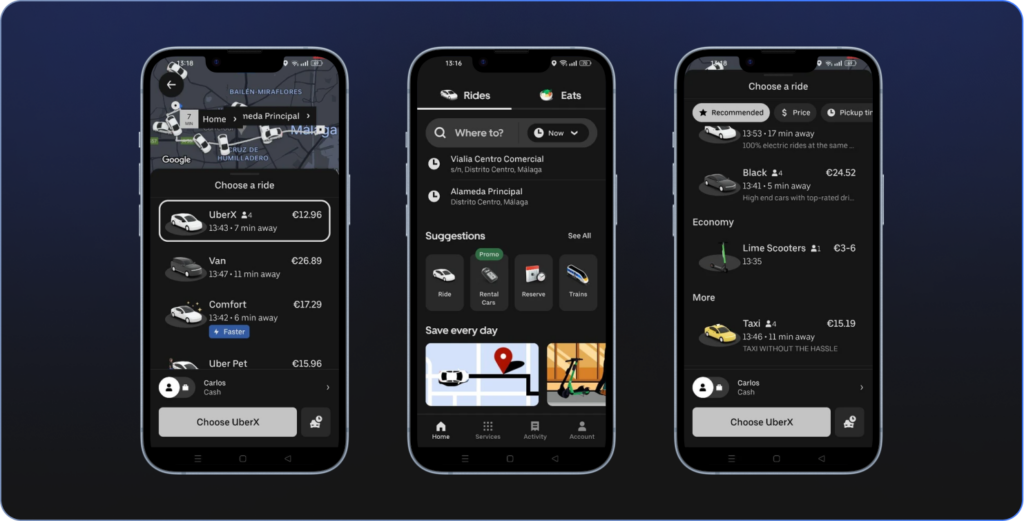
The cost to develop an Uber like app in 2026 breaks down like this:
- Basic MVP: $30,000 to $60,000. Riders, drivers, maps, payments. Enough to launch in one city.
- Mid range app: $60,000 to $150,000. Cleaner design, live tracking, ratings, a solid admin panel, support for more cities.
- Large platform: $150,000 to $300,000 and up. AI for pricing and routing, deep driver tools, and servers built to take heavy traffic.
The big cost driver here is live location. Tracking dozens or thousands of cars at once eats server power and developer hours. That is the engine of the whole app, so it is worth doing right.
Building for both phones at once? Our iOS app development and Android app development pages show what each side needs.
We have done this kind of live tracking work before. See the real time tracking app we built with IoT and a full admin dashboard.
Cost to Build a DoorDash App (Food Delivery)
People always ask how much it costs to build a DoorDash app. The honest range is wide, and there is a reason.
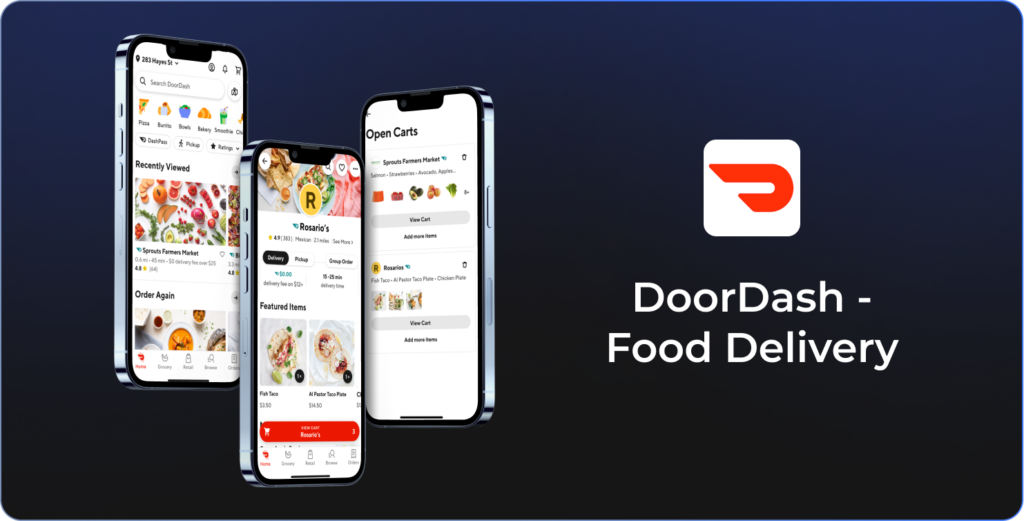
A food delivery app usually has four sides, not two:
- The customer app
- The driver app
- The restaurant app
- Your admin panel
Four apps means more work than a ride app. That is the catch. Each side needs its own screens, its own logic, and its own testing.
Here is the 2026 cost to build a DoorDash style app:
- Single restaurant MVP: $20,000 to $40,000. One menu, a cart, a payment flow. Great for proving an idea.
- Regional platform: $50,000 to $120,000. Many restaurants, live order tracking, driver dispatch, a real admin panel.
- National aggregator: $150,000 to $350,000 and up. AI menus, smart dispatch, demand pricing, and tools for big restaurant chains.
A $20,000 build proves a concept. It will not beat DoorDash on day one. That is fine. You are not trying to. You are trying to learn fast and cheap.
Selling groceries instead of meals? The playbook shifts a little. Read our take on on demand grocery app success before you set a budget.
On Demand Delivery App Development Cost by Feature
Want to see where the money goes? Look at the parts, not the whole. Every feature carries its own price. Here is a rough feature map for 2026.
| Feature | What It Does | Cost Range |
|---|---|---|
| Sign up and profiles | Customers and providers join | $1,000 to $2,500 |
| Real time GPS tracking | Live location on a map | $5,000 to $8,000 |
| Payments | Cards, wallets, payouts | $3,000 to $7,000 |
| Push alerts and in app chat | Messages and updates | $2,000 to $4,000 |
| Ratings and reviews | Trust and feedback | $1,000 to $3,000 |
| Admin dashboard | You run the whole show | $5,000 to $10,000 |
| Maps and route APIs | Directions and ETAs | $5,000 to $25,000 |
Add these up and you can build your own quote. That is the real on demand delivery app development cost, feature by feature.
Smart teams reuse strong, ready made parts instead of coding everything from zero. Our API development work plugs in maps, payments, and chat without burning months of budget.
What Drives the Cost of an On Demand App?
Five things move your final price more than anything else.
Features. A skeleton app is cheap. A loaded one is not. Every shiny add on costs time. Most founders overspend on features nobody uses.
Platform. iOS only is cheapest. Android only is close. Both at once costs more, but reaches everyone. There is a clever middle path, and we cover it below.
Design. A plain layout is fast. A custom, polished look takes skill and hours. Good design pays you back, though. People trust apps that feel clean.
Backend. This is the part users never see: the servers, the database, the brain. It is also where heavy apps spend a big chunk of the budget.
Want AI? Smart routing, demand pricing, and recommendations are the hot ask in 2026. They lift the price, but they can lift your revenue too. See what is possible with our AI features work.
How Team Location Changes Your Cost
Location is the single biggest lever on your budget. The same app costs wildly different amounts depending on where your team sits.
Read that table again. A US team can charge five times what an India team charges for the same hours.
And here is the part many people miss: the quality gap is far smaller than the price gap. A strong India team ships the same clean code at 40% to 60% less. That is why so many global apps are built offshore.
Short on in house staff? You can plug in skilled people fast with a remote development team instead of hiring full time.
| Team model | Where the team sits | Hourly rate | Same mid range app costs about |
|---|---|---|---|
| In house US team | United States | $100 to $200+ | $120,000 to $250,000 |
| Nearshore team | Latin America | $40 to $80 | $70,000 to $130,000 |
| Offshore team | India and South Asia | $25 to $50 | $45,000 to $100,000 |
Hidden Costs of On Demand App Development
The build price is only half the story. Apps cost money to run, not just to make. These are the costs that ambush people later.
- Upkeep. Plan for 15% to 20% of the build cost every year. Apps need fixes, updates, and new features. They are gardens, not statues.
- Map fees. Maps charge per request. Check Google Maps Platform pricing so a busy month does not surprise you.
- Payment fees. You pay a small cut on every sale. See Stripe pricing for the going rate.
- App store fees. Apple takes $99 a year through the Apple Developer Program. Google asks for a one time $25 to use the Google Play Console.
- Marketing. A great app with no users is a quiet failure. Budget to get the word out.
Want The Bigger Picture First?
Our guide to mobile app development walks through how the whole build works.How to Build an On Demand App and Save Money
You can build smart without building cheap. There is a difference. Here is how the sharpest founders stretch a budget.
Start with an MVP. Build the few features that prove your idea. Launch. Learn. Then grow. The MVP is not a watered down app. It is a focused one.
Go cross platform. One codebase that runs on both phones can save you a pile of cash. Tools like Flutter app development and React Native development do exactly that. New to the idea? Our breakdown of the best cross platform frameworks makes the choice easy.
Reuse, do not rebuild. Strong APIs handle maps, chat, and payments for you. No need to invent them.
Hire offshore. Same quality, smaller bill. The math above speaks for itself.
Cut the extras. You do not need every feature on day one. Ship the core. Add the rest when users ask.
If you are just getting going, read our guide to mobile app development for startups for a lean path to launch.
How Much Should You Budget?
Quick gut check, based on where you are:
- Just testing an idea? Set aside $25,000 to $45,000 for an MVP.
- Ready for real users? Plan for $50,000 to $120,000.
- Going big from day one? Expect $150,000 and up.
Paying $150,000 for your very first build is usually a mistake. Prove the idea first. Spend big only when the market says yes.
Picking the right partner matters as much as the budget. Our list of the top mobile app development companies in the USA is a good place to compare before you commit.
FAQs
Q: How much does it cost to build an app like Uber in 2026?
A ride app like Uber costs about $30,000 to $60,000 for a basic MVP, $60,000 to $150,000 for a full app, and $150,000 to $300,000 and up for a large platform with AI.
Q: How much does it cost to build a DoorDash app?
A single restaurant MVP runs $20,000 to $40,000. A regional food delivery platform with four apps costs $50,000 to $120,000. A national aggregator can pass $300,000.
Q: What is the cheapest way to build an on demand app?
Start with an MVP, build it cross platform with Flutter or React Native, and hire an offshore team. Together these three moves can cut your cost in half.
Q: How long does it take to build an on demand app?
A basic app takes 3 to 4 months. A mid range app takes 5 to 7 months. A large platform can take a year or more.
Q: Does an on demand app cost more on iOS or Android?
The two cost about the same on their own. Building for both at once costs more, unless you use a cross platform tool that shares one codebase.
Q: What ongoing costs should I plan for?
Budget 15% to 20% of the build cost each year for upkeep. Then add map fees, payment fees, app store fees, and marketing on top.
Q: Can I build an on demand app for under $30,000?
Yes, but only an MVP with core features. It will prove your idea and pull in early users. It will not match a giant like Uber on day one, and that is okay.
Q: Why do quotes vary so much between companies?
Team location, feature list, and design quality. A US agency and an India agency can quote five times apart for the same app. Always compare what is inside the quote, not just the number.
Do not Miss Our Latest Tech Insights
Stay one step ahead in the fast-moving world of AI and technology. Add us as a Preferred Source on Google and get our latest articles, guides, and industry insights delivered straight to your search feed.