+1 740 762 6496
 +91 70189 46603

TABLE OF CONTENT
- A Quick Brief on iOS App Development, Its Pros and Cons
- Quick Sneak Peek at Android App Development, Pros and Cons
- Measure 2026 Market Dynamics Android Vs iOS Development
- Android vs iOS Development 2026 Technical Considerations
- Factors Need To Be Overlooked When Choosing a Platform For Development in 2026
- Looking To Build An App For Your Next Project?
- FAQs
Overview
- Pros and Cons Premium performance and high ROI, but limited market share, higher costs, and strict App Store rules.
- Pros and Cons Wide reach and flexible, but fragmentation, slower updates, and higher testing costs are key drawbacks.
- Android holds 71.68% global share; iOS leads revenue at $85.1B despite a smaller user base.
- iOS has less fragmentation; Android needs broader testing. Both support AI integration and cross-platform frameworks.
- Decide based on target market, budget, user behavior, privacy needs, and distribution strategy.
- Pick iOS for premium users, Android for global scale, or cross-platform for both audiences.
Currently, iOS and Android are the most renowned mobile OS in 2026. Worldwide, 5.28 million users are using smartphones. This number is skyrocketing, and that’s why firms have been allocating their budgets for app development apart from web development and promotional ads. For any entrepreneur or founder, it’s a dilemma to choose between iOS and Android mobile app development.
One wrong decision can waste 30 to 40% of the budget. However, it’s not a matter of brand presence but a strategic decision that impacts your budget, revenue model, and timeline. This blog presents the difference between iOS and Android development and what to choose in 2026.
A Quick Brief on iOS App Development, Its Pros and Cons
iOS app development is the method of developing apps for Apple’s mobile OS and hardware. The mobile app development practice is popular for delivering premium performance & strong security. It is ideal for firms targeting high-end users and global markets.
Pros
- iOS apps gain huge ROI as iOS users spend more on apps and subscription-based features. This makes it ideal for apps focused on monetization.
- iOS users deliver high retention rates and brand loyalty. It often upgrades to new devices consistently and stays within the Apple ecosystem.
- Apple has strong design guidelines and ecosystems to verify uniformity across devices. This makes it easier to offer an intuitive & smooth user experience.
- iOS has an exclusive ecosystem & an in-depth app store review process that offers strong built-in security. It is necessary for apps that manage crucial data.
- iOS supports iPhones & iPads, which means it supports a limited number of devices and screen sizes. The development process is streamlined, and testing is also quicker than Android testing.
Cons
- iOS App Development requires Mac hardware and is more expensive compared to Android.
- iOS apps can’t be distributed outside the App Store. This offers Apple significant control over the distribution strategy.
- Apple takes more time for app review, so the delay can be slightly longer.
- The iOS market share is lower compared to Android’s. It holds only 18 to 28% of the worldwide smartphone market.
Quick Sneak Peek at Android App Development, Pros and Cons
Android mobile app development is popular because it offers flexibility and wide reachability. It supports various devices, so businesses that want to engage the maximum audience can choose this. However, it comes with complications like fragmentation. These apps can seamlessly perform on every other device. These are basically available in the Google Play Store and can be downloaded via APK files.
Pros
- Android is the biggest market player in the mobile app market, holding 70-72% of the market share. It gives organizations access to billions of users across demographics.
- Android is an open-source platform, so personalization is easy & can be seamlessly integrated with third-party services.
- Reviewing Android apps is quick and brings less challenge compared to the App Store. It allows quick release and bug fixes.
- Android OS apps can be distributed via various app stores & APK downloads, which gives firms better flexibility & control. Android dominates broad regions such as Southeast Asia, Europe, India, & Africa.
Cons
- Android users are slow to update compared to OS. It supports various older versions of the app. This limits a firm’s ability to use advanced features & APIs.
- The Android App Development requires testing across multiple device configurations, screen sizes, and OS. It needs more time, resources, and advanced testing strategies. These practices need to be handled with precision.
- Development & testing both take time in Android app development. Various accounts are required for various Android OS versions and hardware. To streamline this complex business, one can choose an automation QA framework.
- Android users have a lower retention and engagement rate than iOS users.
Development Costs (2026)
| Parameter | iOS | Android |
|---|---|---|
| Simple App (MVP) | $25,000 - $50,000 | $20,000 - $40,000 |
| Medium Complexity App | $50,000 - $120,000 | $60,000 - $140,000 |
| Complex App | $100,000 - $300,000 | $120,000 - $360,000 |
| Developer Hourly Rate (US) | $50 - $120/hour | $45 - $110/hour |
| Developer Hourly Rate (India) | $25 - $60/hour | $25 - $60/hour |
| User Tech Spending | $101/month | $50/month |
| Annual Developer Account Fee | $99/year | $25 (one-time) |
| Overall Cost Comparison | Lower upfront, faster QA | 20-30% higher due to fragmentation |
| Annual Maintenance Cost | 15-22% of initial cost | 15-25% of initial cost |
Measure 2026 Market Dynamics Android Vs iOS Development
To select the right mobile app development platform, first, you must look at who is using the devices and how they behave. The choice is defined by more than a code, and is defined by the geography and revenue.
Global Market Share
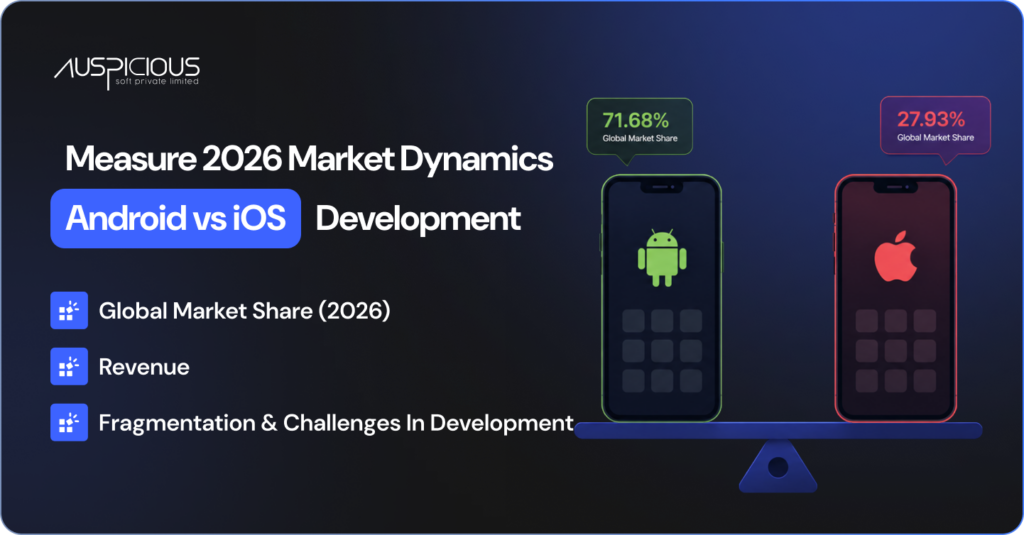
In 2026, Android is dominating the market globally by owing 71.68 percent mobile OS market share, whereas iOS owns 27.93 percent only. If your aim is to engage a vast user base, prefer Android. In the US, iOS leads the market with 59.31 percent, but Android holds 40 percent market share. If you want to target premium users from the US, Canada, & Australia, iOS App Development is a good choice.
Revenue
Through market share, you can measure the number of users who use each platform, but revenue metrics define the amount users spend. In this matter, iOS leads. Even though iOS holds a minimal market share, it generates $85.1 billion, whereas Android generates $49.7 billion. This difference is due to user behavior. iPhone users pay more for in-app purchases & premium plans. iOS is the winner, but Android’s massive user base can bring more downloads & ad impressions.
Fragmentation & Challenges in Development
The significant factor that differentiates Android and iOS development is device fragmentation. Android is operating on thousands of models, with their screen size, OS version, and hardware capabilities. The complication usually adds 15-20% of QA testing time. This is our custom app development, which helps to deliver immense value and make the app function across the fragmented Android ecosystem. However, it doesn’t make Android App Development a bad choice. iOS might get you there faster, but it is flexible and could be worth extra.
Market Share & User Statistics
| Parameter | iOS | Android |
|---|---|---|
| Global Market Share | 29.25% - 31.48% | 68.24% - 70.75% |
| US Market Share | 55% - 59.8% | 40% - 45% |
| India Market Share | 8% - 8% | 92% - 95% |
| China Market Share | 14% - 31% | 69% |
| Active Users Globally | 1.46 - 1.8 billion | 3.9 - 4.5 billion |
| Active Users in US | 118-125 million | 100-133 million |
| User Loyalty Rate | 88% - 94% | 89% - 91% |
Android vs iOS Development 2026 Technical Considerations
Modern mobile app development is not about the best OS but the right architecture. Here are some technical considerations to make-
Cross-Platform Frameworks
Many companies currently avoid this dilemma, “what to choose,” by building both at the same time. When you partner with the renowned companies, they use a single codebase for both platforms. 46% of mobile apps are now leveraged with Flutter and React Native. Following this approach helps you to cut down the development time by 40%. Startups that want to perform best can choose this approach.
Integration with AI and Smart Agents
We are relying on the environment-reliant smart app. Currently, the maximum number of apps developed in 2026 are leveraged with AI-powered personalization. By collaborating with the AI agent development company, businesses can integrate predictive search or context-aware assistants. The smart technologies have transformed the way apps are communicated with the OS of Google & Apple. The development platform choice can vary based on the AI ecosystem.
Security, Privacy, and App Store
Both platforms follow rigorous security standards. The Apple App Store follows a rigorous process that demands 24-72 hours. However, Google Play is quicker, but it needs to be secure since it is open-source. When your app works with the crucial financial data, the perceived security of the iOS ecosystem can be a significant brand benefit.
Technical Specifications
| Parameter | iOS | Android |
|---|---|---|
| Device Fragmentation | Low (limited devices) | High (hundreds of devices) |
| OS Versions to Support | iOS 17-18 (84% on latest) | Android 12-15 (70% across 3-4 versions) |
| Screen Sizes | 5-6 primary sizes | 100+ screen sizes/resolutions |
| Testing Complexity | Low to Medium | High (20-25% more testing hours) |
| 5G Device Penetration | 73.4% of active devices | 51.8% of active devices |
| Update Adoption Speed | Fast (84% on iOS 18 in 12 months) | Slow (38% on Android 15 in 12 months) |
| Average Device Lifespan | 5.5 years | 3.5 years |
| OS Update Support | Up to 6 years | ~3 years (varies by manufacturer) |
Factors Need To Be Overlooked When Choosing a Platform For Development in 2026
A successful mobile app development is more about integrating tools and having enough coding skills. During app development, developers have to focus primarily on various other factors that are mentioned below. These tips help to decide which platforms go well in 2026.
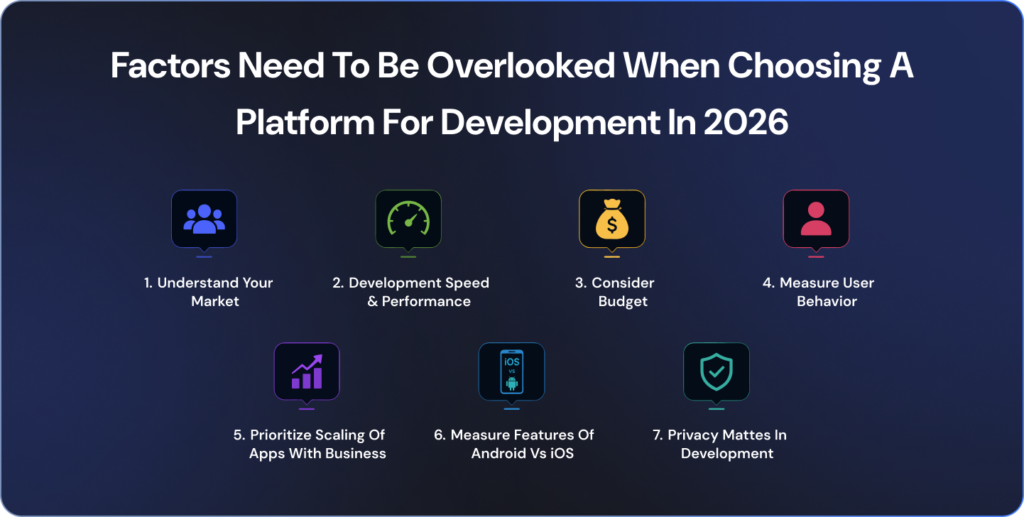
Understand Your Market
Discuss the market you want to target, the requirement of the audience, and their geographical locations. If your targeted users are from Australia, America, and Japan, then iOS must be your first choice. These regions have the highest incomes, and users are likely to spend money on apps & subscriptions.
Hire an iOS app developer if you are building for professional and enterprise clients. On the other hand, Android App Development is a good choice if you are going to target regions such as Africa, Asia, India, and Europe. These regions hold a wide number of Android users.
Development Speed and Performance
Your timeframe, budget, & development team expertise matter for deciding which platform to start with. If your aim is to quickly release your product in the market, then iOS is the best choice. The app store review process is predictable and takes almost 2 days. Most of the iPhone users update to the upgraded version quickly, making maintenance easier.
However, the Android platform is flexible, and its development environment works smoothly. It allows your team to have better options for development with whatever tools they prefer. Deployment is also cost-effective in Android apps. App reviews are mostly approved within hours, so updates are faster. The Android platform gives more freedom to design and distribute.
Consider Budget
The development budget for iOS is $80,000 – $250000, which may fluctuate based on complexities. Developing an Android app falls within a similar range for initial development. However, because of vast devices & OS versions, these apps often come with 15-20% of high maintenance costs. If your plan is to develop an app for both platforms, then the cost might increase.
Measure User Behavior
Android and iOS users behave differently, which can affect the product strategy. iOS users are more engaged with the premium apps, upgrade to new features, and seek a streamlined user experience. There are fewer chances that they will switch platforms once they find it. At the same time, Android users are more diverse.
Android apps are comfortable with customization, allow free and paid models, and come with a wide range of demographics. Most Android users rely on their devices as their primary computing devices. It means they are open to trying new apps to explore a fresh experience. If you want a premium engagement, iOS is a good fit. If you want to target a global audience and run ad-supported models, choose Android.
Prioritize Scaling of Apps With Business
Most successful apps don’t stay on a single platform, so your decision must fit with the long-term plan. If you seek to validate your idea with high-value users without scaling, choose iOS. It’s ideal for premium markets & engages paying users early. It’s a smart move if your app depends on premium pricing, subscription, and high-margin transactions.
Most of the startups hire iOS developers to design an MVP that appeals to investor enterprise clients. Choose Android if you prioritize user growth and reach. If your business model depends on scale, network effects, and a social platform marketplace, choose Android. Make a decision that supports your business vision.
Measure Features of Android vs iOS
The iOS and Android App Development have similar functionalities, but a few differences. When businesses understand these challenges, they can decide which option better aligns with their project. Ultimately, the end choice is based on the target audience, strategies, & firm vision. Most of the leading businesses develop apps for both platforms to drive their market reach. However, you can choose a platform that best aligns with the priorities.
Privacy Matters in Development
Privacy is a necessary factor that influences the choice of developers and users’ decisions. Consider the data protection regulations when deciding what to choose. Understanding Android and iOS security and how they manage privacy matters. It can significantly impact an app’s compliance demands, user trust, and development cost.
API automation, QA, and security validations are necessary considerations during development. iOS follows a locked-down practices that limit functionality, but safeguards users. Android delivers better flexibility & allow freedom to developers to integrate strong privacy practices.
App Store & Distribution
| Parameter | iOS App Store | Google Play Store |
|---|---|---|
| Total Apps Available | 2.12 million | 2.21 million |
| App Approval Time | 24 hours | 2 hours |
| Approval Process | Strict, quality-focused | More lenient |
| App Review Guidelines | Very strict | Moderate |
| Paid Apps Percentage | 4.66% | 3.04% |
| Commission on In-App Purchases | 30% (15% after year 1 for subscriptions) | 30% (15% after year 1 for subscriptions) |
| Sideloading Support | Limited (EU only via DMA) | Supported |
Looking To Build An App For Your Next Project?
Deciding between Android & iOS mobile app development means choosing the accurate platform that fits with the target audience, app demands, & business goals. If you want to build a premium app with paid features and subscriptions in regions like the UK, US, iOS is the premium choice.
iOS offers higher revenue potential and a streamlined development process. The strict regulations and privacy policies also make this good for apps managing crucial data. If your aim is to develop a market and target the emerging markets like Asia, Africa, and India, choose Android. It has a massive global audience, allowing better flexibility and multiple distribution channels. It is well compatible with the supported models and apps that demand extensive customization.
If your budget allows, you can develop the apps for both platforms. Choose mobile app testing tools throughout the development process to ensure quality across every platform. If you are still in doubt about what to choose, talk with the best mobile app development company today. The professional experts will evaluate your demands and prepare a blueprint.
FAQs
Q: Should I build my app for iOS or Android first in 2026?
The choice between iOS and Android can fluctuate due to various factors. The audience you target, business vision, and your budget decide a lot. iOS could be great if you want to engage premium users or markets such as Europe and the US. However, Android works better for a vast reach. Startups can choose one platform first for ideal validation and then expand it. Businesses can prefer cross-platform app development to grab the audiences of both platforms simultaneously.
Q: What are the biggest technical challenges of Android development compared to iOS?
For Android apps development, it creates challenges such as device fragmentation, as apps must perform across multiple hardware, screen sizes, & OS configurations. Testing becomes more complicated compared to the iOS-controlled ecosystem. In Android platforms, UI consistencies and performance optimizations can be tough. In addition, security gaps and delayed OS updates on a few devices demand additional attention. These factors make Android development more resource-intensive than iOS.
Q: What is the difference between iOS and Android app development in 2026?
The iOS app development in 2026 prioritizes a seamless process. It verifies a consistent user experience and platform. Android development delivers flexibility with various programming languages. However, it demands diverse device management. iOS apps can be developed quickly and tested, whereas Android apps can reach a broader audience. Well, both platforms support advanced tools & technologies.
Q: How much does it cost to develop an iOS app vs an Android app in 2026?
The designing & development budget for both platforms is similar, might be approx. $10,000 to $150,000 based on features and challenges. The Android app might cost slightly due to additional testing & device compatibility demands. Maintenance costs also differ as Android apps might demand frequent updates. Cross-platform frameworks can minimize overall costs by sharing code across both platforms.
Q: Which platform generates more app revenue — iOS or Android in 2026?
The iOS platform generates high revenues through in-app purchases and subscriptions because of the user base’s spending capacity. The Android platform is raising the market due to the highest downloads & engagement. In 2026, iOS remains profitable for users, whereas Android delivers scale & ad-based monetization opportunities. The right selection is based on the monetization strategies.
Q: Which platform is better for launching a startup app in 2026?
To launch a startup app, the best platform depends on the market goals. iOS is preferred for quick MVP launches, improved monetization, and a controlled environment. Android is good for businesses that want to reach a vast audience quickly in regions like Asia. Most of the startups begin with iOS for validating ideas, and then they expand their reach to Android.
Do not Miss Our Latest Tech Insights
Stay one step ahead in the fast-moving world of AI and technology. Add us as a Preferred Source on Google and get our latest articles, guides, and industry insights delivered straight to your search feed.