+1 740 762 6496
 +91 70189 46603

TABLE OF CONTENT
- Logistics App Cost
- Cost by App Type (Detailed Breakdown)
- Factors Influencing Logistics App Development Costs
- Build vs Buy Comparison Table
- Cost Breakdown of Logistics App Development
- Hidden Cost Factors in Logistics App Development
- Logistics App ROI — Does the Investment Make Sense?
- Technologies Driving Logistics Apps in 2026
- Logistics App Cost by Feature Set
- Advantages of a Logistics Software Development Company
- Key Features Every Successful On-Demand Delivery App Should Have
- Logistics App Tech Stack Table
- Cost-Saving Tips for Logistics App Development
- Conclusion
- FAQs
Overview
- The global logistics software market will reach $14.1 billion by 2027, driven by last-mile delivery demands, e-commerce fulfilment complexity, and real-time supply chain visibility requirements. In 2026, every logistics operation without a purpose-built app is operating at a structural disadvantage against competitors that do.
- But logistics app development costs vary enormously by type. A simple delivery tracking app — showing drivers their next drop and customers their parcel location — costs $20,000–$50,000. A full freight marketplace connecting shippers with carriers, with dynamic pricing and ELD compliance, costs $200,000–$350,000. The difference is not just scale: it is the specific backend complexity, regulatory requirements, and real-time data infrastructure each type demands.
- This guide breaks down logistics app development costs by app type, explains the hidden costs most guides ignore, analyses the ROI case, and provides the recommended 2026 tech stack.
The logistics industry is undergoing a transformational evolution due to the developments in technology and increasing consumer expectations. With on-demand delivery apps, businesses from all sectors try to meet the need for speed, efficiency, and transparency in logistics operations. It is, therefore, important to know the cost dynamics of logistics app development in 2026 for those looking to invest in logistics software. This article gets into the dynamics of cost determination and gives insight about how a company can partner up with a strong logistics software development company to maximize ROI.
With increased e-commerce adoption, the criticality of appropriate logistics solutions would be more pivotal. Customers, today, also expect delivery without any hassles, real-time tracking, swift resolution of issues with the help of cutting-edge technology. On-demand delivery apps have changed the face of last-mile logistics. Companies are able to satisfy the demands of their customers, all while maximizing their resources. Building such apps would necessitate understanding the costs associated with them and the benefits of using a dedicated logistics software development company. Businesses focusing on innovative features and user-centric designs can develop impactful solutions that drive growth and operational excellence.
Logistics App Cost
| App Type | Complexity | Cost Range | Timeline | Main Technical Challenge |
|---|---|---|---|---|
| Delivery Tracking App | Low–Medium | $20,000 – $50,000 | 2–4 months | Real-time GPS updates + push notifications |
| Last-Mile Delivery App (3 panels) | Medium | $40,000 – $90,000 | 3–6 months | Route optimisation + customer, driver, admin panels |
| Fleet Management App | Medium | $60,000 – $140,000 | 4–8 months | Telematics integration + vehicle data APIs |
| Warehouse Management App | Medium–High | $70,000 – $160,000 | 5–8 months | Barcode/RFID scanning + inventory logic |
| Freight Marketplace App | High | $120,000 – $250,000 | 7–12 months | Dynamic pricing engine + carrier matching |
| Full Supply Chain Platform | Very High | $200,000 – $350,000+ | 10–18 months | ERP integration + full compliance modules |
Cost by App Type — Detailed Breakdown
Delivery Tracking App — $20,000 to $50,000
A delivery tracking app shows customers real-time parcel location and delivery status, and gives drivers a daily manifest with turn-by-turn navigation. This is the simplest logistics app type — functionally similar to the tracking component in a FedEx or UPS app, built as a standalone product for a regional courier. Core cost components: Customer-facing app (iOS + Android) — $12,000–$20,000. Driver app — $8,000–$14,000. Backend API with GPS update engine — $6,000–$12,000. Admin dashboard — $4,000–$8,000. QA, project management, and App Store submission: $4,000–$8,000. Total: $20,000–$50,000. Real-world reference: Regional couriers and 3PL companies building their first customer-facing tracking tool fall in this range. The technical constraint is real-time GPS polling at the right frequency — too frequent and API costs spike; too infrequent and the map lags for customers.
Last-Mile Delivery App — $40,000 to $90,000
Last-mile delivery apps — the driver-facing equivalent of DoorDash Dasher or a regional courier platform — require three separate panels: customer app, driver/courier app, and dispatcher/admin dashboard. The driver app includes live route optimisation, proof-of-delivery capture (photo and signature), earnings tracking, and a communication channel with dispatch. The dispatcher panel handles order assignment, live fleet tracking, and exception management. The cost jump from a simple tracking app to a three-panel last-mile product comes primarily from the real-time matching engine, route optimisation API integration, and the added complexity of the driver app (which must work reliably in poor connectivity areas with offline fallback). Real-world reference: Platforms like Lalamove, Bringg, and Onfleet operate in this space. A competitive MVP starts around $40,000–$55,000. Adding a white-label customer app, driver earnings dashboard, and full admin reporting pushes to the $70,000–$90,000 range.
Fleet Management App — $60,000 to $140,000
Fleet management apps go beyond delivery tracking to include vehicle health monitoring (tyre pressure, fuel level, engine diagnostics via OBD-II API), driver behaviour scoring (harsh braking, speeding, idle time), maintenance scheduling, and regulatory compliance documentation. The telematics hardware integration — connecting to GPS trackers and OBD-II devices installed in vehicles — is the primary technical complexity driver. Key integrations: Samsara or Geotab API (telematics data), Google Maps Platform (routing and geofencing), Twilio (driver SMS alerts), and ELD compliance modules for US interstate trucking fleets. Fleet apps must also handle data retention, exportable logs for driver hour compliance, and in some cases DVIR (Driver Vehicle Inspection Report) workflows.
Freight Marketplace App — $120,000 to $250,000
A freight marketplace connects shippers (businesses with goods to move) with carriers (trucking companies and owner-operators). This is the logistics equivalent of building Uber — but for freight. The technical complexity includes dynamic pricing engines (lane-based market rates), carrier vetting and compliance verification (FMCSA SAFER database checks), DOT number validation, load board integration, and often payment advance (factoring) functionality. Real-world reference: Convoy (acquired 2023) raised $260M building this type of platform. A competitive MVP with basic load matching, carrier profile verification, GPS tracking, and payment processing typically starts at $120,000–$150,000. Full platform with mobile apps for shippers and drivers, a web dispatch portal, and automated compliance checks runs $200,000–$250,000.
Factors Influencing Logistics App Development Costs
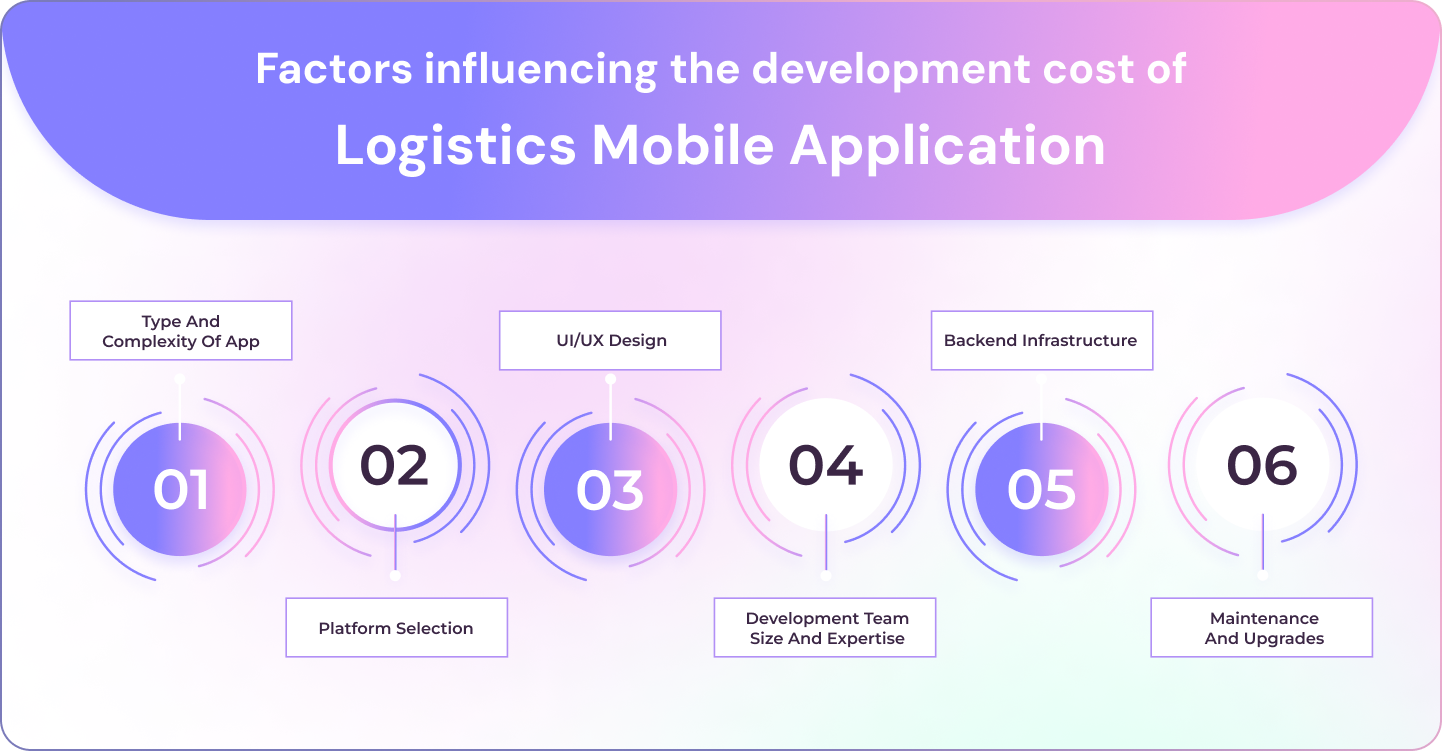
Several factors affect the cost of developing a logistics app in 2026. Here is the detailed breakdown:
1. Type and Complexity of App
The logistics apps could be as simple as a basic fleet tracking tool to complex on-demand delivery apps that provide real-time tracking, optimized routes, and advanced analytics. The cost mainly depends on the complexity of features that the app is supposed to offer:
Simple Apps: GPS tracking, simple reporting, user authentication.
Mid-Level Apps: Include route optimization, in-app communication, and real-time notifications.
Advanced Apps: Feature AI-driven predictive analytics, multi-language support, and integration with IoT devices for live monitoring.
2. Platform Selection
Will your app be available on Android, iOS, or both? Native apps (built specifically for one platform) typically cost more than cross-platform apps. With the rise of frameworks like Flutter and React Native, many businesses opt for cross-platform solutions developed by a seasoned logistics software development company to save time and costs.
3. UI/UX Design
A good app design guarantees the satisfaction and retention of users. Even though it would be expensive, an intuitive and aesthetically pleasing design would be worth every penny in terms of successful on-demand delivery apps.
Build a Logistics App That Pays for Itself — Get a Free Cost Estimate
See real pricing for delivery, fleet & freight apps plus ROI data — then get a custom quote tailored to your fleet size.4. Development Team Size and Expertise
The development team’s makeup—comprised of developers, designers, project managers, and quality assurance specialists—plays a role in cost. A development company with significant experience in logistics software will effectively manage the project and produce excellent results.
5. Backend Infrastructure
The backend of the app is the one that will be dealing with the database, user interactions, and third-party integrations. High-end backend systems with powerful APIs and cloud infrastructure drive up the development cost.
6. Maintenance and Upgrades
Post-launch maintenance is the process of ensuring the app works flawlessly. This includes updates, bug fixes, and feature enhancements in the overall budget.
Build vs Buy Comparison Table
| Option | Upfront Cost | Ongoing Cost | Customization | Best For |
|---|---|---|---|---|
| Custom Development | $50K–$200K | $10K–$30K/year | Unlimited | Enterprises with unique workflows |
| SaaS (Onfleet, Bringg) | $0–$1K setup | $500–$5,000/month | Limited to vendor | SMBs needing fast deployment |
| White-Label Solution | $10K–$30K | $200–$2,000/month | Moderate | Mid-market with brand needs |
| Open Source (customized) | $5K–$20K dev cost | $5K–$15K/year maintenance | High | Tech-savvy teams with dev resources |
Cost Breakdown of Logistics App Development
To make things clearer, let’s break down the cost into major components:
1. App Development
The cost of the app development varies greatly considering the complexity and features of the app. Basic apps with fewer functionalities are cheap but may not fulfill the demand of an escalating business. Mid-level apps come in between costs and functionalities such as GPS tracking, route optimization, and the facility of providing reminders.
| Name | Basic Features | Mid-Level Features | Advanced Features |
|---|---|---|---|
| App Development | $10,000 - $30,000 | $30,000 - $70,000 | $70,000 - $150,000 |
Advanced apps are suitable for large-scale operations featuring AI-driven analytics, IoT integration, real-time updates to enhance efficiency and user satisfaction.
2. UI/UX Design
Investment in UI/UX design is a must to retain users and ensure the app’s success. A basic design is suitable for simple apps that include the main layouts and interfaces. However, for an excellent user experience, customized designs based on your brand identity and user preference are worth extra money.
| Name | Basic Design | Custom Design |
|---|---|---|
| UI/UX Design | $2,000-$7,000 | $8,000-$20,000 |
3. Platform Costs
It has to be said that the decision of single-platform and cross-platform development affects the total cost. With cross-platform applications, built on frameworks like React Native, you can reach more users with lower costs compared to the development of different native applications for Android and iOS. It’s especially valuable for startups and small businesses.
| Name | Single Platform (Android or iOS) | Cross-Platform |
|---|---|---|
| Platform Costs | $10,000-$50,000 | $20,000-$60,000 |
4. Backend Development
A strong backend will give a smooth execution and integration of third-party systems. Although a bare minimum backend suffices for tiny applications, full-fledged backends with API and cloud power are necessary in order to conduct complex logistics-related operations and guarantee scalability.
| Name | Simple Backend | Advanced Backend with APIs |
|---|---|---|
| Backend Development | $5,000-$15,000 | $20,000-$50,000 |
Hidden Cost Factors in Logistics App Development
GPS Infrastructure and Real-Time Location API Costs
Real-time GPS tracking is not free at scale. Google Maps Platform charges per API call — Maps SDK, Directions API, and Distance Matrix API are each billed separately. A fleet management app tracking 200 vehicles with 30-second GPS updates generates approximately 16,000 API calls per hour. At $0.005 per call, that equals $80/hour — or $57,600/month in map API costs alone. This is why serious logistics apps at scale switch to HERE Technologies or TomTom, which offer better per-request pricing at high volumes.
Route Optimisation API Costs
Basic A-to-B directions are cheap. Multi-stop route optimisation for 20+ delivery drops — required for any last-mile delivery driver app — requires specialised APIs like Routific ($49–$299/month), OptimoRoute ($49–$249/month), or Google’s Fleet Routing API (usage-based). Building a proprietary optimisation engine to avoid these fees adds $30,000–$80,000 in development cost but may be worthwhile at large enough delivery volume.
ELD Compliance for US Interstate Trucking
US interstate trucking fleets are legally required to use FMCSA-compliant Electronic Logging Devices (ELD). If your fleet management app serves commercial vehicles on interstate routes, ELD integration is a federal compliance requirement — not optional. ELD integration adds $15,000–$40,000 in development cost and requires certification testing. Ignoring this and then retrofitting it post-launch typically costs twice as much.
Third-Party API Subscriptions (Ongoing Monthly Costs)
A production logistics app typically requires 4–8 external API subscriptions that are absent from most developer quotes: telematics hardware APIs ($20–$100/vehicle/month), address validation and geocoding (Loqate or SmartyStreets at $50–$200/month), freight rate APIs for dynamic pricing (usage-based), weather APIs for route risk assessment, and SMS notification services (Twilio at approximately $0.0075/message). These recurring costs should be modelled before committing to the business case.
Compliance and Insurance Integration
Freight marketplace apps operating in the US must verify carrier operating authority via the FMCSA SAFER database, insurance certificate currency ($750,000 minimum liability for general freight), and cargo insurance. Building an automated compliance verification workflow — checking carrier credentials in real time before allowing them to accept loads — adds $20,000–$35,000 in integration development. It is consistently underestimated during initial scoping.
Logistics App ROI — Does the Investment Make Sense?
| ROI Metric | Typical Improvement | Business Basis |
|---|---|---|
| Fuel Cost Reduction | 8–15% | Multi-stop route optimisation eliminates unnecessary mileage per driver per day |
| Delivery Capacity Increase | 20–35% | Better dispatch and driver utilisation enables more deliveries per vehicle per shift |
| Failed Delivery Rate | Reduced 30–60% | Real-time ETA alerts and customer reschedule links dramatically reduce missed deliveries |
| Customer Support Cost | Reduced 40–50% | Self-service tracking adoption means fewer inbound 'where is my order' support calls |
| Driver Idle Time | Reduced 25% | Telematics monitoring and optimised routing reduce unproductive time between jobs |
| Payback Period | 12–24 months | Validated across Auspicious Soft logistics client portfolio — fleet size dependent |
Technologies Driving Logistics Apps in 2026
The cost of logistics app development is also determined by the integration of emerging technologies:
1. Artificial Intelligence (AI)
AI enhances decision-making by predicting delivery times, optimizing routes, and forecasting demand. While integrating AI adds to the cost, it significantly improves operational efficiency.
2. Internet of Things (IoT)
IoT devices monitor vehicle conditions, track shipments, and provide real-time updates. Developing IoT-compatible logistics apps involves additional investment but offers unmatched transparency and control.
3. Blockchain
Blockchain ensures tamper-proof records for supply chain transactions. Inclusion of blockchain features incurs additional development costs but reduces fraud and increases trust.
4. Cloud Computing
Cloud-based logistics apps ensure scalability and real-time access to data. Collaboration with a logistics software development company that has experience in cloud integration can ensure the best possible cost optimization without compromising on reliability.
Build a Logistics App That Pays for Itself — Get a Free Cost Estimate
See real pricing for delivery, fleet & freight apps plus ROI data — then get a custom quote tailored to your fleet size.5. Big Data Analytics
Advanced analytics help in generating actionable insights regarding performance metrics and customer behavior, thereby ensuring data-driven decisions.
Logistics App Cost by Feature Set
| Feature | Technology Used | Dev Hours | Cost Estimate (USA) |
|---|---|---|---|
| Real-Time GPS Tracking | Google Maps API / HERE Maps / Mapbox | 80–120 hrs | $8,000–$24,000 |
| Route Optimization Engine | Google Directions API, AI routing ML | 100–200 hrs | $10,000–$40,000 |
| Driver Mobile App (iOS+Android) | React Native or Flutter (cross-platform) | 200–350 hrs | $20,000–$70,000 |
| Dispatcher Web Dashboard | React.js, Node.js backend | 150–250 hrs | $15,000–$50,000 |
| In-App Communication | Twilio, Sendbird | 40–80 hrs | $4,000–$16,000 |
| Push Notifications | Firebase Cloud Messaging | 20–40 hrs | $2,000–$8,000 |
| Analytics & Reporting | Custom dashboard + data warehouse | 60–120 hrs | $6,000–$24,000 |
| IoT Integration (sensors) | MQTT protocol, AWS IoT Core | 100–200 hrs | $10,000–$40,000 |
Advantages of a Logistics Software Development Company
Creating logistics apps demands expertise in multiple domains. Partnering with a trusted logistics software development company has several benefits:
1. Customized Solutions
An expert team makes sure that the app is created according to your business needs. It could be fleet management or on-demand delivery apps.
2. Cost-Effective Development
Experienced developers use their skills to optimize the process, hence reducing the time and cost of developing the app.
3. Scalability
A professional logistics software development company designs applications that can scale with your business.
4. System Upkeep
Maintenance, upgrades as well as continued support to ensure your app stays competitive.
Key Features Every Successful On-Demand Delivery App Should Have
On-demand delivery apps should provide features to enhance the user experience. Here is a must-have functionality for an on-demand delivery app.
1. Real-time tracking
Users should be able to track the shipments and deliveries in real-time. This increases the level of transparency.
2. Route Optimization
Makes use of AI to find the best delivery routes for time and fuel cost savings.
3. Multi-Language Support
It is the most important factor for reaching the global audience.
4. Payment Integration
Multi-payment options make it easy to use.
5. Feedback and Ratings
Helps users leave feedback, allowing businesses to upgrade their services.
6. Inventory Management
Stock levels are monitored, and when low, alerts for replenishment.
Logistics App Tech Stack
| Component | Technology | Purpose | Monthly Cost |
|---|---|---|---|
| Mobile — Driver app | React Native | Cross-platform driver app — GPS, navigation, proof-of-delivery, offline mode | Open source |
| Mobile — Customer app | React Native or Flutter | Order tracking, push notifications, delivery rating, reschedule | Open source |
| Maps — Low volume | Google Maps Platform | Standard mapping, directions, geocoding for smaller fleets | $200–$600/mo |
| Maps — High volume | HERE Technologies | Better pricing at 10,000+ daily location tracking API requests | Per-request pricing |
| Route Optimisation | Routific or OptimoRoute | Multi-stop delivery route optimisation algorithms | $49–$299/mo |
| Real-Time Backend | Node.js + Socket.io | WebSocket-based live location broadcasting to all clients | Open source |
| Database | PostgreSQL + Redis | PostgreSQL for orders and routes; Redis for live location cache | $50–$200/mo hosting |
| Push Notifications | Firebase Cloud Messaging | Driver job alerts and customer delivery notifications | Free |
| Payments | Stripe | Driver earnings, customer payments, marketplace transaction splits | 2.9% + $0.30/txn |
| Telematics | Samsara or Geotab API | Vehicle data, ELD compliance, driver behaviour scoring | $15–$45/vehicle/mo |
Cost-Saving Tips for Logistics App Development
While logistics app development can be costly, the following strategies can help optimize your budget:
1. Start Small
Begin with a Minimum Viable Product (MVP) to test the market and gather user feedback before investing in additional features.
2. Opt for Cross-Platform Development
Using frameworks like Flutter or React Native reduces development time and costs by creating a single app for both iOS and Android.
3. Choose an Experienced Partner
Work with a logistics software development company that has a track record of successful high-quality solutions.
4. Prioritize Must-Have Features
Features that fit within your business model and are capable of generating value quickly
Conclusion
The cost of logistics app development in 2026 depends upon several factors like the complexity of the application, the platform for which it will be developed, and technology integrations. Starting from basic to more advanced applications like on-demand delivery with AI and IoT integration may range from $20,000 to over $150,000. With the help of a trusted logistics software development company, you get your customized and scalable solution according to your requirements.
Businesses will be able to enhance operational efficiency, improve customer satisfaction, and gain a competitive edge in the fast-evolving logistics landscape with investment in a logistics app. Strategic planning is a must, prioritize the essential features, and have the right partnership that can bring the vision to reality.
FAQs
Q: How much does a logistics app cost to build in 2026?
Logistics app costs range from $20,000 for a simple delivery tracking app to $350,000+ for a full freight marketplace or supply chain platform. The most common logistics apps — last-mile delivery with three user panels (customer, driver, admin) — typically cost $50,000–$100,000. Cost is primarily driven by the number of user panels, real-time GPS requirements, route optimisation complexity, and regulatory compliance needs.
Q: What is the most expensive part of building a logistics app?
The three biggest cost drivers are: real-time GPS infrastructure (location updates at scale generate significant API costs), multi-panel architecture (customer app plus driver app plus admin dashboard is effectively three separate apps sharing one backend), and route optimisation (multi-stop algorithms require specialised third-party APIs or expensive custom development). ELD compliance for US interstate trucking adds $15,000–$40,000 on top of core development.
Q: Can a logistics app work without an internet connection?
Yes — and offline capability is often critical for logistics apps used in warehouses, rural delivery routes, and cargo depots with poor signal. We build offline-first logistics apps using Core Data on iOS and Room on Android for local data storage, with automatic background sync when connectivity is restored. Designing for offline adds 15–25% to development cost but is essential for professional logistics deployments.
Q: What is the ROI of a logistics app for a delivery business?
Logistics apps typically achieve payback within 12–24 months. The most reliable ROI drivers are: 8–15% fuel cost reduction through route optimisation, 20–35% increase in deliveries per vehicle through better dispatch, 30–60% reduction in failed deliveries through real-time customer communication, and 40–50% reduction in customer support costs through self-service tracking. The business case is strongest for fleets of 20+ vehicles with daily delivery volume above 100 drops.
Q: How long does logistics app development take?
Simple delivery tracking apps take 2–4 months. Full last-mile platforms with three panels take 4–7 months. Fleet management apps with telematics integration take 5–9 months. Freight marketplaces with carrier matching and compliance verification take 8–14 months. These timelines include design, development, QA, and App Store or Google Play submission but do not include MLS or telematics hardware procurement time.
Do not Miss Our Latest Tech Insights
Stay one step ahead in the fast-moving world of AI and technology. Add us as a Preferred Source on Google and get our latest articles, guides, and industry insights delivered straight to your search feed.