+1 740 762 6496
 +91 70189 46603


TABLE OF CONTENT
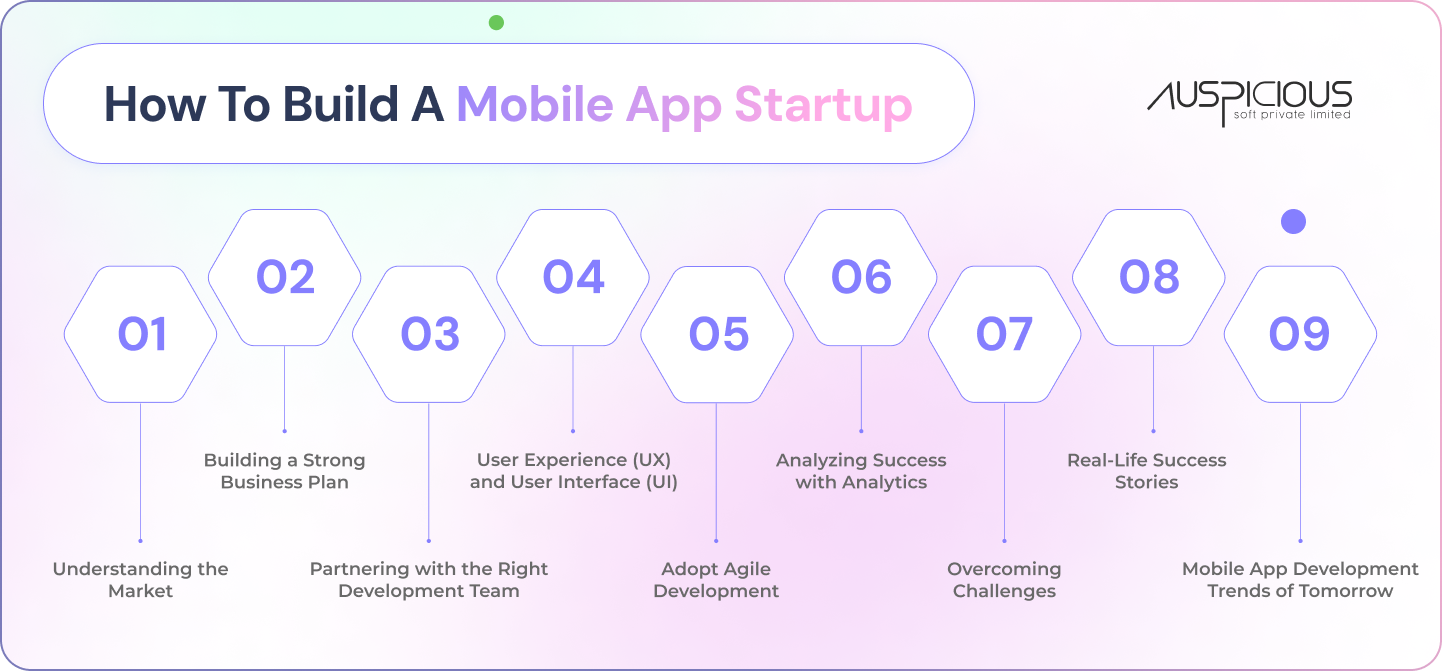
- Building a Mobile App Startup: Vital Strategies for Success
- Understanding the Market
- Building a Strong Business Plan
- Partnering with the Right Development Team
- User Experience (UX) and User Interface (UI)
- Adopt Agile Development
- Analyzing Success with Analytics
- Overcoming Challenges
- Real-Life Success Stories
- Mobile App Development Trends of Tomorrow
- Conclusion
- FAQs
The world of mobile apps is flourishing: new startups pop up in every corner of the globe daily, but not all of them bring success. Building a mobile app startup requires more than just a good idea it demands a strategic approach, as well as careful planning. And sometimes, a certain partnership makes all the difference in turning your vision into a successful reality, like for example working with the best mobile app development company USA or custom software development companies.
77% of mobile apps are abandoned after first use. Only 0.5% of consumer apps achieve significant financial success. However, startups that follow structured product development methodology are 3.5x more likely to survive their first 3 years than those that build without validation.
Understanding the Market
Market research for mobile app startups in 2026 is faster, cheaper, and more rigorous than ever before — and skipping it is the single highest-cost mistake early-stage founders make. 42% of failed startups cite ‘no market need’ as their primary failure reason (CB Insights), meaning the most common way to waste a $50,000-150,000 development budget is to build something nobody actually wants. Before engaging any development company, founders should complete three validation activities: competitor analysis (download and use the top 5 apps in your category, document their reviews and 1-star complaints — that gap IS your product opportunity), user interviews (minimum 15 conversations with your target persona using structured discovery questions), and landing page validation (build a simple page describing your app’s core value proposition and run $500 in paid traffic to measure conversion intent).
Turn Your App Idea Into a Funded, Scalable Startup
Get a free consultation on MVP strategy, tech stack, and budget — built on 200+ successful app launches.Identify Your Target Audience:
Identify the demographics, geographic, and behavior of your target users.
Analyze Competitors:
Study apps similar to yours and their strengths and weaknesses. Study the reviews from the user side as well. This helps you know what works and what doesn’t.
Analyze Market Trends-:
Monitor trends in technology, users’ preferences, and industry trends. Your app should reflect these and be innovative for its time.
Building a Strong Business Plan
A mobile app startup business plan differs fundamentally from a traditional business plan because the unit economics are driven by metrics that traditional plans do not address: customer acquisition cost (CAC), lifetime value (LTV), day-1/day-7/day-30 retention rates, and monthly active user growth trajectory. These metrics determine whether your app business is viable before you raise a dollar of external capital. Investors in 2026 are looking for at minimum a 3:1 LTV:CAC ratio, a Day-30 retention rate above 15% (the median for consumer apps), and a realistic path to 10,000 monthly active users before asking for Series A capital. Your business plan should model these metrics explicitly and show how your product decisions drive improvement in each.
App Concept:
Define the purpose, features, and benefits of your app clearly.
Revenue Model:
Decide how you will generate income through subscriptions, advertisements, in-app purchases, or a freemium model.
Marketing Strategy:
Outline how you will promote your app to attract and retain users.
Budget and Resources:
Estimate the costs of development, marketing, and maintenance and ensure that you have the necessary funding.
Partnering with the Right Development Team
The success of a mobile app is directly related to its quality and usability. With the most advanced mobile app development companies in the USA, there will be high-quality outputs, and it will catch the attention of your target users. Here’s why:
Experienced Diverse Technological Expertise
It includes the expertise of cutting-edge technologies such as Artificial Intelligence (AI), Machine Learning (ML), Augmented Reality (AR), and Internet of Things (IoT), etc.
You can create an app that best suits your business goals and objectives by working with a company that specializes in custom software development.
Scalability and Flexibility
Highly professional developers design the apps to grow with your business, adding new features or meeting increased user demands as they arise.
Post-launch Support
A good development company will provide ongoing maintenance and updates to keep your app running and competitive.
User Experience (UX) and User Interface (UI)
The first step in retaining users would be intuitive and aesthetically pleasing design. Even the most innovative apps are bound to fail if they lack proper UX/UI. So focus on:
Simplicity: The app should not contain unnecessary clutter and be user-friendly.
Consistency: All app screens must uniformly have design elements so the user has a coherent experience.
Responsiveness: Optimize for various devices and screen sizes to cater to a greater audience.
Feedback Mechanisms: Integrate functionalities to facilitate user feedback and help you improve.
Adopt Agile Development
Agile development methodology is not just a project management approach for mobile app startups — it is a fundamental risk management strategy. Traditional waterfall development (plan everything, build everything, test everything, launch everything) is catastrophically expensive for startups because you only discover that users do not want Feature X after spending 6 months and $80,000 building it. Agile development in 2-week sprints means you are getting real user feedback on working software every 14 days — allowing course corrections before small wrong turns become budget-destroying pivots. Startups using agile development are 28% more likely to ship on time and 37% more likely to meet user expectations at launch than those using waterfall approaches.
Act Promptly in Response to Changes
Agile will make it easy to react to feedback from users and market trends.
Give More Rapid Results
The breaking down of the development process into several phases allows for quicker release and update processes.
Improve Collaboration
Proper communication between developers, stakeholders, and users ensures that everyone is aligned with the project goals.
Marketing Strategy
Building a great app is only half the battle. Success requires a robust marketing strategy. Here are some essentials:
App Store Optimization (ASO):
Optimize your app’s title, description, keywords, and visuals to improve its visibility and ranking in app stores.
Social Media Marketing:
Build and increase awareness through platforms such as Instagram, Twitter, and LinkedIn.
Influencer Marketing:
Partner with influencers in your niche to reach a larger audience.
Content Marketing:
Use blogging, videos, and tutorials highlighting the features and benefits of your app.
Paid Advertising:
Leverage targeted ads on search engines and social media platforms that drive downloads and increase the overall visibility of your app.
Analyzing Success with Analytics
Tracking your app’s performance is essential for continuous improvement. Utilize analytics tools to monitor:
User Acquisition:
Assess how users discover your app and which channels drive the most downloads.
Engagement Metrics:
Measure time spent in the app, user retention rates, and feature usage to understand user behavior.
Revenue Generation:
Analyze the effectiveness of your revenue model and identify opportunities to increase income.
Feedback and Ratings:
Pay close attention to user reviews and ratings to address concerns and improve satisfaction.
Overcoming Challenges
Building a mobile app startup is not without its challenges. Some of the common ones include:
Funding Constraints:
Get funding from investors, grants, or crowdfunding platforms for development and marketing purposes.
Competition:
Make your app unique by focusing on features that no one else has, and give your users an experience that no one else can beat.
Technical Issues:
Ensure that your app is robust and free of bugs by hiring a custom software development company.
User Retention:
Introduce loyalty programs, periodic updates, and tailored experiences to ensure the user is not losing interest.
Real-Life Success Stories
Most of the successful mobile app startups have begun with a strategic approach and right partnerships. For instance,
Airbnb
Identifying a gap in the travel industry and focusing on user-friendly design, Airbnb changed the game for short-term rentals.
This was initially a simple photo-sharing application, but innovative features and scalability transformed it into a global phenomenon.
Zoom:
It prioritized simplicity and reliability, becoming a popular choice for video conferencing during the pandemic.
Mobile App Development Trends of Tomorrow
The mobile app business is continuously changing. Be ahead with these upcoming trends:
5G Technology:
Apps will deliver faster internet connectivity, bringing about smoother services like quality streaming and true-time interaction.
Artificial Intelligence (AI):
Apps made with AI can make real-time suggestions, automate repetitive functions, and improve the usability of applications.
Blockchain Integration:
Apps using blockchain technology will offer better security and transparency, especially in financial and healthcare sectors.
Augmented Reality:
AR is revolutionizing businesses such as retail, education, and gaming by offering highly interactive and engaging experiences.
Eco-Friendly Apps:
Sustainable development is gaining importance, and applications are being designed to promote eco-friendly habits and solutions.
Turn Your App Idea Into a Funded, Scalable Startup
Get a free consultation on MVP strategy, tech stack, and budget — built on 200+ successful app launches.Conclusion
Building a successful mobile app startup requires a mix of innovation, strategy, and right partnerships. Collaborating with a top mobile app development company in the USA or a custom software development company can ensure your app is designed precisely for your business needs and is scalable and competitive.
User experience, agile development, and effective marketing strategy are keys to success for startups in this dynamic world of mobile applications. The correct approach with the right tool will allow your app to create a memorable success story by translating your vision into tangible success.
FAQs
Q: How do I validate my mobile app idea before building?
Validate your app idea with three low-cost methods before spending on development:
- Build a landing page with a call-to-action (email signup, waitlist, pre-order) and run $300-500 in Facebook or Google ads to test conversion intent.
- Conduct 15-20 user interviews using structured discovery questions to verify the problem exists and your solution resonates.
- Create a clickable prototype in Figma (or no-code tool) and watch real users attempt to use it. If you get strong signals from all three, development investment is justified.
Q: What is the most common reason mobile app startups fail?
CB Insights analysis of 300+ startup failures identifies the top reasons: 42% had no market need (built something users did not want), 29% ran out of cash (underestimated development and marketing costs), 23% had the wrong team (no technical co-founder or experienced developer), 19% faced competition from better-funded incumbents, and 18% had pricing or business model issues. The top three — market need, cash, and team — are all solvable with proper preparation before development begins.
Q: Should I build a native or cross-platform app for my startup?
For 90% of mobile app startups, cross-platform development (React Native or Flutter) is the correct choice. It launches on both iOS and Android simultaneously from a single codebase, reducing development cost by 30-40% and halving your ongoing maintenance burden. Native development is only justified when your app requires advanced platform-specific hardware features (ARKit-exclusive, Core ML on-device, or complex Android hardware APIs) that cross-platform frameworks cannot access.
Q: How much funding do I need to build and launch a mobile app startup?
A realistic budget for a MVP mobile app startup in 2026: Development (cross-platform): $30,000-80,000. Design (UX/UI): $8,000-20,000. Backend & infrastructure: $10,000-30,000. App Store submission & setup: $1,000-5,000. Initial marketing/user acquisition: $15,000-50,000. Post-launch maintenance (Year 1): $15,000-40,000. Total realistic range: $80,000-$225,000 to reach 1,000 meaningful active users.
Q: How do I choose the right mobile app development partner for my startup?
Evaluate potential development partners on five criteria:
- Portfolio — have they built apps similar to yours that are live in the App Store?
- Process — Do they use agile development with regular deliverable milestones?
- Communication — Are they responsive within 24 hours and proactive about problems?
- Technical Depth — Can the lead developer explain architecture decisions clearly?
- Reference — Can they connect you with a past startup client to verify the experience?
Do not Miss Our Latest Tech Insights
Stay one step ahead in the fast-moving world of AI and technology. Add us as a Preferred Source on Google and get our latest articles, guides, and industry insights delivered straight to your search feed.