+1 740 762 6496
 +91 70189 46603


TABLE OF CONTENT
- What ADA Website Compliance Actually Means
- Why ADA Website Lawsuits Are Exploding in 2026
- Step by Step:ADA Lawsuit Cost in 2026
- ADA Remediation Cost in 2026
- Remediation Cost vs Lawsuit Cost: The Real Math
- Scan vs Overlay vs Real Fix: What Actually Protects You
- Who Gets Sued the Most
- Common WCAG Issues That Trigger Lawsuits
- How to Make Your Website ADA Compliant
- What You Get With Auspicious Soft
- FAQs
Overview
- Fixing your site is far cheaper than a lawsuit. Remediation runs $1,500 to $50,000. Lawsuits run $30,000 to $400,000 or more.
- More than 8,600 ADA website lawsuits were filed in 2025, and 2026 is on pace to break that record.
- Online stores are the top target, close to 79 percent of all cases.
- Small businesses are not safe. Most sued companies earn under $25 million a year.
- Widgets do not protect you. Scans catch only about a quarter of the issues, and overlays catch less.
- WCAG 2.1 AA is the standard courts use. Meet it, prove it, and monitor it.
AI Summary:
ADA website compliance protects US businesses from accessibility lawsuits, which topped 8,600 in 2025 and are rising in 2026. Fixing a site is far cheaper than getting sued. Remediation runs $1,500 to $7,500 for a small site and up to $50,000 for a large store, while lawsuit settlements average $30,000, court judgments $85,000, and class actions $400,000, plus heavy legal fees. Online stores face nearly 79 percent of cases, and small businesses are common targets. Accessibility overlay widgets do not protect you; only real code fixes meeting WCAG 2.1 AA do. Auspicious Soft builds accessible, compliant websites for US businesses.
How much does ADA website compliance cost in 2026, and what happens if you skip it? Short answer: fixing your site is cheap. A small site runs $1,500 to $7,500. A big store can reach $50,000. Getting sued is not cheap. Settlements average $30,000, court rulings hit $85,000, and class actions land near $400,000. Fixing wins on cost every time.
Here is the truth most owners miss. An accessible website is not a nice extra. It is legal armor. And in 2026, the people filing these lawsuits have a new weapon. They use AI to write the complaint in minutes.
This guide gives you real numbers, the traps to skip, and how to protect your site before a demand letter lands. Auspicious Soft is a custom software development company that builds accessible web platforms for US businesses, so these ranges come from real work, not a scare tactic.
| What you need | Typical cost | Timeline |
|---|---|---|
| Accessibility audit (WCAG 2.1 AA) | $2,500–$10,000 | 1–2 weeks |
| Small site remediation (<20 pages) | $1,500–$7,500 | 1–4 weeks |
| Mid-size site remediation | $7,500–$25,000 | 4–10 weeks |
| Large site / ecommerce / SaaS | $25,000–$50,000+ | 3–6 months |
| Ongoing monitoring | $200–$1,000/month | Continuous |
What ADA Website Compliance Actually Means
The Americans with Disabilities Act, or ADA, says businesses open to the public must be usable by people with disabilities. Courts now treat your website like a physical store. If a blind user cannot check out, or a keyboard user cannot open a menu, that is a barrier.
There is no separate rulebook for private business websites. Instead, courts and the government point to one standard: the WCAG guidelines. Most cases use WCAG 2.1 Level AA as the bar. It became a global ISO standard in 2025, so it is not going away.
See Exactly Where Your Site Stands
Book a free accessibility review with the Auspicious Soft team and get a clear plan.Two quick facts. ADA Title III covers most businesses that serve the public. And the government spells out how this works online in the DOJ web accessibility guidance. If you sell to US customers, this applies to you.
Why ADA Website Lawsuits Are Exploding in 2026
The numbers keep climbing. More than 8,600 ADA website lawsuits hit US businesses in 2025, and federal filings alone rose 27 percent. Mid year data for 2026 points to another record.
Three things drive it.
First, online stores are easy pickings. Retail and ecommerce make up close to 79 percent of all cases. Product filters, sliders, and checkout flows break the rules all the time.
Second, small businesses are in the crosshairs. Most sued companies earn under $25 million a year. Plaintiff firms know smaller sites settle fast and fight less.
Third, and this is the 2026 twist, AI made suing almost free. Filings by people without a lawyer jumped about 40 percent. Someone can now ask a chatbot to scan your site and draft a legal complaint in minutes. The barrier is gone.
Here is the opinion. This stopped being a big company problem. It is a volume game now, and the machine runs on autopilot. Waiting to get caught is a bad bet.

ADA Lawsuit Cost in 2026
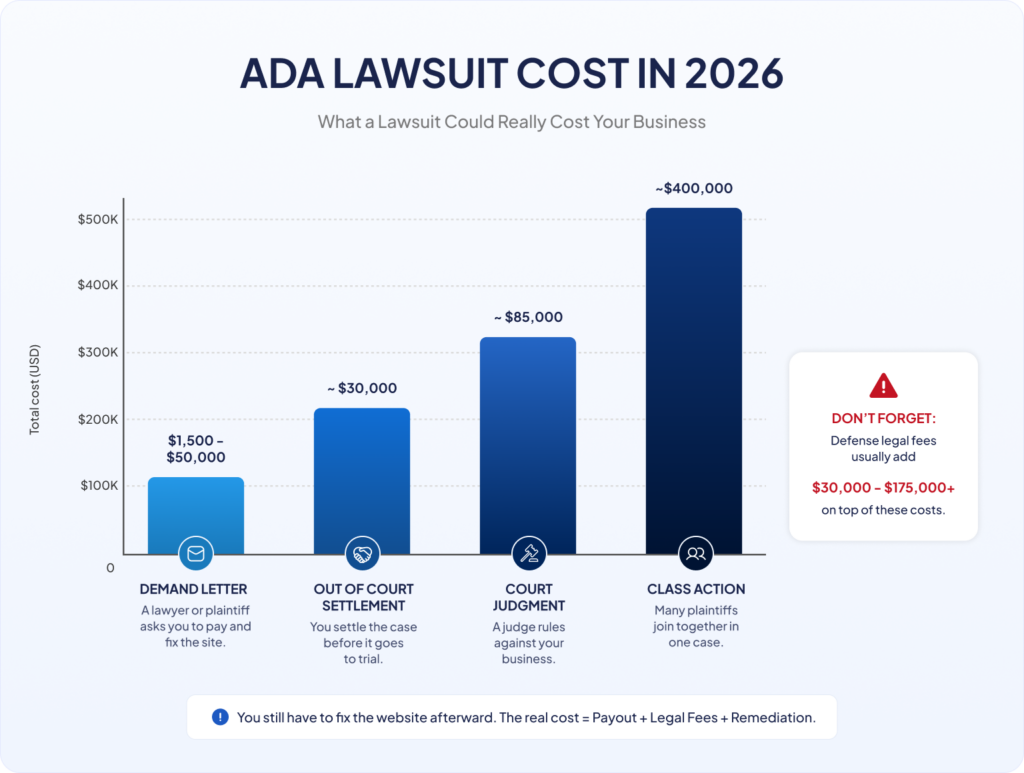
What does a lawsuit really cost? It depends how far it goes. Here is the honest spread.
| Stage | What happens | Typical cost |
|---|---|---|
| Demand letter | A lawyer or plaintiff asks you to fix your website and may seek compensation before filing a lawsuit. | $1,500–$50,000 |
| Out-of-court settlement | The dispute is resolved before trial through a negotiated settlement. | Around $30,000 |
| Court judgment | The case goes to court, and a judge rules against your business. | Around $85,000 |
| Class action | Multiple plaintiffs bring a single lawsuit over the same accessibility issue. | Around $400,000 |
And here is what people forget. Defense legal fees pile on top, usually $30,000 to $175,000, even if you win. Some cases run $50,000 to $150,000 in legal fees alone. You still have to fix the site afterward too. So the real cost is the payout, plus lawyers, plus the repair you skipped.
ADA Remediation Cost in 2026
Now the other side. Fixing your site is not free, but it is small change next to a lawsuit. Cost tracks your site size.
| Site type | What it is | First-year cost |
|---|---|---|
| Small site | Brochure website or small business site with fewer than 20 pages | $1,500–$7,500 |
| Mid-size site | Business website with many pages, forms, and interactive features | $7,500–$25,000 |
| Large or complex site | Ecommerce store, customer portal, SaaS platform, or custom web application | $25,000–$50,000+ |
Inside those totals, the parts price like this. An audit runs $2,500 to $10,000, or about $125 per page. Code fixes run $250 to $550 per page. Monitoring runs $200 to $1,000 a month. The audit tells you exactly where you stand before you spend a dollar on fixes.
Remediation Cost vs Lawsuit Cost: The Real Math
Put the two side by side and the choice makes itself.
| Path | First-year cost | Legal risk afterward |
|---|---|---|
| Fix the site first | $1,500–$50,000 | Very low. Demonstrates a good-faith effort to meet accessibility requirements. |
| Wait and get sued | $60,000–$200,000+ | High. You may still need to remediate the website after legal action. |
Walk through one example. A small online store ignores accessibility. A demand letter shows up asking $10,000 to settle. Fight it and defense fees start near $30,000. Settle and it runs about $30,000. Either way, the site still needs fixing after. Total pain: often $50,000 to $70,000.
That same store could have run an audit for $5,000, fixed the issues for around $8,000, and added monitoring for a few hundred a month. Call it $15,000 for the year, no lawsuit, and a site that works for every customer.
Same store. One path costs three to four times more and comes with a legal fight. Fixing first is not a cost. It is insurance.
Scan vs Overlay vs Real Fix: What Actually Protects You
Three options get sold as ADA compliance. Only one holds up. Here is the plain comparison.
| Option | WCAG coverage | Lawsuit protection | Typical cost |
|---|---|---|---|
| Free automated scan | About 25% of accessibility issues detected | Weak | $0–$200/month |
| Accessibility overlay widget | Little to none | None (may increase legal risk) | $500–$6,000/year |
| Professional remediation | Full WCAG 2.1 AA compliance | Strong | $1,500–$50,000 |
That widget that promises instant compliance with one line of code? Skip it. Around 1 in 4 sites that got sued in 2025 already had one installed. In 2025, the FTC hit an overlay company with a $1 million order for claiming its tool made any site compliant automatically. It did not.
Here is the strong opinion. Overlays sell a feeling of safety, not real safety. They sit on top of broken code instead of fixing it. Screen reader users often find they make the site worse. Courts and disability groups both reject them. Real protection means fixing the actual code, and that is developer work, not a plugin.
Who Gets Sued the Most
Some sites carry far more risk. Watch out if you run any of these.
Online stores. Ecommerce is the number one target by a wide margin. If you use a platform theme with heavy custom work, get it checked. Solid Shopify development with accessibility built in beats a bolted on fix later.
Content heavy sites. Blogs, portals, and marketing sites often fail on images and forms. Clean WordPress development dodges the common traps.
Healthcare and public services. These face extra pressure from rules tied to federal funding, which push many health sites to WCAG 2.1 AA on a set deadline. If you build here, treat healthcare software development as accessibility first.
Mobile apps. Apps are covered too, not just websites. Accessible mobile app development keeps you clear on both fronts.
Repeat targets. Get sued once, fix nothing, and you get sued again. Nearly half of 2025 cases hit companies that had been sued before.
Common WCAG Issues That Trigger Lawsuits
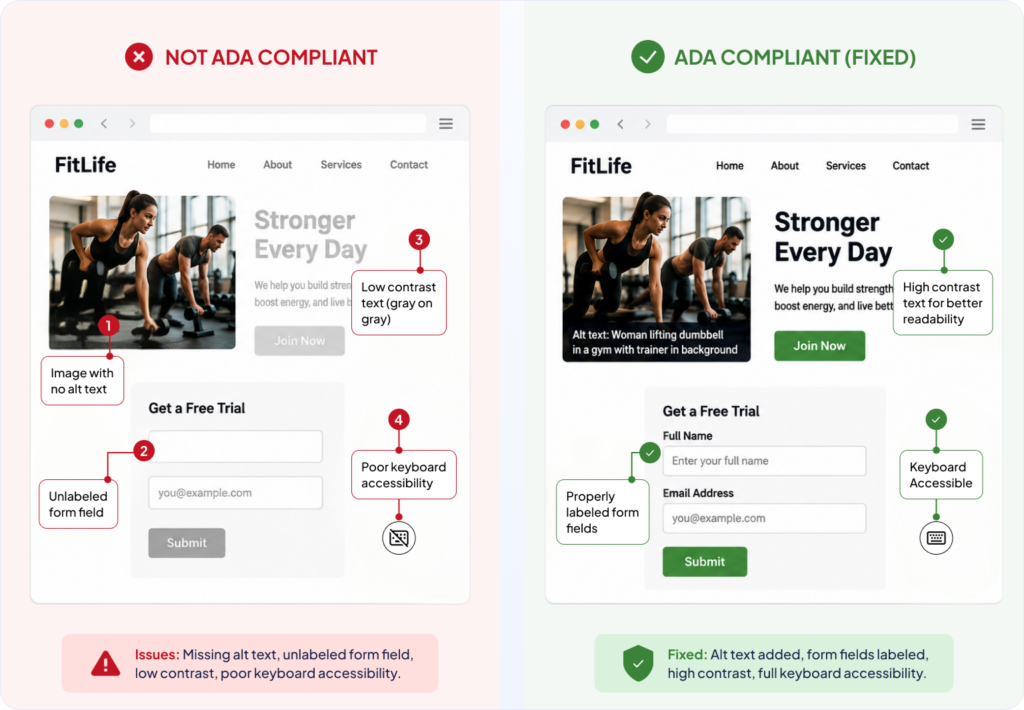
Most lawsuits point to the same short list. The good news is these are all fixable.
- Missing alt text on images, so screen readers cannot describe them.
- Form fields with no labels, so users cannot tell what to type.
- Low color contrast, so text is hard to read.
- No keyboard access, so people who cannot use a mouse get stuck.
- Bad focus order and hidden buttons that trap navigation.
For how widespread these are, WebAIM tracks the most common accessibility errors across the top million sites every year. The pattern barely moves, which is why the same fixes protect most businesses.
How to Make Your Website ADA Compliant
You do not need to guess. A clear path gets you protected.
Start with a real audit. A scan plus manual testing shows every issue and ranks it by risk. Remember, scans alone catch only about a quarter of problems.
Fix the code, not the surface. Repair the actual labels, contrast, keyboard flow, and structure. No widgets.
Test like a real user. Check with a screen reader and keyboard only, the way people with disabilities browse.
Monitor after launch. New pages break things. Ongoing checks catch problems before a plaintiff does.
Document everything. Keep records of your audit and fixes. This proves good faith if anyone comes knocking.
Building or rebuilding anyway? Bake accessibility in from day one with proper custom web development services. It costs far less than retrofitting later.
What You Get With Auspicious Soft
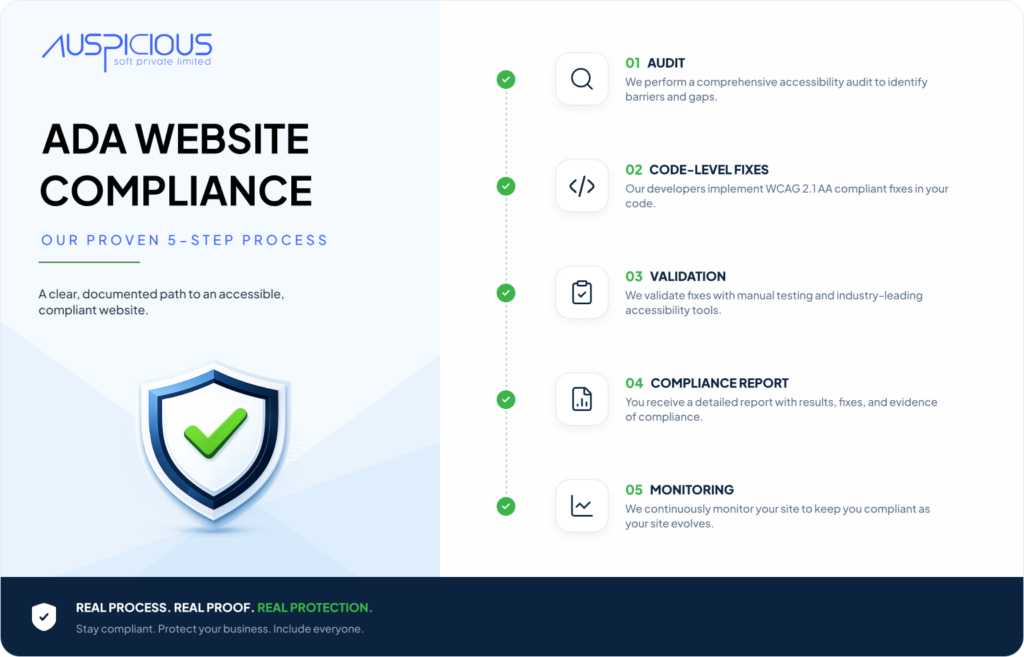
Guesswork is expensive. A clear plan is not. Here is what a proper accessibility project delivers.
- A full WCAG 2.1 AA audit, with every issue ranked by legal risk.
- Real code level fixes across design, content, and structure. No overlays.
- Validation that each fix actually works.
- A compliance report you can show if you are ever challenged.
- Ongoing monitoring so new pages stay compliant as you grow.
Why teams pick Auspicious Soft: 200+ projects delivered since 2018, a team of 30+ engineers, fixed price options, full transparency, and US timezone availability. More on the team is on the about Auspicious Soft page.
See Exactly Where Your Site Stands
Book a free accessibility review with the Auspicious Soft team and get a clear plan.FAQs
Q: How much does ADA website compliance cost in 2026?
A small site runs $1,500 to $7,500 all in. A mid size site runs $7,500 to $25,000. A large store or app can reach $50,000 or more. The audit alone is $2,500 to $10,000.
Q: How much can an ADA website lawsuit cost?
Settlements average around $30,000, court judgments near $85,000, and class actions around $400,000. Defense legal fees add $30,000 to $175,000 on top, even if you win.
Q: Can a small business really get sued over its website?
Yes. Most sued companies earn under $25 million a year. Plaintiff firms target smaller sites because they settle faster.
Q: Do accessibility widgets or overlays make my site compliant?
No. Around 1 in 4 sued sites had a widget installed. The FTC fined an overlay company $1 million in 2025 for false compliance claims. Fix the code instead.
Q: What standard do I need to meet?
WCAG 2.1 Level AA is the standard most courts and the government use. Meeting it, documenting it, and monitoring it is your best protection.
Q: How long does ADA remediation take?
A small site can be fixed in one to four weeks. A large store with hundreds of pages and a custom checkout can take three to six months. An audit gives you a firm timeline.
Q: Are mobile apps covered by the ADA too?
Yes. Courts treat apps like websites. If your app serves the public, it needs to meet the same WCAG standard.
Q: What are the most common issues that cause lawsuits?
Missing alt text, unlabeled forms, low contrast, and no keyboard access. These four show up in most cases and are all fixable.
Do not Miss Our Latest Tech Insights
Stay one step ahead in the fast-moving world of AI and technology. Add us as a Preferred Source on Google and get our latest articles, guides, and industry insights delivered straight to your search feed.