+1 740 762 6496
 +91 70189 46603


TABLE OF CONTENT
- Custom Software Development: Your Key to a Future-Ready Business
- What is Custom Software Development?
- Benefits of Custom Software Development
- Why Hire Custom Software Developers in California?
- The Custom Software Development Process
- Preparing for a Future-Ready Business with Custom Software
- Conclusion
- FAQs
Overview
- Custom software development is the process of designing, building, and deploying software applications built specifically for a single organisation’s workflows, data structures, and business objectives — as opposed to off-the-shelf products designed for a broad market.
- In 2026, businesses increasingly recognise that off-the-shelf software creates invisible constraints: you adapt your processes to the software rather than the software to your processes, pay perpetual licensing fees for features you do not use, and depend on a vendor’s roadmap for capabilities you need today. Custom software eliminates all three.
- This guide covers what custom software development actually involves, the honest cost comparison with off-the-shelf alternatives, the measurable business benefits backed by data, how to choose the right development partner, and the exact six-phase process our team follows from discovery to maintenance.
AI Summary:
Businesses using custom software see 34% higher productivity than those using off-the-shelf solutions (Forrester). The global custom software development market reaches USD 146.18 billion by 2030. 72% of US enterprises report that off-the-shelf software requires significant workarounds that reduce efficiency.
Custom software development is your key to a future-ready business in this era of a digital world. Businesses need to be agile, adaptable, and innovative in this fast-paced market in order to come out on top. Custom software development offers tremendous benefits, especially to companies in a market as thriving as California.
Especially designed according to the requirements of the firm, customized software allows for flexibility, efficiency, and scalability, which general, off-the-shelf solutions cannot provide. If you think about the best way to prepare your business for the future, then the key to being the best might lie in partnering with a custom software development company in California.
This article addresses the benefits of custom software development and why a software development company in California can provide that edge your business needs to grow and innovate.
What is Custom Software Development?
Custom software development is the process of designing and building software applications tailored to the specific requirements, workflows, and objectives of a single business — rather than purchasing a pre-built product designed for a broad market. Unlike off-the-shelf software (Salesforce, Shopify, QuickBooks), custom software is owned outright by the business that commissions it, built to their exact process specifications, and can be modified at any time without vendor permission.
Custom software development means building software that does exactly what your business needs — owned by you, designed for your processes, and never dependent on a vendor’s update roadmap.
Custom Software vs Off-the-Shelf — Which Is Right for Your Business?
| Criteria | Custom Software | Off-the-Shelf Software | Winner by Use Case |
|---|---|---|---|
| Upfront Cost | Higher — $15K to $1M+ | Lower — $0 to $50K setup | Off-the-shelf for tight budgets and fast deployment |
| Ongoing Cost | Low — hosting and maintenance only | High — perpetual licensing $500–$50K+/month | Custom for long-term 3+ year operational use |
| Fit to Your Process | 100% — built for your workflows exactly | Partial — you adapt your process to the software | Custom — eliminates workflow compromise from day one |
| IP Ownership | 100% — you own the full source code | None — you licence access from the vendor | Custom — code is a sellable, fundable business asset |
| Scalability | Unlimited — extend as business grows | Vendor-dependent roadmap and pricing tiers | Custom for businesses with complex growth trajectories |
| Integration Flexibility | Any API, system, or third party | Limited to vendor's partner ecosystem | Custom for organisations with complex existing tech stacks |
| Security Control | Full — you control data and infrastructure | Shared — depends on vendor security posture | Custom for businesses with sensitive data requirements |
| Time to Launch | Longer — 3 to 18 months to build | Faster — days to weeks to deploy | Off-the-shelf when urgent deployment is the priority |
| Vendor Dependency | None — code is yours indefinitely | High — vendor pricing changes affect you | Custom for long-term operational independence |
| Best For | Unique workflows, competitive tech, sensitive data | Standard functions, tight budget, fast start | Evaluate both against your 3-year total cost of ownership |
Benefits of Custom Software Development — Quantified
40% Average Productivity Increase
McKinsey research on enterprise software modernisation consistently shows 35–50% productivity improvements when businesses replace manual or disconnected off-the-shelf systems with purpose-built custom software. The gain comes from three sources: eliminating manual data re-entry between systems that do not integrate, removing workarounds employees develop to compensate for software that does not fit their actual process, and automating repetitive tasks that no off-the-shelf product was designed to handle.
Elimination of Perpetual Licensing Costs
A mid-sized company spending $8,000–$25,000 per month on SaaS licensing for a function that could be replaced by a custom system often achieves full investment payback within 18–30 months. After payback, the saving is permanent — custom software carries no recurring licensing fee, only hosting and maintenance costs (typically 15–20% of the initial build cost per year). This creates a compounding financial advantage over time that SaaS never can.
ROI Within 18 Months for Targeted Automation
Custom software built for a specific high-volume internal process — invoice automation, compliance document generation, field data collection — typically achieves ROI within 12–18 months. The calculation is straightforward: hours saved per week multiplied by average employee cost, compared against development cost plus annual maintenance. For any process consuming 20+ hours of employee time per week, the business case is usually compelling.
Complete IP Ownership
When you build custom software, you own the source code outright. This asset has real business value: it can be sold as a standalone product to others in your industry, licensed to partners, used as collateral in investment and M&A discussions, or retained as a moat against competitors. SaaS licences produce no intellectual property asset — only months of paid access that expire the moment you stop paying.
Long-Term Competitive Advantage
Custom software can encode capabilities, processes, and algorithms that are unique to your business and that competitors cannot purchase off a shelf. This is the basis of technology-driven competitive moats. The same principle that gives Amazon, Uber, and Airbnb their advantages applies at smaller scales — the companies winning in commoditised markets are increasingly those with proprietary operational software that competitors simply cannot replicate.
Custom Software Development Cost (2026)
| Tier | Description | Cost Range | Timeline | Examples |
|---|---|---|---|---|
| Simple | Single workflow, internal tool, basic CRUD application | $15,000 – $40,000 | 2–4 months | Invoice automation, inventory tracker, staff scheduling tool |
| Business Platform | Multi-user, role-based access, API integrations, reporting | $50,000 – $120,000 | 4–8 months | CRM, customer portal, order management system, booking platform |
| Complex System | Multi-module, high data volume, extensive API ecosystem | $100,000 – $300,000 | 6–14 months | ERP, logistics platform, marketplace, fintech application |
| Enterprise | Mission-critical, compliance-heavy, legacy integration, global scale | $300,000 – $1,000,000+ | 12–36 months | Custom ERP replacement, banking core, government platform |
How to Choose a Custom Software Development Company
| Sr. No | What to Verify | Red Flag to Watch For |
|---|---|---|
| 1 | Portfolio includes projects in your industry or with comparable complexity | Portfolio is generic, stock screenshots, or lacks real project case studies |
| 2 | Client references available for direct contact — not just written testimonials | No direct reference contact available — testimonials only, no names or companies |
| 3 | Discovery phase is a defined step in their process — not optional or rushed | Jumps straight to quoting without any requirements gathering or scoping session |
| 4 | Fixed-price or milestone-based contracts available for scoped projects | Time-and-materials only with no cap — budget exposure is unlimited |
| 5 | Source code ownership is explicitly stated in the contract as 100% yours | Source code ownership is vague, shared, or not addressed in the contract |
| 6 | Post-launch maintenance SLA is defined with response time commitments | 'We will support it' without defined SLA, response times, or support channels |
| 7 | Security practices are documented — OWASP, code review, penetration testing | Security is 'best effort' — no defined standards, frameworks, or testing cadence |
| 8 | Single point of contact — dedicated PM with regular sprint reporting | Multiple contacts, unclear ownership, no regular reporting cadence |
| 9 | Technology choices are explained and justified for your specific use case | Same tech stack recommended for every project regardless of requirements |
| 10 | They push back on requirements they think are wrong — not simply yes to everything | Agreement to everything in the sales process without questioning scope or approach |
Why Custom Software Development Is a Must for Today’s Businesses
California is the world’s largest technology ecosystem — Silicon Valley, Los Angeles, and San Diego together host more software engineers, technology companies, and development talent than any comparable region globally. For businesses seeking custom software development partners, California offers access to engineers with experience building at scale (from Google, Apple, Meta, Salesforce alumni networks), a legal and IP protection framework designed for technology businesses, a culture of innovation that produces creative technical solutions rather than template-based approaches, and proximity to the largest venture capital ecosystem in the world for businesses with growth ambitions. Auspicious Soft’s California-based team brings this ecosystem’s standards of quality to businesses of all sizes.
1. Efficient and Productive: On the first instance, custom software is set to operate based on your current workflow and system. This means that effectiveness is highly improved since there are fewer repetitions of work or combating incompatibility of functionality. With the more than perfect fit of the software with your business activities, your workers can complete their work in the shortest time possible and with higher perfection to create a productive workplace environment.
2. Scalability and Flexibility: One of the biggest advantages to custom software is that it can scale. As your business grows, so will your software needs. Custom solutions are built to scale with your business so you can add new features and functionalities without having to overhaul your entire infrastructure of software. A California software development company may be able to create a solution that fits for your future needs. Is it adding new products? Is it expanding into other services? Is it entering new markets?
3. Enhanced Security: Security is one of the critical requirements for businesses, especially those that handle customer data information. Custom software can implement complex security measures to fit your particular industry and regulatory environment. Custom software also minimizes vulnerabilities often found in widely-used off-the-shelf solutions since it is built uniquely for your environment hence as much less prone to general cyber attacks.
4. Cost-effective in the long term: Although it does save you money in the long term, developing custom software saves you from various costs that other types of software require. For one, it saves you from licensing fees; helps reduce unnecessary third-party software used in the process; and optimizes workflows. Custom software can help cut down on operating costs by directly targeting inefficiencies related to your business-acting as a smart investment for companies looking toward sustainable growth.
5. Competitive Edge: In California, the market is very competitive, so differentiation is a virtue to stand out. Custom software allows you to implement unique features that express your brand and enhance your service offerings. With custom features and user-friendly design, you offer the experience that sets you apart from competitors, and because of that, you are able to retain the customers with reinforced customer loyalty and boosted brand value.
Custom Software Development Process
| Phase | Duration | What Happens | Output |
|---|---|---|---|
| 1 — Discovery | 2–4 weeks | Stakeholder interviews, process mapping, technical architecture, integration audit, risk assessment | Product spec document, technical architecture, project plan, fixed-price quote |
| 2 — Design | 2–4 weeks | UX wireframes, UI design system, database schema, API contract design, clickable prototype | Approved UI screens, design system, prototype ready for handoff to development |
| 3 — Development | 8–24 weeks | Agile 2-week sprints, feature building, code review, automated testing, live demo every sprint | Working software delivered in increments — stakeholders see real progress fortnightly |
| 4 — Testing | 2–4 weeks | Functional QA, integration testing, security audit, performance load testing, UAT with stakeholders | QA report, resolved issue log, stakeholder sign-off for production launch |
| 5 — Deployment | 1–2 weeks | Production environment setup, data migration, staff training, go-live monitoring | Live production system, deployment documentation, training materials |
| 6 — Maintenance | Ongoing | Bug fixes, performance monitoring, OS/dependency updates, security patches, feature additions | Monthly maintenance reports, SLA compliance records, system health dashboard |
Why Hire Custom Software Developers in California?
California is definitely one of the global innovation hubs and hosts some of the leading talent in tech. Thus you are able to easily get the best professionals for custom software development projects. Therefore, you can basically obtain unmatched industry leadership expertise combined with local market insights through a software development company in California, along with a dedicated team to quality and innovation. Here is why. Choose to partner with California-based development companies for your business.
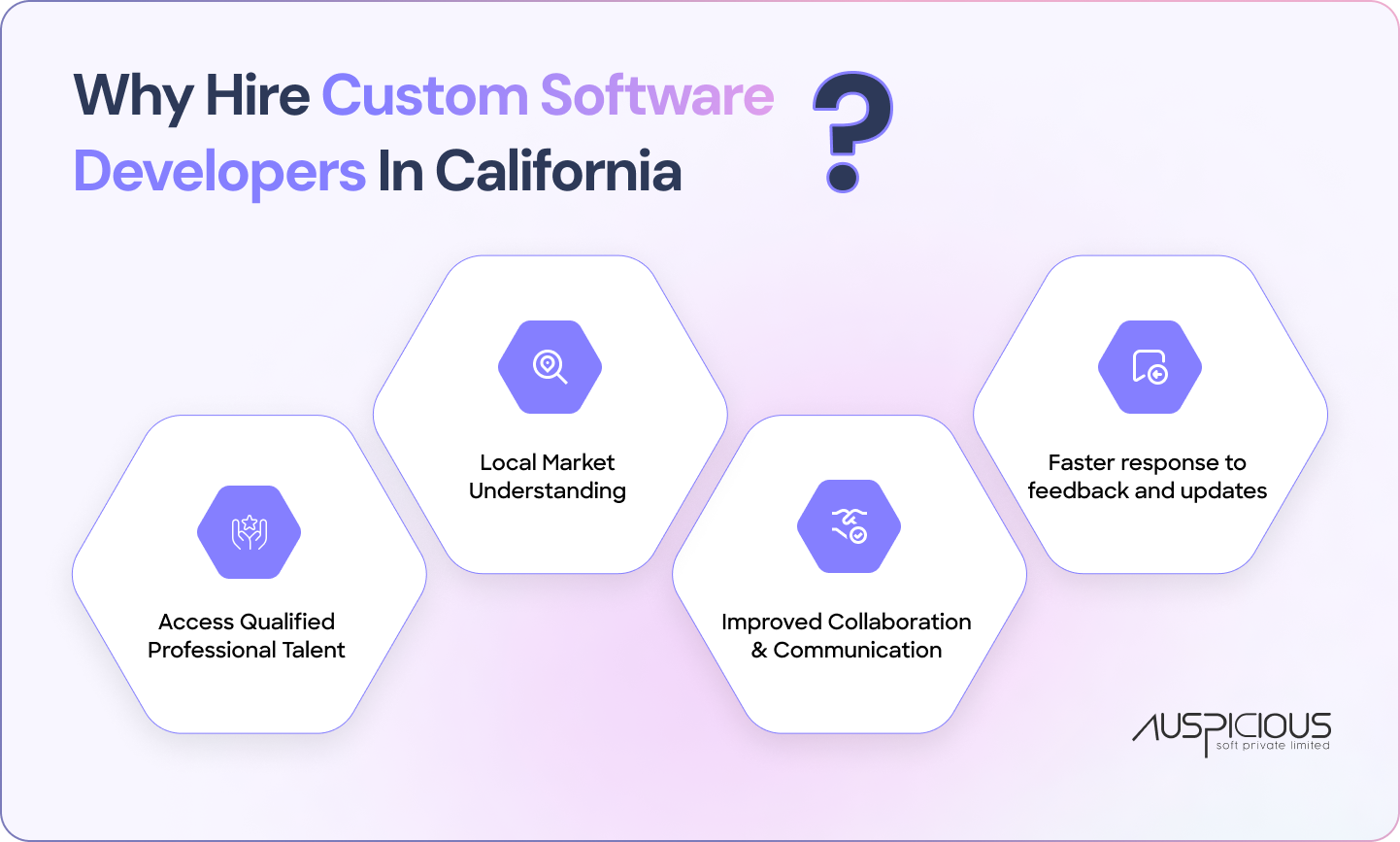
1. Access Qualified Professional Talent
A growing tech industry in California helps attract the best talent in software development, UX/UI design, cybersecurity, and data science. Work with a custom software development company in California to access a strong team that can develop complex, innovative solutions for your business through the latest technologies and best practices.
2. Local Market Understanding
A California-based development company would be keenly aware of the regulations prevailing in the locality, the present and upcoming trends that are heard of within the industry, and what would work for the people being targeted. All of this will make it a prime development opportunity to focus on building a software solution that meets regional requirements and would be appreciated by customers in that locale, thus giving you an edge in the market.
3. Improved Collaboration and Communication
Proximity can make collaboration easier. Proper scheduling of meetings and check-ins with a California-based development company usually correlates to better communication and even a better understanding of the project itself. Being well communicative with your development team is what you need to stay on the right track with the project, even for you to ensure that the final product shall be accurate to all your expectations.
4. Faster response to feedback and updates
With a California-based software company, there is faster response time to any change or update required. A close geographical location helps make adjustments based on feedback at a much faster rate whether this is during the development phase or after the product has been deployed. Rapid response capabilities are vital for adapting to market trends, evolving customer needs, or new regulations.
The Custom Software Development Process
Custom software development requires several stages to successfully deliver a product that helps cater to a client’s needs and thus delivers the highest possible value. The following shows what a California-based custom software development company might have in place to get them through the project:
1. Requirement Gathering: It begins with a detailed consultation to understand the client’s requirements, pain points, and goals. This phase ensures the software meets business objectives and hits at critical challenges for that specific business.
2. Design and prototyping: After requirements gathering, the design stage is turned on. Developers would create wireframes and prototypes as to how the final product is going to look and how it is going to work. This is a phase for clients to give their input to refine the design before development is done.
3. Development: In this stage, developers design the software according to requirements that were agreed upon in the design and functionality. Regular testing can be performed on the product to ensure that it performs as expected.
4. Quality Assurance and Testing: The software is subjected to rigorous testing so that bugs are detected and security and compatibility issues solved. The test guarantees the software is stable, secure, and friendly to use.
5. Deployment and Integration: After the testing process, the software is deployed and integrated into whatever currently existing systems are in place. Software development support provides assistance toward a smooth transition and features to be in great working order.
For custom software, maintenance and support are a must as that is what updates and optimizes it to be relevant. A good California software development company will provide with maintenance services and addresses future updates, feature additions, and technical issues.
Preparing for a Future-Ready Business with Custom Software
Custom software development in 2027 and beyond will be characterized by AI-assisted development that accelerates delivery without reducing customization. In 2026, tools like GitHub Copilot, Cursor, and Anthropic’s Claude are already enabling development teams to produce working code 30-50% faster than without AI assistance — reducing the cost gap between custom and off-the-shelf without reducing the uniqueness advantage. Low-code platforms (Retool, Bubble, Webflow) are extending the range of business-specific applications that can be built without traditional software development, handling simple internal tools so developer time can focus on complex, value-differentiating custom capabilities. The result is a custom software market that becomes more accessible to smaller businesses while delivering more sophisticated capabilities to enterprise clients.
Conclusion
Custom software development is not a trend; it is the strategic approach of establishing a future-proof business that will stay relevant through the challenges of the future. Hiring a software development company in California will bring you industry leaders and innovative solutions shaped around your specific needs.
This investment in custom software will have your business prepared to face future challenges, increase operational efficiency, and ultimately retain customers in the long term. If you want to put your business on the map of success, then custom software becomes the perfect key for unlocking your future-ready potential.
FAQs
Q: How much does custom software development cost in 2026?
Custom software development ranges from $15,000 for a simple internal tool to $1,000,000+ for an enterprise platform. The most common range for a serious business application with multiple user roles, database, API integrations, and admin panel is $50,000–$200,000. Cost is driven by complexity, number of integrations, data volume requirements, security standards, and team location.
Q: Is custom software development worth it?
Custom software is worth it when any of these apply: your business processes are complex enough that no off-the-shelf software fits without significant compromise; you are spending more on SaaS licensing annually than custom development would cost over three years; you need to own your IP as a business asset; or your competitive advantage depends on proprietary technology. For standard business functions like email, document management, or basic accounting, off-the-shelf is almost always more cost-effective.
Q: How long does custom software development take?
Simple internal tools take 2–4 months. Business platforms with multiple modules and integrations take 4–8 months. Complex enterprise systems take 12–36 months. These timelines include discovery, design, development, QA, and deployment. A common planning mistake is not accounting for 2–4 weeks of QA testing and any required data migration time before the go-live date.
Q: Who owns the code after custom software development?
In a correctly structured contract, you own 100% of the source code and all intellectual property. Before signing any development contract, verify that the IP ownership clause is unambiguous — it should state explicitly that all code, design assets, and documentation created under the engagement transfer to you upon final payment. Auspicious Soft includes this clause in every client contract without exception.
Q: What is the difference between custom software and a SaaS product?
Custom software is built for one company’s specific requirements — you own it, modify it freely, and pay only for hosting and maintenance. SaaS (Software as a Service) is software you access via subscription — the vendor owns the platform, updates it on their schedule, and your access stops if you stop paying. Custom requires more upfront investment but eliminates the permanent licensing cost and vendor dependency that SaaS creates.
Do not Miss Our Latest Tech Insights
Stay one step ahead in the fast-moving world of AI and technology. Add us as a Preferred Source on Google and get our latest articles, guides, and industry insights delivered straight to your search feed.