+1 740 762 6496
 +91 70189 46603

TABLE OF CONTENT
- 1. Clearly Define Your Goals and Expectations
- 2. Evaluate the Portfolio of Potential Partners
- 3. Look for Technical Expertise and Up-to-Date Knowledge
- 4. Consider Communication and Collaboration Style
- 5. Focus on User-Centered Design (UI/UX)
- 6. Check on Post-Launch Support and Maintenance
- 7. Ensure-Cost-Transparency-and-Budget-Alignment
- Conclusion
- FAQs
Overview
- Undefined goals produce misaligned deliverables — clarity before partner selection prevents 40% of project failures.
- Live App Store ratings and user reviews are the only honest portfolio evidence that matters.
- 2026 technical expertise means AI integration, modern frameworks, and cloud-native architecture — not just mobile.
- Response time, milestone cadence, and async documentation predict project success more than technical skill.
AI Summary:
60% of app projects go over budget due to wrong partner selection (Clutch). 40% of first-time app builders report they would choose a different development company if starting over. Average cost of a failed app development partnership: $85,000 in wasted budget.
In 2026, businesses are increasingly looking toward development in mobile applications as a means of improving customer engagement through better facilitation of processes that will help the business keep ahead of the competition.
As the number of mobile apps grows further, choosing the right mobile app developers could make or break your digital success, whether you’re just starting a company or whether it’s an established one. While this may be the right partner turning your vision into a real application, a wrong choice will lead to wastage of resources, time, and frustration.
Key Strategies That Will Help You Find The Perfect Mobile App Development Partner
1. Clearly Define Your Goals and Expectations
The most common reason that app development partnerships fail is not technical incompetence — it is misaligned expectations that were never clarified before the contract was signed. Defining your goals before evaluating any development partner means specifying: the platform (iOS, Android, or cross-platform), the core user persona and their primary problem your app solves, the three most important features for launch, your timeline and budget ceiling, success metrics for the first six months post-launch (MAU target, App Store rating goal, retention rate), and post-launch support requirements. A development company evaluated against clearly defined goals can be assessed objectively — one evaluated against vague aspirations will always seem adequate until the project is underway and the gaps become painfully apparent.
Checklist:
-Identify the core features and functionalities.
-Know your target audience.
-Set a budget range and timeline.
2. Evaluate the Portfolio of Potential Partners
Portfolio evaluation for mobile app development companies requires going beyond the case studies on their website — which are curated to show only their best work in the most favorable light. The only portfolio evidence that matters is apps that are live in the App Store or Google Play, with real user reviews and ratings that independent users have submitted without the company’s influence. Download the apps. Use them as a first-time user. Check the crash rates implied by the 1-star reviews. Look at the last update date — an app last updated 18 months ago signals a partner who does not maintain their work post-launch. Check that the stated functionality actually works. This 30-minute evaluation process reveals more about a development company’s actual quality than any sales presentation.
Checklist:
-Review their past mobile app projects.
-Diverse experience across industries is preferable.
-App ratings and user reviews in app stores.
3. Look for Technical Expertise and Up-to-Date Knowledge
Technical expertise requirements for mobile app development partners have expanded significantly in 2026. It is no longer sufficient to be proficient in Swift and Kotlin — top-tier partners must demonstrate: cross-platform capabilities (Flutter or React Native), cloud-native backend architecture (AWS, GCP, or Firebase), AI integration experience (on-device ML Kit or cloud AI APIs), security expertise (OAuth 2.0, certificate pinning, secure data storage), and performance optimization skills (profiling tools, Instruments, Android Profiler). The easiest way to assess technical depth is to ask the lead developer to walk you through the architecture of their most recent project — their ability to explain design decisions, trade-offs, and scalability considerations reveals their genuine expertise level far more reliably than a resume.
Checklist:
-Ask them about their prowess in programming languages, such as Swift, Kotlin, etc.
-Also, ask how nascent technologies like AI, AR, and blockchain are being applied.
-Seek an understanding of their testing, security measures, and scalability.
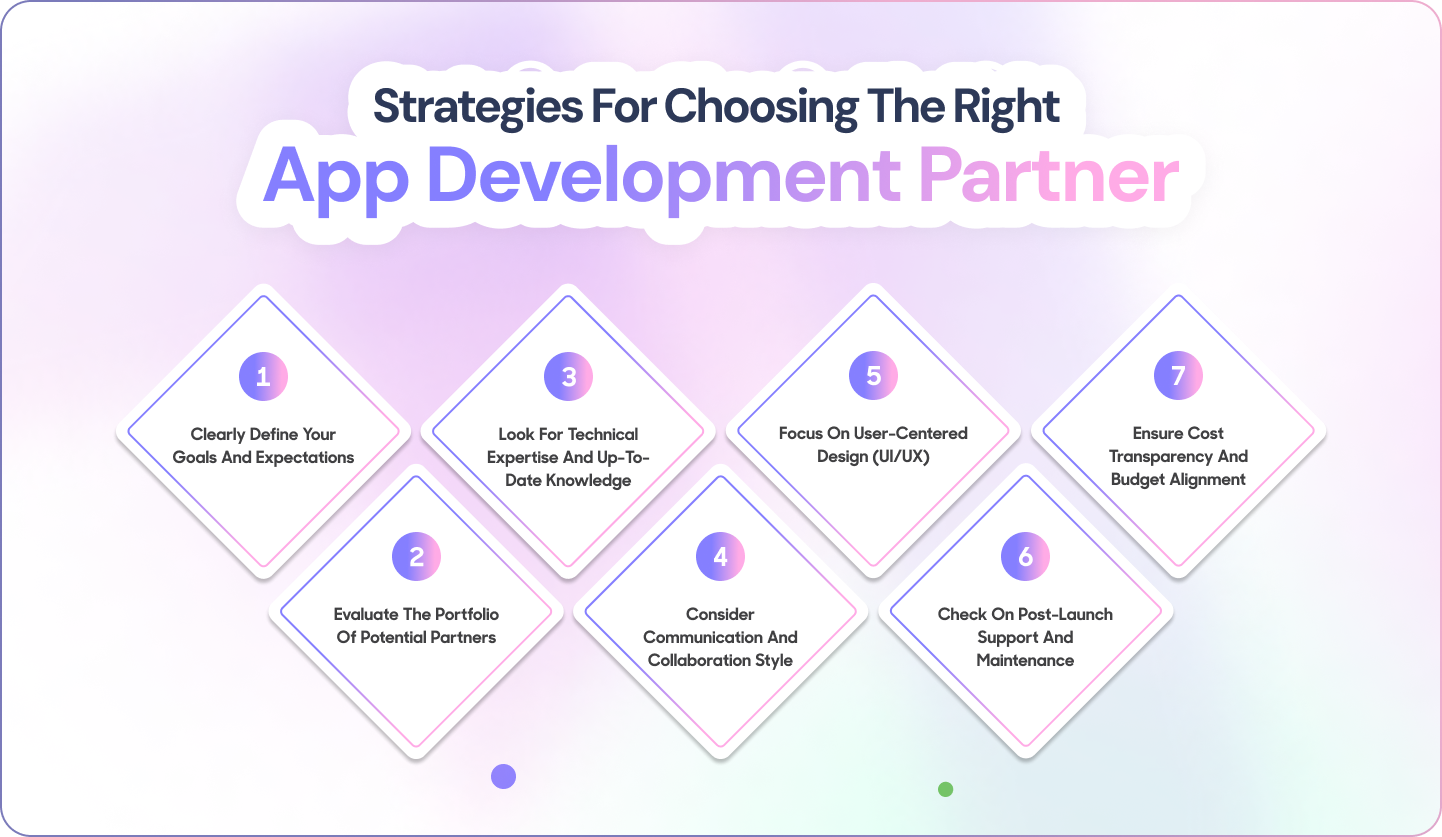
4. Consider Communication and Collaboration Style
Communication quality is the single most predictive indicator of project success in mobile app development partnerships — more predictive than technical skill, portfolio quality, or pricing. The reason: a technically excellent team that communicates poorly will produce a technically excellent product that does not match what you actually wanted, because requirements were never clearly transmitted. The communication standards to require in any app development partnership: response to messages within 4 business hours during agreed working hours, bi-weekly sprint demos with working software (not just status updates), shared project management tool access (Jira, Linear, or Notion) with real-time visibility into task progress, a dedicated project manager who is your single point of contact, and written documentation of all requirement changes.
Checklist:
-Inquire about their channels of communication, whether email or Slack.
-Ensure that you receive periodic updates about the work through a project management tool.
-Check how they handle feedback and revisions.
5. Focus on User-Centered Design (UI/UX)
A well-designed app is one of the major points that determine user retention and engagement. It starts with the design being centered on the user, pays much attention to what the needs and behaviors of the end-users will be, streamlining the interaction with it. If you’re looking for a partner to develop a mobile app, check how much they emphasize UI/UX design. Again, the best among the developers stand out while standing truly abreast of current user interface trends and principles of user experience. They should be able to determine how to develop a user-friendly app; it must look beautiful and provide exceptional experiences to users.
Checklist:
-See their design philosophy for UI/UX.
-Ask them whether they do wireframing, user research, or usability testing.
-Ensure the design is consistent in all their past work.
6. Check on Post-Launch Support and Maintenance
Development of an app is just the opening act. The real challenge starts once an app reaches the market. Bugs will show up, user feedback will necessitate changes, and operating systems will continue to update. For this reason, it’s very important that a mobile app development company providing mobile app development services by its experts is able to extend support way beyond launch. Ask your potential app development partner about their policies regarding maintenance and updates. Do they offer packages for periodic updates, bug fixing, and feature enhancements? Ongoing support will keep your application functional at its best when new devices and platforms emerge.
Checklist:
-Ask about their post-launch support services.
-Describe bug fix, update, and maintenance policies clearly.
-Do they have monitoring services for the performance of your app?
7. Ensure Cost Transparency and Budget Alignment
The budget is an essential factor in your choice. Like with any major investment, you want to be sure that the mobile application developers you consider are going to be transparent about the costs. You do not want any surprises or hidden fees throughout the project when it has already started. From your conversations, you want to ask for a detailed cost breakdown of day-to-day development, what the cost of design will be, the cost of testing, and how much is provided for post-launch support.
Checklist:
-Ask for a detailed cost breakdown; ensure cost transparency, avoiding hidden fees.
-Discussion of payment terms and milestones.
Conclusion
Do not Miss Our Latest Tech Insights
Stay one step ahead in the fast-moving world of AI and technology. Add us as a Preferred Source on Google and get our latest articles, guides, and industry insights delivered straight to your search feed.