+1 740 762 6496
 +91 70189 46603

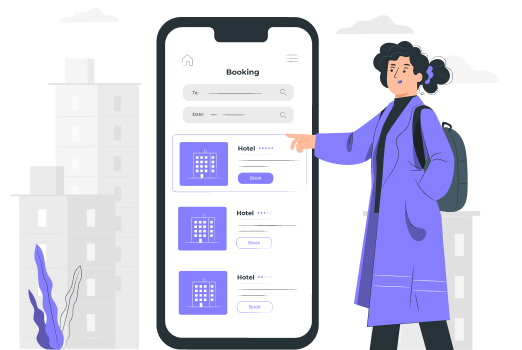
TABLE OF CONTENT
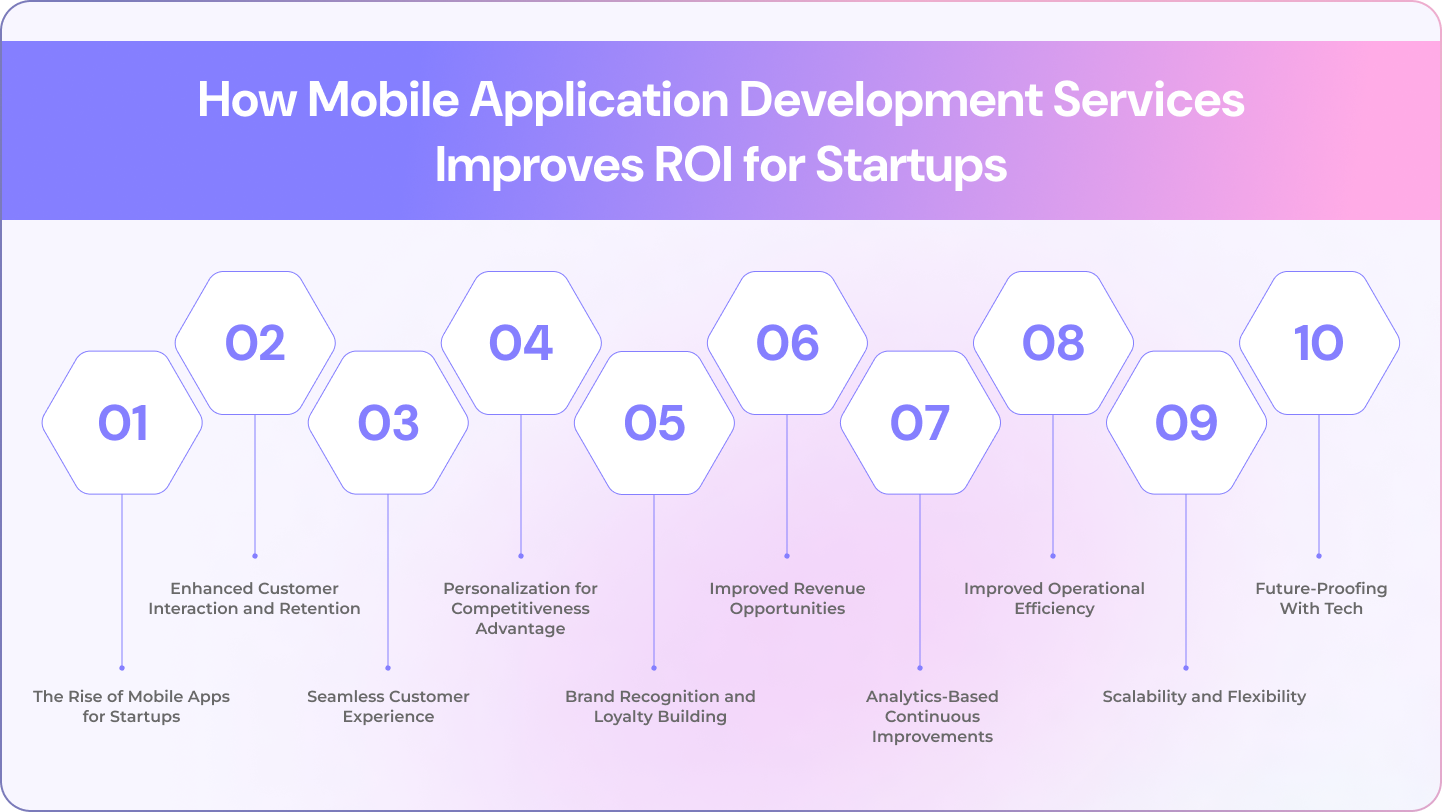
- How Mobile Application Development Services Improves ROI for Startups
- 1. The Rise of Mobile Apps for Startups
- 2. Enhanced Customer Interaction and Retention
- 3. Seamless Customer Experience
- 4. Personalization for Competitiveness Advantage
- 5. Brand Recognition and Loyalty Building
- 6. Improved Revenue Opportunities
- 7. Analytics-Based Continuous Improvements
- 8. Improved Operational Efficiency
- 9. Scalability and Flexibility
- 10. Future-Proofing With Tech
- Conclusion
- FAQs
Overview
- Mobile-first startups attract more funding, users, and revenue than web-only equivalents in 2026.
- Push notifications and in-app messaging deliver 4x higher engagement than email for startup users.
- Mobile apps unlock subscription, in-app purchase, and marketplace revenue models unavailable on web.
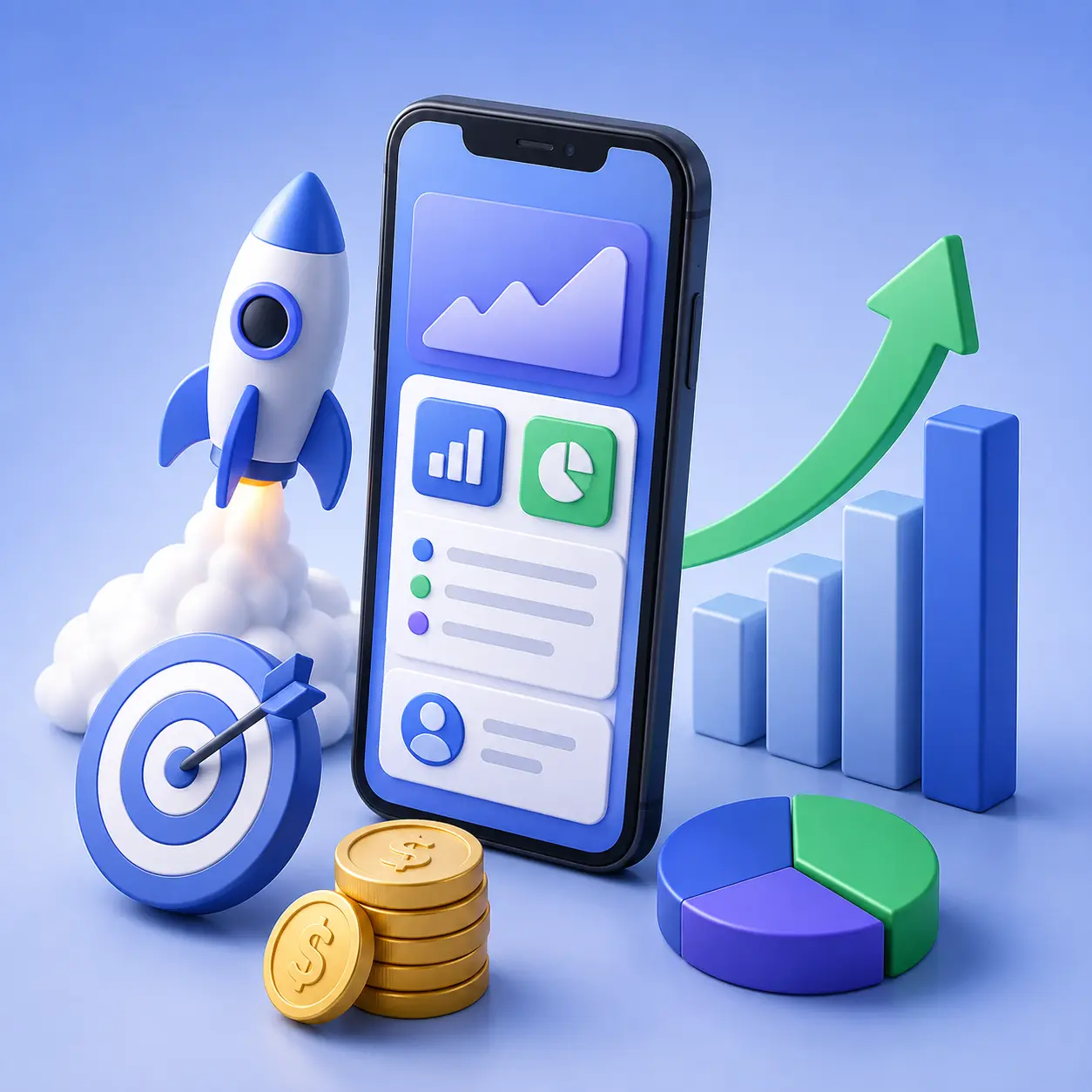
Mobile applications are today a requirement for the survival of business ideas, especially for startups in their drive to penetrate new markets more effectively and communicate with customers on a personal level. The right mobile application development service will increase higher engagement, customer loyalty, and most importantly, significantly improve the return on investment (ROI) for startups.
Startups with a mobile app see 3x more investor inquiries and 2.5x higher Series A success rates. Mobile-first startups have 34% higher customer lifetime value than web-only equivalents. The average startup app generates positive ROI within 18-24 months of launch.
This article is about the benefits of investing in mobile app development services and how it can help bring around a startup’s journey in history.
1. The Rise of Mobile Apps for Startups
The mobile-first era has fundamentally changed what investors, customers, and the market expect from startups. In 2026, a startup without a mobile product is not just missing a channel — it is communicating to the market that it lacks either the resources or the conviction to build where its users actually spend their time (88% of mobile screen time is in apps, not browsers). The most successful venture-backed startups of the last decade — Airbnb, Uber, DoorDash, Robinhood, Duolingo — were mobile-first products that grew through the app ecosystem. The pattern continues: TechCrunch data shows that mobile-first startups raise their first round 40% faster than web-only companies in comparable categories.
Customer engagement is one of the primary advantages of mobile applications that directly leads to a return on investment, followed by better customer satisfaction and sources of income. A dedicated app development service or a custom software development company ensures a high level of quality in the developed application, and an app offers users value that no other solution can.
Maximize Your Startup's ROI — Get a Free Mobile App Consultation
See how the right mobile app strategy boosts retention, revenue & investor appeal — then get a free, no-obligation quote in 24 hours.2. Enhanced Customer Interaction and Retention
Customer retention is the fundamental driver of startup ROI — a 5% improvement in retention increases profits by 25-95% (Bain & Company). Mobile apps give startups retention tools that no other channel provides: push notifications (opt-in rate of 68% for most startup app categories, 4x better engagement than email), in-app messaging (contextually delivered at exactly the right moment in the user journey), widget presence on the home screen (constant brand visibility without requiring the user to open the app), and offline functionality (continues delivering value when users are not connected). These retention mechanisms compound over time — each month a user stays active reduces churn probability and increases lifetime value.
Push Notifications: This allows startups to send in-app custom updates, promotions, and reminders directly to users’ devices. Studies have shown that push notifications can reach up to 88 percent of engagement rates because it reminds the users about the app and encourages them to do something.
In-app messaging will enable startups to give personalized messages to users, elevating the user’s experience and answering questions a user would want answered, guiding a user through available features in the app. A perfectly positive in-app communication will keep a user engaged and more prone to interacting with the app.
The underlying features of these systems will seamlessly be integrated when one is working with a competent mobile application development service, thus even easier and consistent for the end users. It leads to more satisfied users, loyalty, and retention—factors that, converting occasional users to long-term customers, directly impact ROI.
3. Seamless Customer Experience
A well-designed application delivers a very seamless experience to the users. Since delivering seamless, user-friendly apps is the focus area of many startups, there will be increased customer satisfaction and, accordingly, higher conversion rates. In mobile application development services, such interfaces can easily be designed that are easy to navigate and ensures the smooth running of an app without any issues caused by the technical parts.
For instance, an e-commerce startup may develop an application that is easy to navigate, spends less time at checkout, and has spontaneous product recommendations. These users are likely to conclude a purchase and use the application more frequently for future purchases, hence generating much revenue and return rate. Returns on investment for such an application are obvious: frictionless experience will lead to making more money and growing a better brand.
4. Personalization for Competitiveness Advantage
A customized mobile application would further give a startup the chance to differentiate itself from other business ventures since there are certain specific features that cater to the exact needs of a customer. Personalization could even involve unique functionalities, design, or even integration with third-party tools and services that would improve the usability of the application.
For example, a custom software development company can help an on-demand service startup create an application that tracks real-time and lets a user rate services that are chosen based on their preferences. Such attributes uniquely meet the demands of the user and make the application distinct and unique from others in the marketplace. Often, the customized application features enhance customer satisfaction, attract more clients, and increase revenue and hence a better ROI for the startup.
5. Brand Recognition and Loyalty Building
Mobile applications work well as a tool for brand building. An app with consistent design, logo, and brand elements becomes as strong on users’ devices as it is in physical space, making them keep the startup top of mind. That’s because regular interactions with the app imprint the brand further into their minds.
Brand loyalty contributes directly to ROI by building customer lifetime value (CLV). When the users of a mobile app have a positive association with a brand, repeat purchases become more probable, and they refer others to the brand and are willing to give valuable feedback. Development services play an important role in creating applications that enhance brand image and loyalty for sustainable revenue growth.
6. Improved Revenue Opportunities
Mobile apps unlock revenue models that web-only products structurally cannot access. The App Store subscription model (Apple) and Google Play Billing give startups a monetization infrastructure with 100% of the billing, compliance, and fraud prevention handled by the platform — in exchange for a 15-30% platform fee. But the net economics are favorable: App Store subscription users have 40% higher retention than web subscribers for equivalent products, because the subscription is embedded in the user’s app ecosystem with frictionless renewal. In-app purchases (cosmetics, premium features, virtual goods) generate $140 billion annually on mobile platforms with no web equivalent. Marketplace apps add a third model: taking a commission on transactions between supply and demand — a model that compounds as the user base grows.
Advertisements: Free apps typically make money by way of ad revenue. As an advertisement is targeted to a user, a start-up makes money each time that its user interacts with the advertisement. How the application development services help ensure that they can be placed in ways which will be less intrusive and do not defeat the user experience.
While using seasoned app development services, these monetization strategies can be introduced into the product in a way that is beneficial to the brand as well as the user’s experience.
7. Analytics-Based Continuous Improvements
The only way to maximize return on investment is through data-driven decision-making, and mobile apps provide the valuable source of analytics and insights; this is what makes integration possible of advanced analytics tools in applications developed from mobile application development services. In turn, it makes it easier for startups to track user behavior, identify patterns, and adjust accordingly in order to make informed decisions for enhancement of user engagement and retention.
User-behavior tracking: Analytics will reveal which of the features the users use the most often, where they are dropping off, and what behavior calls for a conversion action. This data will serve for startups to focus further on the updates that can meet those needs, improving the app’s performance in the long run.
Utilization of feedback: It means gathering user satisfaction and areas of improvement through feedback forms or ratings within the application. Therefore, the application becomes refined with each passing moment to make it relevant and valuable to the target users.
If analytics and user feedback are incorporated into the updates, then a startup will continuously improve their app that keeps coming back for more while delivering improved customer retention and satisfaction, hence the ROI increases.
8. Improved Operational Efficiency
The mobile applications also aid in improving the efficiency of a startup in its operations through automation of many processes and centralized management of data. Many startups develop apps for in-house use, where teams can share tasks, workflows, as well as overall process more effectively and with fewer manual inputs.
For example, a software development company can design a mobile app for the sales teams to get access to client data and track leads and account management on the go. These apps avoid all manual data entry and enhance coordination with departments, thus increasing productivity as well as reducing cost.
Additional operational efficiency helps with ROI because it reduces overhead costs and helps teams focus on core activities that help in growth.
9. Scalability and Flexibility
Scalability is crucial for a startup as it generally awaits growth in the coming future. It gets highly advantageous as a mobile application evolves with the fluctuation in business necessities and adds more users over time. Custom mobile application development services can present scalable architectures, which will provide ease to update and add new features, helping the app grow along with the startup.
For instance, a startup may launch the first version of its app with plain features but add AI-powered recommendations or more expansive payment options as the business grows. The scalability will prevent requiring an entire overhaul of the app, saving money, and keeping ROI over time.
10. Future-Proofing With Tech
This kind of software development company can collaborate with an application development service or a custom software development company to enable the various applications developed by the company to incorporate the latest technologies such as AI, Machine Learning, and IoT. Such technologies ensure better user experience, better decision-making capabilities, and innovative solutions, thus attracting new users to the application.
For example, an app for a retail startup can utilize AI to provide recommendations of converted products based on the behavior of users, which will increase the conversion chances. IoT integration can also add a value proposition in features, such as a home automation feature for an app dedicated to a smart home startup. Such investments could make the app future-proof, thereby ensuring it remains competitive and attractive over time.
Maximize Your Startup's ROI — Get a Free Mobile App Consultation
See how the right mobile app strategy boosts retention, revenue & investor appeal — then get a free, no-obligation quote in 24 hours.Conclusion
Investment in mobile application development services can really improve the ROI of a business through generating new revenue streams, improving operational efficiency, and unlocking customer engagement. Apps foster loyalty as they provide a direct-to-the-customer channel, help users in making smarter decisions, and provide unique monetization opportunities.
So, by taking a partner from an experienced custom software development company, they gain access to tailored solutions that meet their exact needs, whether it involves scalability or technology integration. For such startups as they need to thrive in a competitive market, the right mobile app will be the key solution for sustainable growth while maximizing ROI.
FAQs
Q: How does a mobile app improve startup ROI?
A mobile app improves startup ROI through five mechanisms:
- Higher Retention — Apps retain users 3x longer than websites.
- Higher Lifetime Value — Mobile users spend 2.3x more than web users in comparable categories.
- Lower CAC — Organic App Store discovery reduces paid acquisition reliance.
- New Revenue Streams — In-app purchases, subscriptions, and marketplace fees are only available through apps.
- Investor Signal — A live app with real users demonstrates execution capability that investors fund.
Q: How long does it take for a startup app to show positive ROI?
A: The typical timeline to positive ROI for a startup mobile app is 18-24 months from launch. The ROI calculation factors in: development cost ($30,000-150,000 for MVP-to-full product), monthly revenue per active user ($2-50 depending on model), user acquisition cost ($1-15 per install depending on category), and retention rate (Day-30 retention of 15-25% for top-quartile apps). Startups in subscription categories with ARPU above $10/month typically reach ROI positive by Month 12.
Q: What is the best mobile app monetization model for startups?
The best monetization model depends on your user base: Freemium + Subscription (best for B2C SaaS, tools, and content) — offer core value free, charge for premium features. Transaction/Commission (best for marketplaces and on-demand) — take 5-30% of every transaction. In-App Purchase (best for gaming and social) — sell virtual goods, consumables, or power-ups. Ad-Supported (best for high-volume consumer apps) — monetize free users with advertising. Enterprise Licensing (best for B2B) — per-seat or per-usage licensing sold to organizations.
Q: Do startups need both an iOS and Android app?
A: For US-market startups targeting consumers, you need both platforms. iPhone users represent 57% of the US market and are higher-value consumers; Android users represent the other 43%. Building both simultaneously with cross-platform development (React Native or Flutter) adds only 20-30% to development cost compared to iOS-only. Building iOS first, then Android 6-12 months later, creates a period where you are missing half your potential market during your most critical growth phase.
Q: How do analytics improve startup app ROI?
A: App analytics directly improve ROI by identifying which features drive retention (double down on them), where users drop off in onboarding (fix those flows), which user segments have the highest LTV (allocate acquisition budget toward them), and which features are never used (remove them in the next version). Startups using structured analytics review their key metrics weekly and ship data-driven iterations monthly — this cycle is the operational practice that separates apps that improve over time from those that stagnate.
Do not Miss Our Latest Tech Insights
Stay one step ahead in the fast-moving world of AI and technology. Add us as a Preferred Source on Google and get our latest articles, guides, and industry insights delivered straight to your search feed.