+1 740 762 6496
 +91 70189 46603


TABLE OF CONTENT
- Types of Real Estate Apps in 2026
- Real Estate App Cost Breakdown (2026)
- Must-Have Features for Real Estate Apps in 2026
- Tech Stack for Real Estate Apps (2026)
- Real Estate App Monetisation Models
- AI Features for Real Estate Apps in 2026
- Types of Real Estate App
- Key features of the Real Estate mobile application
- Breaking down the cost of Real Estate mobile application
- Step by Step process of developing Real Estate Mobile application
- Summary
- FAQs
Overview
- The global PropTech market is projected to reach $94 billion by 2027, and real estate apps sit at the centre of that transformation. In 2026, property portals, rental management platforms, investment analysis tools, and AR virtual tour apps all depend on purpose-built mobile experiences to connect buyers, sellers, renters, and agents in real time.
- But real estate apps are not a single product category. A property listing app for a boutique agency looks nothing like an AI-powered investment analysis platform or an AR-enabled virtual tour product. The features you need, the tech stack required, and the cost you will pay vary dramatically by app type.
- This guide breaks down the six types of real estate apps built in 2026, the must-have features for each, the full cost range from a $30,000 listing app to a $300,000+ PropTech platform, the recommended tech stack, monetisation models, and an internal link to our Los Angeles real estate app specialisation.
The traditional way of searching for properties in newspaper ads has been replaced by real estate apps. With smart real estate apps, now you can connect with realtors and make the deal. The Deloitte Centre for Financial Services reports that 34% of real estate companies have embraced technology, 30% are moving towards modernisation, and 27% still use old systems. Just 5% of businesses have updated their systems to use cutting-edge technology like AI/ML in real estate applications.
Unlike other industries, the tech landscape is also growing. Why are you still following the traditional process of listing properties when you have the smart techniques? According to a survey, 74% of prospective homeowners begin their online property research using smartphones and tablets. Investing in a real estate application development is a game changer for business. Read the below guide if you are going to develop a real estate application soon.
Types of Real Estate Apps in 2026
| Type | Target User | Key Differentiating Feature | Example Apps |
|---|---|---|---|
| Property Listing / Portal | Home buyers, renters | MLS/IDX data feed integration, map-based search with filters | Zillow, Trulia, Realtor.com |
| Rental Management App | Landlords, property managers | Lease management, rent collection, maintenance request tracking | Buildium, Avail, Rentec Direct |
| Agent CRM / Lead App | Real estate agents, brokers | Lead pipeline management, automated follow-up sequences, open house tools | Follow Up Boss, LionDesk, kvCORE |
| Real Estate Investment App | Investors, REITs, syndicators | ROI calculator, cap rate analysis, market data overlays, deal sourcing | Roofstock, Fundrise, DealMachine |
| AR Virtual Tour App | Remote buyers, luxury segment | 360-degree immersive tours, augmented reality room overlay and measurement | Matterport, iStaging, 3D Walkthrough |
| Commercial Real Estate App | Brokers, tenants, investors | Floor plan measurement tools, lease comparables, available space search | CoStar, Crexi, CompStak |
Real Estate App Cost Breakdown (2026)
| App Type | Complexity | Cost Range | Timeline | Primary Cost Driver |
|---|---|---|---|---|
| Basic listing app — single agency or brokerage | Low | $30,000 – $60,000 | 3–5 months | Map integration, property search, and saved listings |
| Rental management platform | Medium | $50,000 – $120,000 | 4–7 months | Payment processing, lease logic, and multi-panel architecture |
| Agent CRM and lead management app | Medium | $50,000 – $100,000 | 4–7 months | Pipeline automation, contact management, and CRM API sync |
| Investment analysis and deal sourcing app | Medium–High | $70,000 – $150,000 | 5–9 months | Financial modelling engine and live market data API integration |
| Full portal / marketplace (Zillow model) | High | $100,000 – $250,000 | 8–14 months | MLS data licensing, two-sided marketplace, and search scale |
| AR virtual tour platform | High | $80,000 – $180,000 | 6–10 months | AR engine, 3D data processing, and media storage at scale |
| Full PropTech platform — AI, AR, investment | Very High | $200,000 – $400,000+ | 12–20 months | AI personalisation, multi-panel architecture, and all data integrations |
Must-Have Features for Real Estate Apps in 2026
AI-Powered Property Recommendations
Machine learning recommendation engines analyse a user’s search behaviour, saved properties, price range, and commute preferences to surface the most relevant listings — not just the most recent ones. Apps with AI recommendations show 23% higher listing engagement rates compared to traditional search-only interfaces. In 2026 this is no longer a differentiator for major portals — it is an expectation. For smaller apps in competitive markets, adding AI recommendations is the fastest way to close the gap with Zillow-scale competitors. Tech Required: Amazon Personalize (managed) or custom collaborative filtering model hosted on AWS/GCP. Integration cost: $15,000–$40,000.
AR Virtual Tours
Augmented Reality virtual tour capability powered by Apple’s ARKit (iOS) or Google’s ARCore (Android) lets buyers explore properties remotely with spatial accuracy. In 2026, 64% of home buyers say they would make an offer on a home they toured only virtually — a statistic that has accelerated post-pandemic property search behaviour permanently. AR tours reduce unnecessary in-person viewings and are a competitive differentiator particularly for luxury, out-of-state buyer, and new development segments. Tech Required: Apple ARKit / ARCore, Matterport API or custom 3D capture workflow. Integration cost: $20,000–$60,000 depending on custom vs. third-party capture.
Built-In Mortgage Calculator
An in-app mortgage calculator with real-time interest rate data converts property browsers into qualified leads. Users who interact with mortgage calculators show 3x higher contact-agent conversion rates than those who do not. In 2026, the calculator should pull live rate data (Freddie Mac PMMS API or Bankrate API), support adjustable vs. fixed rate scenarios, and include estimated property tax and insurance data where available. Tech Required: Freddie Mac PMMS API or Bankrate API, simple amortisation formula on frontend. Implementation cost: $3,000–$8,000.
Neighbourhood Data Overlays
Integration with Walk Score, GreatSchools, Crime Mapping, and transit data providers overlays neighbourhood quality signals directly on property listings and map views. This is consistently the most-requested feature from homebuyers in 2026 UX research and dramatically reduces the time-to-decision cycle — buyers no longer need to manually research neighbourhood quality in separate browser tabs. Tech Required: Walk Score API ($0.025/request), GreatSchools API (free with attribution), Google Places API for amenity proximity. Implementation cost: $5,000–$15,000.
Saved Searches with Push Notification Alerts
Users who set saved searches and receive push notifications for new matching listings return to the app 4.7x more frequently than users without alerts set up. This single feature has the highest individual impact on real estate app retention and should be in every MVP. Building it correctly requires a query-matching engine on the backend that runs against new listing data as it arrives, plus Firebase Cloud Messaging for iOS and Android push delivery. Tech Required: Backend query engine (Node.js or equivalent), Firebase Cloud Messaging. Implementation cost: $8,000–$20,000.
In-App Messaging — Buyer to Agent/Landlord
In-app messaging between buyers or renters and agents or landlords — with read receipts, photo sharing, and viewing scheduling — reduces response time from 48 hours (email) to under two hours. This is the single most important factor in converting enquiries to viewings, and it is the core feature that makes a property portal meaningfully different from a listings website. Without in-app messaging, users generate an enquiry on your platform and take the conversation to email, WhatsApp, or phone — and you lose the relationship. Tech Required: Twilio Conversations API or Firebase Firestore real-time messaging. Implementation cost: $12,000–$25,000.
Tech Stack for Real Estate Apps (2026)
| Component | Technology | Why This Choice | Monthly Cost |
|---|---|---|---|
| Mobile Frontend | React Native or Flutter | Cross-platform — one codebase covers iOS + Android, reducing cost by 35–45% | Open source — no licensing cost |
| Maps and Location | Google Maps Platform | Places API, Maps SDK, Geocoding, Distance Matrix — industry standard for property mapping | $100–$800/mo based on usage |
| Property Data / MLS Feed | Spark API or SimplyRETS | IDX-compliant MLS data feed for US property listings — required for public listing apps | $150–$500/mo |
| AR Engine | Apple ARKit / Google ARCore | Native AR frameworks — best performance for virtual tour and room overlay features | Free — platform SDK |
| Real-Time Updates | Firebase Realtime Database | Instant push when saved-search properties list — required for effective alert system | Free – $25+/mo |
| Payment Processing | Stripe | Rental payments, listing fees, subscription plans — simplest compliant solution | 2.9% + $0.30/transaction |
| Backend API | Node.js + PostgreSQL | Scalable, well-supported backend for property data and user management | $50–$300/mo hosting |
| Media Storage and CDN | AWS S3 + CloudFront | Property photos, floor plans, and AR tour assets — fast global delivery | $20–$200/mo based on storage |
| Search and Filtering | Elasticsearch | Full-text and geo-search for large property datasets — essential at marketplace scale | $50–$300/mo hosting |
Real Estate App Monetisation Models
| Model | How It Works | Best For | Revenue Potential |
|---|---|---|---|
| Agent Subscription | Agents pay monthly or annual fee for access to listing tools, lead management, CRM, and featured placement | Agent-focused platforms and portals | $49–$299/month per agent — predictable recurring revenue |
| Transaction Commission | Platform takes a percentage of completed rental payments or property sales facilitated through the app | Rental marketplaces and sales portals | 5–15% per transaction — high value but requires significant trust |
| Premium / Sponsored Listings | Property owners or developers pay for featured placement in search results and category pages | Portal apps with established search traffic | $99–$999/month per listing depending on market and location |
| Mortgage Lead Generation | Refer qualified buyers to mortgage lenders and receive a referral fee per funded loan | High-volume buyer-focused apps | $500–$2,000 per funded loan — very high unit economics |
| Data Licensing | License aggregated market data (price trends, inventory levels, area analytics) to banks, developers, and insurers | PropTech platforms with large, proprietary data sets | $1,000–$10,000+/month for B2B data licensing agreements |
AI Features for Real Estate Apps in 2026
AI is no longer a “nice-to-have” in real estate apps—it’s quickly becoming a baseline expectation. Platforms like Zillow have already set the standard with intelligent recommendations and automated valuations, and users now expect faster, smarter, and more personalized property discovery experiences. In 2026, integrating AI is less about innovation and more about staying competitive in a crowded market.
| AI Feature | How It Works | Cost to Add |
|---|---|---|
| AI Property Valuation (AVM) | ML model trained on MLS data, comparables, and market trends to estimate fair market value in real time. | $30,000–$80,000 |
| Predictive Price Analytics | Forecasts property price movement 6–24 months ahead using economic indicators and local data. | $20,000–$60,000 |
| Smart Property Matching | Learns from user search behavior to recommend properties before users explicitly search for them. | $15,000–$40,000 |
| Virtual AR Tours | Augmented reality overlay showing room dimensions, furniture placement, and renovation previews. | $25,000–$70,000 |
| AI Chatbot (Lead Qualifier) | 24/7 chatbot answers buyer/renter questions, qualifies leads, and schedules agent appointments automatically. | $10,000–$30,000 |
| Document AI (Contract Review) | Scans lease or purchase agreements to flag unusual clauses, missing terms, or price discrepancies. | $20,000–$50,000 |
Types of Real Estate App
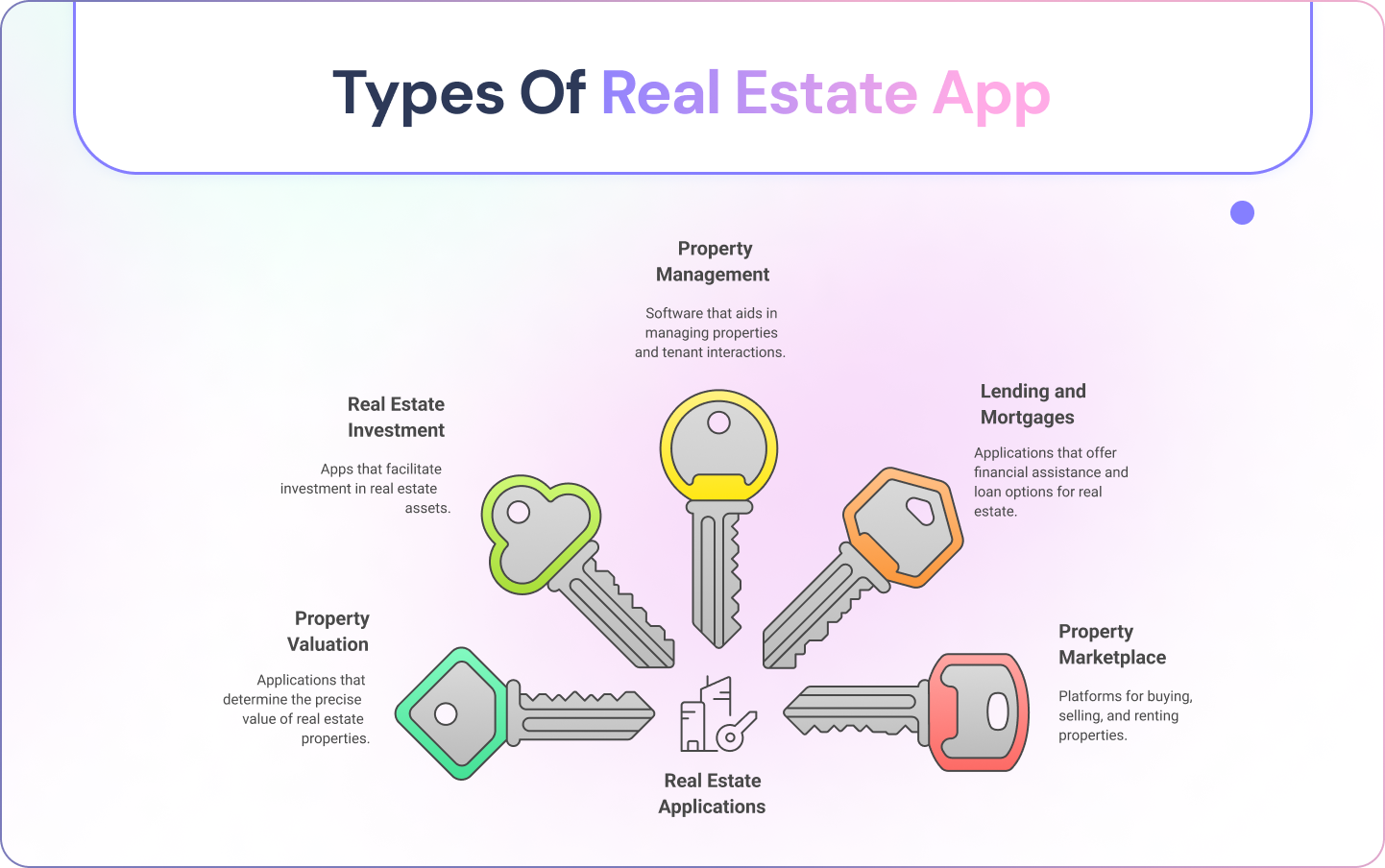
Property Valuation Application
Apps for property evaluation by real estate mobile app development companies determine the precise value of a single flat or house for sale. They rely on data obtained from the proprietor or other internet sources. Businesses and real estate agents may create applications with useful features to engage audiences with the aid of a real estate mobile app development firm.
Apps for Real Estate Investment
Cryptocurrency and equities are not the only ways to invest. One of the earliest types of assets that evolves over time is real estate. In addition to searching for and purchasing real estate, people are thinking about investing in it. To determine the worth of real estate, they do their own investigation and study. People may become full-fledged private property investors with real estate investing applications.
Apps for Property Management
Navigating numerous homes may be difficult, but property management applications make it effortless. This kind of real estate software really serves as a digital assistant, easing communication between landlords and tenants and adding transparency to the renting process. Tenants may pay their rent online, request maintenance, and more with the ease of mobile access. However, automated procedures like rent collecting, financial tracking, and other property management tasks are advantageous to landlords.
Apps for Lending and Mortgages
Numerous financial institutions provide cash or other forms of financial assistance to consumers via these applications. Depending on their company needs, users may select a lender, determine the sort of loan they want, and filter among a variety of loan possibilities.
App for the Property Marketplace
Building a marketplace with all the characteristics needed for purchasing, selling, and renting homes is considered possible by real estate companies. When the general public thinks of a real estate or property app, they think of this kind of software that caters to everyone’s demands.
Key Features of the Real Estate Mobile Application
Onboarding of users
A seamless onboarding experience is the first step to a successful app. Users are more likely to spend time on an app if it is simple to sign up for. The registration and signup procedure should be easy for users to complete when they visit your app.
Adding Search filters
Alternatives like search filters and categories make it easier for users to search and locate properties that meet their requirements. When selecting real estate mobile app development, make sure you understand the elements that your clients find most appealing so that you can seamlessly incorporate them.
Build Your Real Estate App — Get a Free Cost Estimate
See real pricing for listing apps, PropTech platforms & AI features — then get a custom quote for your property business.Interactive Map View
Users may locate properties as well as neighboring sites and services with the use of an interactive map. By giving consumers a precise perspective of the region surrounding the property, the tool improves the browsing experience.
Detailed Property Listings
To assist buyers or renters in making well-informed selections, incorporate comprehensive property listings into your real estate mobile app design. These should include information like location, area, number of accommodations, amenities, pricing, and more.
Mortgage Calculator
By calculating possible monthly mortgage payments depending on the home’s price, down payment, interest rate, and other financial variables, mortgage calculators assist users in creating a budget. It’s an extra function you may include to make your consumers’ life easier.
Call or Chat Options
Provide phone and chat capabilities so users may get in touch with operators fast. Users will be able to respond to enquiries and make choices more quickly as a result. Direct communication will enable people to get in touch with one another and receive the help they need right away.
Breaking down the cost of Real Estate mobile application
You may be wondering how much it costs to create an app right now. When evaluating the cost, there are a number of aspects to take into account, which are listed below:
• Web and Mobile Development
The more sophisticated the features you want to include, the higher the development costs will be. The platform your app will operate on, such as iOS or Android, should also be taken into account. It is better to create cross-platform apps that are compatible with every device & OS.
• Design of UX/UI
A distinctive UI/UX design will provide responsive UI and positive user experiences by examining your target audience.
• Quality and Testing assurance
Before releasing your product to the public, it is vital that you test it. Testing, both automated and manual, will ensure that there are no issues left and that performance is unaffected.
The cost of an easy solution might range from $25,000 to $45,000. The price of advanced real estate applications by app development companies might reach $70,000. The intricacy of the project will determine the total cost of creating a real estate mobile app. The more complex the application you want to create, the more technologies and expertise you’ll need.
Real Estate App Cost Breakdown by Development Component
| Development Component | Basic App | Advanced App | Enterprise App |
|---|---|---|---|
| UI/UX Design | $5,000–$15,000 | $15,000–$35,000 | $35,000–$70,000 |
| iOS App Development | $15,000–$40,000 | $40,000–$90,000 | $90,000–$180,000 |
| Android App Development | $12,000–$35,000 | $35,000–$80,000 | $80,000–$160,000 |
| Backend & API Layer | $10,000–$25,000 | $25,000–$60,000 | $60,000–$120,000 |
| MLS / IDX Integration | $8,000–$20,000 | $20,000–$40,000 | $40,000–$80,000 |
| Map & Location Services | $3,000–$8,000 | $8,000–$20,000 | $20,000–$50,000 |
| AI/ML Features | N/A | $20,000–$60,000 | $60,000–$200,000 |
| Total Estimate | $53,000–$143,000 | $163,000–$385,000 | $385,000–$860,000 |
Step by Step process of developing Real Estate Mobile application
• Decide your requirement
Determining the needs and advantages of corporate real estate applications is the first step. Understanding the business is achieved by defining its characteristics and functionalities, determining its target market, and using intelligent technology.
• Hire a real estate app development company
Hiring a real estate app development company is the next step. Businesses must carefully analyse an app development company’s portfolio, evaluations, and prior work before employing them. You must engage them for your real estate app as soon as you are happy with their level of knowledge.
• UI/UX design
By guaranteeing methodical market and competition study, the skilled UI/UX design team helps real estate companies wireframe the app layout. The designs should be seamless, information-accessible, and easy to understand.
• App development
The process of developing an Android, native, or iPhone app starts as soon as the UI/UX design is complete. A real estate mobile app development business uses agile development approaches to guarantee a methodical and systematic approach, from integrating third-party APIs to adding intelligent features.
• Assurance of Quality and Implementation
The next stage of creating a real estate app by an app development company is checking the application for faults, and resolving problems. The application is prepared for deployment and user presentation after it shows no faults or performance problems.
• Maintenance and Assistance
In order to guarantee seamless operation, real estate apps need to be regularly maintained and supported for issues that appear later.
Summary
The demand for easy-to-use and feature-rich apps is higher than ever as technology continues to change the real estate industry. With so many real estate companies in the market, you need an app that grabs attention and helps you close more deals. This is only possible when you work with a real estate mobile app development company like Auspicious Soft, which has years of experience, creates smooth and reliable apps, and provides support whenever you need it.
FAQs
Q: How much does it cost to build a real estate app in 2026?
Real estate app development costs range from $30,000 for a basic property listing app for a single brokerage to $400,000+ for a full AI-powered PropTech platform with AR tours, investment analysis tools, and an agent CRM. The most common range for a professional real estate marketplace with search, map integration, saved listings, saved search alerts, and agent contact is $70,000–$150,000.
Q: Do I need MLS data for my real estate app?
If you are building a US property search or listing app for public users, yes — you need MLS/IDX data access. This requires a data agreement with your regional MLS and an IDX-compliant data feed provider such as Spark API or SimplyRETS. MLS data licensing typically costs $150–$500/month. International markets have equivalent providers — Rightmove in the UK, Domain in Australia, Immobilienscout24 in Germany.
Q: How long does it take to build a real estate app?
A simple property listing app takes 3–5 months from kickoff to App Store launch. A full marketplace with search, agent tools, saved listings, push notification alerts, and payment integration takes 8–14 months. Adding AR virtual tour integration extends any project by 2–4 months. These timelines include design, development, QA, and App Store/Play Store submission.
Q: What is the best tech stack for a real estate app in 2026?
For cross-platform iOS and Android: React Native or Flutter for the mobile frontend. Google Maps Platform for property maps and location search. Firebase or AWS for the real-time backend. Spark API or SimplyRETS for US MLS property data. Stripe for payment processing. Elasticsearch for full-text property search at scale. AWS S3 and CloudFront for property photo storage and delivery.
Q: How do real estate apps make money?
The most proven real estate app monetisation models are: agent subscriptions ($49–$299/month per agent), featured listing fees from property owners, transaction commissions on rental payments (5–15%), and mortgage lead referral fees ($500–$2,000 per funded loan). Large portals like Zillow generate primary revenue from premier agent advertising — agents pay for prominent placement in zip code search results pages. Data licensing to institutional buyers is a secondary revenue stream for platforms with large proprietary data sets.
Q: What is the difference between a real estate app and a PropTech platform?
A real estate app typically refers to a consumer-facing mobile application for property search, listing, rental management, or agent productivity. A PropTech platform is a broader term for technology-driven real estate infrastructure — which may include apps but also encompasses AI valuation engines, market data analytics, digital closing infrastructure, and enterprise property management systems. Most clients we work with start with a focused real estate app and scale toward a platform over 18–36 months.
Do not Miss Our Latest Tech Insights
Stay one step ahead in the fast-moving world of AI and technology. Add us as a Preferred Source on Google and get our latest articles, guides, and industry insights delivered straight to your search feed.