+1 740 762 6496
 +91 70189 46603


TABLE OF CONTENT
- What Is Agentic AI in Healthcare?
- Agentic AI vs Generative AI vs Chatbots
- Why 2026 Is the Turning Year for Agentic AI in Healthcare
- Our Honest Take: Start Where Mistakes Cost Dollars, Not Lives
- Top Use Cases of Agentic AI in Healthcare
- How Agentic AI Workflows Work in Healthcare
- Agentic AI in Healthcare Cost: Breakdown
- Build vs Buy: Which Path Fits You?
- Risks, Governance and Regulation You Cannot Skip
- How to Start With Agentic AI in Healthcare
- Why Build Your Agentic AI With Auspicious Soft
- FAQs
Overview
- Agentic AI acts. It does not just chat. It completes work across your systems with a human watching the risky steps.
- The fastest wins are on the money side. Prior authorization and claims pay back quickly and rarely touch patient safety.
- Real results are here now. Some prior auth platforms report up to 8x ROI, and claims agents push first pass clean rates from the low 80s into the mid 90s.
- Cost splits in two. A one time build, then a monthly run cost for model use, integrations, and compliance.
- Governance is the hard part, not the model. Decision logs, human review, and audit trails decide whether an agent survives in production.
AI Summary:
Agentic AI in healthcare is software that can set a plan, pull the right data, use approved tools, and finish a full task on its own, inside rules your team sets. The strongest uses are prior authorization, claims, patient scheduling, and clinical notes. A basic agent costs around $15,000 to build. A full healthcare agent usually runs $50,000 to $140,000, and advanced autonomous systems go past $300,000, plus a monthly cost to run it.
A chatbot answers a question. An agent gets the job done. That one line is the whole shift happening in healthcare right now.
What Is Agentic AI in Healthcare?
Think of a capable assistant who has a goal, not a script. You hand it a job. It breaks the job into steps. It reads the records it needs. It uses the tools it is allowed to use. Then it finishes and flags anything odd for a human.
That is agentic AI in healthcare.
The large language model is only the brain. Around it sit four things that make it useful and safe: memory, tools, a plan, and guardrails. Take those away and you are back to a chatbot that guesses. New to the idea? Start with our plain guide to AI agents for business, then come back here.
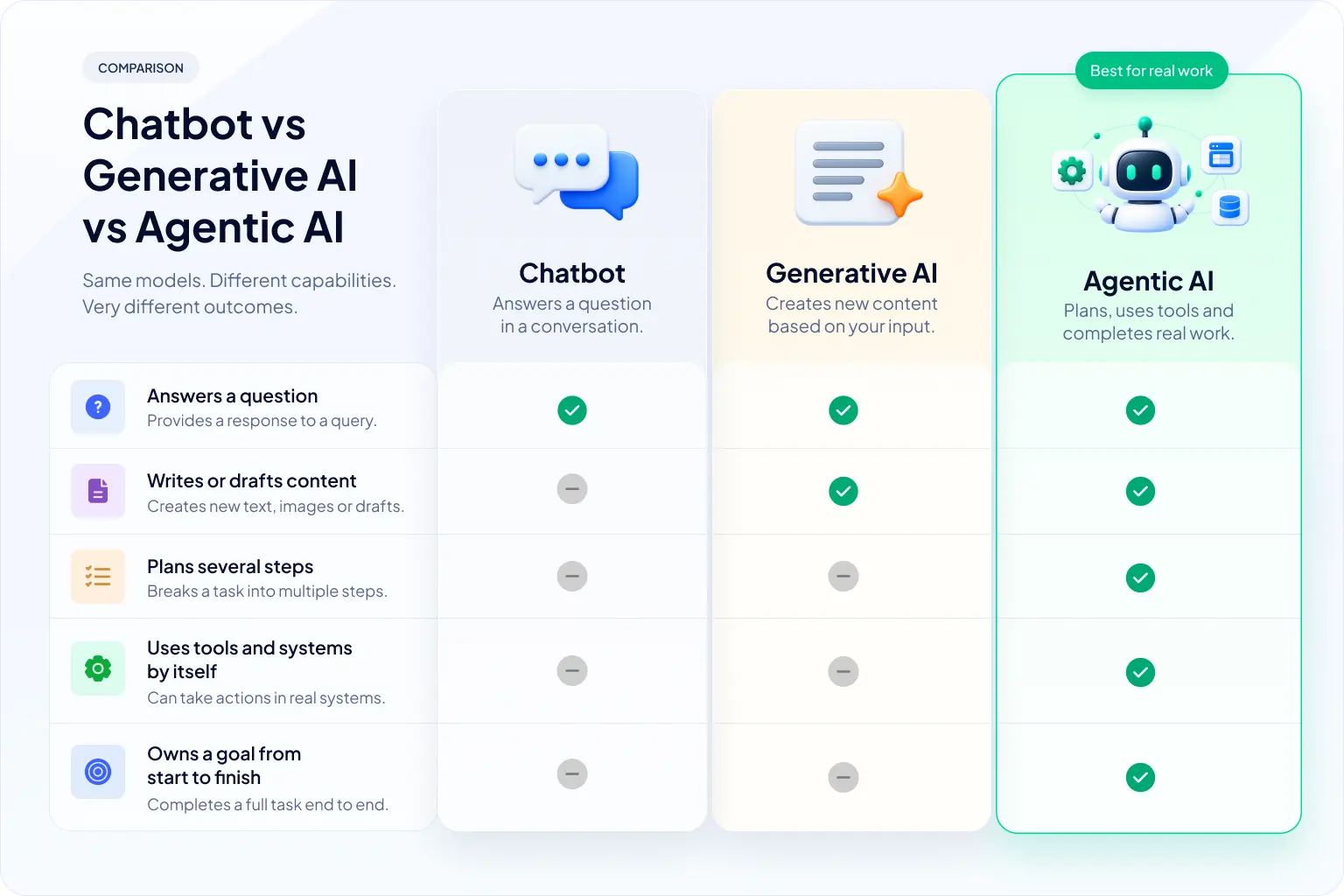
Agentic AI vs Generative AI vs Chatbots
People use these words like they mean the same thing. They do not.
| What It Does | Chatbot | Generative AI | Agentic AI |
|---|---|---|---|
| Answers A Question | Yes | Yes | Yes |
| Writes or Drafts Content | No | Yes | Yes |
| Plans Several Steps | No | No | Yes |
| Uses Tools & Systems By Itself | No | No | Yes |
| Owns A Goal From Start To Finish | No | No | Yes |
Generative AI responds. Agentic AI executes. A note drafting tool gives the doctor a summary. An agent reads the visit, writes the note, codes it, checks it, and queues it. Different jobs. Different value. If a simple assistant is all you need right now, see our AI chatbot development page.
Why 2026 Is the Turning Year for Agentic AI in Healthcare
The push is not hype. It is pain plus proof.
Doctors are drowning in paperwork. Physicians now complete roughly 40 prior authorization requests a week, which burns close to 13 hours of clinician and staff time, and 94% say the process adds to burnout. That is the wound. Agents are the bandage that finally fits.
The money is following fast. The market for agentic AI in healthcare is set to grow from about $1.8 billion in 2026 to nearly $20 billion by 2034, around 35% every year, and healthcare leads all sectors in adoption. Leaders believe it too. Deloitte’s 2026 outlook found that 80% of healthcare executives expect agentic AI to deliver measurable value soon, up from fewer than half in 2024.
But read the fine print. Gartner predicts that over 40% of agentic AI projects will be canceled by the end of 2027 because of rising costs, unclear value, or weak risk controls. So the winners will be the careful ones, not the loud ones.
Our Honest Take: Start Where Mistakes Cost Dollars, Not Lives
Here is where Auspicious Soft parts ways with a lot of the noise.
Most teams want to start with a flashy clinical agent. That is backwards. Start on the money side first. Prior authorization, claims, eligibility. In those workflows an error costs a resubmission, not a patient. The data is clean. The rules are known. And the payback shows up in weeks, not years.
Earn trust there. Build your logs, your review steps, your audit habit. Then move toward the bedside once your team actually believes the agent.
One more warning. Watch out for “agent washing.” Plenty of vendors slap the word agentic on an old chatbot. The test is simple. Ask one question: can it take an action in a real system, or does it only talk? If it only talks, it is not an agent, no matter the label.

What Will Your Agent Cost?
Get a realistic build and run estimate in 24 hours.Top Use Cases of Agentic AI in Healthcare
These are the ones earning their keep today, grouped by where they live.
Administrative and Revenue Cycle Use Cases
This is the sweet spot. Fast ROI, low clinical risk.
Prior authorization. The agent reads the order, pulls the history, matches payer rules, submits, and tracks status. In production, authorization turnaround dropped from 5 to 7 days down to 24 to 48 hours, staff time on prior auth fell by 70%, and initial approvals rose about 30%. US hospitals spend close to $20 billion a year on claim denials, most of them preventable, which is why one agentic prior auth platform reports up to 8x ROI and a 94% provider satisfaction rate.
Claims and denials. Agents scrub claims before they go out and draft appeals after a denial. First pass clean claim rates climbed from 82% to 96%, preventable denials fell 50% to 60%, and teams saved an estimated $3 to $5 per claim in avoided rework.
Eligibility and benefits. The agent confirms coverage and authorization needs before the visit, so the front desk catches problems early instead of eating a denial later.
Patient scheduling. The agent books, reschedules, and fills no show gaps. One scheduling deployment reported 468% ROI and $3.2 million in recovered revenue, mostly from reduced no shows.
Clinical Use Cases
Higher value, higher care needed.
Clinical documentation. This is the most mature clinical use. The agent turns the visit into a structured note so doctors stop charting at midnight. Kaiser Permanente completed the largest generative AI rollout in healthcare history, deploying Abridge ambient documentation across 40 hospitals and more than 600 medical offices.
Patient monitoring and follow up. After surgery, the agent checks in, reads device data, and raises an early flag when recovery drifts off track.
Triage and decision support. The agent gathers symptoms, routes urgent cases to staff, and surfaces the right guidance inside the workflow. Errors here compound into care decisions, so this is where human review stays tight.
Operational Use Cases
Supply chain and inventory. Agents watch usage, predict demand, and trigger reorders. Health system pilots have shown inventory cost cuts of 12% to 18%.
Staffing and capacity. Agents help with scheduling, bed capacity, and shift coverage.
How Agentic AI Workflows Work in Healthcare
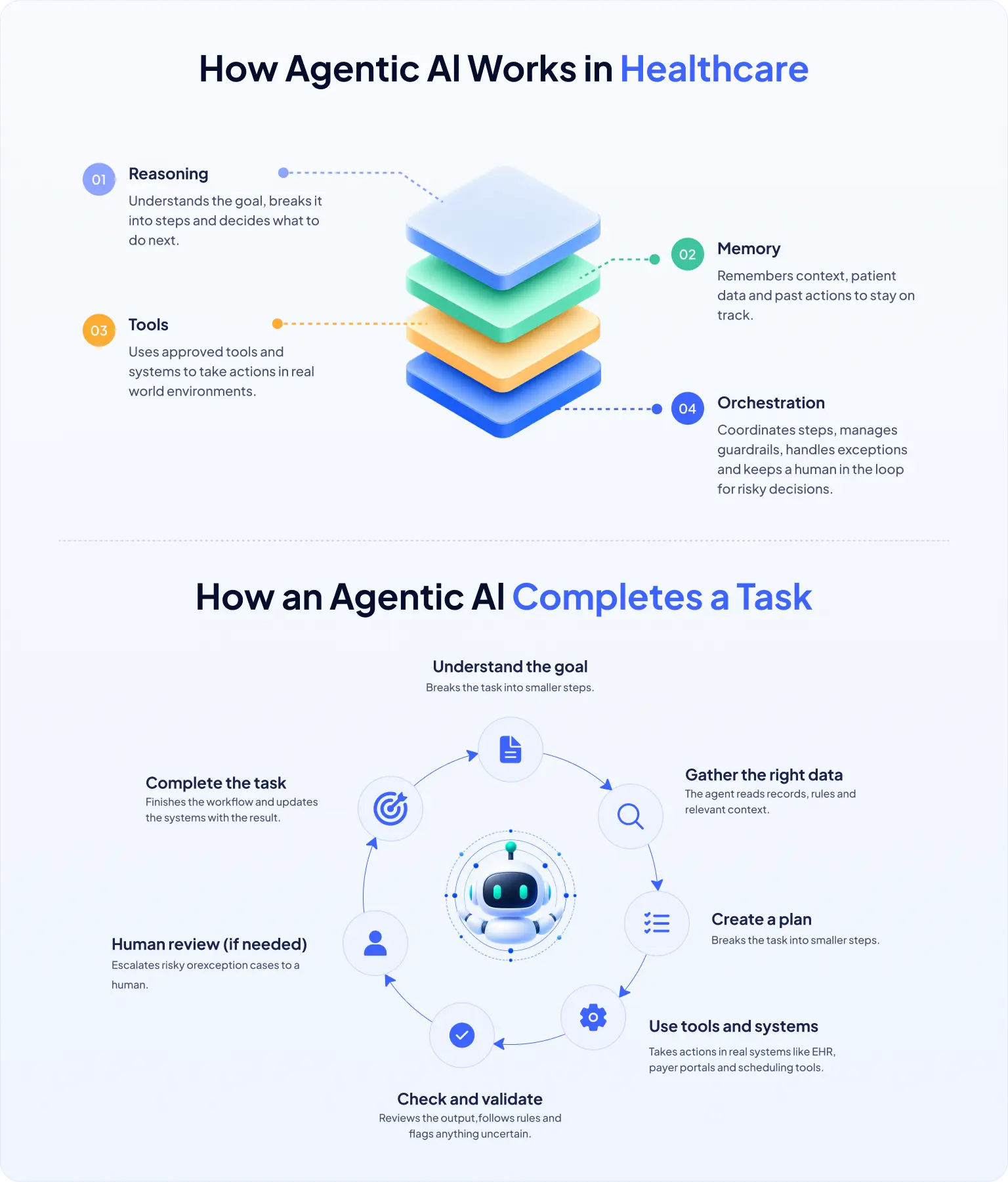
An agent is not one model with a smart prompt. It is a system. Most production healthcare agents share the same four layers.
| Layer | What It Does |
|---|---|
| Reasoning Core | The model that plans and decides the next step. |
| Memory | Short term memory for the task, plus long term memory for context. |
| Tools | Approved actions and APIs, like book_appointment or submit_claim. |
| Orchestration | The controller that checks each step, enforces rules, and logs everything. |
Around those sit retrieval, so the agent pulls real facts instead of guessing, and observability, so every action is recorded. For high stakes care work, the best setup is a hybrid. A fixed workflow for the steps that must never change, plus agent freedom for the reasoning in between. Pure autonomy is too brittle for the clinic. Pure scripting cannot handle the messy cases.
The Agent Loop, Step by Step
- Goal. You give it a clear job.
- Plan. It breaks the job into steps.
- Gather. It pulls records, rules, and schedules.
- Act. It uses approved tools through function calls.
- Check. Guardrails test each output for safety and accuracy.
- Escalate. Anything risky or unclear goes to a human.
- Log. Every decision is saved for audit.
That last step is not paperwork. In healthcare it is the difference between a tool you can defend and one you cannot.
A Real Workflow: Prior Authorization
A doctor orders an MRI. The old way means days of calls and forms.
The agent reads the order. It pulls the patient history. It checks the payer policy. It picks the right clinical evidence. It submits the request. It tracks the reply. If the payer wants more proof, it gathers that too. A staff member only steps in on the odd case. Days of work shrink into minutes of review.
Agentic AI in Healthcare Cost: Breakdown
Here is the straight answer, no fog.
In 2026 the spend splits in two. There is the one time build. And there is the monthly run cost for model use, tool calls, and compliance. Building got easier. Running it well at scale is where the real money sits now.
| Type Of Agentic AI in Healthcare | What It Handles | Build Cost (USD) | Monthly Run Cost |
|---|---|---|---|
| Basic Agent | FAQ, Reminders, Simple Intake | $15,000 To $35,000 | $500 To $2,000 |
| Workflow Agent | Scheduling, Prior Auth, Claims | $40,000 To $120,000 | $1,500 To $5,000 |
| Advanced Autonomous Agent | Multistep Clinical & Revenue OPS | $120,000 To $300,000+ | $5,000 To $20,000+ |
For a full end to end healthcare agent, build budgets often land between $50,000 and $140,000 before monthly maintenance. Healthcare sits at the top of the market on purpose. The compliance, audit trails, and safety checks are not optional here.
What moves the number:
- Compliance. HIPAA work, audit logs, and bias testing add real cost. Add them late, and you pay twice.
- Integrations. Every EHR and payer portal the agent touches adds scope.
- Autonomy. More freedom means more guardrails, which means more build time.
- Maintenance. Plan for about 15% to 30% of the build cost every year to keep it running well.
One honest point. Most production deployments reach positive ROI within 12 to 18 months, and the admin side can show results much faster.
Build vs Buy: Which Path Fits You?
Off the shelf tools are fast but rigid. They may not fit your EHR, your rules, or your edge cases. Custom gives you fit, control, and an audit trail you own. It costs more up front and pays back when the agent touches money and safety.
Our take: buy the generic parts, build the parts that are core to your care and compliance. Most teams win with a mix.
What Will Your Agent Cost?
Get a realistic build and run estimate in 24 hours.Risks, Governance and Regulation You Cannot Skip
A smart agent with no guardrails is a liability. Full stop.
Hallucination is real. In agent based clinical systems, hallucinations still touched about 30% of clinical scenarios even after mitigation. Retrieval helps, but it reduces the risk, it does not erase it. That is exactly why a human reviews the high risk steps.
The rules are moving. The FDA has authorized more than 1,250 AI enabled medical devices, and none of them is generative or agentic yet, so the line for classifying an agent as a regulated device is still unsettled. At the same time, starting March 2026 the CMS prior authorization rule requires health plans to publicly report turnaround times, approval rates, and appeal outcomes, with an auditable reason for every AI assisted denial. And the EU AI Act, phasing in through 2026, classifies many healthcare AI tools as high risk, with duties for data governance and human oversight.
Agent sprawl is the quiet danger. Spin up too many agents with no control and you get waste, overlap, and compliance gaps.
Good governance looks boring and that is the point. Decision logs with access rights. Model change alerts. Bias testing on file. Clear audit rights before any agent goes live. A human in the loop on anything that reaches a patient.
How to Start With Agentic AI in Healthcare
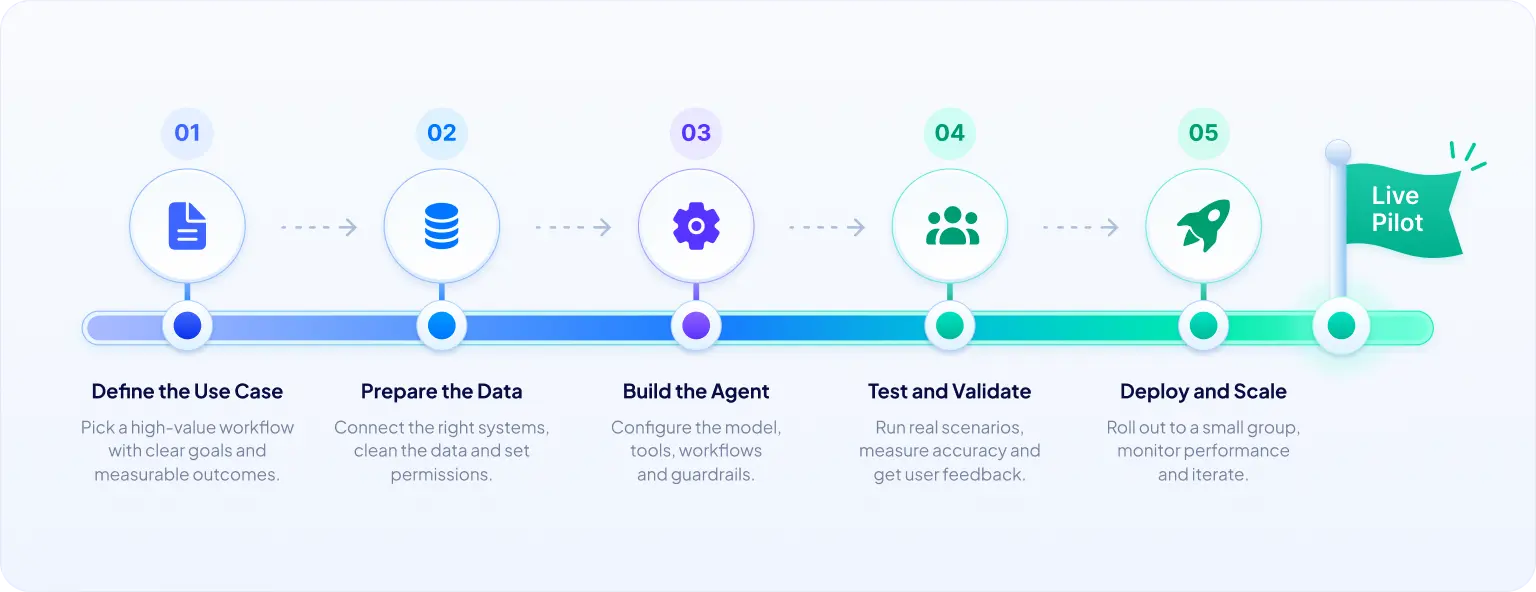
A simple path that works.
- Pick one narrow, painful workflow. Prior auth for a single specialty is a classic first win.
- Set a clear goal and a review threshold. Decide what the agent handles alone and what it escalates.
- Build small, with logging from day one. Observability is not a later task.
- Measure in weeks. Track turnaround, denial rate, and staff hours saved.
- Harden, then expand. Lock the integrations, then point the next agent at the next leak.
Why Build Your Agentic AI With Auspicious Soft
Auspicious Soft has built custom software and AI, for startups and large teams across India and the USA. We design healthcare agents that fit your workflow, follow HIPAA, and show their work on every step.
We start small, prove value, then scale. No giant risky launch. Just steady wins your team can trust.
FAQs
Q: What is agentic AI in healthcare in simple words?
It is AI that plans and finishes full tasks on its own, inside your rules. It acts, it does not just reply.
Q: How is agentic AI different from generative AI?
Generative AI writes and answers. Agentic AI takes action across your systems to complete a goal.
Q: Is agentic AI in healthcare safe and HIPAA ready?
It can be, when built right. You need access limits, encryption, human review, and full audit logs, all from day one.
Q: How much does agentic AI in healthcare cost?
A basic agent starts near $15,000. A full healthcare agent often runs $50,000 to $140,000 to build, and advanced systems pass $300,000, plus a monthly run cost.
Q: Which use case gives the fastest ROI?
The money side. Prior authorization and claims pay back fastest and carry low clinical risk.
Q: Will agentic AI replace doctors and nurses?
No. The strong 2026 uses support staff. They cut admin work and flag issues. Humans still decide care.
Q: How long does it take to build a healthcare agent?
A simple agent can go live in a few weeks. A full workflow agent usually takes a few months, mostly due to integration and compliance.
Do not Miss Our Latest Tech Insights
Stay one step ahead in the fast-moving world of AI and technology. Add us as a Preferred Source on Google and get our latest articles, guides, and industry insights delivered straight to your search feed.