+1 740 762 6496
 +91 70189 46603

TABLE OF CONTENT
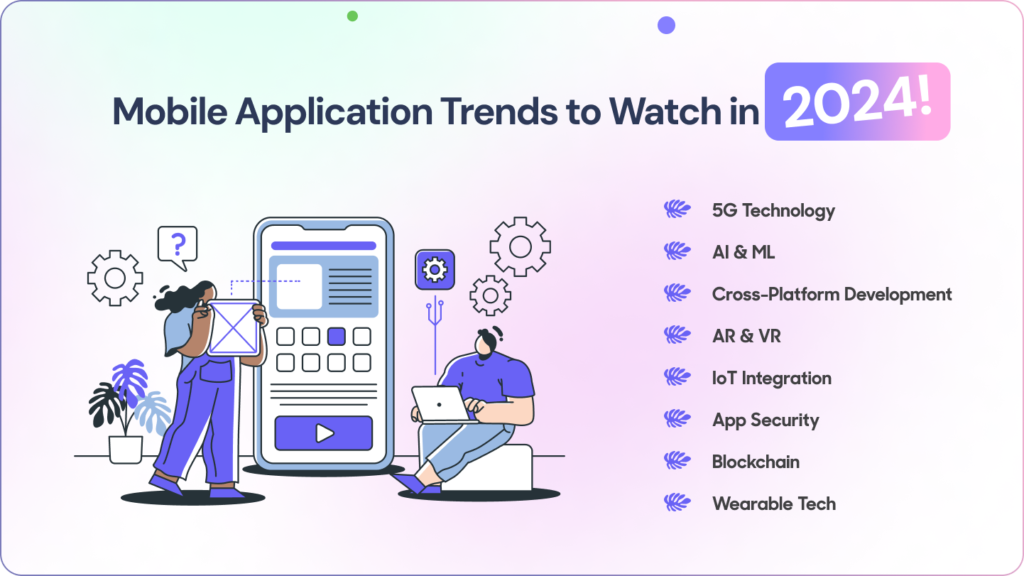
- The Future of Mobile App Development: Trends to Watch in 2024
- 5G Technology: Revolutionizing Mobile Experiences
- Artificial Intelligence and Machine Learning: Smarter Apps
- Cross-Platform Development: Efficiency Meets Performance
- Augmented Reality and Virtual Reality: Beyond Gaming
- Internet of Things (IoT): Connected Everything
- Increased Focus on App Security
- Blockchain Technology: Secure and Transparent Transactions
- Wearable Technology: Extending Mobile Experiences
- 2026 Mobile App Trends Comparison
- Conclusion
- FAQs
Overview
- 5G enables sub-10ms latency and 10Gbps speeds, making real-time AR, cloud gaming, and IoT apps viable.
- On-device AI via Apple Intelligence and Gemini Nano makes every mobile app genuinely intelligent in 2026.
- Flutter and React Native now deliver near-native performance, making cross-platform the dominant choice in 2026.
- AR in retail, healthcare, and real estate delivers 40% higher conversion rates than non-AR alternatives.
With time the concept of mobile app development has kept changing quickly. In today’s scenario the businesses need to keep ahead of the curve to stay competitive in light of evolving user expectations and technology improvements. In order to make sure that their apps not only meet but also surpass customer expectations, those who invest in custom mobile app development must keep a watch on developing trends.
The global mobile app market generates $935 billion in 2026. 7 billion mobile devices are in use globally. AI features are present in 91% of top-performing mobile apps. 5G now covers 40% of the global population.
The key developments in mobile app development that developers should keep a careful eye on in 2024 will be discussed in this blog.
1. 5G Technology: Revolutionizing Mobile Experiences
5G has moved from future promise to present reality in 2026. Global 5G coverage now reaches 40% of the world’s population, with the United States achieving 95% coverage in major metropolitan areas through T-Mobile, Verizon, and AT&T networks. For mobile app developers, 5G changes what is architecturally possible: sub-10ms latency enables real-time AR experiences that feel physically anchored to the real world (impossible on 4G), 10Gbps peak download speeds make cloud-streamed gaming with console-quality graphics viable on a phone, and 5G’s network slicing capability allows mobile apps to request dedicated bandwidth for latency-critical operations. The practical implication for app businesses: features that were technically feasible but practically unusable on 4G (live multi-person AR collaboration, real-time 4K video analysis, connected vehicle interfaces) are now production-ready applications.
With the help of 5G, mobile app developers will be able to create apps with improved features like virtual reality (VR), augmented reality (AR), and real-time video streaming. With the faster data transfer, lower latency, and smoother operation, these apps can really be beneficial to provide a more enjoyable user experience. Businesses will have a major advantage in the coming time when it comes to providing their clients with new tech solutions if they include 5G into their custom apps.

Ready to Build an App with 2026's Winning Tech Stack?
91% of top apps now use AI — make sure yours does too.2. Artificial Intelligence and Machine Learning: Smarter Apps
The AI landscape for mobile apps has transformed fundamentally between 2024 and 2026. Apple Intelligence (on-device AI across the iPhone 16 lineup and newer) and Google’s Gemini Nano (on-device AI on Pixel 9 and Android flagships) have moved AI from a cloud-dependent luxury to an on-device capability available to every major platform. This means mobile apps can now access AI features — natural language understanding, image analysis, personalization, text generation — without an internet connection, with near-zero latency, and without sending user data to external servers. In 2026, AI features are present in 91% of top-performing mobile apps across all categories. Apps without AI personalization are now at a meaningful competitive disadvantage for user retention and engagement.
AI-driven chatbots, for example, can offer real-time customer service, and machine learning algorithms can study user behaviour to provide recommendations and material that is specifically targeted to them. Additionally, mobile app developers will employ AI to improve app performance, foresee possible problems before they happen, and bolster security via sophisticated threat detection.
Custom apps will becoming smarter, more user-friendly, and more tailored to their customers’ individual needs as AI and ML continue to advance.
3. Cross-Platform Development: Efficiency Meets Performance
The cross-platform vs. native debate has been largely resolved in 2026 in favor of cross-platform for most business use cases. Flutter’s Impeller rendering engine (default on iOS, rolling out on Android) delivers consistent 60-120fps animations that are functionally indistinguishable from native for the vast majority of app interactions. React Native’s New Architecture (JSI, Fabric, TurboModules) has eliminated the legacy JavaScript bridge’s performance bottleneck. The result: 70% of new mobile apps launched in 2026 use cross-platform frameworks, driven by 30-40% cost savings, simultaneous iOS/Android launch capability, and a unified codebase that requires one team instead of two. Native development remains the right choice for apps requiring deep platform-specific hardware access or maximum graphics performance — but for most business, consumer, and productivity apps, cross-platform is the rational default.
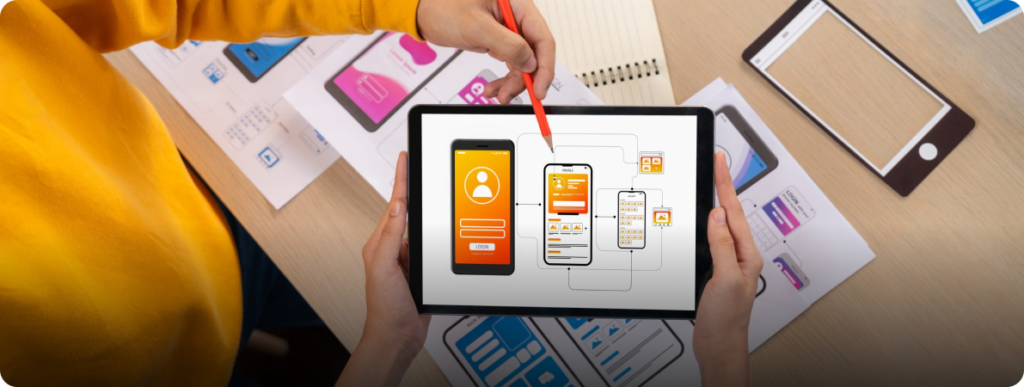
The efficiency of cross-platform development lies in its ability to reduce development time and expenses. Developers may write code once and deliver it across different platforms. But by 2024, the emphasis will be on striking a balance between performance and efficiency. It is imperative for mobile app developers to guarantee that cross-platform applications provide a seamless, native-like experience.
4. Augmented Reality and Virtual Reality: Beyond Gaming
Augmented reality has crossed the adoption threshold from novelty to functional business tool in 2026. IKEA Place (AR furniture placement), Sephora Virtual Artist (AR makeup try-on), and Zillow’s 3D Home tours have collectively demonstrated that AR in commerce drives measurable conversion improvements — IKEA reports 40% higher purchase confidence among AR users compared to photo-only browsing. Apple’s Vision Pro and ARKit 8 have advanced spatial computing capabilities, while Google’s ARCore runs on 2+ billion Android devices, giving AR developers a massive addressable installed base for the first time. The mobile app categories showing the strongest AR adoption and business impact in 2026 are retail (product try-on), real estate (virtual tours), healthcare (surgical training and patient education), and industrial maintenance (step-by-step AR repair guidance).
For instance, AR can be used by retail apps to let users see things in-home before they buy them. Medical personnel can receive VR-based training simulations through healthcare apps. Mobile app developers will be essential in making these creative concepts a reality by developing unique solutions that use AR and VR to offer benefits beyond amusement.
5. Internet of Things (IoT): Connected Everything
With time, more devices are being connected to the Internet of Things, which is still growing. In coming days we all will be seeing a growing emphasis on IoT integration in custom mobile app development to provide seamless device connectivity.
Wearable technology and smart home systems are just two of the examples of the many IoT devices that mobile app developers will need to create apps for. These applications will have to maintain device synchronization, handle huge volumes of data, and offer real-time updates. IoT integration can present new possibilities for data collecting, automation, and individualized user experiences for enterprises.
Custom apps with the ability to connect and control these devices efficiently will become indispensable as the Internet of Things expands.
6. Increased Focus on App Security
App security will continue to be a primary concern in the coming time due to the increase in cyberattacks. To safeguard user data and guarantee compliance with laws like the CCPA and GDPR, custom mobile app development must include strong security measures.
It is important for mobile app developers to remain alert regarding potential vulnerabilities and incorporate advanced security features, such as secure APIs, biometric authentication, and end-to-end encryption. Businesses need to spend money on bespoke apps that can help them to protect sensitive data and uphold user confidence as fraudsters become more skilled.
7. Blockchain Technology: Secure and Transparent Transactions
Mobile app development is incorporating blockchain technology, which is most recognised for powering cryptocurrency. 2024 will see a growing use of blockchain in custom mobile app development to improve transaction security, transparency, and traceability.
Decentralized apps that provide safe peer-to-peer transactions, data integrity, and fraud protection can be made by mobile app developers using blockchain technology. Blockchain integration may greatly help industries like finance, supply chain, and healthcare by giving users more accountability and confidence.
The use of blockchain in custom mobile app creation will grow as it develops, opening us new avenues for safe and open communication.
8. Wearable Technology: Extending Mobile Experiences
Wearable technology is becoming more and more commonplace, with gadgets like augmented reality glasses, activity trackers, and smartwatches gaining popularity. By developing apps that expand the mobile experience to wearables, custom mobile app development will need to meet the needs of this expanding trend by 2024.
Creating apps that work with different wearables and provide features like health tracking, notifications, and seamless smartphone connectivity will be the responsibility of mobile app developers. By fusing wearable technology with mobile app convenience, businesses will be able to provide customers a comprehensive experience.
2026 Mobile App Trends Comparison
| Trend | Current Adoption (2026) | Business Impact | Implementation Cost | Priority for 2026 |
|---|---|---|---|---|
| AI/ML Integration | 91% of top-performing apps | Very High | $15K – $150K | Critical |
| 5G Optimization | 45% of new mobile apps | High | $5K – $20K | High |
| Cross-Platform (Flutter/React Native) | 70% of new apps | Very High | Saves 30–40% development cost | Essential |
| AR Features | 23% of retail & ecommerce apps | High | $25K – $100K | Category Dependent |
| Super App Features | Growing rapidly across industries | Medium-High | $200K – $500K+ | Strategic |
| Blockchain Integration | 8% of finance-focused apps | Medium | $30K – $100K | Niche |
| IoT Integration | 34% YoY growth | High in industry-specific use cases | $20K – $80K | Industry Dependent |
Conclusion
There are a tonne of intriguing opportunities for mobile app development as we approach 2024. The industry’s emerging trends—from blockchain and IoT to 5G and AI—will change how companies approach developing custom mobile apps. To provide creative, safe, and user-focused solutions, mobile app developers must keep ahead of these developments.
Businesses should make sure they stay competitive in a constantly changing digital world by embracing these emerging technologies and concentrating on developing customised apps that cater to the specific demands of their clientele. The creation of mobile apps has a bright future ahead of it, and those who follow these trends will be in a strong position to succeed.
Ready to Build an App with 2026's Winning Tech Stack?
91% of top apps now use AI — make sure yours does too.FAQs
Q: What are the biggest mobile app trends in 2026?
The five most impactful mobile app trends in 2026 are:
- On-device AI integration (Apple Intelligence, Gemini Nano) enabling personalized experiences without cloud dependency.
- 5G-powered real-time features (AR, cloud streaming, sub-10ms interactions).
- Cross-platform dominance — Flutter and React Native capturing 70% of new app development.
- Super app consolidation — single apps replacing multiple specialized apps.
- Privacy-first design driven by stricter regulations and user demand for data control.
Q: Will AI replace mobile app developers in 2026?
AI coding tools (GitHub Copilot, Cursor, Claude) are reducing development time by 30-50% for experienced developers — but they are augmenting developers, not replacing them. AI generates code well but requires experienced developers to architect systems, evaluate code quality, make trade-off decisions, and integrate AI-generated code safely. The developers at risk are those who refuse to adapt to AI-assisted workflows; those who embrace AI tools are delivering more features in less time and commanding higher rates. Net developer demand remains strong in 2026 despite AI advancement.
Q: Is 5G important for mobile app development in 2026?
5G is important for specific app categories — AR/VR experiences, real-time collaboration, connected vehicle interfaces, and cloud gaming — that require the low latency and high bandwidth 5G provides. For most business, productivity, and consumer apps, 5G improves performance but does not enable fundamentally new features. Develop for 4G as your baseline and treat 5G as a performance enhancement layer for features that benefit from it — do not require 5G as a prerequisite that excludes the 60% of users not yet on 5G coverage.
Q: What mobile app development trend has the best ROI in 2026?
AI personalization (specifically, recommendation engines and adaptive content delivery) has the best documented ROI among 2026 mobile app trends. Apps with AI personalization see 35% higher Day-30 retention, 26% longer session duration, and 3x higher in-app purchase conversion rates compared to non-personalized equivalents. The implementation cost ($15,000-50,000 for integration with existing personalization platforms like Braze or Amplitude) is the most favorable cost-to-impact ratio of any current mobile trend.
Q: Should I build a cross-platform or native app in 2026?
For 90% of mobile app projects in 2026, cross-platform development with Flutter or React Native is the right choice. It saves 30-40% of development cost, launches on iOS and Android simultaneously, and delivers near-native performance that users cannot distinguish from native in everyday use. Native development (SwiftUI, Jetpack Compose) is worth the premium only for: apps requiring deep platform-specific hardware integration (advanced camera APIs, AR Kit-exclusive features, complex Android sensor access), apps where maximum graphics performance is a core requirement (3D games, real-time video processing), and enterprise apps deployed exclusively on one platform where the native integration advantages justify the cost.
Do not Miss Our Latest Tech Insights
Stay one step ahead in the fast-moving world of AI and technology. Add us as a Preferred Source on Google and get our latest articles, guides, and industry insights delivered straight to your search feed.