+1 740 762 6496
 +91 70189 46603


TABLE OF CONTENT
- What Is RAG in Simple Words
- RAG Implementation Cost in 2026: The Quick Answer
- What Drives RAG Cost Up or Down
- What a RAG System Really Costs Each Month
- A Real RAG Cost Example With Worked Numbers
- Hidden RAG Costs That Wreck Budgets
- How to Cut RAG Cost Without Cutting Quality
- The Future of RAG in AI
- Build RAG or Buy a Tool: A Straight Answer
- How Auspicious Soft Builds RAG
- FAQs
Overview
- A basic RAG build starts near $15,000. A complex agentic RAG build can pass $300,000.
- Running costs never stop. Plan for $500 to $3,000 a month for most setups, and more at scale.
- Data cleanup is the real budget killer, not the model and not the vector database.
- Output tokens cost 3 to 6 times more than input. Caching and batching cut your bill fast.
- You do not need the biggest model. Right sized retrieval beats a bigger brain.
- RAG is not dead. Agentic RAG is the main pattern in 2026.
- Start small. A pilot on one dataset can prove value before you spend six figures.
AI Summary:
RAG, short for Retrieval Augmented Generation, lets an AI model answer from your own documents instead of memory, which cuts hallucinations. In 2026, a RAG build costs about $15,000 to $120,000, and enterprise or agentic systems can pass $300,000. Running costs sit around $500 to $3,000 a month, covering model API calls, a vector database, cloud hosting, and upkeep. Output tokens cost 3 to 6 times more than input, so caching and batching lower the bill.
The biggest hidden cost is data cleanup, not the model or the database. Real vector database bills often run 2.5 to 4 times higher than the pricing page. Agentic RAG is the leading pattern in 2026. Auspicious Soft builds custom RAG systems for startups and enterprises across the USA.
How much does a RAG system cost to build in 2026? Most projects land between $15,000 and $120,000 for the build, plus about $500 to $3,000 a month to run. A small internal search bot sits at the low end. A full agentic setup for a bank sits far above it, often past $300,000.
Now the part most guides bury. Teams almost always blow their budget. Real vector database bills run 2.5 to 4 times higher than the pricing page. Why? The model and the database are rarely the expensive part. Your messy data is.
This guide gives you real 2026 numbers, live tool costs, the hidden fees, a worked example, and where the future of RAG in AI is headed. It is grounded in current pricing and a team that has shipped 200+ projects since 2018. Auspicious Soft is a custom software development company that builds these systems for startups and enterprises across the USA.
What Is RAG in Simple Words
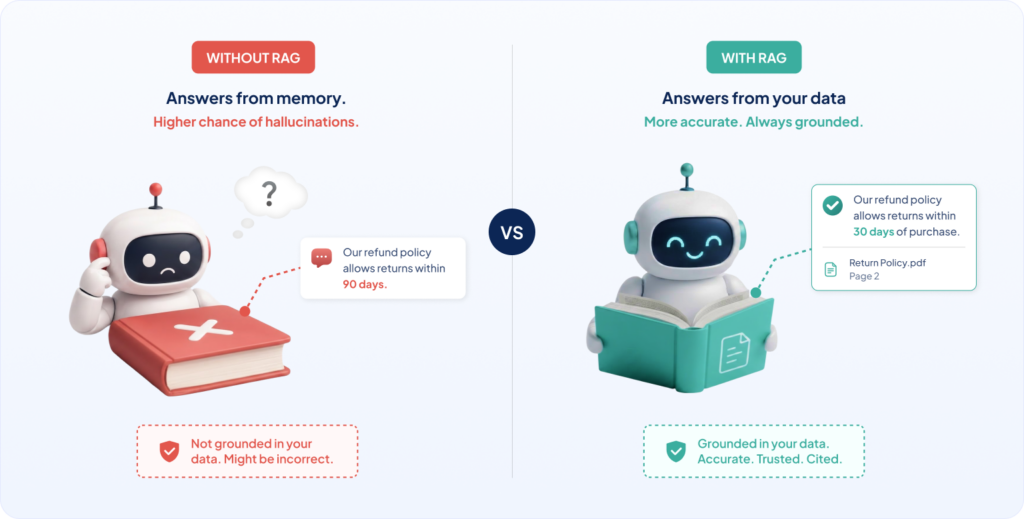
RAG stands for Retrieval Augmented Generation. Think of it as an open book exam for AI. A normal model answers from memory. A RAG model checks your documents first, then answers.
The flow is short. You ask a question. The system searches your data for the best matches. It hands those snippets to the model. The model writes an answer grounded in your facts.
Why does this matter so much? One reason. It cuts hallucinations. The AI stops guessing and starts citing your real content. For the deeper theory, the original RAG paper from 2020 lays out the idea. For a plain walk through of the plumbing, this explainer on how retrieval augmented generation works is a solid start.
RAG now sits at the core of most business AI. Chatbots, copilots, internal search, support tools. Many of these are just RAG under the hood. That is why the AI and ML development services team at Auspicious Soft gets more RAG requests than any other kind of build.
RAG Implementation Cost in 2026: The Quick Answer
Price follows scope. A bot that reads one folder is cheap. A system that reasons across ten sources with agents is not. Here is the honest spread.
| Project type | What it does | Typical build cost | Typical timeline |
|---|---|---|---|
| Simple RAG Bot | Answers questions from a single, well-structured knowledge source with a basic chat interface. | $15,000–$35,000 | 3–6 weeks |
| Mid-Size RAG Application | Connects to multiple data sources with a custom UI, user authentication, roles, logging, and analytics. | $40,000–$90,000 | 8–16 weeks |
| Enterprise or Agentic RAG Platform | Supports multiple knowledge sources, AI agents, governance, compliance, advanced security, and enterprise integrations. | $100,000–$300,000+ | 4–9 months |
Read this as a starting band, not a fixed quote. Two projects with the same feature list can differ by half based on data quality alone. Compliance heavy work in finance or healthcare adds another $15,000 to $50,000 on top.
What Drives RAG Cost Up or Down
A few things move the number more than anything else.
- Data sources. One clean source is simple. Ten messy ones full of PDFs, images, and old databases push cost up fast.
- Data quality. Clean text is cheap to index. Scanned files, tables, and duplicates need heavy prep.
- Accuracy needs. A support bot can be good enough. A medical or legal tool must be near perfect, and that testing costs real money.
- Users and scale. Ten users is easy. Ten thousand users need caching, monitoring, and stronger hosting.
- Rules and compliance. Finance and healthcare add access controls, logs, and audits, which stretch both budget and timeline.
See the pattern? Most of these are about your data and your rules, not the AI model itself.
Skip The Trial and Error
Ship a working RAG pilot in weeks with a team that has delivered 200+ projects since 2018.What a RAG System Really Costs Each Month
The build is one bill. Running it is another. These repeat every month.
| Cost item | What it covers | Typical monthly cost |
|---|---|---|
| Model API Calls | AI model usage for processing prompts and generating responses (input and output tokens). | $100–$2,000/month |
| Vector Database | Storing, indexing, and searching embeddings for fast and accurate retrieval. | $45–$700/month |
| Cloud Hosting | Infrastructure for the application, APIs, queues, caching, monitoring, and scaling. | $200–$2,000/month |
| Data Refresh & Maintenance | Reindexing data, updating knowledge sources, prompt tuning, and maintaining retrieval quality. | $300–$2,500/month |
Two of these hide traps. Let us price them out.
Model API Cost By Tier
You pay per token. Input is what you send, which includes your prompt plus all the retrieved text. Output is what the model writes back.
| Model tier | Best use in RAG applications | Typical price per 1M tokens (input / output) |
|---|---|---|
| Budget Models | High-volume workloads, FAQs, simple knowledge retrieval, and basic search. | $0.10–$0.30 input / $0.30–$0.60 output |
| Value Models (Most RAG Apps) | Customer support, enterprise search, AI copilots, and general-purpose RAG systems. | $2–$3 input / $10–$15 output |
| Frontier Models | Complex reasoning, AI agents, multi-step workflows, compliance, and high-stakes decision support. | About $5 input / $25–$30 output |
Output costs 3 to 6 times more than input on almost every provider. So trimming answer length saves more than trimming your prompt. Prompt caching cuts repeated input by about 90 percent. Batch jobs run at half price. In 2026, Claude Sonnet 5 is a strong value pick and Claude Opus 4.8 sits at the frontier tier, while budget models like DeepSeek stay near the bottom. Prices move often, so check current model API pricing before you set a budget.
Vector Database Cost By Scale
| Vector database setup | Best for | Typical monthly cost |
|---|---|---|
| Free Tier or pgvector | MVPs, prototypes, and applications with fewer than 500,000 vectors. | $0–$50/month |
| Managed Database (10 Million Vectors) | Most production RAG applications with reliable performance and scaling. | $45–$135/month |
| Managed Database (100 Million+ Vectors) | Large enterprise search platforms and AI systems with massive knowledge bases. | $700+/month |
A Real RAG Cost Example With Worked Numbers
Numbers beat theory. Say you run a support RAG that answers 50,000 questions a month. Here is a realistic monthly bill. Your data will shift these figures, so treat it as a model, not a promise.
Assumptions:
- A value tier model at about $3 per million input tokens and $15 per million output tokens
- Each answer uses about 3,000 input tokens (prompt plus retrieved text) and 600 output tokens
- A few million stored vectors on a managed database
The Math:
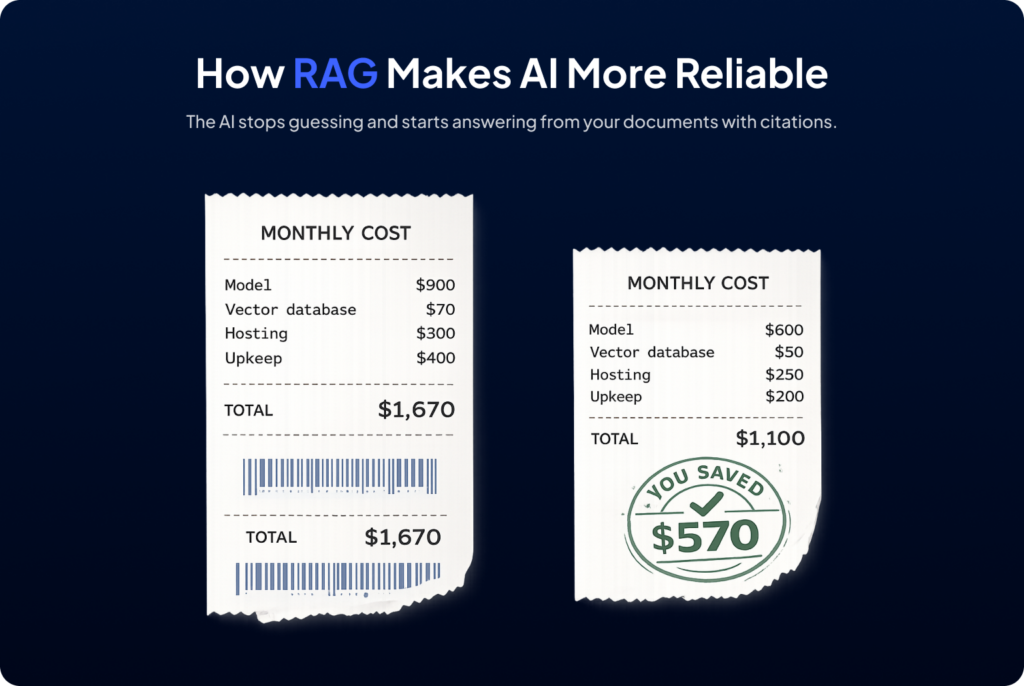
- Input: 50,000 x 3,000 = 150 million tokens, about $450
- Output: 50,000 x 600 = 30 million tokens, about $450
- Model calls total: about $900
- Vector database: about $70
- Cloud hosting: about $300
- Reindexing and upkeep: about $400
- Monthly total before tuning: about $1,670
Now turn on two settings. Cache the repeated system prompt, so most input drops by roughly 90 percent. Batch the non urgent jobs at half price. Model cost can fall by a third or more.
- Monthly total after tuning: about $1,100
Same system. Same answers. A few smart settings cut the bill by hundreds of dollars a month. That tuning is what a careful build includes and a rushed one skips.
Hidden RAG Costs That Wreck Budgets
This is where projects break. The sticker price looks fine. Then these show up.
Data cleanup. Your files are messy. They always are. Fixing, chunking, and tagging them is often the biggest single line item. On some builds it rivals the entire backend cost. Plan for it early, not late.
Evaluation and testing. A RAG system that sounds smart but cites the wrong page is worse than no bot at all. Testing retrieval quality takes time, and it is the first thing teams cut. Do not cut it.
Security and access. Not every user should see every document. Building access rules at the retrieval layer, not just the login screen, is quiet work that adds up.
Drift and upkeep. Your data changes. New docs, new policies, dead links. Without regular reindexing, answers rot over time. This is a monthly cost, not a one time task.
The blunt opinion. Most companies waste half their RAG budget on the wrong 80 percent of their documents. They dump everything into the index, pay to store and search it all, and still get weak answers. The winners index the small slice that answers real questions and skip the rest. Less data, cleaner data, better answers, lower bill.
How to Cut RAG Cost Without Cutting Quality
You can spend less and still ship something great. A few rules help.
Start small. Pick one high value use case. Prove it works. Then grow. A pilot on one dataset can cost a fraction of a full build.
Skip the from scratch model. Training your own model runs into the millions. Hosted models cost only a few dollars per million input tokens. Use them. Fine tune only when you truly must.
Right size the model. The biggest model is rarely needed. A smaller, cheaper model with strong retrieval often beats a giant model with weak retrieval.
Turn on caching and batching. These two switches alone can shave a third off your monthly bill, as the example above showed.
Reuse proven tools. Frameworks like LangChain and LlamaIndex handle the wiring. Vector stores like Pinecone, Qdrant, Weaviate, and Chroma handle search. No need to build these from zero.
Clean less, but clean smart. You do not need to index everything. Index the documents that answer real questions. Skip the rest for now.
RAG usually lives inside a product, not on its own. If you are adding it to an app or a site, pair it with solid mobile app development or a strong base from a proven web development team so the AI has a clean home.
The Future of RAG in AI
Some people claim big context windows killed RAG. They did not. Bigger context made retrieval smarter, not pointless. You still cannot stuff a whole company knowledge base into one prompt cheaply. Retrieval keeps costs down and answers sharp.
So where is the future of RAG in AI going? A few shifts stand out for 2026.
Agentic RAG is the main pattern now. Instead of one search and one answer, agents plan. They decide when to search, what to search, and whether the result is good enough. If not, they search again. It reads less like a pipeline and more like a small team of checkers.
Hybrid search is standard. Keyword search plus meaning based search, working together, beat either one alone.
Multimodal RAG is rising. Not just text anymore. Images, tables, audio, and charts now feed the answer.
Knowledge graphs add trust. Linking facts in a graph helps the AI reason from complete, connected data instead of loose scraps.
Private and on device RAG is growing. For sensitive data, more teams keep retrieval in house rather than sending everything to a public API.
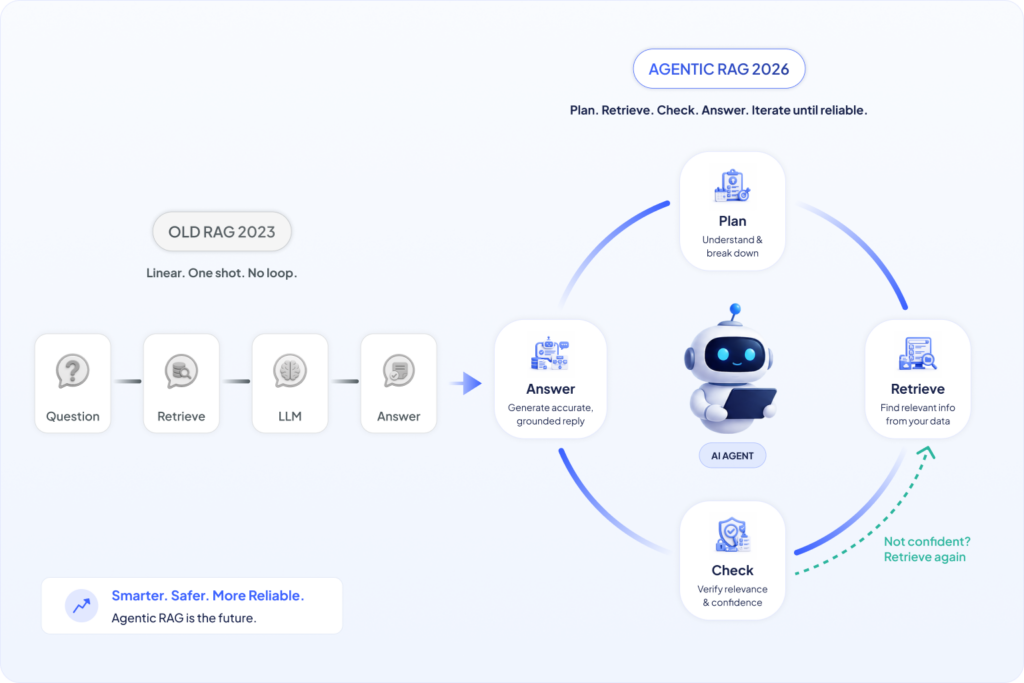
Here is the take. The future of RAG in AI is not about a bigger brain. It is about smarter retrieval, tighter guardrails, and answers you can trust. Teams that get the data layer right will win. The ones chasing the shiniest model will keep paying for weak results.
Build RAG or Buy a Tool: A Straight Answer
Off the shelf tools look tempting. They start fast. But they bend your business to their rules. Your data, your access needs, and your workflows are unique. A rigid tool rarely fits all three.
A from scratch build sits at the other extreme. Full control, high cost, long timeline.
For most companies the sweet spot is a custom RAG layer built on top of hosted models. You keep control over your data and rules without paying to reinvent the model. That is the route Auspicious Soft recommends for most teams. It is also why clients pair iOS app development services with their AI builds when the RAG feature lives inside an app.
Still weighing it up? Get a free quote and get a clear recommendation before you spend a dollar.
How Auspicious Soft Builds RAG
Trial and error is expensive. A proven process is not. Auspicious Soft ships RAG in three steps.
- Discovery. A short scope of your data, your goals, and your must have answers. You get a fixed price and a timeline before any code.
- Pilot. A working RAG on one high value dataset in weeks, so you see real answers before you commit the full budget.
- Scale. More sources, agents, access rules, and monitoring, added only once the pilot proves its worth.
Why teams pick Auspicious Soft: 200+ projects delivered since 2018, work across healthcare, fintech, logistics, real estate, and education, fixed price options, full transparency, and US timezone availability. [Add one real client result here, for example: cut support reply time by 60 percent for a fintech client.] More on the team is on the about Auspicious Soft page.
Skip The Trial and Error
Ship a working RAG pilot in weeks with a team that has delivered 200+ projects since 2018.FAQs
Q: How much does it cost to build a RAG system in 2026?
Most builds run $15,000 to $120,000. Simple bots start near $15,000. Complex agentic systems with compliance can pass $300,000.
Q: Is RAG cheaper than fine tuning a model?
Usually yes. RAG lets a model read your documents without retraining it. Fine tuning needs data prep and compute, and you repeat it every time your data changes. RAG is often the faster and cheaper path.
Q: How long does it take to build a RAG app?
A pilot can ship in 3 to 6 weeks. A mid size app takes 2 to 4 months. Large agentic systems take 4 to 9 months or more.
Q: What does it cost to run a RAG system each month?
Plan for $500 to $3,000 a month for most setups. That covers model calls, a vector database, cloud hosting, and upkeep. Large enterprise systems run higher.
Q: Do I need a vector database for RAG?
For most real setups, yes. A vector database makes meaning based search fast. Tiny prototypes can use a free tier or pgvector, but production systems rely on it.
Q: Will a RAG system leak our private data?
Not if it is built right. You control what gets indexed, set access rules at the retrieval layer, and can keep everything in your own cloud. Sensitive data can stay fully in house.
Q: Is RAG dead in 2026?
No. Long context windows did not replace it. RAG is now smarter and more agentic. It stays the main way to ground AI in your private data.
Q: What is agentic RAG?
It is RAG where an agent decides when and what to retrieve, checks the result, and searches again if needed. It handles hard questions far better than a single search.
Q: Which model is best for RAG?
There is no single winner. Match the model to the task and the budget. A smaller model with strong retrieval often beats a bigger model with weak retrieval.
Q: Can a small business afford RAG?
Yes. Start with a focused pilot on one dataset using a hosted model and a free or low cost vector tier. Prove value first, then scale the spend.
Do not Miss Our Latest Tech Insights
Stay one step ahead in the fast-moving world of AI and technology. Add us as a Preferred Source on Google and get our latest articles, guides, and industry insights delivered straight to your search feed.