+1 740 762 6496
 +91 70189 46603

TABLE OF CONTENT
- What Is Generative AI?
- What Is an LLM App?
- Why Build an LLM App Now?
- Where Most LLM Apps Go Wrong
- A Field Note From Real Builds
- How LLM App Development Works, Step by Step
- How to Pick the Right Model for Your App
- The Tech Stack for LLM App Development
- RAG, Fine Tuning, or Prompting: Which One?
- AI Agents: The Next Step in Generative AI
- How Businesses Use Generative AI
- How to Keep Your Data Safe
- How to Measure If Your AI Is Any Good
- How Much Does LLM App Development Cost?
- How to Pick an LLM App Development Company
- FAQs
Overview
- LLM app development means building a real product on top of a language model, not just a chat box.
- The model is the easy part. Data, guardrails, tests, and cost are the hard parts.
- Start with prompting. Add RAG for your own data. Fine tune only when you must.
- Pick the smallest model that passes your test. It saves real money.
- Check how good it is with a real test set, and build safety in from day one.
- Choose a partner who can build the full app and stay after launch.
AI Summary
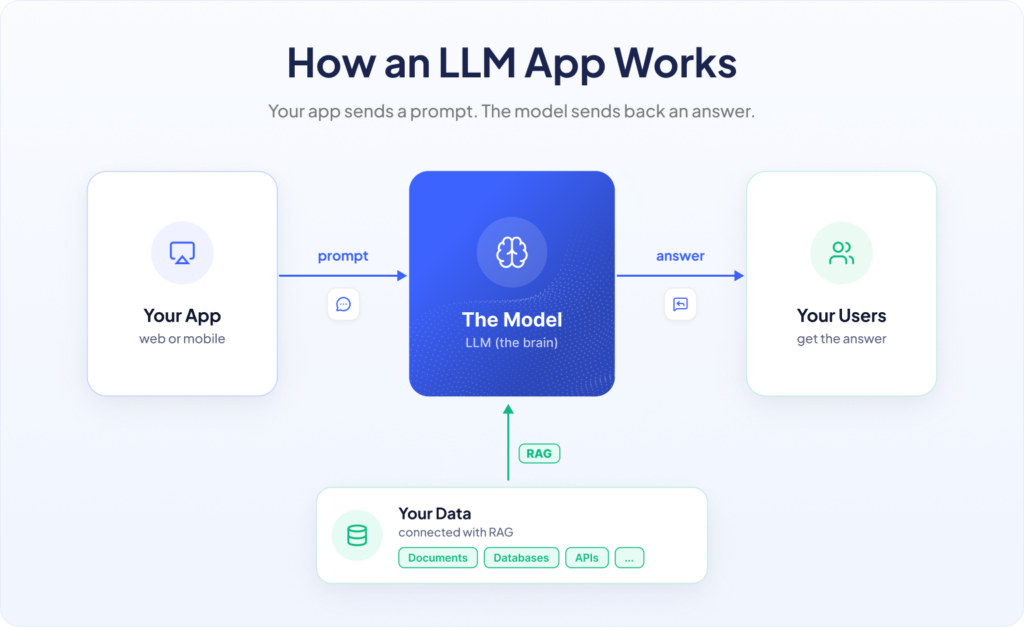
LLM app development means building real software on top of a large language model, like the ones behind ChatGPT or Claude. You send the model a prompt. It sends back text, code, or a choice. Your app wraps that power inside a product that solves a real problem.
Every founder wants an AI app. Few know what that really means.
What Is Generative AI?
Generative AI is software that makes new things. Text. Images. Code. Audio. Video. You give it an input. It hands back fresh output that did not exist a moment ago.
Old software followed fixed rules. This does not. It learns from huge piles of data. Then it guesses what comes next. That one trick powers most AI tools you hear about today.
What Is an LLM App?
An LLM, or large language model, is a type of generative AI trained on text. It reads. It writes. It thinks in a rough way.
An LLM app is your product built around that model. A support bot. A writing tool. A search box that finally gets you. A tool that reads a 90 page file and answers your question in one line.
Here is what an LLM app is not. It is not a chat box glued onto a site. A thin wrapper around an API is a demo, not a product. The gap between the two is where money is won or lost.
Building that real product is normal custom software development work, plus a smart AI layer on top.
Why Build an LLM App Now?
The numbers are loud. The global generative AI market was worth around 22 billion dollars in 2025. It may pass 324 billion dollars by 2033, growing close to 40% each year, according to Grand View Research.
But hype is a weak reason to build. Real need is a strong one.
Ask one blunt question first. Does AI remove a slow, dull, costly task for your users? If yes, build. If you just want to say you have AI, stop. Users smell a gimmick fast, and it burns trust.
Where Most LLM Apps Go Wrong
Most guides sell you a dream. Here is the truth from real builds.
The model is the easy part. You can swap one model for another in an hour. The pain hides elsewhere.
- Bad scope kills builds. Teams make a giant brain when a tiny tool would do the job.
- Bad data kills answers. The model is only as smart as what you feed it.
- No guardrails kills trust. One wrong reply to a buyer can cost you that buyer.
- No testing kills sleep. If you cannot tell good from bad, you cannot ship with a calm mind.
- Wild cost kills profit. Each call to the model costs money. At scale, that bill grows fast.
Fix these five and you beat most of the market. Skip them and even the best model will not save you.
| What people think matters | What actually matters |
|---|---|
| Picking the smartest model | Feeding it the right data |
| Adding more features | Doing one task really well |
| Launch fast, fix later | Test quality before launch |
| Set it and forget it | Tune it again and again |
A Field Note From Real Builds
Picture a common build. A shipping firm wants a bot that answers one question: “Where is my order?”
The easy version takes a day. Plug in a model. Wire up a chat box. The demo looks great.
Then real buyers show up. They type messy questions. They ask about refunds, not just orders. The bot guesses. It gives a sure, wrong answer. Support tickets go up, not down.
What fixes it? Not a smarter model. The fix is dull work. Link the bot to the live order data with RAG. Add a rule: if the bot is not sure, pass it to a human. Test it on 200 real past chats before launch. Track how often it gets the answer right.
That is the whole game. The flashy demo is 10% of the job. The other 90% is data, rules, and tests. Skip that 90% and your app breaks in week one.
How LLM App Development Works, Step by Step
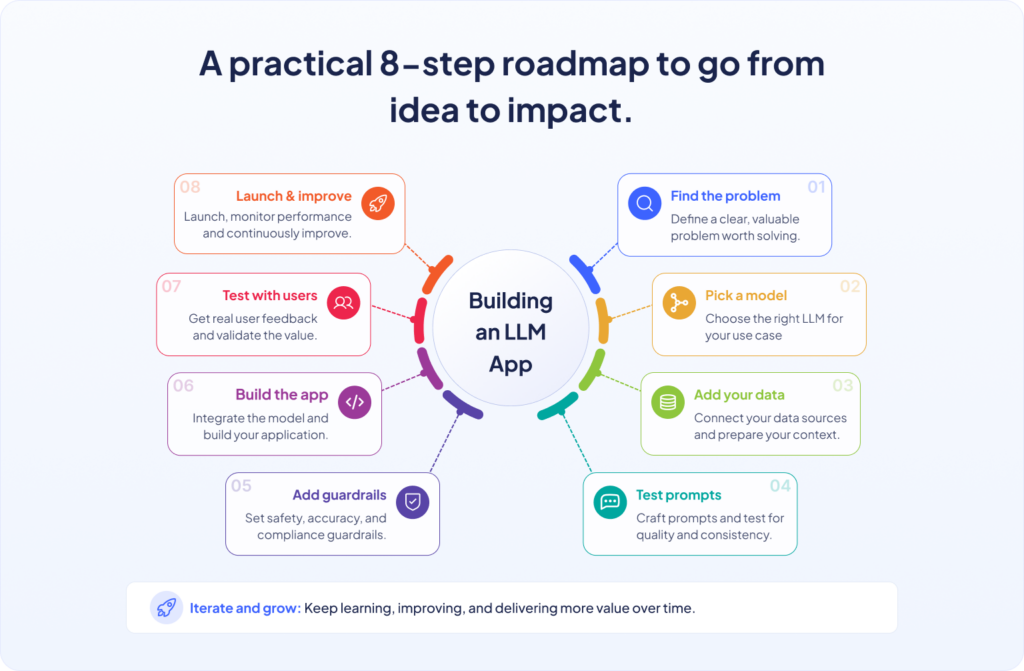
- Find the real problem. Talk to users. Pick one painful task, not ten.
- Pick your model. Test a few. Weigh brains, speed, and cost.
- Feed it your data. This is where RAG comes in. More on that below.
- Write and test prompts. Tiny wording tweaks can flip the whole result.
- Add guardrails. Block bad inputs. Catch bad outputs before users see them.
- Build the app around it. Design, backend, and clean API development tie it all together.
- Test with real people. Measure how often it is right. Hunt down weak spots.
- Launch, watch, improve. The work slows down. It never fully stops.
How to Pick the Right Model for Your App
You do not need the biggest model. You need the right fit. Weigh four things.
- Brains. Can it handle your task well?
- Speed. Fast replies keep users happy.
- Cost. Bigger models cost more per call.
- Privacy. Some models can run inside your own cloud.
A simple rule works well. Start with a strong all round model to prove the idea. Then test a smaller, cheaper one on the same task. If the small one passes, ship it and save money. Many tasks do not need the top model at all.
Open models like Llama let you run it all in house, which helps with privacy. Browse them on Hugging Face. Closed models like GPT and Claude are often easier to start with. Both paths work.
The Tech Stack for LLM App Development
You do not need every tool. You need the right few. Here is the common stack.
| Layer | What it does | Common tools |
|---|---|---|
| Model | The AI that understands and generates responses | GPT, Claude, Gemini, Llama |
| Framework | Connects prompts, tools, and workflows | LangChain, LlamaIndex |
| Memory | Stores and retrieves business knowledge | Pinecone, Weaviate, Chroma |
| Backend | Handles business logic and APIs | Python, Node.js |
| Frontend | Provides the user interface | React, Next.js |
| Cloud | Hosts and scales the application | AWS, Google Cloud, Azure |
New to the wiring? Read the OpenAI API docs to see how one model call works. Many teams also lean on LangChain to link the pieces.
RAG, Fine Tuning, or Prompting: Which One?
This choice trips up most teams. Here it is in plain words.
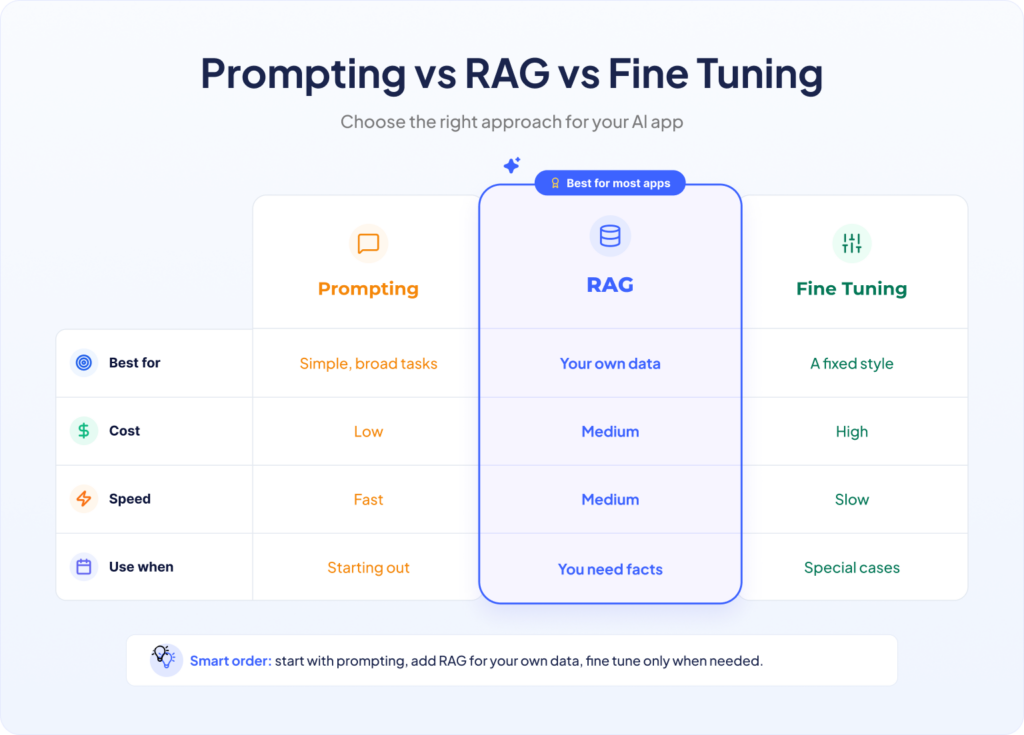
- Prompting. You write clear steps. Cheap and fast. Good for simple, broad tasks.
- RAG (retrieval augmented generation). You link the model to your own data. It looks things up before it answers. The best fit for most business apps.
- Fine tuning. You train the model more on your own data. Costly and slow. Save it for special cases.
| Method | Best for | Cost |
|---|---|---|
| Prompting | Simple, broad tasks | Low |
| RAG | Answers from your own data | Medium |
| Fine Tuning | A fixed style or niche skill | High |
Here is the smart order. Most teams jump to fine tuning way too soon. Start with prompting. Add RAG when you need your own facts. Fine tune only when the first two fall short. This order saves you months and a lot of cash.
AI Agents: The Next Step in Generative AI
A basic LLM app answers one question at a time. An AI agent goes further. It can plan steps, use tools, and finish a task on its own.
Say you ask an agent to set up a meeting. It checks your calendar, finds a free slot, writes an email, and sends it. All in one flow.
Agents are strong. They are also harder to steer. Start with a simple app first. Move to agents once your basics are rock solid. Walk, then run.
How Businesses Use Generative AI
You have seen how it works. Here is where it makes money.
- Support bots that answer common questions all day and all night.
- Tools that write, fix, and polish content in seconds.
- Search that reads all your files and gives one clear answer.
- Apps that turn long files into short notes.
- Code helpers that speed up your dev team.
- Sales tools that draft replies and score leads for you.
Each one can live inside a mobile app, a web app, or a native iOS app development services build. The AI is the engine. The app is the car your users drive.
How to Keep Your Data Safe
AI apps touch private data. Handle it with care from day one.
- Pick tools that do not train on your inputs. Read the fine print.
- Keep private data in your own cloud when you can.
- Let only the right people see the right data.
- Hide private details before they reach the model.
- Follow the rules for your field, like HIPAA for health data or GDPR for user data in Europe.
Trust is hard to earn and easy to lose. One data leak can end a deal. Build safety in first, not last.
How to Measure If Your AI Is Any Good
You cannot fix what you cannot measure. Most teams skip this step. Do not be most teams.
Track a few simple numbers.
- Right answers. How often does it give the right one?
- Facts. Does it stick to your real data, or make things up?
- Speed. How fast does a reply come back?
- Cost. How much does each answer cost you?
- User votes. Let users give a thumbs up or thumbs down.
Build a test set of real questions with known answers. Run it after each change. If a tweak drops your score, you catch it before users do. This one habit sets lasting apps apart from ones that flop.
How Much Does LLM App Development Cost?
Cost swings a lot. It rides on scope, data, and scale. Rough ranges still help you plan.
| Project Type | Rough Cost | Rough Timeline |
|---|---|---|
| Simple bot or AI tool | $8K–$25K | 3–6 weeks |
| Custom AI app with RAG | $25K–$70K | 2–4 months |
| Full AI product with fine-tuning | $70K+ | 4+ months |
Two hidden costs sting later. First, model usage costs, charged per call. Second, upkeep, since models and data keep changing. Plan for both from day one.
How to Pick an LLM App Development Company
The right partner saves your budget. The wrong one drains it. Use this quick list.
- Ask for shipped AI work, not slide decks.
- Check that they handle data and guardrails, not just the model.
- Make sure they can build the full app, from backend to design.
- Pick a team that sticks around after launch.
Auspicious Soft builds all of this in one place. You get AI and ML development services, plus mobile and web teams under one roof. See the full story on the about Auspicious Soft page.
Related reading: the complete guide to API development, the best cross platform app development frameworks, and what an iOS app developer does.
FAQs
Q: What is LLM app development?
It is the work of building software on top of a large language model. Your app sends prompts to the model and turns its replies into a useful product, like a bot, a search tool, or a writing helper.
Q: What is the difference between generative AI and an LLM?
Generative AI is the big group. It makes text, images, audio, and more. An LLM is one kind of it, trained on text. So every LLM is generative AI, but not every generative AI is an LLM.
Q: How long does it take to build an LLM app?
A simple tool can take a few weeks. A custom app that uses your own data often takes two to four months. Bigger products take longer.
Q: How much does it cost to build a generative AI app?
Simple tools start near $8k. Custom apps with your own data run roughly $25k to $70k. Big products cost more. Model usage and upkeep add ongoing cost.
Q: Do I need to train my own model?
Most times, no. Most business apps work great with prompting and RAG on top of a ready model. Training your own is rare and costly. Try the simple paths first.
Q: Is my data safe with an LLM app?
It can be, with the right setup. A good team keeps your data private, lets only the right people in, and picks tools that do not train on your inputs. Ask about this before you start.
Q: Which is better, RAG or fine tuning?
For most apps, RAG. It lets the model use your own facts with no heavy training. Fine tuning fits a narrow style or skill, and it costs more.
Q: Can I add AI to an app I already have?
Yes. In many cases you can add an AI layer to your current app through an API. You do not always need to rebuild from scratch.
Q: What is the best LLM for app development?
There is no single best one. GPT, Claude, and Gemini are strong all round. Llama is great when you want to run it in house. Test a few on your own task and let the results decide.
Q: Which language is used for LLM app development?
Python leads for the AI side. Node.js is common for the backend. React and Next.js run the frontend. The right mix depends on your app.
Do not Miss Our Latest Tech Insights
Stay one step ahead in the fast-moving world of AI and technology. Add us as a Preferred Source on Google and get our latest articles, guides, and industry insights delivered straight to your search feed.