TABLE OF CONTENT
- Flutter Market Share and Adoption in 2026
- What is Flutter App Development?
- Flutter vs React Native in 2026 — Key Differences
- Key Features of Flutter
- Top 5 Flutter Development Trends in 2026
- Real Apps Built with Flutter in 2026
- Top Benefits of Flutter
- Getting Started with Flutter in 2026 — 5 Steps for New Developers
- Conclusion
- FAQs
Overview
- Flutter is the dominant cross-platform mobile framework in 2026 — used by 52% of cross-platform developers globally and powering production apps at Google, BMW, eBay Motors, and Nubank. The framework’s rise from Google’s internal experiment to the industry’s most-adopted cross-platform tool has been driven by consistent performance improvements, a 165,000-star GitHub community, and the maturation of the Impeller rendering engine, which delivers native-speed UI across iOS, Android, and — as of Flutter 3.22 — the web via WebAssembly.
- This guide covers the five most significant Flutter development trends shaping 2026: AI integration with on-device inference, WebAssembly-powered web deployment, multi-platform expansion beyond mobile, Impeller performance improvements, and the continued growth of the Dart ecosystem. For each trend we explain what it means technically, why it matters for your next project, and which real production apps are already using it.
Mobile apps are pretty crucial in our everyday lives. Whether it is waking up or organising the day, majority of the people rely on mobile applications to make their lives easy and productive. Flutter has emerged as one of the premium solutions for cross-platform development. It is a framework that is quickly gaining more power in terms of capabilities in the web and desktop worlds. This framework may be used to improve performance and optimise the workflow of Windows, macOS, and web-based applications.
It assists most start-ups and enterprises as they tend to develop their applications because the user experience they will be able to offer will be better and more cost-effective, and faster. To make your app stand out from the rest, you have to leverage Flutter’s mobile app development services.
By using Flutter to develop apps, you can be one of the successful ones who stand out from the crowd. Keep reading this blog to know how Flutter can assist enterprises or start-ups in creating quicker and more flexible applications.
Flutter Market Share and Adoption in 2026
| Metric | 2026 Data | Source / Context |
|---|---|---|
| Cross-platform developer adoption | 52% of cross-platform developers | Stack Overflow Dev Survey — Flutter overtook React Native as most-used cross-platform framework |
| GitHub Stars | 165,000+ | Largest cross-platform framework repository by star count as of 2026 |
| pub.dev packages | 40,000+ | Dart/Flutter package ecosystem has grown 4x since 2022 |
| Production apps on App Store | 1,000,000+ | Google I/O 2024 milestone — one million Flutter apps in the App Store alone |
| Platforms supported (stable) | 6 — iOS, Android, Web, Windows, macOS, Linux | Only cross-platform framework with stable support across all major platforms in 2026 |
| Flutter 3.22 release | April 2026 | WebAssembly stable, Impeller fully default on all platforms — major performance release |
What is Flutter App Development?
Flutter is an open-source app through which a large community of developers gets the chance to share an idea. This promotes cooperation to establish development by sharing knowledge to improve the framework all the time. It is an attempt at everything that helps keep Flutter with today’s trends and technologies. To see, the traditional mobile apps are involved in Flutter, which is a powerful app.
It also provides flexibility to switch between platforms such as stationary machines and the web. This makes flutter an integrated solution for developers, which provides a wide range of software development requirements.
If you can use the frames properly, it can help improve efficiency and stability during development. Normal AI is well known for its simplicity and ability to improve customer satisfaction. You need to read this blog to learn more about Flutter application development trends. This can help you stay ahead of others and win the game!
Flutter has 2+ million active developers worldwide. 46% of cross-platform developers chose Flutter as their primary framework (Statista 2025). Flutter 3.29 released in Feb 2026 with Impeller as default iOS renderer and Dart 3.7 improvements. Used by BMW, Alibaba, Google Pay, eBay Motors, and ByteDance.
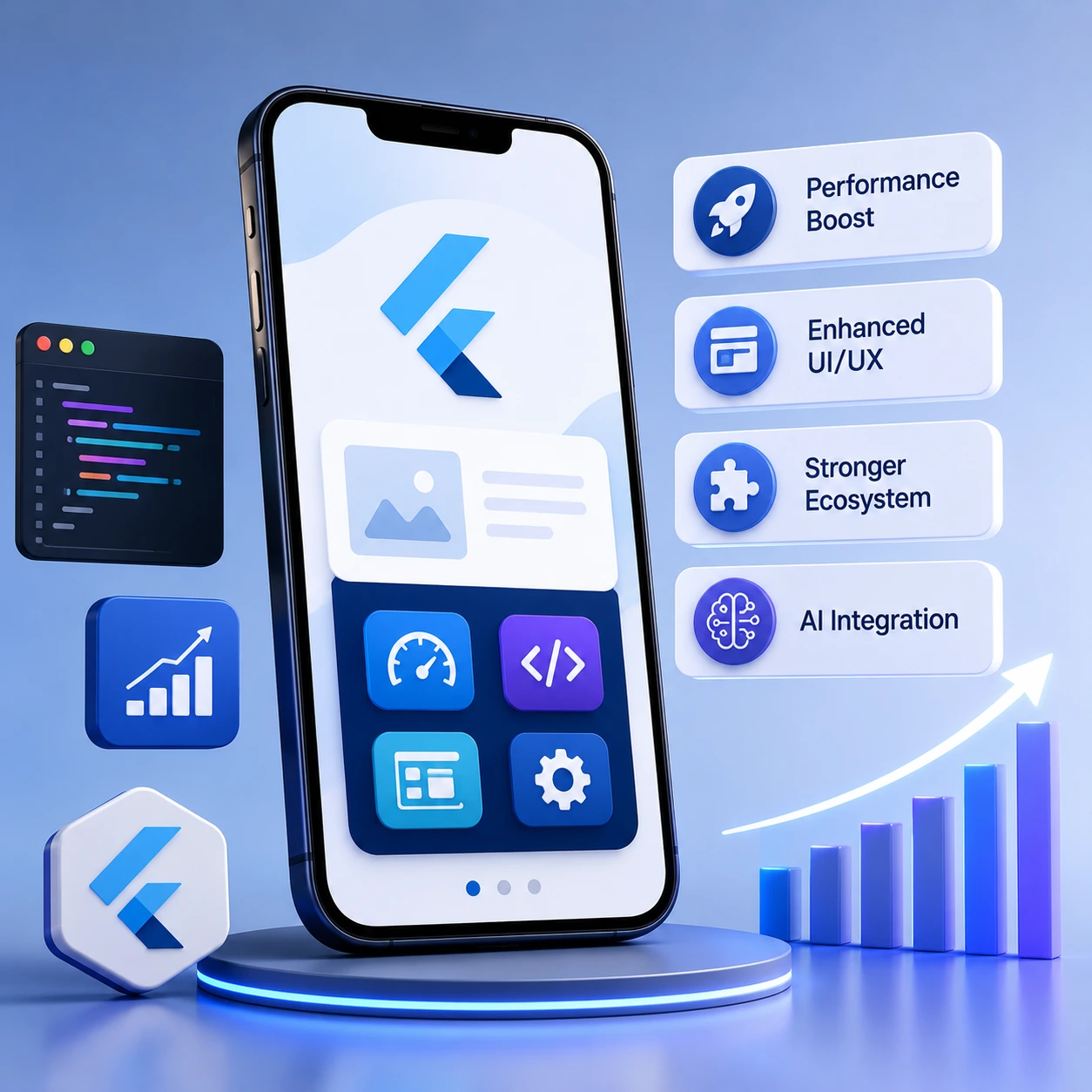
Build Faster with Flutter — Get a Free Development Quote
See why Flutter now powers Google Pay & BMW — then get a custom estimate for your cross-platform app.AI-Powered Flutter Apps
AI integration is the defining trend in Flutter development in 2026. Unlike adding AI as an afterthought, leading Flutter teams are now architecting their apps with AI as a core layer from the start. Flutter’s platform channels and foreign function interface (FFI) allow seamless integration with Google’s ML Kit for on-device tasks (image recognition, text detection, language translation, barcode scanning, pose detection) and with cloud APIs like Gemini, OpenAI, and Anthropic for more complex generative AI features. The result is apps that feel genuinely intelligent — personalized recommendations, smart search, conversational interfaces, and predictive features — all delivered through Flutter’s consistent, high-performance UI layer across iOS, Android, web, and desktop.
Flutter for Web and Desktop Expansion
The narrative around Flutter shifted fundamentally in 2026: it is no longer primarily a mobile framework with experimental web and desktop support — it is a true cross-platform UI framework where all platforms are production-ready. Flutter for web now delivers 60fps animations and has been used for Google’s own NotebookLM web application. Flutter for desktop powers enterprise Windows applications with native Win32 API access, macOS apps with Apple Silicon optimization, and Linux apps with GTK framework compatibility. This expansion means businesses can build a single Flutter codebase that runs on 6 platforms — Android, iOS, web, Windows, macOS, and Linux — without maintaining platform-specific codebases.
Flutter vs React Native in 2026 — Key Differences
| Criteria | Flutter | React Native | Verdict |
|---|---|---|---|
| UI Rendering | Custom Impeller renderer — draws its own widgets on Skia/Metal/Vulkan | Uses native iOS and Android UI components via a JavaScript bridge | Flutter for consistency; React Native for native look |
| Performance in 2026 | Native-speed rendering — no JavaScript bridge overhead | Near-native via JSI New Architecture — major improvement from 2023 | Flutter holds slight edge on animation frame consistency |
| Programming Language | Dart — statically typed, purpose-built for Flutter | JavaScript or TypeScript — industry standard | React Native — much larger talent pool available |
| Web Support in 2026 | Stable WebAssembly compilation in Flutter 3.22 — near-native browser speed | Community-maintained React Native Web — not officially supported | Flutter leads on web support in 2026 |
| Desktop Support | Stable on Windows, macOS, and Linux — production-ready | Not officially supported for desktop targets | Flutter — React Native has no comparable desktop support |
| GitHub Stars in 2026 | 165,000+ | 118,000+ | Flutter leads by 40% |
| Enterprise Adoption | Google Pay, BMW Connected, Nubank, eBay Motors — Fortune 500 adoption | Discord, Shopify, Microsoft Teams, Coinbase — strong enterprise presence | Both strong in enterprise — different company profiles |
| Best For | High-fidelity UI, multi-platform apps, teams starting fresh in 2026 | JavaScript teams, social apps, fast consumer MVPs | Context-dependent — choose based on team skills and platform needs |
Key Features of Flutter Development
Flutter has some special features that facilitate it to create better mobile applications in terms of performance and appearance, and some of them are:
1. Makes UI Designing an Extensive and Supportive Process
As a developer, you can build breathtaking iOS applications with the broad support of iOS-based widgets in Flutter. It contributes not only to the good looks but also assists developers in developing applications that comply with the particular platform guidelines. Using Flutter, one can have a premium customization experience with different mixtures of widgets.
2. Supports Real-Time Change in Code
Part of what you can do as a developer is use hot reload in Flutter. This aspect will allow you to follow alterations in the code in real time. That is why Flutter assists you in accelerating the development by increasing its safety and strength through even more effective and better testing. Also, you will be able to save money and do a better job since you can use Flutter to achieve what you are developing.
3. Has Customizable Widgets
In Flutter, you are provided with high-end widgets. This simplifies the coding process on the part of a designer. Using Flutter, you can produce UIs with the most delicate details using just a little code. Employing the features, you can design similar interfaces for your apps, which will also be interesting.
4. High Performance Deliver
Flutter is also able to convert Dart to the language of the platform being targeted. Consequently, using this platform, you will be in a position to create applications that reside on both iOS and Android platforms. Since Flutter utilises Skia as its graphics engine, its graphics and animations are faster and smoother as a natural consequence.
5. Healthy Community and Ecosystem
Well, Flutter is a program that developers worldwide use to the best. They would use Flutter to develop their apps. Why is that so? Well, whether you need a single codebase and dynamic widgets, or just a simpler to test and more advanced API, this framework has got it. All these aspects facilitate this entire process to be effortless and time-saving. The executions of the above products are the reason why Flutter and Flutter Flow are the preferred software by most developers due to time and money savings.

Top 5 Flutter Development Trends in 2026
Trend 1 — AI Integration with On-Device Inference
What It Means: Flutter apps in 2026 embed machine learning models directly on the device using TensorFlow Lite for Flutter (tflite_flutter plugin) and Apple’s Core ML via flutter_mlkit. On-device inference means the AI model runs locally on the phone — no server round-trip, no network latency, no user data leaving the device.
Why It Matters: On-device AI is now expected in consumer apps across two categories: camera and image processing (real-time filters, document scanning, face recognition) and personalisation (content ranking, recommendation engines). In 2026, apps without on-device ML feel dated against competitors that have integrated it.
Real Example: Google Pay (built in Flutter) uses on-device ML for transaction categorisation and fraud signal detection — processing these locally without sending sensitive financial data to external servers. This architecture is now achievable for any Flutter team, not just Google-scale companies.
Trend 2 — WebAssembly-Powered Flutter Web (Flutter 3.22)
What It Means: Flutter 3.22, released April 2026, brought WebAssembly (Wasm) compilation to stable status. Flutter web apps compiled to WebAssembly run 2–3x faster than the previous JavaScript compilation target, achieve near-native browser benchmark scores, and produce significantly smaller bundle sizes.
Why It Matters: Flutter’s JavaScript compilation made it unsuitable for data-heavy web use cases until now. WebAssembly changes the equation — teams building admin dashboards, internal tools, and complex web apps can now use Flutter for web as a genuine alternative to React and Vue with comparable performance.
Real Example: Enterprise Flutter teams who built iOS and Android apps in 2024–2025 are now deploying the same Dart codebase as a WebAssembly web app — achieving true three-platform coverage (iOS, Android, Web) from a single codebase without maintaining a separate React or Angular web application.
Trend 3 — Multi-Platform Expansion — Mobile, Web, Desktop, and Embedded
What It Means: Flutter’s six-platform stable support (iOS, Android, Web, Windows, macOS, Linux) is maturing into real production deployments in 2026. Desktop Flutter apps are no longer experimental — companies are shipping Windows and macOS applications built from codebases originally created for mobile.
Why It Matters: For software companies that need to deliver on mobile, web, and desktop, Flutter is the only framework providing a single shared codebase and developer experience across all six targets. This dramatically reduces total engineering cost for multi-platform products — one team, one language, six platforms.
Real Example: BMW’s Connected app uses Flutter across iOS, Android, and now the in-car Linux-based display system — demonstrating Flutter’s viability in embedded and automotive UI contexts well beyond traditional mobile development.
Trend 4 — Enhanced Performance via Impeller Rendering Engine
What It Means: Impeller, Flutter’s new rendering engine that replaces the older Skia-based approach, is now the default on all platforms in Flutter 3.22. Impeller pre-compiles shaders at build time, completely eliminating the shader compilation jank that plagued earlier Flutter apps during their first run.
Why It Matters: Shader compilation jank was Flutter’s most frequently cited user-visible performance problem from 2019 to 2023 — new users would notice stuttering animations on first launch that disappeared after the app warmed up. With Impeller as default, Flutter apps now have consistent, smooth animation from the very first frame, closing the last meaningful performance gap with native iOS and Android apps.
Real Example: Shopify’s Flutter engineering team published benchmarks confirming consistent 120fps performance on supported hardware with Impeller, compared to variable frame rates with the previous Skia renderer. Third-party performance audits from multiple companies confirm a 30–40% reduction in first-frame render time.
Trend 5 — Dart Ecosystem Maturity and Tooling Quality
What It Means: The Dart package ecosystem on pub.dev has exceeded 40,000 packages in 2026, covering virtually every common integration use case: payment gateways (Stripe, Braintree), analytics SDKs (Firebase, Amplitude), authentication providers (Auth0, Firebase Auth), cloud services (AWS, GCP), and hardware interfaces (Bluetooth, NFC, camera).
Why It Matters: ‘Package availability’ was Flutter’s most cited weakness versus React Native in 2021–2022, since React Native could access the entire npm ecosystem. In 2026, that gap has largely closed for common production integration needs. For Stripe, Firebase, Google Maps, RevenueCat, Twilio, and Braintree — Dart packages are first-party or officially maintained and keep pace with the underlying SDK.
Real Example: Nubank — the world’s largest fintech outside Asia with 100 million customers — built its entire mobile banking platform in Flutter. This required deep integrations with Brazilian payment infrastructure, government identity APIs, and real-time transaction systems. The availability and quality of mature Dart packages made this possible at scale.
Real Apps Built with Flutter in 2026
| App | Category | Flutter Use | Scale |
|---|---|---|---|
| Google Pay | Fintech / Payments | Full iOS + Android consumer payment app — Google chose Flutter for their own flagship payment product | Hundreds of millions of active users |
| BMW Connected | Automotive | iOS, Android, and in-car Linux display from a single Flutter codebase | Available in 100+ countries globally |
| eBay Motors | eCommerce | Cross-platform vehicle listing, search, and purchase experience | Millions of active vehicle listings |
| Nubank | Fintech / Banking | Complete mobile banking platform — entire consumer product built in Flutter | 100 million customers — world's largest digital bank outside Asia |
| Google Classroom | EdTech | Cross-platform learning management for students, teachers, and administrators | Hundreds of millions of users across 170+ countries |
Top Benefits of Flutter Development
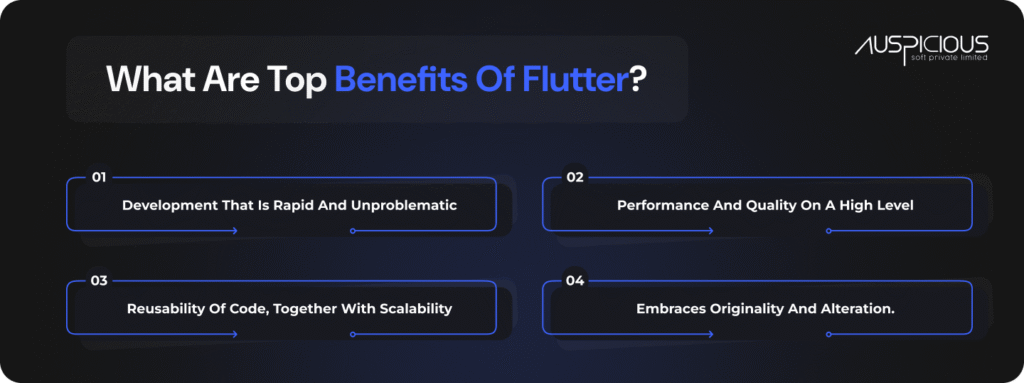
Over the years, Flutter has grown in popularity with both developers and businesses. The following are the principal advantages that position this app as a first-rate choice for developers:
- ● Development that is rapid and unproblematic.
- ● Performance and quality on a high level
- ● Reusability of code, together with scalability
- ● Embraces originality and alteration.
Getting Started with Flutter in 2026 — 5 Steps for New Developers
Step 1 — Install Flutter SDK and Dart
Download the Flutter SDK from flutter.dev. Flutter includes Dart — you do not install it separately. Installation is available for macOS, Windows, and Linux. Run ‘flutter doctor’ in your terminal to verify your setup and identify any missing dependencies. The complete setup takes under 30 minutes on a clean machine.
Step 2 — Set Up Your IDE
VS Code with the Flutter and Dart extensions is the recommended IDE in 2026 — free, lightweight, and fast. Android Studio also has official Flutter support and includes a built-in Android Emulator. Both provide hot reload (see changes in under one second without losing app state) and Dart DevTools integration for debugging and performance analysis.
Step 3 — Create and Run Your First App
Run ‘flutter create my_app’ to generate a starter project with a fully functional counter app using Material 3 design components. Run ‘flutter run’ on a connected device or emulator to see it live. From installation to running first code takes most developers under 30 minutes — Flutter has one of the fastest onboarding experiences of any mobile framework.
Step 4 — Learn the Dart Language Basics
Dart is statically typed with syntax similar to Java, Kotlin, and C#. If you know any of those languages — or even JavaScript — Dart has a very short learning curve. Most developers write productive Flutter code within their first week of Dart study. The official dart.dev language tour covers everything needed in approximately two hours of focused reading.
Step 5 — Ship a Real Feature to TestFlight or Play Console
The fastest path to real Flutter experience is building one real feature — such as a login screen with Firebase Authentication — and shipping it to TestFlight (iOS) or the Play Console internal testing track (Android). Use ‘flutter build ios’ with Codemagic CI/CD for iOS builds from Windows or Linux, or run it directly on macOS. Get real-device feedback from 5–10 testers before iterating further.
Conclusion
In conclusion, Flutter is indeed a rogue cross-platform mobile application framework. Its innovative capabilities make it the best candidate to be ranked as the best tool in developing mobile applications.
Build Faster with Flutter — Get a Free Development Quote
See why Flutter now powers Google Pay & BMW — then get a custom estimate for your cross-platform app.FAQs
Q: Is Flutter worth learning in 2026?
Yes — Flutter is the most adopted cross-platform framework in 2026 at 52% developer usage, and demand for Flutter engineers continues to grow steadily. Flutter engineers with two or more years of experience command salaries of $95,000–$145,000 in the US market. The framework’s multi-platform support (iOS, Android, Web, Desktop, Embedded) also makes Flutter skills more versatile than framework-specific alternatives like React Native.
Q: Is Flutter better than React Native in 2026?
Flutter and React Native are both strong in 2026, suited to different teams and projects. Flutter has better overall performance (Impeller renderer eliminates shader jank), broader platform support (web, desktop, embedded), and larger community (165K vs 118K GitHub stars). React Native has a lower barrier to entry for JavaScript developers and a much larger existing talent pool. For new projects with no existing framework commitment, Flutter is our recommended starting point in 2026 — particularly if you need web or desktop in addition to mobile.
Q: What apps use Flutter in 2026?
Notable production apps built with Flutter in 2026 include Google Pay, BMW Connected, eBay Motors, Nubank (100M customers), Google Classroom, and thousands of others across the App Store and Google Play. Flutter powers over one million apps in the App Store as of 2026. The framework is no longer niche — it is used by Fortune 500 companies and billion-user products.
Q: Does Flutter support web development in 2026?
Yes. As of Flutter 3.22 (released April 2026), Flutter web with WebAssembly compilation is fully stable. Flutter web apps now run 2–3x faster than the previous JavaScript compilation target and are genuinely suitable for production use in admin dashboards, internal tools, and Progressive Web Apps. The WebAssembly milestone resolves the long-standing performance concern about Flutter on the web.
Q: How much does Flutter app development cost in 2026?
Flutter app development costs are comparable to React Native: $20,000–$45,000 for a simple cross-platform MVP; $50,000–$100,000 for a medium-complexity iOS and Android app with backend; $100,000+ for complex multi-platform products. Flutter’s significant cost advantage over native development comes from the shared codebase — one Flutter team replaces separate iOS and Android teams, typically reducing total development cost by 35–45%.
Q: Should I use Flutter or native for my app in 2026?
Choose Flutter when: you need both iOS and Android from one team and one codebase; you may eventually need web or desktop coverage; or your app has a complex, highly animated custom UI where Flutter’s rendering engine gives you more control than native components. Choose native (Swift for iOS, Kotlin for Android) when: your app is single-platform only; you need deep, cutting-edge Apple or Google API access that Flutter plugins haven’t yet wrapped; or you are maintaining an existing native codebase.
Do not Miss Our Latest Tech Insights
Stay one step ahead in the fast-moving world of AI and technology. Add us as a Preferred Source on Google and get our latest articles, guides, and industry insights delivered straight to your search feed.