+1 740 762 6496
 +91 70189 46603


TABLE OF CONTENT
- Top Practices, Tools, & Benefits of iOS App Development Services in California
- Why choose iOS App Development in California?
- Best Practices in Custom iOS App Development Services
- Some of the Basic Tools for iOS Development
- Benefits of Custom iOS App Development Services
- Why Partner with an iOS App Development Company in California?
- Conclusion
- FAQs
Overview
- California is the United States’ most significant iOS market. With over 68% iPhone adoption in the Bay Area, Los Angeles ranked as the third-largest US app economy city, and the California Consumer Privacy Act (CCPA) creating compliance requirements that affect every iOS app collecting user data, building an iOS app for a California business is categorically different from a generic mobile project.
- This guide covers what professional iOS development looks like specifically for California-based companies in 2026 — from CCPA compliance engineering and SwiftUI-first architecture to App Store Optimisation for competitive California verticals and the specific tools our team uses across CI/CD, testing, and deployment. Whether you are a Silicon Valley startup, an LA consumer brand, or a San Diego enterprise, the practices and tools in this guide reflect the standard the California market expects.
In today’s mobile-first world, iOS application development has become the need of the hour for all those companies that want to ensure a smooth user experience. With such an extensive ecosystem and high-end user base, developing iOS apps has become the need of the hour for many companies, with the motive of augmenting their reach and engagement. California, being the global hub for tech, is dotted with a lot of custom iOS app development services that are transforming businesses through innovative and intuitive mobile solutions.
In this blog, we will discuss the best practices, tools, and benefits of custom iOS app development services which will tell you why partnering with an iOS app development company in California can be a game-changer for your business.
California has the highest concentration of iOS developers in the USA — with over 28,000 iOS engineers in the San Francisco Bay Area alone. iPhone holds 57% of California’s smartphone market. Apple’s $3.3 trillion market cap is based in Cupertino, CA, making California the natural home for iOS excellence.
Why California Businesses Choose iOS-First Development
California’s smartphone market skews heavily toward iOS — and the business case for iOS-first development reflects that market reality. The data below is drawn from App Annie, Sensor Tower, and Apple’s annual App Store economy report.
| Metric | California / iOS Data | US National Average | Business Implication |
|---|---|---|---|
| iPhone Market Share in CA | 68% of smartphone users | 57% nationally | iOS app reaches 19% more CA users than the US average |
| iOS User App Spending | 2.1x higher than Android users | Consistent across regions | Higher average revenue per user from day one |
| App Store Revenue (CA) | Approx. $18B annually | Largest US state contributor | California is the highest-value iOS market in the US |
| CCPA Applicability | Any app collecting data from CA residents meeting threshold criteria | No federal equivalent at this scope | Every iOS app serving CA users needs CCPA compliance engineering |
| Enterprise iOS Adoption in CA | 73% of Fortune 500 CA-HQ companies use iOS-primary devices | Varies by region | Enterprise California clients expect iOS-first delivery |
| iOS User LTV (ecommerce) | 31% higher basket size vs Android iOS users | Varies | Higher per-user revenue from day one of iOS launch |
Best iOS Development Practices for California Businesses in 2026
SwiftUI-First Development
In 2026 SwiftUI is Apple’s primary UI framework for new iOS development. California’s enterprise and consumer app market expects SwiftUI-native apps — the framework produces smaller, more maintainable codebases, has better performance than UIKit for most use cases, and is required for access to several iOS 17+ features. All new iOS projects we build for California clients start with SwiftUI unless a legacy UIKit codebase is involved.
When to Apply: Apply immediately — all new iOS projects started in 2026 use SwiftUI by default.
CCPA Compliance Engineering
The California Consumer Privacy Act applies to any iOS app that collects personal data from California residents meeting at least one threshold: annual gross revenue above $25M, OR data from 50,000+ California consumers per year, OR more than 50% of annual revenue from selling personal data. Compliance engineering includes: App Tracking Transparency (ATT) implementation, accurate privacy nutrition labels, an in-app data deletion request workflow, and a CCPA-compliant privacy policy. Non-compliance exposes your business to fines of $100–$750 per consumer per incident.
When to Apply: Required for any app with significant California users — check thresholds before launch.
TestFlight Beta Programme
TestFlight is Apple’s official beta testing platform and is standard practice for all iOS development we do for California clients. Before any App Store submission, the app goes through two TestFlight cycles: internal (development team) and external (up to 10,000 real users). For California fintech and healthcare clients, TestFlight groups typically include compliance reviewers alongside end users.
When to Apply: Mandatory for all projects — do not skip TestFlight before App Store submission.
CI/CD with Xcode Cloud or Fastlane
Continuous Integration/Continuous Delivery is now standard practice in California’s iOS development community. We use Xcode Cloud (Apple’s native CI/CD, integrated directly into Xcode 15+) or Fastlane for projects requiring more customisation. CI/CD automates building, testing, code signing, and TestFlight distribution — reducing release cycles from days to hours.
When to Apply: Set up from the first sprint — do not treat CI/CD as a later-stage addition.
App Store Optimisation for California Markets
California has some of the most competitive App Store categories: fintech, fitness, food delivery, and enterprise productivity. ASO for California-market apps requires keyword research specific to the US English App Store, localised screenshots for iPhone 16 Pro screen sizes, and A/B testing of app icons and preview videos using App Store Connect’s product page optimisation tools. In competitive California categories, ASO can be the difference between 500 downloads/month and 5,000.
When to Apply: Treat ASO as an ongoing monthly activity — not a launch checklist item.
Accessibility — ADA Compliance from Sprint 1
California has the strongest state-level enforcement of app accessibility requirements. For consumer-facing iOS apps, accessibility compliance is both a legal risk-mitigation strategy and a market reach expansion — 26% of California adults report a disability. We build all iOS apps with full VoiceOver support, Dynamic Type, sufficient colour contrast ratios, and proper accessibility labels from the very first development sprint. Retrofitting accessibility at launch is 3–5x more expensive than building it in from the start.
When to Apply: Non-negotiable for all California consumer-facing apps — build in from sprint 1.
Top iOS Development Tools for California Projects (2026)
| Tool | Purpose | 2026 Cost | Best For |
|---|---|---|---|
| Xcode 16 | Primary IDE — Swift, SwiftUI, Simulator, Instruments, Xcode Cloud | Free (macOS only) | All native iOS development |
| Xcode Cloud | Apple's built-in CI/CD — auto-build, test, distribute to TestFlight | $14.99–$99.99/mo | Teams wanting tightest Apple integration |
| Fastlane | Automation — code signing, TestFlight upload, App Store submission | Free (open source) | Complex multi-environment CI/CD pipelines |
| TestFlight | Beta distribution to up to 10,000 external testers | Free | All pre-launch testing — always use before App Store |
| Firebase iOS SDK | Analytics, Crashlytics, A/B testing, push notifications | Free – $25+/mo | All production iOS apps |
| RevenueCat | In-app purchase and subscription management SDK | Free – $500+/mo (revenue-based) | Any app with subscriptions or in-app purchases |
| Amplitude or Mixpanel | Behavioural analytics — funnels, retention, user segmentation | Free – $995+/mo | Apps focused on improving retention metrics |
| SF Symbols | Apple's 5,000+ vector icon system for design and implementation | Free | All iOS UI design and development |
| SwiftLint | Enforces Swift coding conventions — automated code quality checks | Free (open source) | All Swift codebases — run in CI pipeline |
| Bitrise | CI/CD platform with iOS-specific build machines | $36–$270/mo | Teams needing flexible, powerful iOS CI/CD |
Why choose iOS App Development in California?
Choosing an iOS app development partner based in California is not just a geographic preference — it is a strategic advantage rooted in the density of iOS expertise that exists nowhere else in the world. Silicon Valley is home to Apple’s Cupertino headquarters, 28,000+ iOS engineers in the Bay Area, and alumni networks from Apple, Google, Meta, and every major app publisher. California iOS development agencies are embedded in the same talent ecosystem that builds the world’s best-rated apps — and they operate at the quality standards that the state’s demanding enterprise and consumer client base expects. For businesses building iOS apps that need to compete for position in the US market, a California-based development partner brings proximity to Apple’s design language, hiring reach into top-tier talent, and familiarity with the expectations of the world’s most sophisticated iOS user base.
As it is located near the heart of Silicon Valley, California is recognized as the seat of technological innovation. Not surprisingly, the state houses some of the world’s leading iOS app development companies in terms of having cutting-edge mobile solutions. Creativity, technical acumen, and a perfect understanding of user experience come at the core of iOS app development services in this region.
Current trends in iOS app development are witnessed through California companies using the most up-to-date technologies and best practices to develop user-centric iOS applications. Partnering with an iOS app development company in California will allow you to tap into the most talented pool of developers, innovative solutions, and a competitive edge in the market.
Build a California-Ready iOS App — Get a Free Quote
Navigate CCPA compliance, SwiftUI & California's competitive App Store — then get a tailored estimate from our experts.Best Practices in Custom iOS App Development Services
The development of iOS applications from companies has to involve some practices ensuring the best performance, security, and user satisfaction. Some of the best practices for custom iOS app development services are as follows:
1. User Experience (UX) Design:
The success of an iOS app is largely dependent on the design and the user-friendliness of it. In the case of iOS, the California-based app development company lays equal emphasis on an effortless and user-friendly experience. Agliently following UI/UX design principles will mean that the application is easy to navigate, looks great, and is aligned with the guidelines of Apple.
2. Agile Development Methodology
Agile development forms an essential part of custom iOS app development. It is this approach in which the entire project is divided into fragments of work so that continuous testing and feedback are gained during each iteration. This ensures that the application is released efficiently, as continuous updates and improvement on user input leads to a better product at the end.
3. Integration of Security Measures
Security is a matter of prime importance while developing iOS applications, mostly when associated with critical information. The custom iOS development services in California are more dedicated toward secure implementations for data encryption, authentication, and regular vulnerability assessments to assure the application is secured from cyber threats and other unauthorized accesses.
4. Optimization for Performance
The performance of an iOS app determines its success. One of the best rated iOS developers in California is one who uses techniques that optimize the performance of the application, the time it loads, movement, and its flawless execution. Techniques involved include optimized coding, management of memory, and the least impact on the battery by the application.
5. Continuous Testing and Quality Assurance
Testing is an important part of the iOS development process. The frequent testing would help identify bugs, rectify them, improve functionality, and ensure optimum performance under various conditions. Custom iOS app development services in California have stringent quality assurance protocols for app development that produce high-quality apps which meet the expectations of the users.
Some of the Basic Tools for iOS Development
The iOS development toolchain in 2026 has matured into a well-integrated suite of Apple-first tools supplemented by battle-tested third-party services. Understanding which tools are used at each stage of iOS development helps businesses evaluate whether a potential development partner is operating with current-generation practices or relying on outdated workflows that produce slower, lower-quality results. Here are some of the most essential tools that iOS app development companies in California use to create top-notch apps:
1. Xcode
Xcode is the official IDE of Apple for iOS app development. The environment provides a powerful array of tools in one place-including a code editor, debugging tools, and a simulator-that represents the first choice for any custom iOS app development services. Swift and Objective-C are the primary programming languages for iOS development, which are also supported by Xcode.
2. Swift
Swift is the high-performance, easy-to-use programming language developed by Apple to write apps for the iOS, macOS, watchOS, and tvOS platforms. The simplicity of Swift along with its safety features makes it particularly ideal for developing modern iOS applications. Most companies developing iOS applications in California use Swift as it is fast and efficient, thus allowing clean code.
3. TestFlight
TestFlight is used to carry out test runs of iOS apps from a beta tester before the final version of an app. It allows for the identification of bugs in a precisely defined area, provides feedback on that app, and as such, necessary adjustments are made to customize it according to the performance expectations of the user.
| Tool | Category | Purpose | 2026 Status |
|---|---|---|---|
| Xcode 16+ | IDE | Primary development & debugging environment | Required — latest stable |
| Swift 6.0 | Language | Primary iOS programming language | Required for new projects |
| SwiftUI 6.0 | UI Framework | Declarative UI building | Recommended for all new UI |
| Xcode Cloud | CI/CD | Automated build, test, and deploy | Replaces Bitrise/Jenkins for most |
| TestFlight | Beta Testing | Distribute beta builds to up to 10,000 testers | Apple native — standard |
| Firebase | Backend Services | Auth, analytics, push, crash reporting | Most-used mobile BaaS |
| Instruments | Performance | CPU, memory, energy profiling | Essential for App Store quality |
| SF Symbols 6 | Design Assets | Apple's 5,000+ vector icon library | Required for native look/feel |
4. CocoaPods
CocoaPods is a dependency manager for Swift and Objective-C projects. Many iOS developers use this tool for third party libraries in a simple way; it makes the process of adding libraries to the project easier, so dependency management becomes smooth and enhances the functionality of the app in more ways.
5. Firebase
Firebase: It is an all-inclusive mobile and web development platform which provides multiple tools for building high-quality apps, user engagement, and business growth. It is in widespread use in California-based iOS companies for analytics, user authentication, and real-time database management.
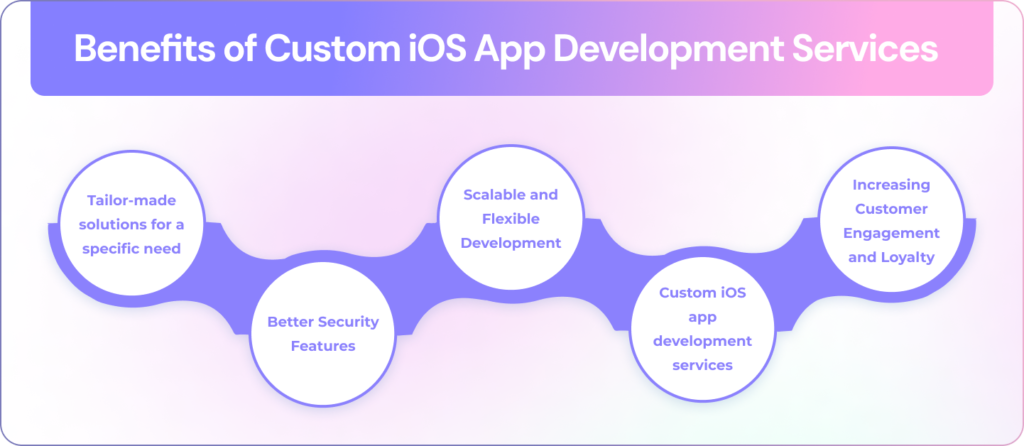
Benefits of Custom iOS App Development Services
iOS development best practices in 2026 have evolved significantly from the UIKit-dominated patterns of five years ago. California-based iOS agencies leading in quality adoption are building exclusively with SwiftUI (Apple’s declarative UI framework) for new projects, using async/await concurrency (Swift 6.0) instead of legacy completion handlers, implementing MVVM or TCA (The Composable Architecture) as their application architecture, and running automated CI/CD pipelines (Xcode Cloud, Fastlane) that deploy tested builds to TestFlight within minutes of a code merge. These practices are not theoretical best intentions — they are operational requirements for shipping iOS apps that pass Apple’s review, perform well on all device sizes, and can be maintained as the codebase grows. There are many reasons why custom iOS app development services are applicable for business growth and increased customer involvement. These include:
1. Tailor-made solutions for a specific need
Thus, custom iOS application development services provide tailored solutions that suit the specific needs of your business. Based on collaboration with you regarding your goals, target audience, and market trends, any iOS application development company in California will surely develop an app exactly aimed at your goals.
2. Better Security Features
iOS applications are very secure applications and used for business transactions with sensitive information. California custom iOS app development services incorporate high security protocols that ensure data breaches, malware, and all other cyberattacks are dodged by the application.
3. Scalable and Flexible Development
Scalability is the necessity for businesses that see growth in the short term. Custom iOS app development services ensure that it matches the needs you would have further into development. Whether you want to add functionality to your application or increase the user capacity, California-based iOS app development company ensures the app scales without any perceptible impact on the performance.
| Practice | Old Approach (pre-2024) | Best Practice 2026 | Benefit |
|---|---|---|---|
| UI Framework | UIKit + Storyboards | SwiftUI 6.0 | 30% faster UI development |
| Architecture | MVC (basic) | MVVM or TCA | Testable, scalable code |
| Concurrency | Callback-based completion handlers | Swift async/await (Swift 6) | Eliminates data races |
| CI/CD | Manual builds and uploads | Xcode Cloud + Fastlane | Automated delivery in minutes |
| Testing | Manual QA only | XCTest + UI Testing suite | Catches regressions before release |
| Dependency Management | CocoaPods | Swift Package Manager (SPM) | Faster, more reliable builds |
4 Custom iOS app development services
Make use of an agile development approach that allows for faster time-to-market approaches. This means you will get the app to the market sooner, keep pace with trends in the market, and establish a competitive advantage through beating your competitors to the attention of your users.
5. Increasing Customer Engagement and Loyalty
An engaging and user-friendly iOS app can significantly boost customer engagement and loyalty. California-based iOS development companies have committed fully to delivering great applications that bring the best experience for users. This goes hand in hand with very high retention rates among the users and great customer satisfaction.
Why Partner with an iOS App Development Company in California?
Partnering with a California-based iOS development company provides advantages that extend beyond developer skill. California companies operate in the same timezone as major US tech companies, facilitating real-time collaboration without the friction of offshore time zone differences. They have access to California’s dense iOS talent pool, allowing them to staff specialized roles — SwiftUI specialist, iOS performance engineer, Apple Intelligence integration developer — that are scarce elsewhere. They attend WWDC (Apple’s Worldwide Developers Conference in San Jose) and maintain relationships with Apple developer evangelists, giving them early access to platform changes that affect your app before those changes become public. And they carry the quality expectations set by competing for California’s enterprise client base — the most demanding in the country.
Companies from California are held to high standards of innovation and making sure that your app for iOS does not only follow the present standard of the industry but also break new grounds on quality and performance. You can thus, with their expertise, develop a mobile application that gives outstanding performance and stands out starkly in the competitive landscape of the applications.
Conclusion
Custom iOS app development services-Businesses require such custom iOS app development services to develop scalable and secure mobile apps with quality. When you come to an iOS app development company in California, you gain access to lots of experiences, cutting-edge tools, and best practices under one roof that can get your success story started. The kind of service beginning from developing a user-friendly experience up to the top level of security for your app is ensured by developers at California and will cater to the specific needs that your business demands.
Custom iOS development services are no longer just an enabler of digital presence but also a method of harnessing customer engagement, loyalty, and growth. Be it a startup or an enterprise, working with an iOS app development company California can be the difference between real success and missed opportunities toward your desired digital transformation.
Build a California-Ready iOS App — Get a Free Quote
Navigate CCPA compliance, SwiftUI & California's competitive App Store — then get a tailored estimate from our experts.FAQs
Q: Does my California iOS app need to be CCPA-compliant?
Yes, if your app collects personal data from California residents and meets any of these thresholds: annual gross revenue above $25 million; data from 50,000 or more California consumers per year; or more than 50% of annual revenue from selling personal data. For most apps with significant California user bases, CCPA compliance is required. This includes a compliant privacy policy, an in-app data deletion mechanism, and proper ATT implementation.
Q: What is SwiftUI and why does it matter for California apps in 2026?
SwiftUI is Apple’s modern declarative UI framework for iOS, macOS, watchOS, and tvOS. In 2026 it is the standard for new iOS development — it produces cleaner code, requires fewer lines for complex UI, and is required for access to many iOS 17+ features. California’s tech-savvy users and enterprise IT departments are increasingly familiar with SwiftUI app quality benchmarks.
Q: How long does iOS app development take for a California business?
A basic iOS app takes 8–14 weeks from kickoff to App Store launch. A medium-complexity business app with API integrations and three to five core features takes 14–20 weeks. Enterprise apps with offline support, ERP/CRM integration, and security audits typically take 20–28 weeks. These timelines include two weeks of QA and one to two weeks for Apple’s App Store review.
Q: How much does iOS app development cost for a California business?
iOS app development for California businesses ranges from $30,000 for a focused single-feature app to $200,000+ for a full enterprise platform. CCPA compliance engineering, accessibility requirements, and the generally higher performance standards California tech companies expect tend to put California projects in the $60,000–$120,000 range for a fully featured consumer or B2B app.
Q: Do you serve clients outside Los Angeles and San Francisco?
Yes. We serve California businesses statewide — San Diego, Sacramento, San Jose, Oakland, Santa Barbara, and beyond. All client communication happens in US time zones, and we offer on-site workshops in major California cities for project scoping and design sprints. Contact us at auspicioussoft.com/contact to discuss your project.
Q: What is CCPA and how does it affect iOS app development?
The California Consumer Privacy Act (CCPA) is a state privacy law that gives California residents the right to know what personal data is collected about them, the right to delete it, and the right to opt out of its sale. For iOS app developers, this means implementing App Tracking Transparency (ATT), providing an in-app data deletion request workflow, updating your privacy policy to CCPA standards, and ensuring your analytics and advertising partners are CCPA-compliant. Non-compliance exposes your business to fines of $100–$750 per consumer per incident.
Do not Miss Our Latest Tech Insights
Stay one step ahead in the fast-moving world of AI and technology. Add us as a Preferred Source on Google and get our latest articles, guides, and industry insights delivered straight to your search feed.