+1 740 762 6496
 +91 70189 46603

Overview
- React is still the safe default for most products, mainly because its talent pool and ecosystem are so large.
- Angular earns its learning curve on big, long-lived enterprise apps with large teams.
- Vue is usually the fastest route from idea to working product, and it has deep roots in the Laravel community.
- Svelte produces the leanest pages. The tradeoff is a smaller hiring pool.
- On Laravel? Its official starter kits support React, Vue, Svelte and Livewire, so none of these choices lock you out.
AI Summary:
Frontend Frameworks to Elevate Your Web Development Game” by Auspicious Soft compares seven leading frontend frameworks for building modern web applications: React (Facebook’s component-based library with virtual DOM, large community, pairs well with Laravel backends), Angular (Google’s TypeScript-based framework for enterprise apps with two-way data binding), Vue.js (progressive, shallow learning curve, ideal for fast time-to-market SPAs), Svelte (compiles at build time for lightweight, high-performance apps), Bootstrap (CSS framework with responsive grids and pre-built components), Ember.js (“convention over configuration” for large, structured applications), and Foundation (modular, scalable framework for enterprise-grade responsive UIs).
Picking a frontend framework looks like a technical decision. In practice, it’s a business one. The framework you choose affects how quickly your first version ships, how easy it is to hire in year two, and how much your next redesign will cost. Get it right and nobody talks about it. Get it wrong and you feel it in every sprint. After 200+ projects at Auspicious Soft, we’ve noticed a pattern. Most framework regrets don’t come from choosing a bad tool. They come from choosing a good tool for the wrong project.
So this guide does more than list features. For each framework, you’ll see what it’s genuinely good at, where it slows teams down, and how it fits with a Laravel backend. If you only have two minutes, jump to the five-question decision guide near the end. Whether you’re a business in search of the best web development company in the California or a developer diving into Laravel web development, knowing the strengths of these frameworks would really take your web development game to another level.
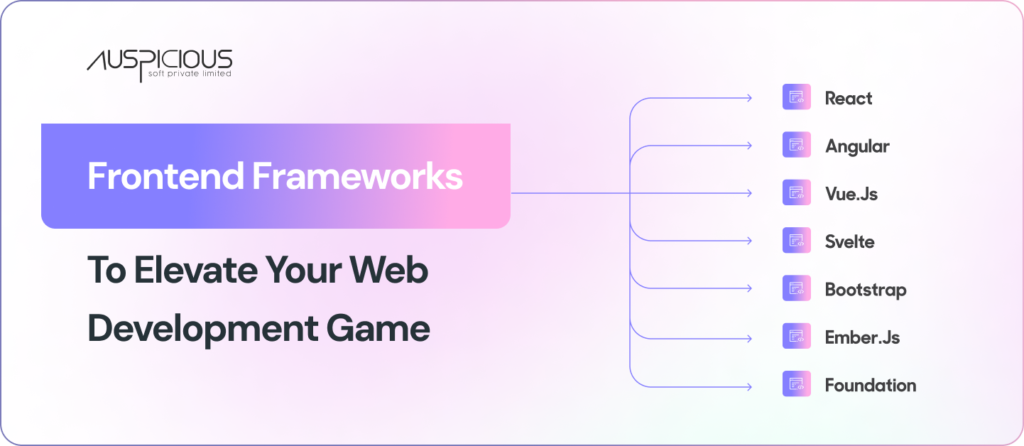
In this blog, we are going to cover the most top-fronted frameworks that can help you build robust web applications and keep you ahead of the curve in the competitive landscape for web development.
1. React
React was developed by Facebook and is one of the most popular frontend frameworks. It has the ability to have simple functions and be flexible, and of course, with virtual DOM and component-based architecture- powered features. The library provides real productivity and hence consumes much less time to develop interactive user interfaces with reusable components.
It depends upon the company with which you’re working, as the best web development company in the USA will, most probably, recommend React since the community is really active and pretty large. One could even use React with Laravel to seamlessly make Laravel web development for building the frontend of the applications so it is pretty versatile.
Pick React If: you’re building a SaaS product, a customer dashboard, or anything that may grow into a mobile app later.
Think twice If: you want strong conventions out of the box. React leaves many architecture decisions to your team.
2. Angular
Angular, by Google, is the most holistic framework for complex web applications available. It uses TypeScript-whose static type adds on top of it, so that code can be predictable and easier to debug. The two-way data binding and dependency injection make it a good candidate for the depths of enterprise-level applications.
For enterprises that are collaborating with the leading web development company in the USA, Angular is usually suggested for projects that require robust functionality and a solid code structure. It enables the applications to work well in harmony with the backend frameworks such as Laravel web development.
Pick Angular If: you’re building a large internal platform, a finance or healthcare portal, or anything with many developers and a multi-year lifespan.
Think twice If: you need an MVP in eight weeks, or your team hasn’t worked with TypeScript.
3. Vue.js
Vue.js is highly trendy nowadays because of its simplicity and flexibility. It could be implemented incrementally in order to build tiny projects. As a progressive framework, even the smallest project can be built incrementally. Its learning curve is shallow compared with other frameworks as well. This makes it aptly suited for beginners, and the veterans also love the framework. The reactive data-binding system and the component-based architecture make it highly efficient.
The best USA-based web development company often suggests Vue.js for applications where the fast time-to-market is crucial without compromising on performance. Integration of Vue.js with web development in Laravel enables a smooth and streamlined development experience that helps you build complex SPAs.
Pick Vue If: you’re launching an MVP, building an admin panel, or upgrading an older app one screen at a time.
Think twice If: you depend on a niche third-party library that only exists for React.

Not Sure Which One Fits Your Project?
Tell us what you’re building and our developers will suggest a stack that matches your timeline and budget.4. Svelte
Svelte is a pretty new kid on the frontend framework block but is really making some waves in terms of how it treats its work. Whereas most of the other frameworks do most of their work in the browser, Svelte shifts the workload to compile time and produces highly optimized, high-performing code running directly in the browser. That alone definitely reduces the size of your application, giving you a better performing application.
Companies seeking to find the best web development company in USA claim that one of the best considerations for web development is Svelte, especially if the project becomes prioritized due to performance. While Svelte is still very much growing in terms of the popularity of the framework, it can also prove a pretty good combination for building both lightweight and more high-performance web applications at Laravel web development.
Pick Svelte If: you’re building a content-heavy site, an ecommerce storefront, or a product where load time directly affects sales.
Think Twice If: you need to scale a large team quickly.
5. Bootstrap
Today, the widely used front-end framework, Bootstrap, is still on the top list as one of the most used CSS frameworks. It is especially friendly for providing a responsive grid system, beautiful pre-designed components, and strong JavaScript plugins. What enables its ease of use in producing mobile-friendly web applications is such simplicity that makes it reliable for many developers to work with.
When you’re working for the best web development company in USA, it can also work on the integration of Bootstrap along with Laravel web development to develop clean and responsive designs. It is useful for development with consistency in the various devices.
6. Ember.js
Ember.js is highly known for the “convention over configuration” philosophy that lets developers focus on unique features rather than just plugging in configurations. It is a strong framework used to build ambitious web applications placed under an overarching focus on productivity and performance.
If you are working with the best web development company in the USA, Ember.js might be their go-to for complex applications that require a well-defined structure. Getting Laravel web development and Ember.js together might give them highly organized codebases that would make a great opportunity for big projects.
7. Foundation
Another good frontend framework for responsive web applications is Foundation. It comprises a whole lot of customizable UI components and has a flexible grid system that can fit quite nicely on any screen size. This is why Foundation is most often used for enterprise level projects because of its modular structure and scalability.
For those looking at working with the best web development company in the USA, Foundation has been able to offer flexibility to shape web applications precisely for the business needs. In conjunction with Laravel web development, it ensures a very seamless experience in developing sophisticated applications with great UI/UX.
| Framework | Best for | Learning Curve | Laravel Support | Watch Out For |
|---|---|---|---|---|
| React | SaaS products, dashboards, apps that may need a mobile version | Moderate | Official starter kit (Inertia) | You choose many pieces yourself unless you use Next.js |
| Angular | Large enterprise apps, big teams, long roadmaps | Steep | Works well with Laravel as an API | Heavy setup; overkill for small MVPs |
| Vue.js | MVPs, admin panels, gradual upgrades of older apps | Gentle | Official starter kit (Inertia) | Smaller ecosystem than React for niche needs |
| Svelte / SvelteKit | Speed-critical sites, content and ecommerce pages | Gentle | Official starter kit (Inertia) | Smaller hiring pool |
| Livewire | Laravel admin tools, portals, form-heavy apps | Easy For PHP Teams | Official starter kit | Not ideal for very app-like or offline UIs |
Why Frontend Frameworks Matter in Laravel Web Development
From this context, the choice of right frontend framework is particularly critical in building Laravel web applications. In all definitions, it holds the title of one of the most used PHP frameworks with elegant syntax, robust back-end capabilities, and seamless integration with several frontend technologies. Its backend can, when implemented on top of frameworks like React, Angular, or Vue.js, power very interactive web applications.
Working with the best web development company in USA means their professional guidance will be of great use for selecting an ideal frontend framework for your project based on Laravel. This collaboration ensures your efforts on Laravel web development are optimized in terms of performance, scalability, and even user experience.
Selecting the Best Frontend Framework for Your Needs
Of these requirements, you will consider the following factors to select the best frontend framework:
Simple applications : This could be required by using a lightweight framework such as Vue.js or Svelte. More complex needs would require Angular or React.
Learning Curve. If your team is new to frontend development, then consider a framework that offers a gentle learning curve, like Vue.js.
Integration with Laravel: A good opinion that makes Laravel web development integration easy.
Community Support: Popular frameworks have extensive community support, which comes in very handy when dealing with new problems.
How Your Framework Choice Affects Cost and Timeline
The framework rarely changes the hourly rate much. It changes the number of hours. Here’s where the money goes:
- Ecosystem. Ready-made components for tables, charts and login mean fewer hours building from scratch. React and Vue lead here.
- Hiring and handover. A large talent pool means faster staffing and less risk if a developer leaves.
- Upgrades. Angular releases a new major version roughly every six months, and other frameworks move quickly too. Budget a little maintenance time each year instead of facing a painful rewrite every five years.
- Performance work. Choosing a lighter framework at the start can save weeks of optimization later.
For reference, our custom web applications with a React, Vue or Angular frontend typically cost $15,000 to $80,000 and take two to six months, depending on scope. You can see what’s included on our [custom web development services] page. If you’re comparing in-house and agency options, see [what dedicated developers cost by region].
Not Sure Which One Fits Your Project?
Tell us what you’re building and our developers will suggest a stack that matches your timeline and budget.Conclusion
Today, the whole web development landscape is becoming pretty competitive with all-new up-and-coming front-end frameworks that come out. The proper selection of the frontend framework at the time of development makes the difference in terms of user experience. Be it React, Angular, or Vue.js, combined with Laravel web development, powerful scalable web applications will be developed.
With the best web development company in the USA, it guides you on selecting all the perfect tools and technologies for your project. With the right framework and a solid backend like Laravel, you’re taking your game in web development to a whole other level.
FAQs
Q: What is the best frontend framework in 2026?
No single framework wins for every project. React is the safest default because of its huge ecosystem and talent pool. Angular suits large enterprise apps, Vue is the quickest to become productive with, and Svelte produces the fastest, lightest pages. The right choice depends on what you’re building, your team’s skills and how long the app needs to last.
Q: Is React or Angular better for enterprise applications?
Both work at enterprise scale. Angular includes more structure out of the box, which helps large teams keep code consistent, and it follows a predictable upgrade schedule. React offers more flexibility and a bigger hiring pool, but your team has to set its own conventions. Teams with 10+ developers and strict standards often lean toward Angular. Teams that value hiring speed and flexibility often lean toward React.
Q: Which frontend framework works best with Laravel?
Vue and React are the most common choices, and both have official Laravel starter kits built on Inertia. Svelte has an official kit too. If your team prefers to stay in PHP, Livewire is often the fastest option for admin panels and internal tools.
Q: Is Vue.js easier to learn than React?
For most people, yes. Vue’s templates look like plain HTML, and its documentation is very beginner-friendly. React isn’t hard, but it relies more on JavaScript patterns and asks you to choose more tools yourself.
Q: Is Svelte ready for production?
Yes. Svelte 5 and SvelteKit run real production sites, and Laravel ships an official Svelte starter kit. The main thing to weigh is hiring, since fewer developers have Svelte experience than React or Vue experience.
Q: Is Bootstrap a frontend framework?
Bootstrap is a CSS framework. It handles layout and styling, not application logic, so you usually use it alongside React, Vue or Angular rather than instead of them. Many new projects now choose Tailwind CSS, but Bootstrap is still a good fit for quick, consistent interfaces.
Q: Does my frontend framework affect SEO?
It can. Apps that render everything in the browser can be slower for search engines to process. Frameworks with server-side rendering, such as Next.js, Nuxt, SvelteKit and Angular with SSR, deliver ready-made HTML, which helps both SEO and page speed.
Q: How much does it cost to build a web app with React, Vue or Angular?
Cost depends mostly on features and integrations, not on the framework. As a rough guide, our custom web applications typically cost $15,000 to $80,000 and take two to six months. Request a free estimate for a figure based on your scope.
Do not Miss Our Latest Tech Insights
Stay one step ahead in the fast-moving world of AI and technology. Add us as a Preferred Source on Google and get our latest articles, guides, and industry insights delivered straight to your search feed.