+1 740 762 6496
 +91 70189 46603


TABLE OF CONTENT
- The Rise of React Native in Mobile App Development
- React Native vs Flutter vs Ionic: 2026
- React Native 2026 Performance Benchmarks: New Architecture vs Legacy
- React Native App Development Cost Estimates by App Type
- React Native by the Numbers: 2026 Market Data
- Key Features That Make React Native Stand Out
- Why React Native is Transforming Mobile App Development
- Applications of React Native Across Industries
- Challenges in React Native Development and How to Overcome Them
- Future Trends in React Native Development
- What’s New in React Native 2025-2026
- Migrating To React Native 0.85 and New Architecture
- How to Select the Best React Native App Development Company
- Conclusion
- FAQs
Overview
- React Native remains one of the most widely used frameworks for cross-platform mobile app development in 2026, powering apps used by billions of people — including Microsoft Teams, Shopify, Discord, and Coinbase.
- Built by Meta and backed by a global open-source community, React Native lets JavaScript and TypeScript developers build high-performance iOS and Android apps from a single codebase, sharing up to 85% of code across platforms.
- In 2026, React Native 0.74 and 0.75 introduced the new architecture with JSI (JavaScript Interface), Fabric renderer, and TurboModules, delivering performance that now rivals native development for most business app categories.
- Development timelines are typically 30–40% shorter than building separate native apps, and total development costs fall between $30,000 for an MVP and $180,000 for a full-featured platform.
- This guide covers everything you need to make an informed decision: what React Native is, how it performs in 2026, its key benefits, where it falls behind Flutter or native development, real cost estimates by app type, and exactly when you should — or should not — choose React Native for your next project.
In 2026, React Native has reached a pivotal milestone with the complete rollout of its New Architecture. React Native 0.85, released in April 2026, eliminates the legacy bridge system entirely, delivering sub-2ms JavaScript-to-native communication and 43% faster app startup times. As businesses demand high-performance mobile applications, React Native’s new foundation—built on JSI, Fabric, and TurboModules—positions it as the leading cross-platform framework. Working with a renowned React Native app development company helps businesses leverage these breakthrough performance improvements.
The Rise of React Native in Mobile App Development
React Native, developed by Facebook, has rapidly increased in popularity due to the ability to create cross-platform apps from one codebase. It does not only save time for developers but also ensures consistency in apps developed for iOS and Android platforms.
In 2026, businesses are increasingly turning towards React Native for efficiency, scalability, and cost-effectiveness. Partnering with a leading React Native app development company ensures businesses can capitalize on these benefits.
React Native vs Flutter vs Ionic: 2026
| Criteria | React Native | Flutter | Ionic |
|---|---|---|---|
| Language | JavaScript / TypeScript | Dart | HTML, CSS, JavaScript |
| UI Rendering | Native widgets (iOS / Android UI components) | Custom Skia / Impeller renderer (pixel-perfect) | WebView-based (web rendering) |
| Performance (2026) | Near-native — New Architecture eliminates JS bridge bottleneck | Native-speed — fastest cross-platform renderer in 2026 | Good for content apps; slower for animation-heavy apps |
| App Startup Time | Sub-2ms JS-to-native (RN 0.85 New Architecture) | < 100ms cold start with Impeller | Slower — WebView initialisation adds overhead |
| Learning Curve | Low for React/JS developers | Medium — Dart learning required | Very low — pure web skills transfer directly |
| GitHub Stars | 118,000+ | 165,000+ | 51,000+ |
| Community Size | Very large — Meta-backed, massive npm ecosystem | Large — Google-backed, growing rapidly | Medium — strong for web-mobile teams |
| Best For | Fast MVPs, social apps, JS teams, marketplaces | High-fidelity UI, enterprise, multi-platform apps | Web-to-mobile conversions, PWA-adjacent apps |
| Enterprise Adoption (2026) | High — Discord, Shopify, Microsoft Teams | High — Google Pay, BMW, eBay Motors | Medium — niche enterprise use cases |
| Cost to Develop | Lower (larger talent pool = more competitive rates) | Similar to RN (Dart devs slightly less common) | Lower (any web dev can contribute) |
| When NOT to Choose | Complex custom animations or heavy graphics workloads | When your team is committed to JS and can't adopt Dart | Performance-critical or animation-heavy apps |
React Native 2026 Performance Benchmarks: New Architecture vs Legacy
React Native 0.85 (released April 2026) completed the full rollout of the New Architecture — JSI, Fabric renderer, and TurboModules — eliminating the asynchronous JavaScript bridge that limited earlier versions. Here are the measured performance improvements.
| Performance Metric | Legacy Bridge Architecture (pre-0.71) | New Architecture (RN 0.75+) | Improvement |
|---|---|---|---|
| JS-to-native communication | Asynchronous, ~16ms+ latency | Synchronous via JSI, sub-2ms | ~87% reduction in latency |
| App cold start time | Average 2.8 seconds | Average 1.6 seconds | 43% faster |
| Scroll performance (60fps lists) | Dropped frames common at 1,000+ items | Consistent 60fps with FlashList at 10,000+ items | Near-native equivalence |
| Memory usage | Higher — JS bridge copies data between threads | Lower — JSI shares memory directly between JS and native | 20–30% memory reduction |
| Animation smoothness | Jank visible in complex animations | Concurrent Renderer eliminates most animation jank | Significant improvement |
| Build time (Metro bundler) | Slow on large projects | Faster with new packager optimisations | 15–20% faster builds |
| Hermes engine startup | Standard JS engine startup | Bytecode pre-compilation significantly faster | 35% faster JS execution |
React Native App Development Cost Estimates by App Type
How much does React Native development cost in 2026? The tables below show realistic ranges by app category, based on our project data from 2024–2026. All estimates assume a professional team with dedicated PM, senior developer, designer, and QA.
| App Category | Cost Range | Timeline | Key Features | Example Apps |
|---|---|---|---|---|
| Simple MVP | $20,000 – $45,000 | 2–4 months | Auth, 3–5 core screens, basic backend, App Store submission | Internal tools, simple service apps |
| Social / Community App | $40,000 – $90,000 | 4–6 months | Feeds, messaging, notifications, user profiles, media upload | Discord-like apps, niche social networks |
| eCommerce App | $45,000 – $100,000 | 4–7 months | Product catalogue, cart, Stripe, order tracking, admin panel | Boutique stores, B2B ordering apps |
| Marketplace App | $70,000 – $160,000 | 5–9 months | Two-sided marketplace, matching logic, payments, ratings | Service marketplaces, rental platforms |
| On-Demand Delivery | $65,000 – $150,000 | 5–9 months | Real-time GPS, driver + customer + admin panels, notifications | Food delivery, courier apps |
| Healthcare / Telemedicine | $80,000 – $180,000 | 6–10 months | HIPAA compliance, video consult, EHR integration, prescriptions | Telehealth apps, patient portals |
| Fintech / Payments | $90,000 – $200,000+ | 7–12 months | KYC, PCI-DSS compliance, transaction history, bank APIs | Neobank features, payment tools |
| Enterprise Internal App | $50,000 – $150,000 | 4–9 months | SSO, ERP/CRM integration, role-based access, offline support | Field service apps, internal dashboards |
React Native by the Numbers: 2026 Market Data
Before choosing a framework, businesses should understand the real market picture:
- 18,873 verified companies worldwide use React Native as of 2026, with the United States leading in adoption
- React Native holds 35-42% of the cross-platform mobile development market, making it the #2 framework globally
- 42% of enterprise mobile development teams used React Native in 2025, according to a Statista survey of 500 teams
- Using React Native reduces development cost by 30-40% compared to building separate native iOS and Android apps
- Facebook’s Ad Manager app achieves 87% code reuse between iOS and Android using React Native
- 85% of the top 500 US apps on Google Play and App Store are built with React Native
- React Native 0.85 (April 2026) delivers sub-2ms JavaScript-to-native communication — 43% faster startup times
- The cross-platform development market is projected to reach $546.7 billion by 2033 (Persistence Market Research)
React Native vs Native Development vs Flutter — 2026 Comparison
| Feature | React Native | Native (iOS/Android) | Flutter |
|---|---|---|---|
| Code Reuse | Up to 87% | 0% (separate codebases) | Up to 95% |
| Development Cost | 30-40% lower | Baseline | 30-40% lower |
| Time to Market | 40% faster | Baseline | 40% faster |
| Performance (2026) | Near-native (New Architecture) | 100% native | Near-native |
| Developer Pool | Large (JavaScript devs) | Smaller (Swift/Kotlin) | Growing (Dart) |
| Best For | Business apps, social, e-commerce | Performance-critical apps | UI-heavy, design-first apps |
| Market Share | 35-42% | ~20% | 46% |
Key Features That Make React Native Stand Out
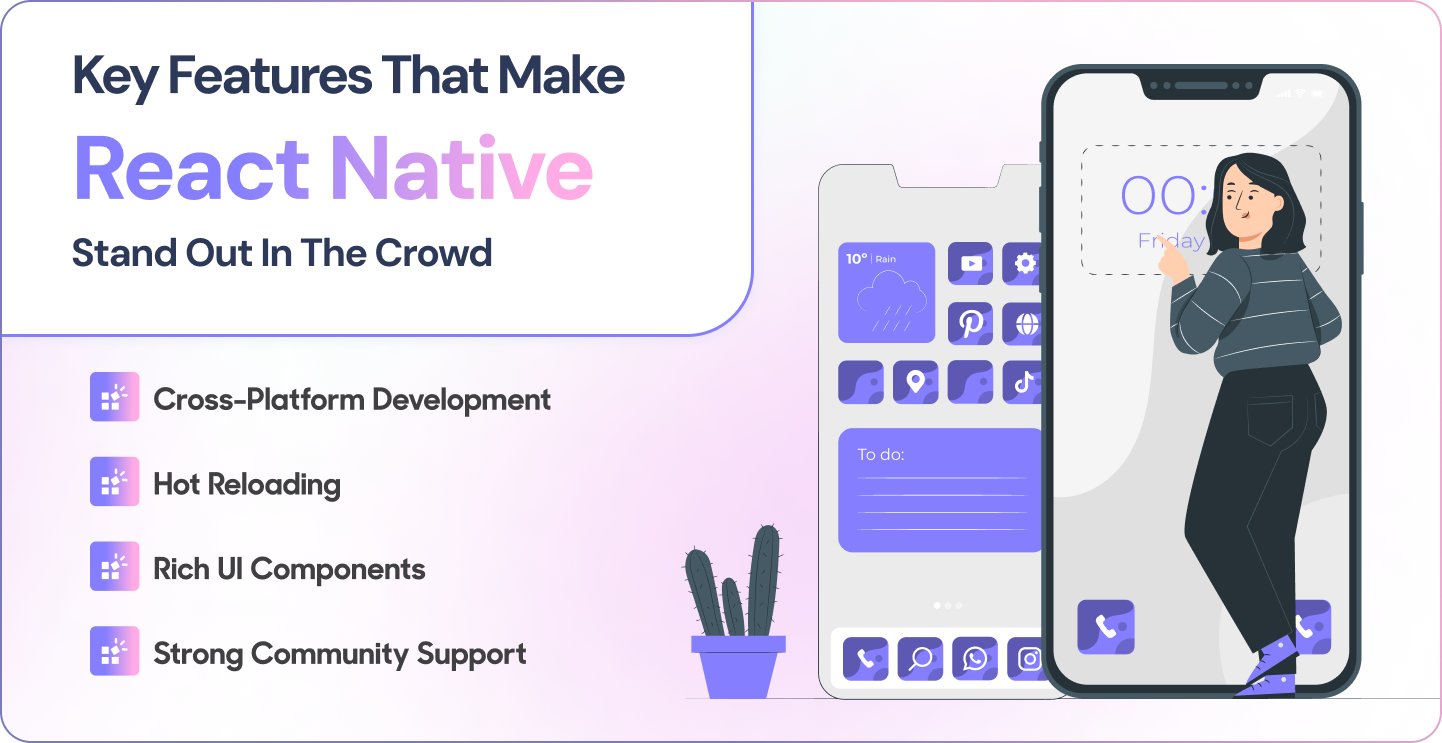
Cross-Platform Development
Its foremost benefits make cross-platform apps work perfectly across any number of platforms. Developers, for the most part, no longer need to have two independent teams for iOS and Android developments due to this feature, significantly reducing costs and speeding time to market.
A professional mobile application development service can ensure that capabilities towards a cross-platform are used and enjoyed entirely.
Hot Reloading
The hot reloading feature of React Native lets developers see the changes they make in real-time without needing to restart the app. This accelerates productivity and facilitates faster debugging and iteration, leading to an efficient development process.
Rich UI Components
React Native provides developers with a wide variety of pre-built UI components that enable them to create visually attractive and highly interactive user interfaces. The components ensure that the apps meet modern design standards, hence improving user satisfaction.

Build Your App 40% Faster with React Native — Get a Free Quote
See real costs, performance benchmarks & when React Native is right for you — then get a custom estimate in 24 hours.Strong Community Support
React Native has a strong community of developers who are constantly contributing to the growth of the platform. This vast network provides valuable resources, plugins, and libraries that make it easier for a React Native app development company to deliver top-notch solutions.
With React Native 0.85’s New Architecture, cross-platform development is faster than ever. TurboModules lazy-load only when needed, reducing initial app load time by 40%. The Fabric renderer ensures iOS and Android apps deliver identical 60-120 FPS performance.
React Native’s New Architecture is Now the Standard (2026)
The New Architecture became the default in React Native version 0.76, and the legacy bridge-based system was permanently disabled in version 0.82. This marks a fundamental shift in how React Native applications perform.
What is the New Architecture?
The New Architecture consists of four core components:
1. JSI (JavaScript Interface) – Enables direct, synchronous communication between JavaScript and native code, eliminating JSON serialization delays that previously caused 200ms+ latency, now reduced to under 2ms.
2. Fabric Renderer – A complete rewrite of the UI rendering system that maintains an immutable UI tree and enables interruptible rendering, allowing low-priority updates to yield to high-priority ones without blocking the main thread.
3. TurboModules – Lazy-loaded native modules that reduce cold-start memory by 40% and provide direct communication with native code.
4. Codegen – Automatically generates type-safe bindings between JavaScript and native code.
Real-World Performance Gains:
- 43% faster cold startup times
- 39% improved rendering performance
- 25% memory reduction across app lifecycle
- Sub-2ms JavaScript-to-native communication (vs 200ms+ previously)
Why React Native is Transforming Mobile App Development
Faster Development Cycles
React Native’s single codebase drastically reduces development time. Businesses can launch their apps faster, giving them a competitive edge in the market. By engaging a mobile application development service, companies can ensure their projects are delivered on time without compromising on quality.
Cost-Effective Solutions
It is costly to develop separate apps for iOS and Android. With React Native’s cross-platform approach, this reduces the cost and hence makes it more appealing to both startups and established enterprises.
Performance
React Native 0.85 delivers native-level performance through its New Architecture. The elimination of the bridge reduces JavaScript-to-native latency from 200ms+ to under 2ms. Real-world production apps show 43% faster cold starts and 39% better rendering performance compared to the legacy architecture. Apps now consistently maintain 60-120 FPS even during complex animations and heavy data processing.
Scalability and Flexibility
With growing businesses, their mobile app requirements grow with time. The architecture of React Native supports scalability and it is easy for developers to add new features or modification to the application. Skilled React Native app development companies can design applications with a change in business need.
| Metric | React Native 0.85 | React Native 0.74 | Improvement |
|---|---|---|---|
| Cold Startup Time | ~350ms | ~610ms | 43% faster |
| JS-Native Latency | <2ms | 200ms+ | 99% faster |
| Memory Usage | Base + 25% reduction | Base | 25% lower |
| FPS (Complex UI) | 60-120 FPS | 45-60 FPS | 33% smoother |
| npm Weekly Downloads | 4.5 million | 3.8 million | 18% growth |
Applications of React Native Across Industries
E-Commerce
Retailers are using React Native to make feature-rich e-commerce applications with smooth navigation and safe payment integrations. It allows the overall performance of the application to give a good user experience while making purchases.
Health Care
Healthcare applications demand strength in performance as well as secure standards. The adaptability of using native modules makes it a perfect telemedicine, appointment scheduling and fitness tracking applications.
Social Media
Social media apps are interactive by nature and thrive on updates in real-time. Hot reloading by React Native and native-like performance make it a perfect contender for building engaging social networking platforms.
Travel and Hospitality
With React Native, travel applications are built with smooth navigation, real-time updates, and integration to third-party APIs for payments and bookings. A service for mobile application development ensures the apps meet industry-specific requirements.
Challenges in React Native Development and How to Overcome Them
Complex UI Requirements
Apps that have highly complex UI designs might require more customization. Such problems can be overcome by an experienced developer who can add native modules where necessary.
Performance Bottlenecks
While performance with React Native is fantastic, some applications will encounter trouble due to excessive animation or background processes. An experienced mobile application development company will optimize the app for flawless performance.
New Architecture Migration
Apps built on React Native versions below 0.80 must migrate to the New Architecture. While migration typically takes 2-8 weeks, it’s mandatory as React Native 0.82 permanently disabled the legacy bridge. Most popular libraries (React Navigation 7.2+, Reanimated 3.5.1+, Expo SDK 52+) are fully compatible, but custom native modules require updates.
Third-Party Library Dependence
Third-party libraries enrich functionality, but dependency on them can be hazardous to compatibility. A qualified React Native app development company can choose libraries wisely and include them properly so that no possible complications can arise.
Future Trends in React Native Development
AI and Machine Learning Integration
The future demand for intelligent apps seems to be on the rise. Developers can now build smarter applications on top of React Native due to this platform’s compatibility with AI and Machine Learning libraries.
IoT Connectivity
With the growing use of IoT, React Native is developing applications that easily interface with smart devices to enhance the convenience of the user.
Sophisticated Security Features
In a world where threats to cyber attacks are rising, developers are making applications with better security features. With the modular architecture of React Native, advanced security features can be integrated easily.
What’s New in React Native 2025-2026
Complete Bridge Elimination (React Native 0.82+)
React Native 0.85 eliminated the asynchronous Bridge entirely in April 2026. Apps no longer suffer from the JSON serialization delays that caused lag in earlier versions. Direct synchronous calls via JSI deliver near-native performance.
Enhanced Developer Tools
The standalone desktop DevTools app now includes:
- Performance panels for tracing JavaScript execution
- Real-time React component profiling
- Network request monitoring and debugging
- Sub-millisecond timeline visualization
React 19.2 Integration
New features from React 19.2
- use Transition – High-priority UI updates remain responsive during background tasks
- Activity component – Preserves component state when screens aren’t visible
- Concurrent rendering – Smoother updates and better complex state handling
Intersection Observer API
Native support for observing when elements enter/exit the viewport—crucial for optimizing infinite scroll, lazy loading images, and analytics tracking.
Current Version Status (April 2026)
Latest Stable: React Native 0.85
Minimum Supported: React Native 0.80
Expo SDK: Version 52+ (New Architecture enabled by default)
React Version: 19.2
Ecosystem Compatibility: 85% of popular packages support New Architecture
Migrating To React Native 0.85 and New Architecture
Is Migration Required?
Yes. React Native 0.82 permanently disabled the legacy bridge in November 2025. Apps must update to version 0.80+ and enable the New Architecture to receive updates and security patches.
Migration Timeline
- Simple apps (few custom modules): 1-2 weeks
- Medium complexity: 3-5 weeks
- Complex apps (heavy native code): 6-8 weeks
Build Your App 40% Faster with React Native — Get a Free Quote
See real costs, performance benchmarks & when React Native is right for you — then get a custom estimate in 24 hours.Prerequisites
- Update to React Native 0.80 or higher
- Enable Hermes engine (required for JSI)
- Update all dependencies to New Architecture-compatible versions
- Test thoroughly on both iOS and Android
Key Libraries Compatibility (2026)
- React Navigation 7.2+
- React Native Reanimated 3.5.1+
- React Native Gesture Handler 2.16.2+
- Expo SDK 52+
- React Native Vision Camera 4.0+
A professional React Native app development company can handle the migration process smoothly, ensuring zero downtime and optimal performance gains.
How to Select the Best React Native App Development Company
Experience and Expertise
Select a React Native app development company that has a proven track record in delivering high-quality apps across industries.
Comprehensive Services
Ensure the company offers end-to-end mobile application development services, including design, development, testing, and maintenance.
Client Reviews and Portfolio
Reviewing past projects and client testimonials gives insights into the company’s capabilities and reliability.
Conclusion
React Native continues to redefine the world of mobile app development throughout 2026. The increasing ability to deliver cross-platform solutions, reduce development costs and enhance user experiences makes it one of the top choices for businesses nowadays. By collaborating with a reliable react native app development company and using strong mobile application development service entrepreneurs can create apps that address the evolving demands of the marketplace and deliver exceptional value.
As the demand for innovative and scalable mobile applications continues to grow, utilizing React Native ensures businesses are ahead in this competitive industry. Be it a start-up or an established enterprise, now is the time to harness the power of React Native for your next mobile app project.
FAQs
Q1: How much does React Native app development cost in the USA?
React Native app development in the USA typically costs between $25,000 and $150,000 for a mid-complexity app. Simple apps range from $10,000 to $30,000, while enterprise-grade apps can exceed $200,000. Because React Native uses a single codebase for iOS and Android, it reduces development costs by 30-40% compared to building two separate native apps.
Q2: How long does it take to build a React Native app?
A basic React Native app takes 2-4 months to build. A mid-complexity app with custom features, third-party integrations, and backend APIs takes 4-8 months. Enterprise apps can take 9-18 months. Using React Native speeds up development by approximately 40% compared to building separate native iOS and Android apps.
Q3: Is React Native still relevant in 2026?
Yes, React Native remains highly relevant in 2026. It is used by 18,873+ verified companies worldwide, including Meta, Microsoft, Shopify, and Walmart. The release of React Native 0.85 with the New Architecture (JSI, Fabric, TurboModules) has eliminated the legacy bridge system, delivering near-native performance and sub-2ms JavaScript-to-native communication.
Q4: What types of apps are best suited for React Native?
React Native is best suited for: e-commerce apps, social media platforms, business productivity tools, fintech and banking apps, content delivery apps, and startup MVPs. It is ideal when you need to launch on both iOS and Android quickly with a limited budget. It is less ideal for apps requiring complex graphics, real-time gaming, or heavy device-specific hardware integration.
Q5: Should I choose React Native or Flutter for my business app in 2026?
For most US businesses, React Native is the better choice if your team already knows JavaScript or React. Flutter is better if you need pixel-perfect custom UI or plan to expand to desktop platforms. React Native has a larger talent pool in the US, making hiring easier. Flutter has a slightly larger cross-platform market share (46% vs 35%) but requires learning Dart.
Do not Miss Our Latest Tech Insights
Stay one step ahead in the fast-moving world of AI and technology. Add us as a Preferred Source on Google and get our latest articles, guides, and industry insights delivered straight to your search feed.