TABLE OF CONTENT
- Understanding Cloud-Based Mobile Application Development
- Benefits of Cloud-Based Mobile Application Development
- How Custom Software Development in California Enhances Cloud Solutions
- Important Considerations in Cloud-Based Application Development
- Emerging Trends in Cloud-Based Mobile Application Development
- Conclusion
- FAQs
Nikhil Bellarykar wrote for the writer, “In today’s fast-paced digital landscape, the business needs to keep up with changing and trending technologies. The development of cloud-based application solutions has recently emerged as a powerful solution for companies to streamline operations, enhance scalability, and reduce costs.” With cloud-basedmobile application development, businesses can optimize their processes and deliver exceptional value to their customers. Whether it is a startup or an established enterprise, investing in mobile application development service and custom software development in California can take your business operations to a whole new level.
94% of enterprises use cloud services in 2026. The global cloud application development market reaches USD 900 billion. Businesses using cloud-native apps reduce IT operational costs by 30-40% and deploy new features 5x faster than on-premise equivalents.
Understanding Cloud-Based Mobile Application Development
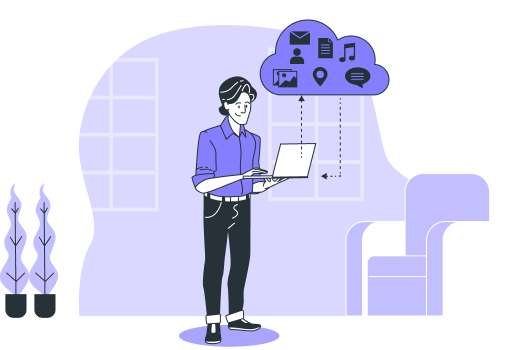
Cloud-based mobile application development refers to building apps where the computing power, data storage, and processing logic reside on remote cloud servers — not on the user’s device. This architecture is fundamentally different from traditional on-premise software where everything runs on local hardware. For businesses, the practical meaning is transformative: your app can scale from 10 users to 10 million without infrastructure procurement delays; your team can deploy updates to all users simultaneously without requiring device updates; and your operational data is centrally managed with professional-grade backup and disaster recovery. In 2026, cloud-native is not the advanced choice — it is the default choice for any business building a serious mobile application.
Especially during these instances when rapid growth of their industries and sudden changes in demand happen, cloud-based solutions benefit these companies by the fact that through a proven mobile application development service, companies can have solutions fit into their particular needs while on cloud, there is flexibility in scale and in scalability.
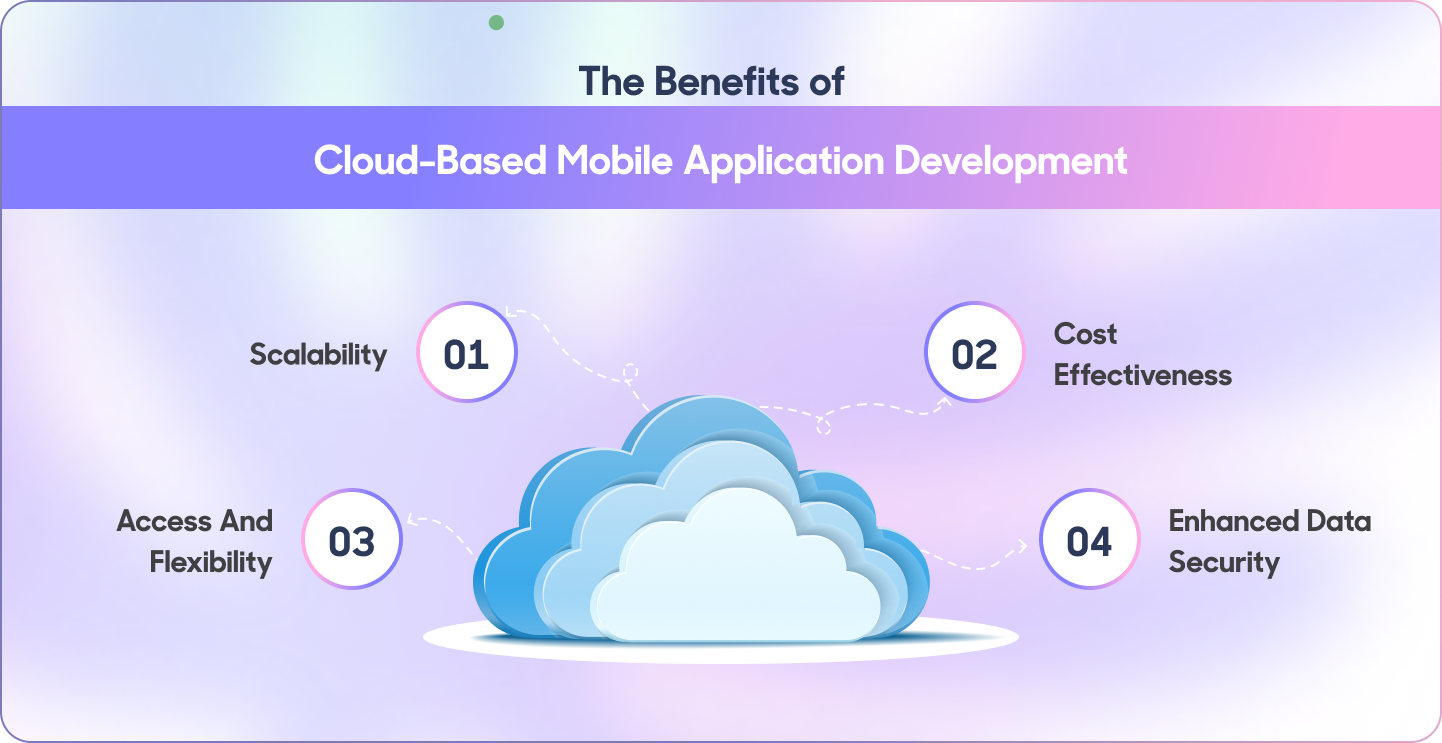
1. Scalability
One of the most significant advantages of cloud-based mobile application development is its scalability. As your business grows, your applications can easily scale to accommodate increased demand. This eliminates the need for costly infrastructure upgrades, ensuring that your resources are used efficiently.
2. Cost-Effectiveness
Cloud-based applications reduce the upfront costs of a traditional software development. Organizations do not have to make investments in expensive hardware or its maintenance. With the service of mobile application development, businesses can access the latest technologies without having to bear high capital expenditures.
3. Access and Flexibility
Cloud-based applications are accessible from any device connected to the internet, so it is ideal for business use by remote teams or with multiple locations. This increases productivity and allows employees to collaborate regardless of their location.
4. Enhanced Data Security
Cloud providers prioritize data security by implementing robust measures, such as encryption and regular updates. Businesses partnering with a custom software development company in California can ensure that their applications meet the highest security standards, protecting sensitive information and building trust with customers.
Benefits of Cloud-Based Mobile Application Development
The benefits of cloud-based mobile development compound over time in a way that on-premise solutions cannot match. Initial cost savings are real but modest — the deeper value comes from speed (features deploy in hours, not months), reliability (AWS and GCP offer 99.99% uptime SLAs), and the ability to integrate with a growing ecosystem of cloud-native AI, analytics, and third-party services through standardized APIs.
| Benefit | Cloud-Based App | On-Premise App | Business Impact |
|---|---|---|---|
| Deployment Speed | Hours to deploy updates | Weeks of release cycles | 5x faster feature delivery |
| Scalability | Auto-scales in seconds | Requires hardware procurement | Handle traffic spikes instantly |
| Uptime | 99.99% SLA (AWS/GCP) | Varies (typically 95-99%) | Fewer customer-impacting outages |
| Cost Model | Pay-as-you-go operational | High upfront CapEx | 30-40% lower IT costs |
| Security | Enterprise-grade + compliance | Depends on internal team | Better compliance posture |
| AI Integration | Native (AWS AI, Google AI) | Complex custom integration | Faster AI feature deployment |
How Custom Software Development in California Enhances Cloud Solutions
Some of the world’s greatest innovators in the field of tech come from California, so that state has been at the epicenter of custom software development. The companies based here are able to make solutions which match up with a business’ particular goals. This is how they contribute towards success in cloud-based mobile application development:
1. Personalized Solutions
Every business has unique requirements, and custom software development ensures that applications are designed to address those needs. By collaborating with experts in California, businesses can develop apps that integrate seamlessly with their existing workflows.
2. Expertise in Cutting-Edge Technologies
California’s developers are at the forefront of technological advancements. They bring expertise in the latest cloud technologies, ensuring that applications are built using the best practices and tools available.
3. Focus on User Experience
A successful application should always be focused on user experience. The California-based custom software developers understand that an intuitive design and functionality create an application that is user-friendly and engaging.
4. Continuous Support and Maintenance
The custom software development in California is not a one-time deployment activity. Instead, the developers will continue providing support and maintenance for applications to keep them up-to-date and working efficiently.
Important Considerations in Cloud-Based Application Development
Cloud-based application development has real risks that must be managed from the architecture phase, not discovered post-deployment. The three most significant: vendor lock-in (building tightly coupled to one cloud provider’s proprietary services makes migration expensive — use containerization with Docker and Kubernetes to maintain portability), data sovereignty (US financial and healthcare regulations require data to reside in specific geographic regions — choose a cloud provider with the right regional data centers), and latency management (cloud-native apps can introduce latency for real-time features — CDN deployment and edge computing mitigations are standard but must be planned for). A competent cloud development partner will address all three in their initial architecture proposal.
1. Choosing the Right Mobile Application Development Service
In order to successfully run a project, it is essential to partner with a reliable mobile application development service. The provider should be one who has experience with cloud-based solutions and is able to deliver high-quality applications.
2. Security End
Data security is one of the most significant concerns for businesses. Ensure that your development partner implements robust security measures to protect sensitive information and comply with industry regulations.
3. Planning for Scalability
Scalability should be a core consideration during the development process. Design your application with future growth in mind to avoid costly modifications down the line.
4. Focusing on User Needs
Understanding your target audience is very important to building an effective application. Deeply research the user preferences and pain points and tailor the solution around that.
Emerging Trends in Cloud-Based Mobile Application Development
The cloud application development landscape in 2026 is defined by three converging trends. Edge computing (processing data closer to users rather than in centralized data centers) is reducing latency for real-time applications from 100ms+ to under 10ms — critical for AR, IoT, and real-time analytics apps. Serverless architecture (AWS Lambda, Google Cloud Functions) allows development teams to build and deploy individual functions without managing servers, reducing operational complexity by 60-70% for appropriate workloads. And the integration of cloud-native AI services (AWS Bedrock, Google Vertex AI, Azure OpenAI) means any cloud application can now access enterprise-grade AI capabilities through a simple API call — no AI team required.
1. AI Integration
AI is being used in cloud-based application services to analyze data for businesses, automate processes to streamline things, and enhance users’ experiences. Partner with a mobile application development firm that can integrate AI into it for the competitive advantage of a business.
2. Green Trend
Sustainability seems to be a growing trend in sectors today. Cloud-based technology is helping businesses reduce footprints on the environment and also reduce the need to physically set up infrastructure since they can optimize resource consumption.
3. IoT Capabilities Expansion
IoT is changing the way of doing business. Cloud-based applications are at the forefront of this change, providing the ability to seamlessly connect between devices and enhance operational efficiency.
4. Data Analytics Improvement
Data-driven decision-making is a priority for businesses. Cloud-based applications with advanced analytics capabilities allow companies to gain valuable insights, which improve strategies and outcomes.
Conclusion
Cloud-based mobile application development is redefining the way companies operate with unmatched scalability, cost-effectiveness, and flexibility. By using custom software development in California, a company can develop tailored solutions to drive growth and innovation. Through a trustworthy mobile application development service, your applications are built with the highest standards of quality and security.
With increasing demand for cloud-based solutions, businesses that make such investments will be able to perform well in competitive markets. Whether it’s streamlining operations, making collaboration easier, or improving customer experience, cloud-based application development is the path to unlocking your business’s full potential.
FAQs
Q: What is cloud-based mobile application development?
Cloud-based mobile app development means building apps where the backend, data storage, and computing logic run on cloud servers (AWS, Google Cloud, Azure) rather than on local hardware. Users access your app from any device, and the cloud infrastructure scales automatically based on demand — eliminating the need to manage physical servers.
Q: How does cloud development reduce costs?
Cloud development shifts infrastructure cost from CapEx (buying servers) to OpEx (pay-as-you-go). Businesses save on hardware procurement, data center space, cooling, and IT maintenance. On average, cloud-native businesses reduce IT infrastructure costs by 30-40% while achieving higher reliability and faster deployment cycles than on-premise equivalents.
Q: Is cloud-based app development secure?
Cloud providers like AWS, Google Cloud, and Azure invest more in security than any individual business can — with SOC 2, ISO 27001, HIPAA, PCI DSS, and FedRAMP certifications, dedicated security teams, and real-time threat detection. Cloud-based apps are more secure than on-premise alternatives when architected correctly by an experienced development team.
Q: Which cloud platform is best for mobile app development?
A: AWS is the most mature with the widest service catalog (recommended for enterprise). Google Cloud excels for AI/ML integration and Firebase-based apps (recommended for startups and mobile-first products). Azure is best for Microsoft ecosystem integration. Most mobile apps use Firebase for real-time features regardless of their primary cloud provider.
Q: How long does it take to build a cloud-based mobile app?
A: A basic cloud-based app with standard features takes 3-5 months. A mid-complexity app with custom backend, real-time features, and third-party integrations takes 5-8 months. Enterprise cloud applications with complex microservices architecture, compliance requirements, and large data volumes typically take 9-18 months to build and deploy.