
TABLE OF CONTENT
- Understanding Quantum Computing
- How Quantum Computing Changes Custom Software Development
- Applications of Quantum Computing in Custom Software Development
- Why California is Leading in Quantum Software Development
- Reasons Challenges of Quantum Computing Integration
- Preparation for the Quantum Future
- Conclusion
Overview
- Quantum computers use qubits instead of bits to solve complex problems exponentially faster.
- Drug discovery, financial optimization, cryptography breaking, and logistics routing benefit most from quantum.
- Quantum decoherence, extreme operating conditions, and skill scarcity are the primary development barriers.
It has emerged as a revolutionary force in the world of technological innovation. Quantum computing promises to tackle problems that are deemed impossible with the classical computers, using the principles of quantum mechanics. Industries, including the domain of custom software development, will begin to change their paradigms.
It may seem complex like optimization algorithms but transforms the manner data is being processed. It is going to be a chief shaper of the future, and already very much in tech hubs like California, where innovation thrives.
IBM’s Osprey quantum processor has 433 qubits. Google’s Willow chip (2024) demonstrated quantum advantage — solving in 5 minutes what classical computers would need 10 septillion years for. The global quantum computing market reaches USD 2.6 billion in 2026, growing at 32% CAGR.
Understanding Quantum Computing
Quantum computing represents a fundamental departure from classical computing architecture. While classical computers process information as binary bits (0 or 1), quantum computers use quantum bits (qubits) that can exist in multiple states simultaneously through a property called superposition. A second property — entanglement — allows qubits to be correlated regardless of physical distance, enabling quantum computers to process vast solution spaces simultaneously. The practical implication: problems that would require classical computers billions of years to solve can theoretically be solved by a sufficiently powerful quantum computer in hours or minutes. Google’s Willow chip (2024) demonstrated this quantum advantage concretely — completing a specific computational task in 5 minutes that would take the fastest classical supercomputer 10 septillion years.
This computational advantage provides a solution and application opportunity for problems in cryptography, artificial intelligence, and logistics in custom software development. Quantum computing will change the way designs, developments, and optimizes software are done at a very much faster pace.

How Quantum Computing Changes Custom Software Development
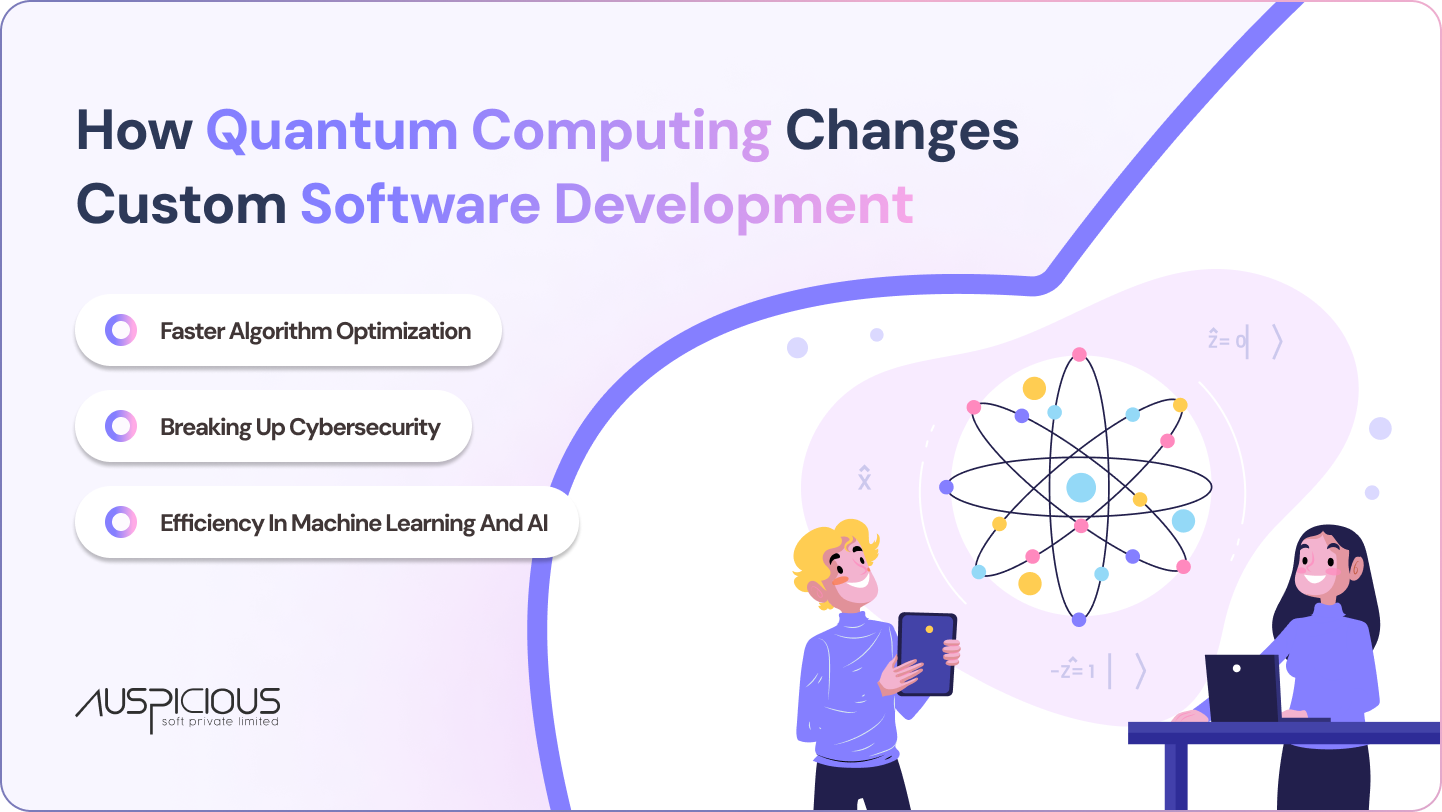
1. Faster Algorithm Optimization
Traditional software will typically use algorithms developed primarily to achieve a given goal. Quantum computers can highly optimize such algorithms. It can quickly find the best routes, investment strategies, or resource allocations in a logistics or financial sector within seconds.
Companies in California that specialize in custom software development have already started to research how quantum algorithms can improve performance for their clients, particularly in industries in which competition is stringent and efficiency is paramount.
2. Efficiency in Machine Learning and AI
The area where machine learning algorithms will be most helped by quantum computing is in requiring gigantic computational resources. Quantum-powered AI can deliver insights with better precision and speed by processing millions of data in parallel. Predictive analytics form the backbone of some of the world’s leading industries, particularly healthcare and retail.
For example, California, known for its strong tech ecosystem, has developers embedding quantum solutions into AI-focused custom software development projects with the rising demand for intelligent applications.
3. Breaking Up Cybersecurity
Quantum computing is also the problem as it is the solution to cybersecurity. While it attacks traditional encryption standards, classical cryptographic systems can be broken by quantum algorithms. However, quantum cryptography provides encryption methods that are unbreakable.
The specialty of California-based software developers in custom software development is that they are among the leaders to realize quantum-safe encryption, so clients’ applications are safe and secure since the very start.
Applications of Quantum Computing in Custom Software Development
Quantum computing’s practical applications in software development center on four problem categories where its parallel processing advantage is most valuable.
1. Optimization Problems
The most complicated optimization problems are those within the industries in logistics, supply chain management, and transportation. Quantum computers solve such types of optimization problems much quicker than classical computers, which may take a couple of years in calculations to find the optimal solution.
For example, a company that develops custom software can leverage the quantum algorithm to design applications to optimize the delivery route or manage real-time inventory.
2. Drug Discovery
The pharmaceutical industry has huge molecular datasets for discovery of new drugs. Quantum computing accelerates this process by simulating much faster and more accurately molecular interaction.
The developers, as well as the custom software development in California, team up with biotech companies to develop quantum computing-powered software that will be capable of analyzing millions of compounds for any potential drugs when it comes to the discovery of drugs. This saves time and the cost of research.
| Application Area | Quantum Advantage | Timeline to Production | Industry Impact |
|---|---|---|---|
| Drug Discovery | Molecular simulation at atomic level | 5-10 years to full scale | 90% faster drug development |
| Financial Optimization | Portfolio optimization across 1M+ variables | 2-5 years (near-term) | 15-25% better risk-adjusted returns |
| Cryptography/Security | Breaking RSA encryption (theoretical) | 10-15 years | Forces post-quantum cryptography now |
| Logistics Routing | Optimal routing across 10,000+ variables | 3-7 years | 30-40% efficiency improvements |
| AI/ML Training | Quantum speedup for specific ML tasks | 5-10 years | 10-100x faster training for some models |
| Climate Modeling | Complex atmospheric simulation | 7-15 years | More accurate climate predictions |
3. Financial Modeling
Quantum computing has the power to transform finance through the real-time risk analysis, fraud detection, and portfolio optimization. The analytics, which are powered by quantum, will be utilized in the current operations, as shown by the firms already investing in the development of customized software.
4. Weather Forecasting
Quantum computers would process huge amounts of atmospheric data to give far more accurate predictions of weather. Abilities like these are highly beneficial for agriculture and disaster management.
Companies building custom software solutions cater to the needs of these industries using quantum-enhanced predictive models.
Why California is Leading in Quantum Software Development
1. Innovation Ecosystem
California is one of the centers on earth for technology and innovation. Companies involved in custom software development within California are strategically placed to discover and apply quantum computing. World-class research institutions are adjacent, coupled with abundant venture capital, putting California at the forefront of the quantum boom for tech.
2. Opportunities for Collaboration
Most of the tech firms in California work hand in glove with giant universities, like Stanford and Caltech, known for pioneering research on quantum. Such a collaboration pushes hard for the acceleration of the inclusion of quantum computing in custom software development projects.
3. Early Adopters
These companies in California have a long history of being technology adopters. Be it a startup or a tech giant, the call for quantum solutions is compelling developers in the state to get ahead in their custom software development.
Reasons Challenges of Quantum Computing Integration
Quantum computing’s path to practical software deployment faces significant technical barriers that software developers and businesses must understand to set realistic expectations. Quantum decoherence — the tendency of qubits to lose their quantum state through interaction with the environment — currently limits quantum computation to microsecond timescales and requires operating temperatures near absolute zero (-273°C). This means current quantum computers are extremely fragile laboratory instruments, not server room hardware. Additionally, the talent scarcity is acute: quantum software engineers capable of writing algorithms that exploit quantum advantage number fewer than 5,000 worldwide in 2026. For most software development businesses, the practical near-term engagement with quantum computing is preparing post-quantum cryptography migration — a necessary defensive measure, not an offensive capability.
1. Access is limited
Quantum computers remain scarce, expensive, and therefore accessible only to a few organizations. For the majority of custom software development companies, quantum computing needs to be accessed in collaboration with tech giants such as IBM, Google, or Amazon.
2. Lack of Specific Knowledge
Quantum computing is an area of specialization. The developers should improve their skill level to absorb the new capabilities in custom software development projects.
3. Hardware Limitation
These are developmental stages of the current quantum computers with less numbers of qubits and high error rates. Developers face the challenge as they introduce new quantum-powered solutions.
Preparation for the Quantum Future
1. Invest in Training
As quantum computing becomes mainstream, developers need to begin their learning curve regarding quantum programming languages, such as Qiskit or Cirq. Companies specializing in custom software development in California already provide training programs to prepare teams for this shift.
2. Quantum Suppliers Partnerships
A custom software development business could easily partner with vendors like IBM, Google, and Microsoft. This will allow them to access quantum computing resources and expertise.
3. Hybrid Approach
Quantum computers may supplement, rather than replace, classical computing. Hybrid solutions, which combine both, may prove well-suited for assisting companies as they transition.
Conclusion:
It is an infant technology; its potential can be nothing but evident. However, after its maturity, indeed, it will emerge as part of custom software development. Businesses will now be able to crack problems that they were never able to crack.
Quantum computing has already begun shaping industries in California by trying it out with software development. Developers and businesses alike are going to need to get along with this change because the world is indeed going digital.
As such, the amount of innovation, cooperation, and learning, California, therefore is a bright future for custom software development, with quantum computing as the driving force.
FAQs
Q: What is quantum computing and how does it affect software development?
Quantum computing uses quantum bits (qubits) that can process multiple solutions simultaneously (superposition) rather than sequentially like classical computers. For software development, this means certain categories of problems — optimization, cryptography, simulation — can be solved exponentially faster. In the near term (2026-2030), the primary practical impact is:
- Need to migrate encryption to quantum-resistant algorithms (post-quantum cryptography) before quantum computers can break current RSA/ECC encryption.
- Opportunity to use quantum cloud services (IBM Quantum, AWS Braket) for specific optimization problems.
Q: When will quantum computing affect my software business?
The timeline varies by use case. Post-quantum cryptography preparation is needed now — NIST published final post-quantum standards in 2024, and organizations should begin migration planning. Quantum-accelerated optimization for logistics, finance, and drug discovery is 3-7 years away. General-purpose quantum computing that replaces classical computing is 15-20+ years away. The near-term action: audit your systems for cryptographic vulnerabilities to quantum attack and begin migration planning.
Q: Is quantum computing relevant to mobile app development?
Currently, quantum computing has no direct impact on mobile app development. Mobile devices will not have quantum processors in the foreseeable future. The indirect impact comes through:
- Back-end systems that mobile apps call may eventually use quantum optimization for routing, pricing, or recommendations.
- Encryption protocols in mobile apps will need to migrate to post-quantum cryptographic standards in the next 5-10 years.
Q: What is post-quantum cryptography and why does it matter?
A: Post-quantum cryptography refers to cryptographic algorithms that remain secure even against quantum computers. Current widely-used encryption (RSA, ECC) can theoretically be broken by a sufficiently powerful quantum computer using Shor’s algorithm. NIST published the first post-quantum cryptographic standards in August 2024 (CRYSTALS-Kyber, CRYSTALS-Dilithium). US federal agencies are required to migrate to these standards by 2030. Businesses in finance, healthcare, and government contracting should begin migration planning now.
Q: How can California-based companies leverage quantum computing?
California leads US quantum computing investment, with major players including Google Quantum AI (Santa Barbara), Rigetti Computing (Berkeley), and IonQ (with California partnerships). For California software companies, practical engagement with quantum computing in 2026 includes: access to quantum cloud services (IBM Quantum Network, AWS Braket, Azure Quantum) for specific optimization problems, partnership opportunities with California quantum hardware startups, and talent access through UC Berkeley, Caltech, and Stanford quantum research programs.
Do not Miss Our Latest Tech Insights
Stay one step ahead in the fast-moving world of AI and technology. Add us as a Preferred Source on Google and get our latest articles, guides, and industry insights delivered straight to your search feed.