+1 740 762 6496
 +91 70189 46603

Contact Us

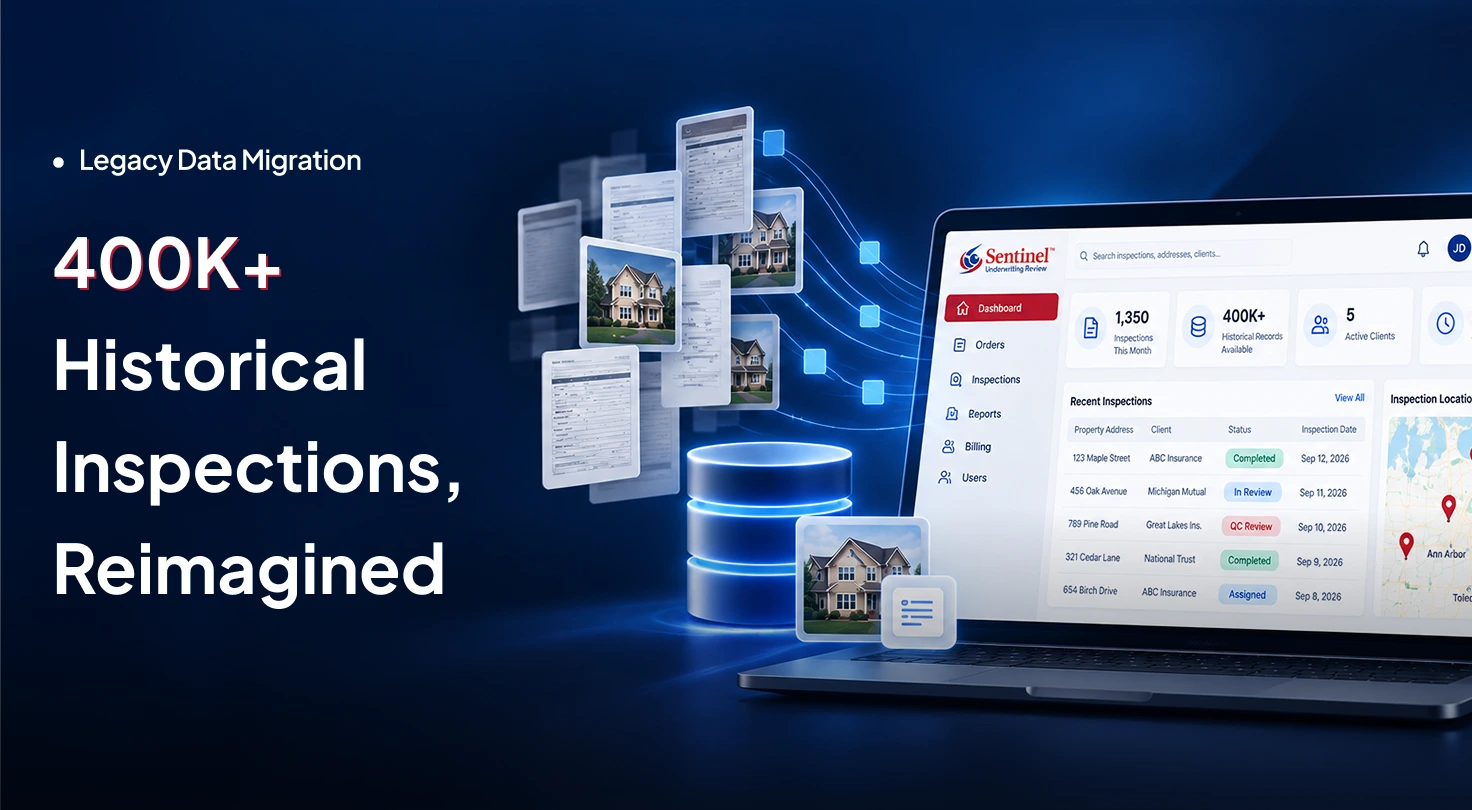
We rebuilt Sentinel Underwriting's entire property-inspection workflow — from order intake to delivered report and invoice — on a modern platform, migrating 400k+ historical inspections and layering in automated valuations, AI-assisted quality review, and role-based portals for every stakeholder.
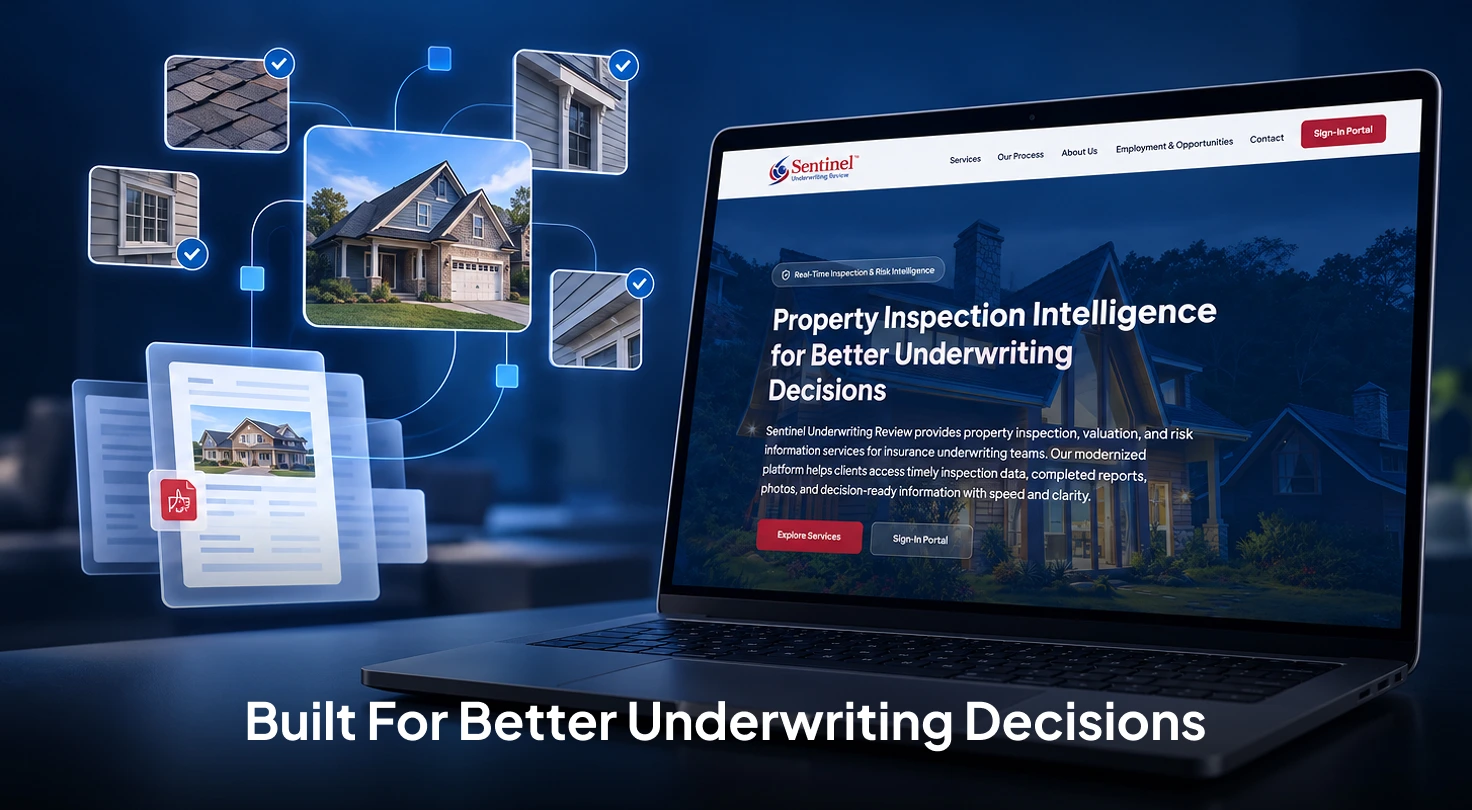
Sentinel Underwriting Review Inc. provides real-time, on-demand risk intelligence across insurance, mortgage, banking, and real estate. For over 48 years, the Michigan-based company has led web-based property inspection and ITV intelligence, with turnaround times as fast as 24 hours.
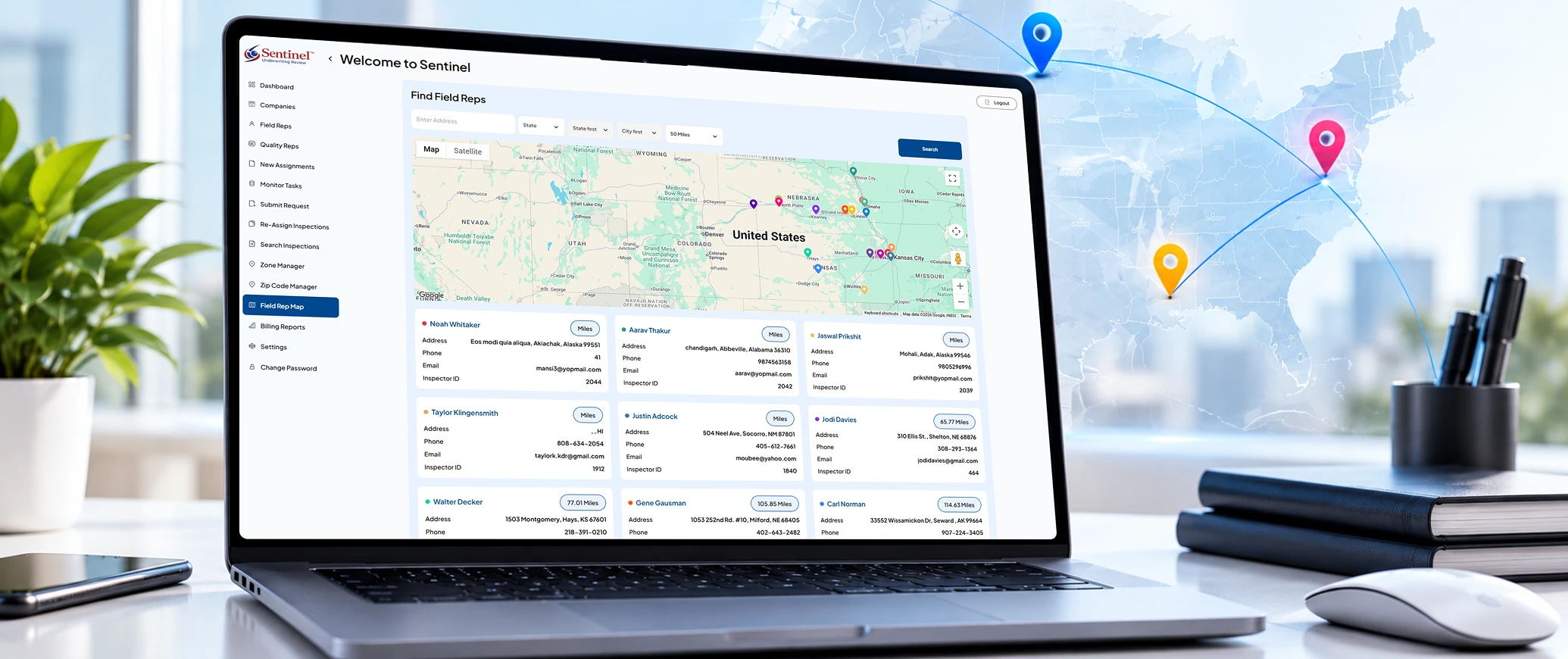
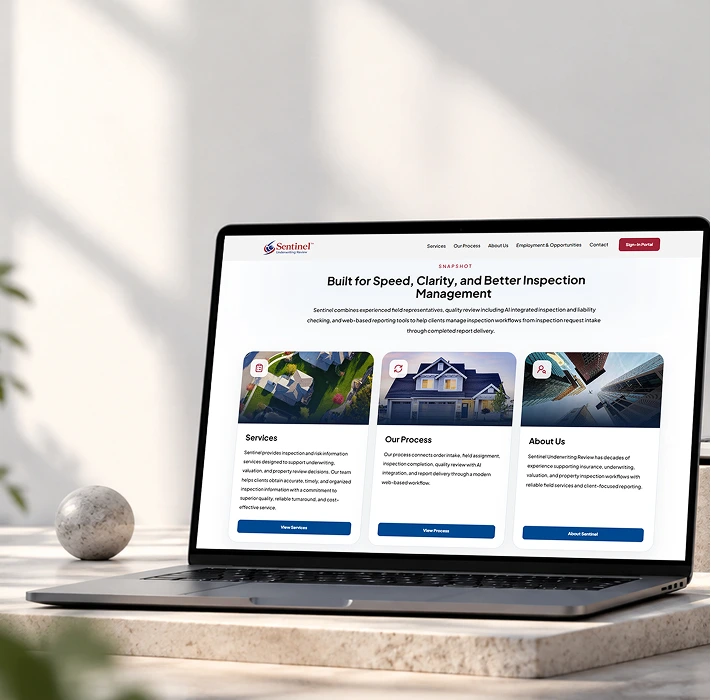
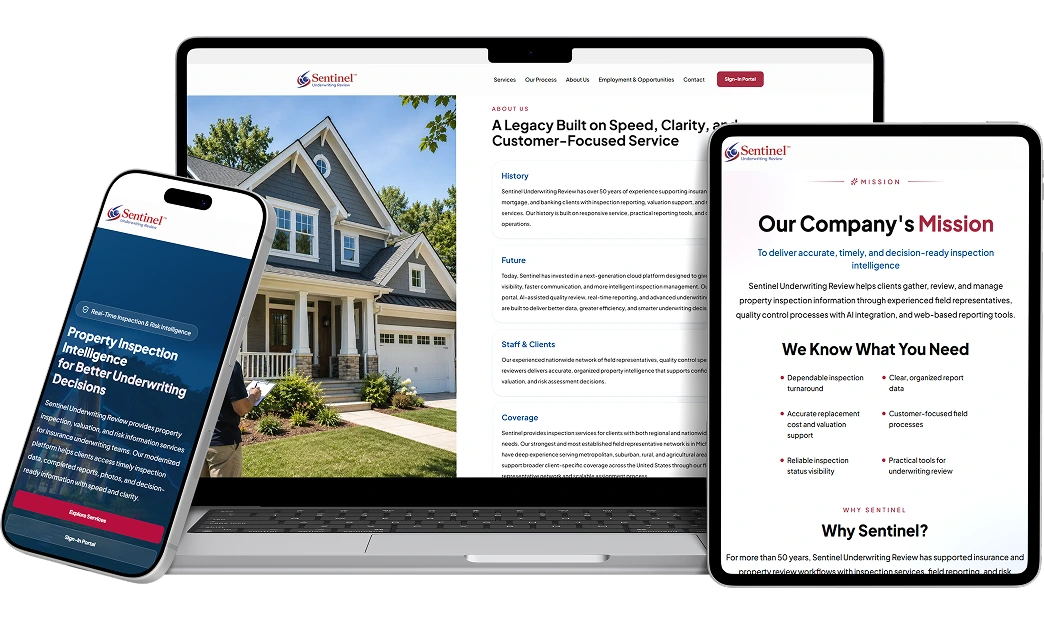
But the platform powering that reputation had aged. Sentinel had outgrown a system built two decades earlier, and asked us to rebuild it — replacing a 20-year-old application with a modern, automated underwriting portal engineered to carry the business for the next twenty.
Sentinel's reputation is built on accurate inspections delivered fast — but the
software behind it had been built roughly twenty years ago, and it was showing its
age. The underlying database had grown inconsistent over time, and simply keeping it
running meant staff constantly watching it and fixing records by hand. Much of the
historical data was corrupted or locked in formats that couldn't easily be
restructured. Worse, the inspection forms at the very heart of the business weren't
captured as structured data at all.
The platform did just enough to keep daily operations going, and no more. It
couldn't support growth, it couldn't automate the manual work draining the team, and
it couldn't produce the reliable reporting an underwriting business depends on.
Sentinel didn't need a patch — it needed a platform rebuilt from the ground up,
without losing two decades of inspection history in the process.
Legacy inspections migrated, cleaned, and searchable in one place
Role-based portals unifying every stakeholder on one platform
Inspections completed end-to-end in the first full month
From design to a live, integrated, AI-assisted portal
A rebuild is one thing. A rebuild that has to inherit twenty years of messy, business-critical history is another. Four challenges defined this project.
The core inspection forms had never been captured as structured data. Rebuilding them as digital, photo-backed forms with clean, queryable fields made every inspection searchable, reportable, and ready for AI-assisted review.
Over 400k+ historical inspections had to move to the new platform — with wrong-timezone dates, free-text policy dates, mixed 5- and 9-digit ZIPs, cryptic dropdown codes, and duplicate records throughout. All of it had to become clean, usable data.
That history was needed for search, reporting, billing, and duplicate detection — but couldn't clog live queues or skew daily metrics. It had to be present and out of the way at once.
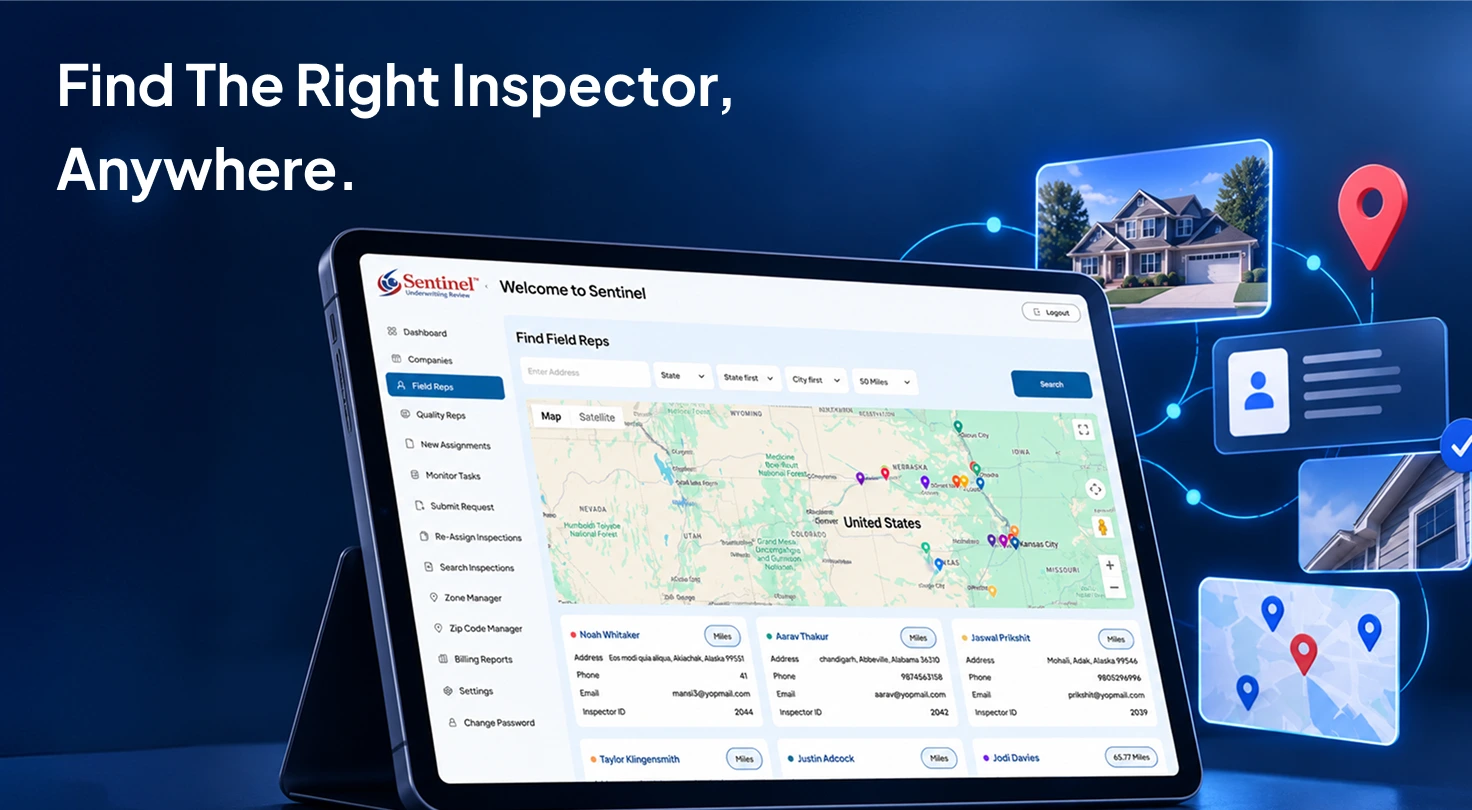
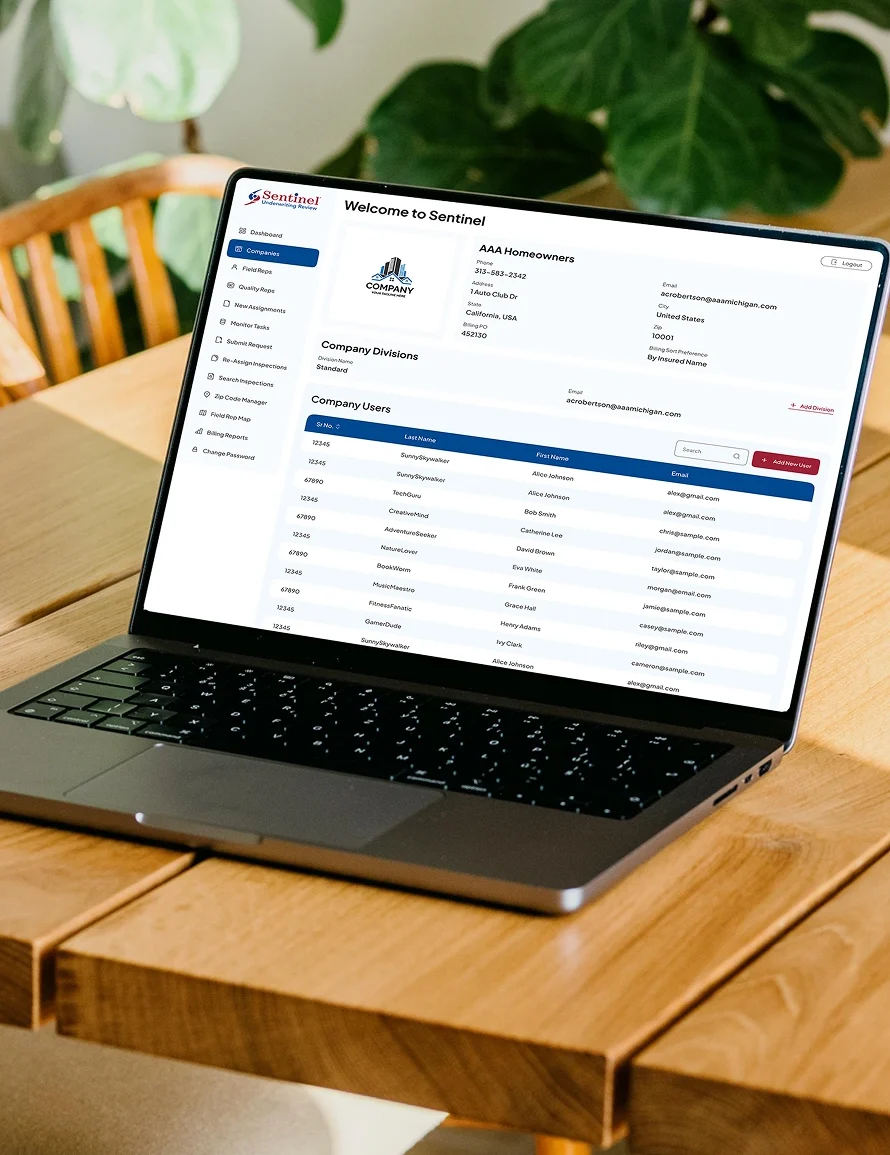
Sentinel admins, field reps, QC reviewers, insurer admins, and underwriters each needed their own focused workspace, while working from a single source of truth — including billing.
Our goal was to replace a system that merely survived with one that actively runs the business — capturing structured data, automating the manual work, and supporting reliable decisions. We delivered it across four connected workstreams.
The stack was chosen for reliability, speed, and long-term maintainability — the qualities an underwriting business needs from software it will depend on for years. A modern React front end keeps the multi-role interface fast and responsive; a strongly-typed Node back end with a typed ORM keeps the data layer safe as the schema evolves; and Azure provides the secure, scalable cloud foundation underneath.
Next.js (React, TypeScript), Tailwind CSS, TanStack Query
Node.js, Express, TypeScript, Prisma ORM, Puppeteer (PDF report generation)
PostgreSQL 18 (Azure Database for PostgreSQL)
Microsoft Azure (VM + Docker, Blob Storage), GitHub Actions CI/CD, Vercel
Rather than rebuild what specialist providers already do well, the platform integrates the services Sentinel's workflow depends on — valuation, data exchange with insurers, AI review, mapping, and email — into one seamless flow.
Replacement-cost (ITV) valuation generated for every inspection
Vision-based review of photos against form answers, flagging issues and drafting comments
Automated daily file exchange over SFTP — incoming orders, outgoing results
Mapping and route planning for field reps and underwriters
Transactional email — assignment digests, reminders, and delivered reports
Handling insurance inspection data means security isn't a feature — it's the foundation. Protection is built into the platform at every layer.
Role-based access, with each of the five roles limited to its own screens and data, enforced on the server.
Token-based authentication, with sensitive fields encrypted at rest.
Photos and reports stored privately, shared only through short-lived signed links.
Destructive and financial actions restricted to Sentinel admins, with an activity log of changes to inspection reports.
The portal is live and running Sentinel's daily operations. Drop a screenshot into each frame below — captured from your own admin access — to turn this into visual proof of the work.
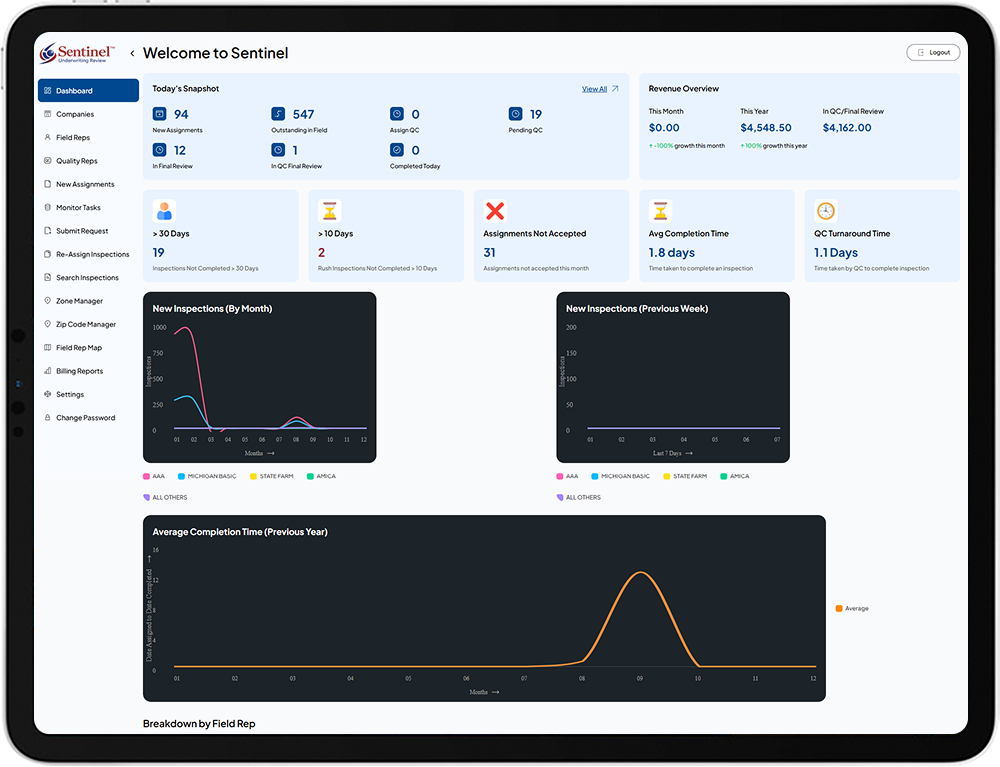
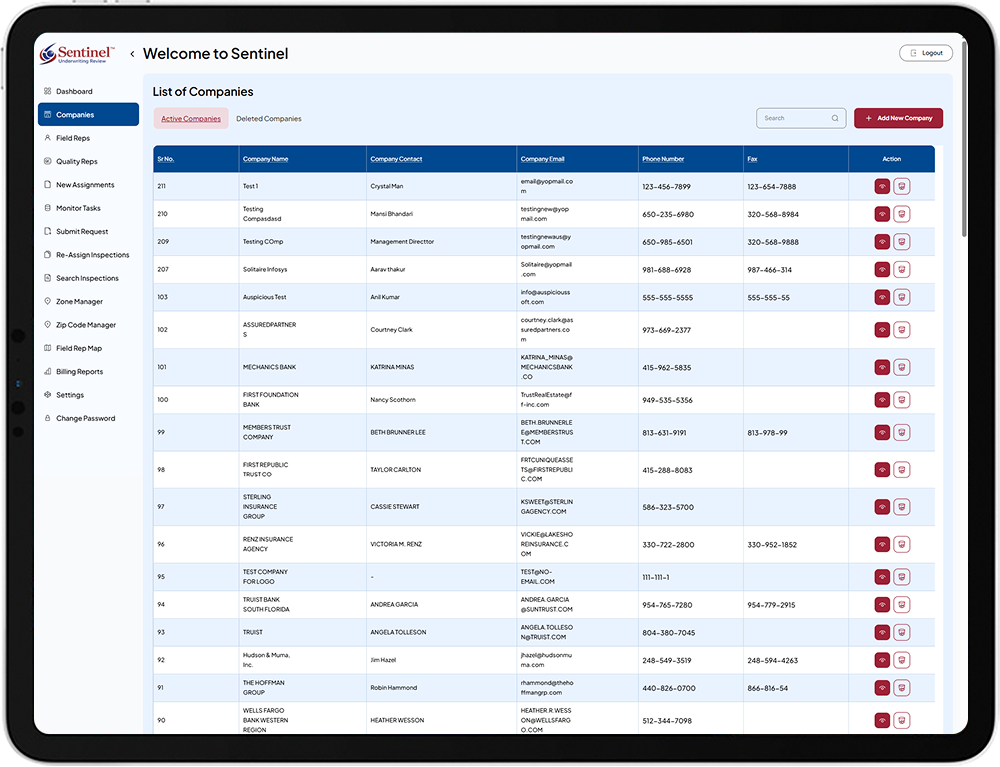
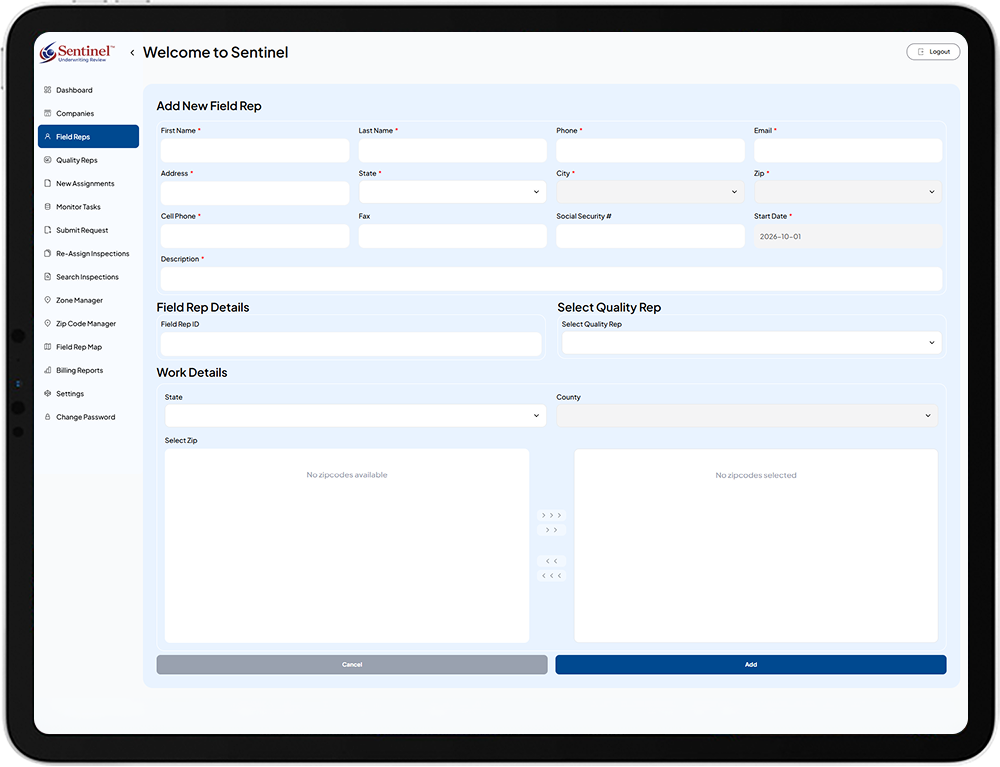
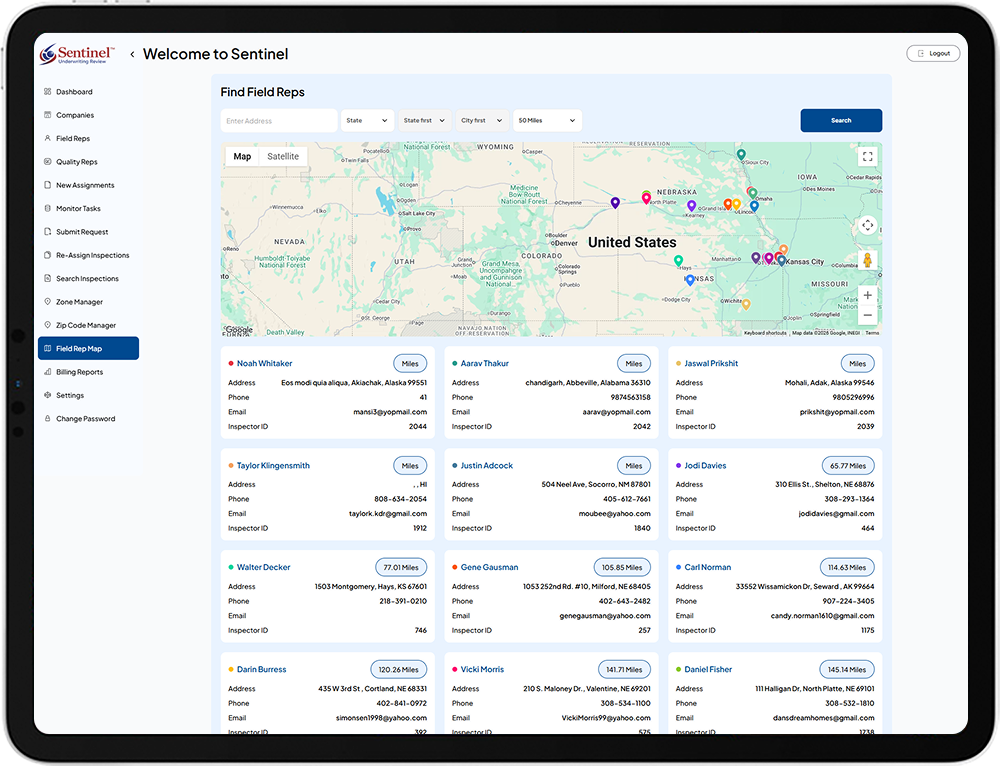
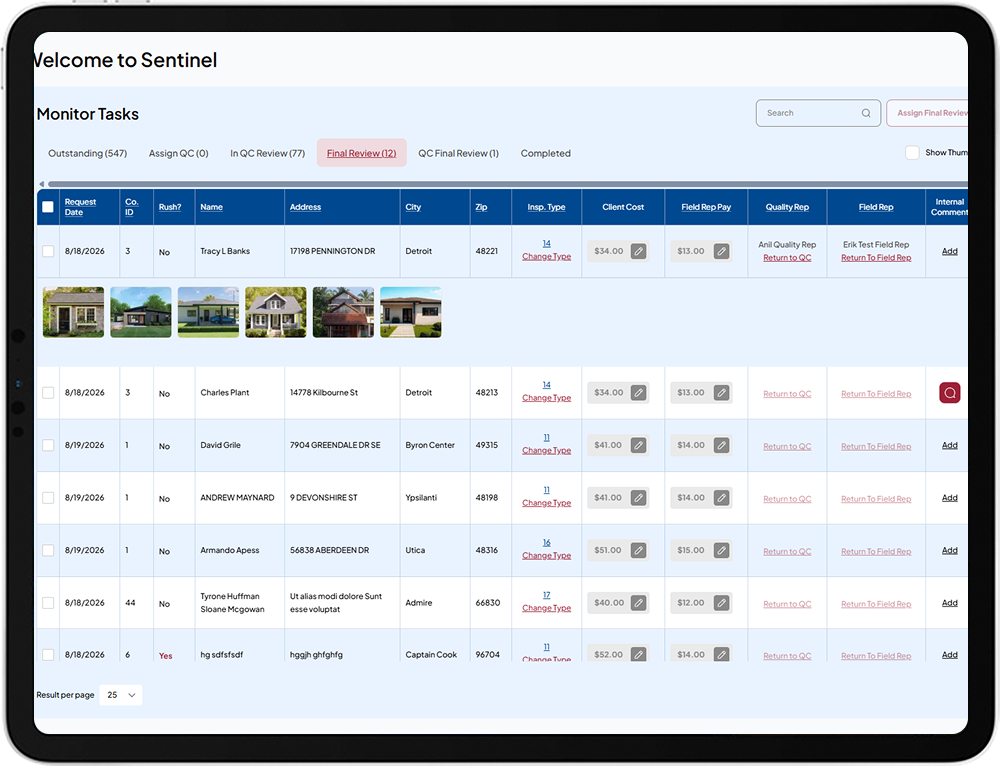
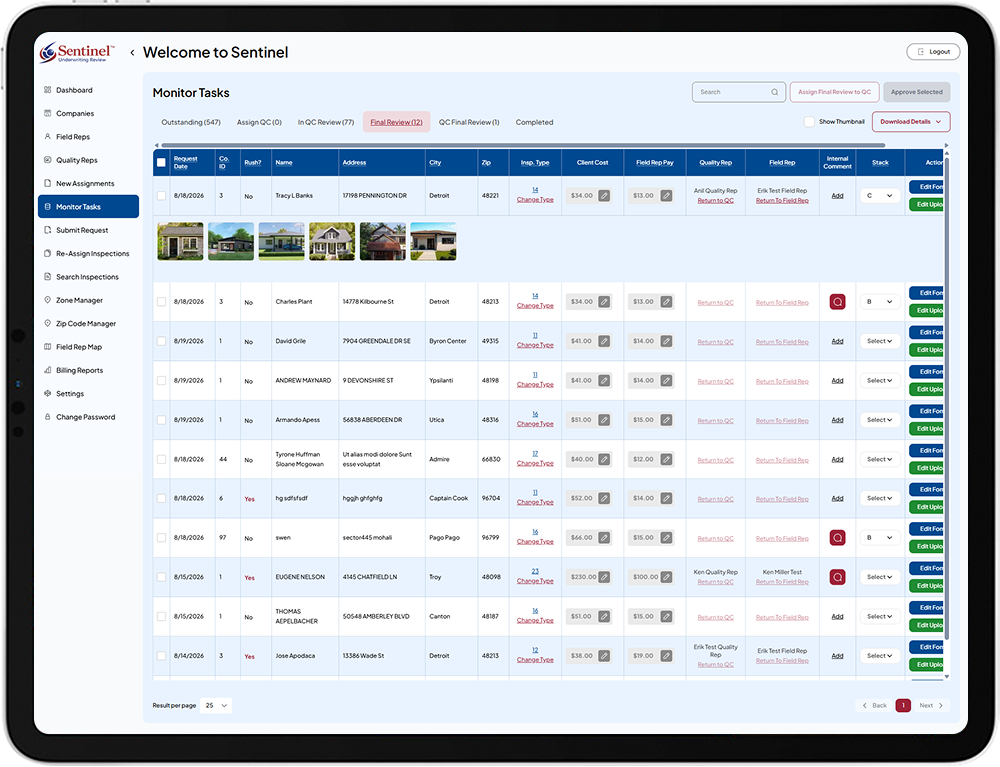
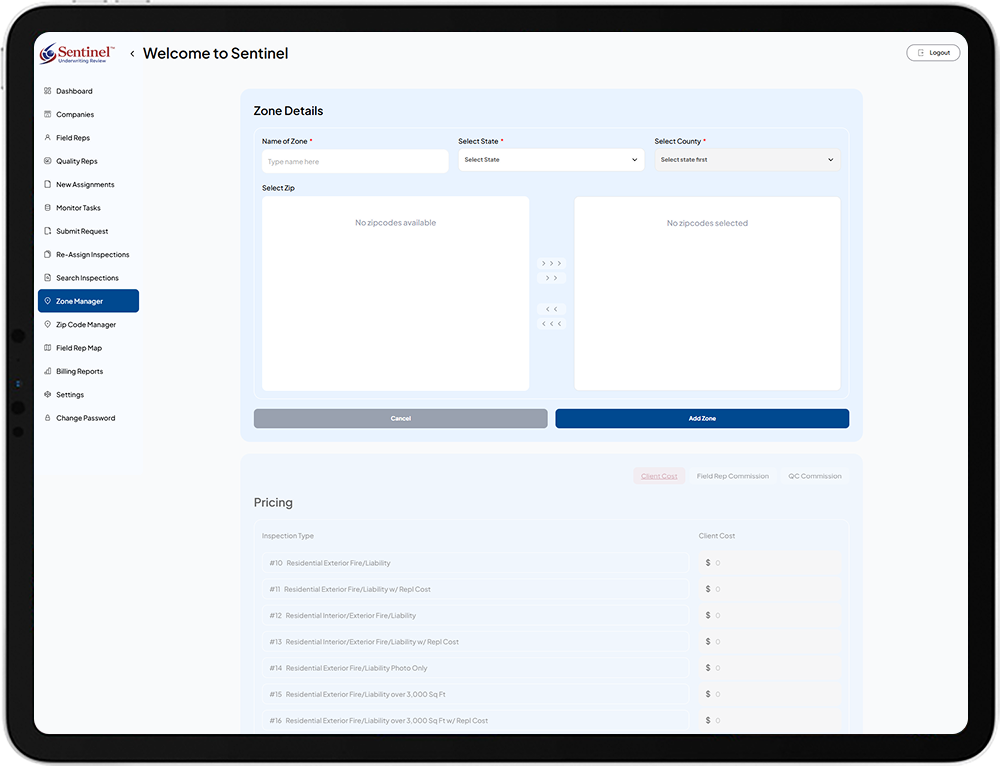
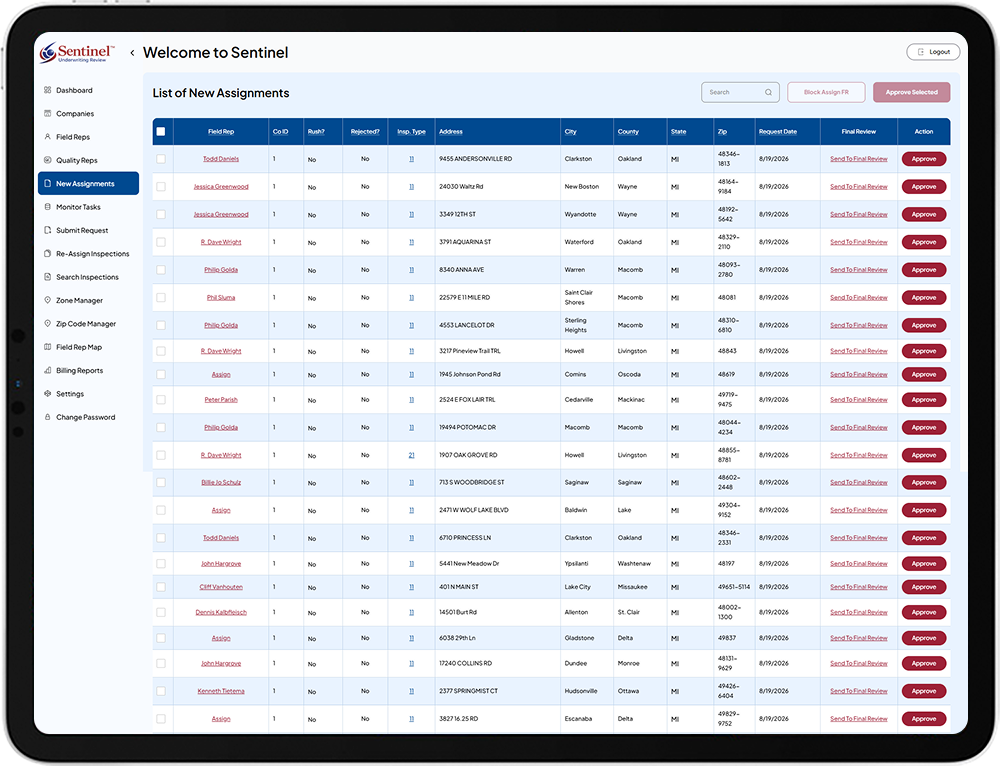
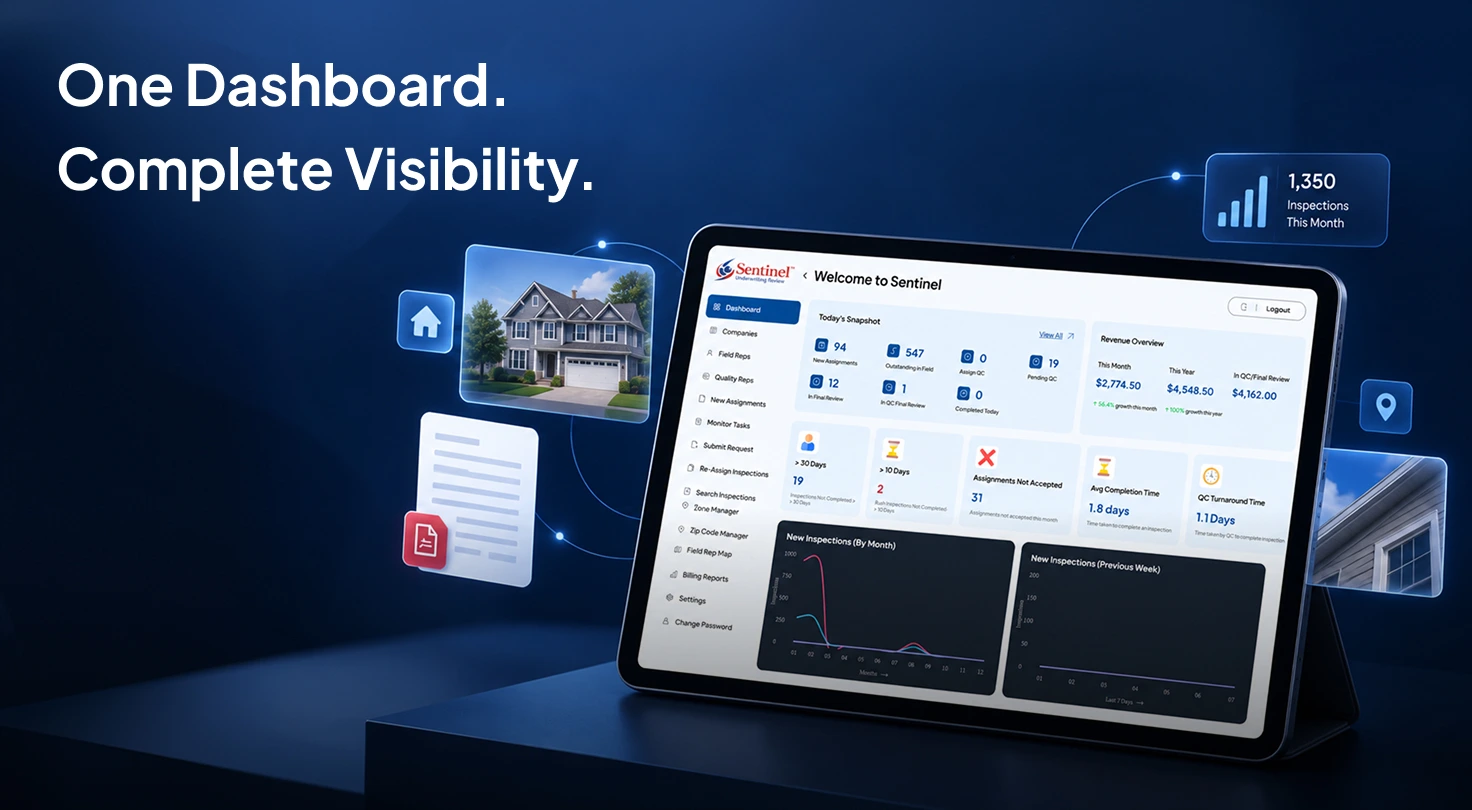
What began as a 20-year-old system that staff had to nurse along is now a platform that actively runs Sentinel's operations. Orders flow in and assign themselves. Inspections are captured as clean, structured, photo-backed data. Every job gets an automated valuation and an AI-assisted review. Two decades of history — more than 400k+ inspections — is migrated, cleaned, and instantly searchable, without cluttering the work the team does today. And in its first full month live, the new workflow carried roughly 1,350 inspections end to end.
| Area | Before (20-Year-Old System) | After (New Portal) | Business Impact |
|---|---|---|---|
| Historical Data | Inconsistent, fixed by hand daily | 400K+ records migrated, cleaned, and searchable | Two decades of history usable, not a liability |
| Inspection Forms | Unstructured, not captured as data | Digital forms with photos, fully structured | Every inspection becomes searchable data |
| Order Handling | Manual assignment and re-keying | Auto-intake + territory-based assignment | Staff freed from repetitive data entry |
| Quality Review | Manual and inconsistent | Two-stage QC + Final, AI-flagged | Consistent quality, issues caught early |
| Valuation | Handled separately | Automated Verisk 360Value on every job | Replacement cost on every inspection |
| Access & Roles | One shared system | Five role-based portals | Each user sees only what they need |
| Billing | Separate from operations | Invoicing generated from the same data | One source of truth, less reconciliation |
The rebuild transformed Sentinel's legacy software into a platform that automates operations, improves quality, and makes twenty years of inspection data accessible.
Historical inspections transformed into a searchable, reportable business asset.
We rescued and modernized 400k+ records from a two-decade-old system — the kind of migration most teams avoid.
We use AI where it earns its place — here, sharpening quality review — not as a gimmick.
Role-based access, encryption, signed links, audit logs, and automated backups come standard.
Multi-role, multi-stage operational platforms with billing built in are our core work, not a stretch.
Sentinel's business ran on a system built roughly twenty years ago. Its database had grown inconsistent and needed constant manual fixing, much of the historical data was corrupted or hard to restructure, and the core inspection forms weren't captured as structured data. It kept daily operations going but couldn't support growth, automation, or reliable reporting — so we rebuilt it.
It runs Sentinel's entire property-inspection workflow for insurance underwriting — from receiving an order, to assigning and completing the inspection, through a two-stage quality review, to delivering the finished report and invoicing it.
Making the new platform work with 20 years of legacy data. More than 400k+ historical inspections were stored inconsistently — wrong time zones, free-text dates, mixed ZIP formats, cryptic codes, and duplicates. We solved it with a go-live cutoff that keeps legacy data searchable but out of live queues, tolerant readers that understand both old and new data shapes, and targeted, reversible corrections that were backed up before being applied.
More than 400k+ historical inspections were migrated and made searchable in one place, and about 1,350 inspections were completed through the new end-to-end workflow in its first full month (September 2026). Manual assignment and re-keying have been replaced by automation across the workflow.
The front end is Next.js (React, TypeScript) with Tailwind CSS and TanStack Query. The back end is Node.js with Express and TypeScript, Prisma ORM, and Puppeteer for PDF report generation. Data lives in PostgreSQL 18 on Azure. The platform runs on Microsoft Azure (a Docker VM plus Blob Storage), with GitHub Actions for CI/CD and Vercel for the front end.
Access is role-based and server-enforced, with each of the five roles limited to its own screens and data. Authentication is token-based, sensitive fields are encrypted at rest, and photos and reports are stored privately and shared only through short-lived signed links. Destructive and financial actions are limited to Sentinel admins, changes to inspection reports are logged, and databases are backed up nightly with five-day retention.
Two months of design followed by six months of development — eight months in total — delivered by a focused team of four to five specialists.