
TABLE OF CONTENT
- What is a Custom Mobile Application Solution?
- The Cost Associated with Mobile Application Development
- Mobile App Development Cost Overview in 2026
- Factors That Affect Mobile App Development Cost
- How Do Custom Mobile Applications Affect Your Business?
- Custom Mobile App vs. Off-the-Shelf Software
- Conclusion
- FAQs
Overview
- How app development costs in 2026 depend on complexity, features, and platform (iOS, Android, or cross-platform).
- It outlines cost ranges for basic, medium, and advanced apps while highlighting factors like UI/UX design, backend infrastructure, and third-party integrations.
- The article also discusses emerging technologies such as AI and IoT that increase development costs.
- Team location and hiring models (freelancers vs agencies) significantly impact pricing.
- Maintenance, updates, and scalability are covered as ongoing expenses.
- The post concludes with tips to optimize costs through MVP development, agile methodology, and selecting the right tech stack.
In recent years, mobile apps have dominated the digital space. It provides a platform for businesses to influence their target audience and operate. But the industry is seeing major changes with the introduction of customized mobile apps. Businesses are venturing more into custom mobile apps due to its business specific features and advantages over the generic apps.
A Mobile application development company will partner with a specific business to develop an application that is tailored to meet its client’s business needs and provide functions and features that are specific to the customer, improving customer satisfaction and retention.
Several factors affect the costs of building such an app, some of which are discussed below.
What is a custom mobile application solution?
A custom mobile application solution is the process of building an application customized to your business needs. The process involves designing a tailor-made app to serve a specific function with various features according to the challenges of the specific industry. This offers flexibility, scalability, and integration potential for future alternatives.
Recent trends have included innovative and futuristic changes in the custom application development sector, integrating
- – AI and machine learning
- – Augmented reality and virtual reality
- – Blockchain technology for security challenges
- – Connectivity through the Internet of Things (IoT)
- – Fast network optimization, such as 5G technology.
Since the introduction of custom mobile app development, businesses have significantly benefited from it. The cost of building a custom mobile app through a mobile application development company has generally depended on the function and platform it is developed for, i.e., iOS or Android. However, in recent years, several studies have found that the costs for both platforms have become quite similar. At the moment, the major factor determining the cost of a mobile app depends on its sophistication, which can be classified into three categories:
Simple:
The simple apps have basic features and take the least amount of time to be developed, which is between 2-4 months.
Medium:
Medium-level apps have somewhat complex features that take more time to develop, which can be 4-6 months.
Complex:
Complex applications have detailed and specific characteristics that require meticulous planning and precision in development. These apps take anywhere between 9 months to a year to develop.
The cost of the apps is significantly affected by the time it takes to develop. Most of the developers are paid on an hourly basis or on a previously discussed contract. Costs are also influenced by several other factors that depend upon your choice of app and the region you live in or hire the developers.

Your Competitors Are Already Online.Mobile App · Web · Software Development — Don't Get Left Behind.
Mobile App Development Cost Overview in 2026
The cost of mobile app development in 2026 is more dynamic than ever, shaped by rapid technological advancement, global talent distribution, and rising user expectations. According to Statista, the global mobile app market is projected to reach $673 billion by 2027, underscoring just how critical mobile experiences have become for businesses of all sizes. Whether you’re building a startup MVP or scaling an enterprise-grade platform, understanding the true cost of development is essential before making any investment decisions.
App development costs can vary significantly depending on multiple factors—such as app complexity, feature set, platform (iOS, Android, or both), design requirements, and the geographic location of your development team. For example, a simple app with basic functionality may cost a fraction of what a feature-rich app with real-time integrations, AI capabilities, or custom UI/UX would require. Beyond development, ongoing expenses like maintenance, updates, cloud hosting, and third-party services can also impact your overall budget.
In this guide, we break down every cost factor — from developer rates by region to hidden post-launch expenses — so you can budget accurately before your first line of code is written.
Mobile App Cost by Complexity
| App Complexity | Examples | Timeline | Cost (USA) | Cost (India/Offshore) |
|---|---|---|---|---|
| Simple | Calculator, to-do, basic booking form, weather | 1–3 months | $5,000–$50,000 | $3,000–$15,000 |
| Medium | Food delivery, fitness tracker, e-commerce, LMS | 3–6 months | $50,000–$150,000 | $15,000–$50,000 |
| Complex | Fintech, social media, AI-powered, real-time data | 6–12 months | $150,000–$500,000+ | $50,000–$150,000 |
| Enterprise | Healthcare platforms, ERP, multi-tenant SaaS | 12–24 months | $500,000+ | $150,000–$300,000 |
Mobile App Developer Hourly Rates by Region
| Region | Hourly Rate (USD) | Avg. Project Cost | Pros | Cons |
|---|---|---|---|---|
| USA / Canada | $100–$200/hr | $150,000–$500,000 | Same timezone, IP protection | Highest cost |
| Western Europe | $60–$130/hr | $80,000–$300,000 | GDPR compliance, strong talent | Mid–high cost |
| Eastern Europe | $35–$75/hr | $40,000–$150,000 | Strong engineering, near-shore | 9–12hr time gap |
| India / South Asia | $15–$40/hr | $15,000–$80,000 | Cost-efficient, large talent pool | Communication gaps |
| Latin America | $30–$70/hr | $35,000–$120,000 | US timezone, growing hubs | Smaller talent pool |
Factors That Affect Mobile App Development Cost
Supporting devices and application platforms:
Custom mobile application solutions develop an app customized to a particular platform, i.e., iOS or Android, or a hybrid app that is compatible with both platforms and is supported by all devices. Such apps cost more according to the types of devices that support their operation.
Functionality and purpose:
The functions that the app will be able to offer and the purpose it serves, such as e-commerce, health and fitness, education, or gaming, determine the cost of its development due to the specifications of the app.
Integration sources:
Most of the apps to operate require integration with third-party services like social media, payment platforms, or API’s. These services incur additional costs that can affect the building cost of your app.
Graphics and visual objects:
If your app uses a more complex graphics interface and visual objects, they will significantly influence the cost of app development. Along with the graphics, the security features used in your app, such as encryption, authentication, and verification features, add additional cost.
Marketing:
Marketing includes promotions and advertisements to reach and attract the target audience. This adds to the expenses of development. The app store through which the application is distributed also charges fees for hosting, app submissions, and updates.
| Hidden Cost | What It Covers | Annual Estimate (USA) |
|---|---|---|
| Apple Developer Account | Required to publish on App Store | $99/year |
| Google Play Account | One-time fee to publish on Play Store | $25 one-time |
| Cloud Hosting (AWS/GCP) | Servers, storage, CDN, databases | $500–$5,000/month |
| Push Notification Service | Firebase Cloud Messaging, OneSignal | $0–$500/month |
| Analytics Tool | Mixpanel, Amplitude, Firebase Analytics | $0–$1,000/month |
| Crash Reporting | Crashlytics, Sentry, Bugsnag | $0–$300/month |
| App Store Optimization (ASO) | Keyword research, screenshots, A/B tests | $500–$3,000/month |
| Annual Maintenance | Bug fixes, OS updates, security patches | 15–20% of dev cost/year |
Backend infrastructure:
App development also requires regular maintenance, data storage, and management, along with other vital services, to run your app smoothly and efficiently. A robust backend infrastructure is vital to a successful app and can be expensive.
Maintenance:
After launching your app, you need to look at the customer feedback for your app’s operation. This allows fixing any bugs or issues related to the app. Moreover, apps need to be maintained and updated regularly to be compatible with the devices and operate smoothly. Maintenance also includes costs such as engineering support, server expenses, etc.
Hiring developers:
Hiring the right developers is the most important thing for building an app. Hiring experienced, skilled, and competent app developers can make all the difference and offer you an advantage over your competitors. A good developer not only will offer you valuable insight about your app but will also recommend suitable changes and modifications depending on market research. But this costs money. This is probably the most important expense in the entire application development phase.
Region:
Lastly, the region where you live or plan to hire developers decides your expenses. North and South American mobile application development companies charge more than developers from the African or Asian continents. So, it is important to hire a competent mobile application development company according to your region. The best option could always be to go local, as it gives you more room for negotiations and personal involvement in the developmental stages.
How do custom mobile applications affect your business?
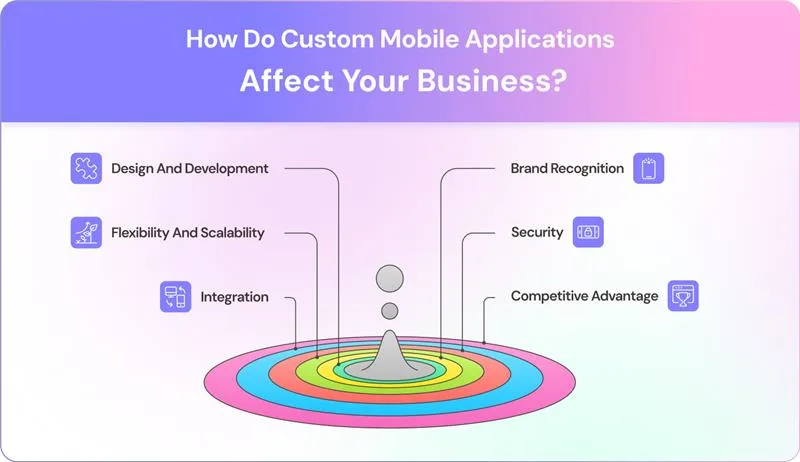
There are numerous advantages to hiring a custom mobile application development company to build your app. It can not only help in scaling your business but also provide you with the flexibility needed to remain in competition. Some of the advantages are:
Tailored features:
Customized apps are tailor-made to suit your customers’ needs and business requirements. The interface is specifically designed to provide your audience with higher navigational and operational comfort. This enhances customer satisfaction and promotes customer retention.
Brand recognition:
A good app reinforces your brand identity through consistent and functional experiences that align with your business’s values. In turn, this helps in gaining customer trust and improving brand value among the clients.
Flexibility and scalability:
Custom apps are developed keeping in mind your and your customer’s unique needs and requirements. It also provides the opportunity to add new required features and perform modifications to improve the functionality of the app. When your business grows, your app can be upgraded accordingly to meet your requirements, ultimately giving you scaling opportunities.
Security:
Custom apps allow the implementation of robust security features to protect your customer data and gain customer trust in the process. It is also necessary to protect yourself in cases of cyber threats.
Your Competitors Are Already Online.Mobile App · Web · Software Development — Don't Get Left Behind.
Integration:
Integration of the business system with custom mobile apps is relatively easier as they are built specifically for your company. This improves overall operational efficiency and helps your business grow.
Competitive Advantage:
Having a customized app that is tailor-made to meet your business needs and long-term goals allows you to perform modifications and upgrades as needed in the future. This gives your business an edge over your competitors and increases the chances of customer satisfaction and retention.
Custom Mobile App vs. Off-the-Shelf Software
When planning your mobile strategy, one of the biggest cost decisions is whether to build a custom app or use an off-the-shelf SaaS solution. Each option has clear trade-offs in cost, flexibility, and long-term value.
A custom mobile app is built from scratch to match your exact business requirements. This means full control over features, design, integrations, and scalability. However, that flexibility comes at a higher upfront cost—typically $20,000 to $150,000+ depending on complexity. Custom apps are ideal for businesses with unique workflows, competitive differentiation needs, or plans to scale significantly. You also own the product, which eliminates recurring licensing fees but introduces ongoing maintenance costs.
In contrast, off-the-shelf software (SaaS) offers a ready-made solution with faster setup and lower initial investment. Most SaaS platforms operate on a subscription model, usually ranging from $20 to $500+ per month, depending on features and user limits. While this makes it budget-friendly upfront, customization is limited, and costs can add up over time. You’re also dependent on the provider’s roadmap, performance, and pricing changes.
In short, choose SaaS for speed and affordability, and go custom if you need flexibility, ownership, and long-term scalability.
| Name | Custom Mobile App | Off-the-Shelf Solution |
|---|---|---|
| Initial Cost | $50,000–$500,000+ | $0–$10,000 setup |
| Ongoing Cost | $10,000–$50,000/year maintenance | $200–$5,000/month subscription |
| Customization | Unlimited — built to your specs | Limited to vendor features |
| Scalability | Scale on your terms | Dependent on vendor pricing tiers |
| Best For | Unique workflows, competitive differentiation | Standard use cases, fast launch |
Conclusion:
A custom mobile application solution can be the key to scaling your business and improving the experience of your customers. Customized solutions offer numerous advantages to the business and help you to remain indispensable and relevant in the competitive market space.
FAQs
Q1: How much does it cost to build an app in the USA?
A mobile app costs between $5,000 and $500,000+ in the USA in 2026, depending on complexity. Simple apps start at $5,000–$50,000. Medium-complexity apps (e-commerce, food delivery) typically cost $50,000–$150,000. Enterprise apps with AI/ML features can exceed $500,000. Development teams in the USA charge $100–$200/hour.
Q2: What is the cheapest way to develop a mobile app in 2026?
The most cost-efficient approaches are:
(1) Use cross-platform frameworks like Flutter or React Native — saves 20–30% compared to building separate iOS and Android apps;
(2) Hire offshore developers in India or Eastern Europe ($15–$75/hr vs $100–$200 in the USA);
(3) Start with an MVP (Minimum Viable Product) with only core features, then iterate based on user feedback.
Q3: How long does it take to build a mobile app?
Simple apps take 1–3 months. Medium-complexity apps take 3–6 months. Complex apps with AI, real-time features, or heavy backend integration take 6–12 months. Enterprise platforms can take 12–24 months. These timelines include discovery, design, development, testing, and App Store submission.
Q4: What are the hidden costs of mobile app development?
Common hidden costs include: Apple Developer Account ($99/year), cloud hosting ($500–$5,000/month), push notification services, analytics tools (Mixpanel, Amplitude), annual maintenance (15–20% of dev cost/year), App Store Optimization, and third-party API fees. Budget an additional 20–30% on top of development cost for the first year of operation.
Q5: Should I hire a US app development company or go offshore?
It depends on your budget and project needs. US-based companies ($100–$200/hr) offer same-timezone communication, strong IP protection, and local accountability — ideal for sensitive or complex projects. Offshore teams in India or Eastern Europe ($15–$75/hr) can cut costs significantly and are suitable for well-documented projects with clear requirements.