TABLE OF CONTENT
- Why Scalability Matters in Mobile App Development
- Role of Cloud Infrastructure
- Cloud-Based Mobile App Development: Major Benefits
- Successful Cloud Platforms Used For Flexible Mobile Application Development
- Best Mobile App Development Company in the USA
- Real-World Examples of Cloud-Based Mobile Apps
- Conclusion
- FAQs
Overview
- Without cloud scalability, a viral moment becomes a catastrophic outage destroying your reputation.
- Cloud infrastructure provides the compute, storage, and networking backbone enabling app scalability.
- Auto-scaling, global CDN, managed databases, and pay-per-use pricing define cloud’s mobile advantage.
- Uber, Netflix, and Airbnb prove cloud infrastructure enables billion-user scale from mobile devices.
Scalability is one of the most important factors in mobile app development in today’s fast-changing technological landscape. With millions of apps competing for attention in app stores, the ability to adapt and expand seamlessly to meet growing user demands is paramount. This is where cloud infrastructure plays a pivotal role.
It enables developers to build scalable, reliable, and efficient applications to be able to cater to the global audience. So for businesses that look for the creation of high-performance apps, collaborating with the best app development company in the USA that utilizes cloud-based solutions will make all the difference.
88% of mobile apps rely on cloud infrastructure for at least part of their functionality. Apps with cloud-native architecture scale 15x faster during peak traffic than server-based apps. AWS Mobile, Google Firebase, and Azure App Service collectively power over 60% of the world’s mobile backends.
Why Scalability Matters in Mobile App Development
Scalability in mobile apps is not a theoretical concern — it is the difference between capitalizing on a viral moment and watching it become your worst nightmare. When a mobile app goes viral (featured by Apple or Google, covered by press, or shared widely on social media), traffic can spike 50-100x in hours. Apps built on non-scalable infrastructure respond to this moment by crashing — exactly when maximum user attention could convert into loyal long-term users. Pokemon GO’s infamous launch in 2016 (servers collapsing under 50x projected load) demonstrated the cost of underestimating scalability. In 2026, there is no excuse for launching a serious mobile product without cloud infrastructure capable of elastic scaling — the technology is available, mature, and affordable from the first user to the millionth.

Your Competitors Are Already Online.Mobile App · Web · Software Development — Don't Get Left Behind.
Cloud-based mobile app development is important to achieve scalability because it provides:
Dynamic Resource Allocation: Cloud platforms allow apps to scale up or down based on demand.
Global Reach: Apps running on cloud infrastructure can effectively reach out to users all over geographical locations.
Cost Efficiency: The pay-as-you-go model provides flexibility and helps businesses minimize cost with scalable infrastructure.
Role of Cloud Infrastructure
Cloud infrastructure for mobile apps refers to the collection of computing resources — servers, databases, content delivery networks, authentication services, and AI APIs — that your app depends on but that run remotely on a cloud provider’s hardware. The key architectural components of cloud infrastructure for a scalable mobile app in 2026 are: auto-scaling compute (EC2 Auto Scaling Groups or Google Cloud Run), globally distributed databases (Aurora Global, Firestore, or DynamoDB), CDN for static assets and API response caching (CloudFront, Fastly), managed authentication (AWS Cognito, Firebase Auth), and real-time infrastructure (WebSocket support, Firebase Realtime Database, or Pusher). Each component serves a specific scalability function, and the integration between them determines your app’s ability to maintain performance under load. Here are a few benefits derived:
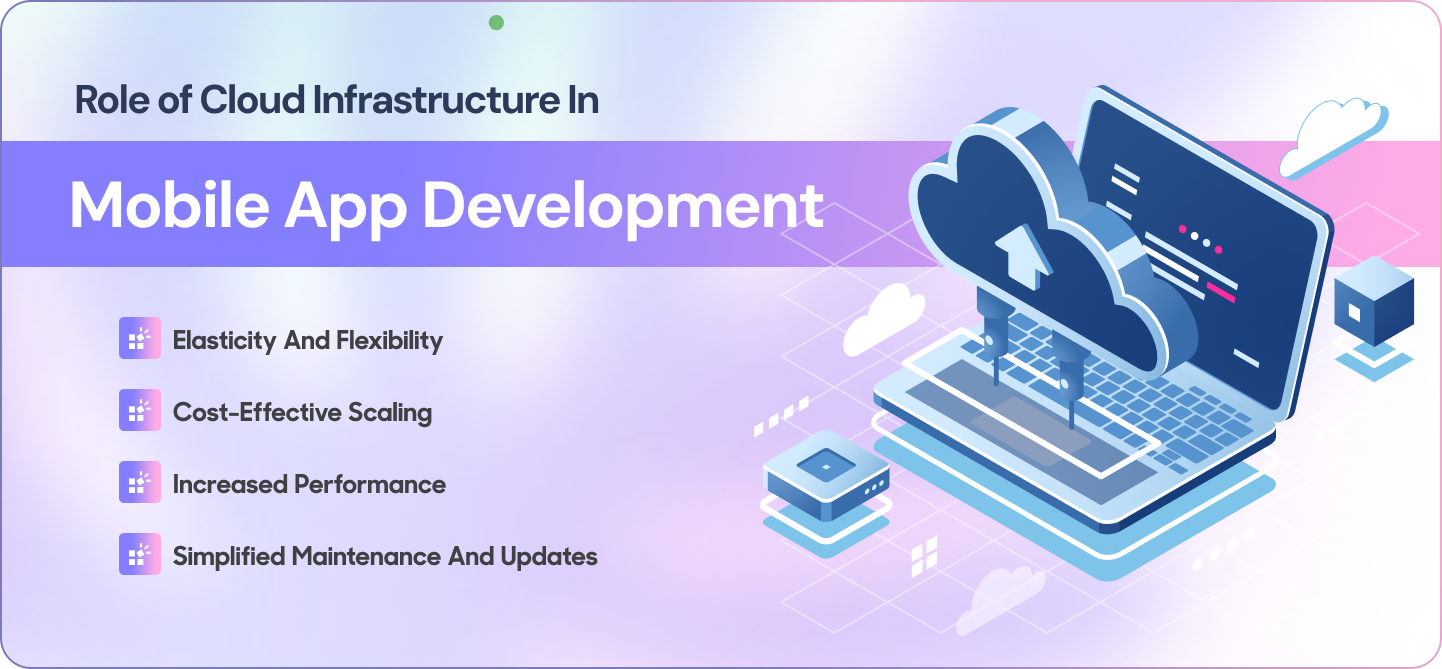
1. Elasticity and Flexibility
Cloud infrastructure allows developers to dynamically allocate computing resources as needed. That means your app can handle a sudden spike in traffic without crashing or slowing down. For businesses aiming to deliver seamless user experiences, working with the best mobile app development company in the USA that specializes in cloud-based mobile app development ensures that their app remains flexible and responsive.
2. Cost-Effective Scaling
This generally calls for expensive and early upfront investment in hardware and data centers. By embracing cloud infrastructure, it will be possible for organizations to scale their applications with a heavy front-end cost investment. In other words, AWS, Google Cloud, and Microsoft Azure offer scalable platforms on the basis of use with some savings; hence, the products become effective tools in scaling up to serve all startups and SMEs optimally.
3. Increased performance
Cloud infrastructure ensures mobile apps run optimally regardless of changing workloads. Through the spreading of app traffic across a network of servers and leveraging CDNs, cloud solutions ensure low latency and fast performance. For instance, a gaming app experiencing a sudden influx of players can maintain a lag-free experience by automatically scaling resources.
4. Simplified Maintenance and Updates
The updating of the application and its maintenance in terms of performance become a lot easier with cloud-based mobile app development. This way, developers can push the updates to the cloud so that every user can be provided with the most updated features and fixes. It decreases the downtime and increases user satisfaction.
Cloud-Based Mobile App Development: Major Benefits
The business benefits of cloud infrastructure for mobile apps extend well beyond cost savings. The most valuable advantages in 2026 are speed of iteration (teams can deploy new features without waiting for infrastructure provisioning), global performance (CDN ensures fast load times for users anywhere in the world — critical for US apps with users in both New York and California), disaster recovery (multi-region cloud deployments provide 99.99% uptime guarantees impossible to achieve with on-premise infrastructure), and access to managed AI services (any mobile app can now integrate ML-powered features through cloud AI APIs without a dedicated data science team). Here are the major benefits it offers:
1. Centralized Data Management
Cloud platforms allow apps to store and manage data centrally. This ensures data consistency across devices and enables users to access their information seamlessly, whether they’re using a smartphone, tablet, or desktop. This is particularly vital for apps in sectors like finance, healthcare, and e-commerce.
2. Improved Collaboration
Cloud-based tools allow development teams to work efficiently together. With shared resources, updates in real time, and streamlined workflows, developers can develop the application faster. Most of the best mobile app development companies in the USA use cloud platforms for smooth collaboration of teams and speedy project delivery.
3. Strong Security
Another crucial consideration by an application developer or any business is security. It has several advanced security features such as data encryption, access controls, and compliance updates which have occurred recently. This ensures the data held here remains private, and in doing this, they gain the users’ confidence.
4. Disaster Recovery and Backup
Cloud infrastructure offers disaster recovery solutions with a reliable guarantee. Apps can rapidly recover data from cloud backups in the event of server failure or data loss. This helps in reducing downtime and maintaining business continuity.
5. Faster Deployment
Moving a software, known as a release, is even faster for mobile applications with cloud-based development. Developers don’t necessarily have to set up extensive equipment sets to test and build software then deliver for consumers. This gives businesses opportunities and a competitive advantage in different kinds of markets where competition demands agile mobility.
Successful Cloud Platforms Used For Flexible Mobile Application Development
1. Amazon Web Services (AWS)
AWS is one of the most widely used cloud platforms, with many services focused on mobile app development. It offers database management, machine learning capabilities, and serverless computing. Many businesses rely on AWS for scalability and global reach.
2. Google Cloud Platform (GCP)
GCP is known for its strong infrastructure and advanced AI and machine learning tools. Solutions like Firebase help it ease mobile app development with a feature such as real-time databases and authentication.
3. Microsoft Azure
Azure gives access to a complete set of tools in cloud-based mobile application development. It integrates nicely with Microsoft products and supports multiple programming languages, making it very attractive to enterprises.
4. IBM Cloud
IBM Cloud is suitable for businesses that require high levels of customization and security. It has features such as AI integration and blockchain support, which makes it suitable for complex mobile apps.
5. Heroku
Heroku is a PaaS that simplifies app deployment and scaling. It is mostly popular among startups and small businesses because of its user-friendly interface and flexibility.
Best Mobile App Development Company in the USA
To achieve all of this, it would be prudent to select the most suitable development partner. Among all, the best mobile app development company in the USA has mastery in the concept of cloud-based mobile application development to ensure your app remains scalable, secure, and efficient. They can help you with such a situation:
Selection of the Platform: Most suitable cloud platform suited to the needs of the application
Architecture Design: Designs for a robust cloud architecture, supporting scalability and high performance.
Implementation and Testing: Testing the app for performance under a variety of conditions.
Continuous Support: Providing maintenance and updates to keep the app up and running.
Your Competitors Are Already Online.Mobile App · Web · Software Development — Don't Get Left Behind.
Real-World Examples of Cloud-Based Mobile Apps
The most successful mobile apps in the world are all built on cloud infrastructure — and understanding how they use cloud to achieve their scale provides a practical blueprint for any business building a mobile product. Uber relies on AWS for real-time driver-rider matching across millions of concurrent users in 70+ countries, with auto-scaling that handles New Year’s Eve traffic 10x above normal without manual intervention. Netflix streams to 270 million users simultaneously using a microservices architecture on AWS, with CDN-cached content reducing server load for commonly requested content. Airbnb processes 400+ concurrent searches per second using AWS RDS for their database layer and ElasticSearch for real-time property search. Each of these companies started small — the cloud infrastructure they use today was accessible to them from day one, scaled gradually as their user base grew, and never required a forklift upgrade.
Netflix: Makes use of AWS to manage millions of streaming users worldwide.
Spotify: Leverages Google Cloud for efficient data storage and processing.
Uber: Leverages a hybrid of AWS and Google Cloud to manage real-time data and global operations.
Dropbox: Leverages cloud solutions for seamless file storage and synchronization across devices.
These examples illustrate how cloud-based mobile app development can revolutionize businesses and deliver an amazing user experience.
Conclusion
With increased adoption of mobile applications, the cloud infrastructure would be highly relevant in future. With trends such as edge computing, AI integration, and IoT (Internet of Things) set to add further strengths to cloud-based mobile application development, investing in such mobile applications today would leave one much better positioned to capture such breakthroughs for future competition.
Cloud infrastructure has revolutionized scalable mobile app development because it has provided the necessary tools and resources to create high-performance, adaptable, and reliable applications. For businesses wanting to provide the best experiences for their users, not using cloud-based solutions is no longer an option-it’s a must.
Partnering with one of the best mobile application development companies in the United States makes sure your application taps on all benefits which come through cloud-based mobile applications development. Starting with resource dynamic re-structuring towards the state-of-the-art security, quick deployment of products is no more unexplainable and will keep the customers glued to apps for scalable ones at an escalating demand over a period.
FAQs
Q: What cloud infrastructure do most mobile apps use?
A: Most mobile apps use a combination of Firebase (Google) for real-time features, authentication, and analytics; AWS or Google Cloud for scalable compute and storage; Stripe for payments; and CloudFront or Fastly CDN for content delivery. Firebase is the most popular starting point for startups, while growing companies migrate to more customized AWS or GCP architectures.
Q: How much does cloud infrastructure cost for a mobile app?
A: Cloud infrastructure costs depend on your app’s traffic and data storage needs. A typical startup-stage mobile app costs $200-500/month on AWS or Google Cloud. A growing app with 100,000 monthly active users costs $1,000-5,000/month. Enterprise-scale apps with millions of users spend $20,000-200,000/month on cloud infrastructure. Firebase’s free Spark plan covers most early-stage apps at zero cost.
Q: What is auto-scaling and why does it matter for mobile apps?
A: Auto-scaling is cloud infrastructure that automatically adds or removes computing resources based on real-time traffic. When your app experiences a traffic spike (from press coverage, an App Store feature, or a marketing campaign), auto-scaling adds servers within minutes to handle the load — then removes them when traffic returns to normal. This prevents outages and avoids paying for idle capacity.
Q: Is Firebase enough for a production mobile app?
A: Firebase is sufficient for most apps at the startup stage and works well up to approximately 500,000 monthly active users before costs escalate significantly. It provides authentication, real-time database, cloud storage, push notifications, and analytics. Larger apps typically migrate critical workloads to custom backend services on AWS or GCP while keeping Firebase for real-time features and notifications.
Q: What is the difference between AWS, Google Cloud, and Azure for mobile apps?
A: AWS has the most mature service catalog and largest market share (31%). Google Cloud excels for AI/ML integration and Firebase-connected apps. Azure integrates best with Microsoft tools (Office 365, Teams, Active Directory). For most mobile apps, Google Cloud / Firebase offers the simplest getting-started experience. AWS offers the most scalability options for high-growth applications.